DIY Chicken Run Repair | Hurricane Destroyed
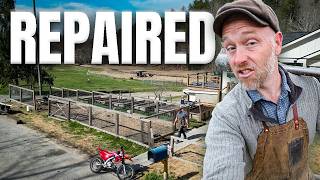
In this hands‑on homesteading video, Victor (Speaker A) leads a repair project on a 1,400‑sq‑ft homestead that was damaged by a recent hurricane. The team (including Josiah, Lily, Gideon, and Rebecca) first digs post holes, pours and cures concrete footers, and constructs a sturdy 4×4 support from 2×6 lumber to anchor a new chicken‑run fence. They assemble a multi‑layer fence using a cattle panel, poultry wire, and a bottom retaining board, then install a mobile coop. While the concrete sets, they transfer compost and wood chips from a nearby pen into raised garden beds, covering the beds with tarp or cover crops as needed. Throughout the build, Victor shares practical tips for beginners, such as using a level, cutting with a chainsaw, and mixing concrete without a mixer. Mid‑project, he cooks a brisket, demonstrating his cooking routine. The video concludes with a showcase of the three‑part chicken system (tall fence, mobile coop, wood‑chip bedding) and a promotion for his upcoming Kickstarter‑backed book “Chicken Tender,” offering bonuses and live training for backers. The overall tone is instructional, conversational, and enthusiastic, emphasizing DIY resilience, permaculture integration, and community engagement.
Chapters
Yesterday we fixed our raised beds in our little 1,400 square foot homestead and front yard. Chicken's on making compost, which is fine. It's a little— it, you know, we don't need so many. And we need to plant our raised beds. And if you're gonna have a garden, you need to have chickens right next to them. You could throw your weeds, your extra produce in there, and then the chickens make the compost where they're at. Just You'll see that. I think today we're going to take compost out of there and put in there. Let's try it. Step 1, dig our hole for our post, set our concrete, because it's going to take a while to cure. So we need to do that first thing, and then we're going to do what construction we can, and then we'll start hauling compost over to the raised beds today before the chickens go in. You can do it while chickens are in. But you have to be mindful of the gate, so it'd be a little easier just to do it now. I want to dig down a third of the length, or a little shy of 5 feet. Does a third go into 58 inches even? I'm, I'm guessing it does. 19.3 to a thinity, it looks like. And this time I'm not going to put soil back on it because rotting on it. We got a good ways to dig. We had to dig this out because our concrete— which, by the way, I think it needs to be more longer than wide like that. It's gonna need to be more narrow. A few inches of gravel on the bottom. Hole is dug. Step 2, let's make the 4x4 out of lumber. In here I need a long 4x4, so we're going to make it out of these long 2x6s. We're using it up, wearing it out, making it do or do without. It was for the high tunnel retainer wall for the chickens, then it was for the brace for putting up, you know, digging our footer for these new posts, and now It'll be for our chicken run. Let me show you a little trick. A lot of you are coming to homesteading, and that means you're new to everything, including even basic construction. I was there once too. This screw won't screw out, it's loose. Okay, so You put it on a hard surface like concrete. And when you homestead, you got to be a jack of all trades, master of one— permaculture. Connect it all, put it all together. All right, here we go. Put weight on it and it comes right out. A viewer sent me these protective glasses. They're pretty cool. You like them? They're called Titus. They're like metal. This is 2x4s. I shouldn't have thrown it down like that. Put those on top of each other. Maybe I should, uh, attach this and it'll help hold it in place. I think I should. I'm looking forward to this part, mixing concrete without mixing concrete. A gallon per bag, let's go! This is great. Supposed to seep in. Okay, that was the first time doing that for me. That was exciting. I was excited to do that, and it's worked. It's absorbed all that water. Now we're going to add more. We're gonna— we're gonna build this up. We're gonna make sure the ground doesn't touch this post. I like trying new things, doing new things when it works, and that worked. It's totally dry now. Well, dry is a strong word, but it's totally absorbed. We're gonna let that set. You're not supposed to work on it for 4 hours. So what time is it? 10 after 9. So after lunch. So let's do everything else we can. What do you need? I need you to help me. Oh yeah, so we got her a trailer. We'll list it. Did you get pictures too? Yeah, pictures and dimensions. People wondering how tall it is, how wide. I feel pretty good about that. It's just 9:30. Can I? I'd really love to fix this, fix anything else we need to fix, get compost out of here. Hey, might as well, while the chickens aren't in here, and haul it out that way, be a little easier. Recompost our raised beds all before lunch so that then after lunch we just come out and finish that. It's gonna be tricky. No, it's not gonna be too tricky. I think we kind of got— I think we got this. Let's see if we can't put this back together. It's a little beat up, but I think it'll straighten out when we put these, um, these shim boards back in. First thing we're gonna do is put these— I guess, what would you call these? They secure the cattle panel in place. Bowed out like crazy there. That will mean it'll hold tighter when we put this on there. It's working rather nicely. It begins. It stayed in so long. I figured it out. 3 cuts for me, 1 cut for Gideon. This part should be easy actually. Just popping things off.
Feels good.
Fix things, that's what I do. That's what I do, fix things. Make things better. Check it out. What do you think? Good. I think if I'm real careful, I'll probably start working on this. I don't see why I couldn't do this, right? It's not high impact. It's not like I'm hanging that gate. Let's do as much as we can for lunch without hanging that gate, and we'll hang in that hang that gate when the concrete dries for sure. Josiah, would you rather drive screws? Sure, probably. Okay, that was so mild. I don't see why we couldn't put the top on. What do you think, Josiah? How do you suggest we cut this off? A skill saw? A chainsaw? Sawzall? We have a chainsaw near— or saw's all nearby. That might be what we do. Josiah, let's see what's entailed in that— the piece across here. Man, that'd be fantastic if we got everything ready but the, uh— all right, let's take that brace off. I don't think we'll need it now that we're securing the fence. It looks like we are going to have to cut that. So idea is, Josiah, for— it looks like I didn't raise that up enough. Yep, you You're right. See how— really should have just put a level on that. That's way lower, isn't it? Shoot. We can stop guessing and we can get a level. I wouldn't have cared, but it's going to affect our top. You might not be able to tell at the bottom, but if it's unlevel up here, you're going to be able to tell. So now undo that, and then we'll— when Lily gets here with a level, we'll raise it. Okay, you're not testing, you're guessing. Now we can put those trims back on. Tramps, that's probably a good word for these things. We're doing it, Josiah. One more piece. I think because we put a lot of concrete in there and we, we brought it up enough so that we don't have— earth will not be around that post. I think it'll last for a long time. I like building back better. The only problem with doing it with this is it's hard to get it level. All we lack here is putting the retaining wall back up. Here, come over here with that.
You got me 79 today.
Oh boy, we should probably have done this already. All right, well, let's do this. Definitely before lunch. We got a few more.
It's not gonna be 79 till 5 o'clock.
Dang, it's still decent out here. Let's get this compost. Get the layer of wood chips off. We don't even sift it anymore. Sure, there's a— there's a few chips here and there, but not really. We just go straight into the wheelbarrow. Are we moving the chickens in here? Look Lord willing, the creek don't rise tomorrow. You want to be in charge of them?
We have to do this for the whole—
no, we just got 2 wheelbarrows per raised bed. 30 minutes till lunch. I think I can pull this off, although We're starting to need 2 on that 4th one. We're needing 2 the 5th one, we'll probably need, and the 6th one. So that means I'm only 1, 2, 6 more. Maybe just 4 more loads. Anyway, I gotta take a quick break to prepare supper. I'm cooking a brisket. There's only a few on a cow. It should be the best cut, and it hasn't been. I'm gonna change that today because it all started last night with the marinade. It's 6:30 this morning. We're letting it come to room temperature and then 7:30 heating it on 275, covered. I love Grok. Grok's been teaching us for a super tender beef brisket recipe. I don't put it directly on the tin foil, put a parchment down first. Okay, what we want is 165 at the thickest spot. We're at like 180, so we're good there. We had it in a broth, tin foil over it. I got this wrapped. Time is ticking. It's 11:45. Let's see if we can't get these— this soil in here before it— before lunch, because it's just getting hotter and hotter. And 80 degrees after just coming out of winter is going to be hot. So what we got here, it's a beautiful one out here working our garden. We got to cover this with something. We can cover it with leaves, silage tarp. We have to sell this tarp for these. I don't know if I know exactly where they are. Or we could probably do another permaculture method, which would be let plants do the work of the farm and put in cover crop. Lily has watered it down here and put in— we put in rye because we're still in the cold. I mean, it may not feel like it now, but Friday it's gonna be 29 degrees. We figured the seeds that come up with the COVID crop are probably the plants. It'll probably just be minimal, easy to work in because it won't be too long. It's not like you're gonna— it's not like the rye's gonna get mature. It's not gonna get super tall. Yeah, and even if it did, we'd just cut it down and hoe it and ready to go. I was skeptical about these raised beds 6 years ago. I mean, we used to have this, an electric net, and then we could open up a piece and come and prep a garden, and we had wood chips all up in here. The raised beds are so easy to maintain, it's incredible. Back, I got our fence up. All I have to do is hang the gate, and I can do that after lunch. The concrete is set. Yeah, what he said. All right, that's it. This is all we lack. You boys are gonna hold this up for me. Oh, that's not gonna be too bad. Heck yes, that is satisfying and super easy. Wow, guys, could keep chickens in there. Oh wait, we got to put in the, uh, we got to put in the container wall. I need to get the pretty shawl over here first.
First.
Now that we've gotten through, we can put our retainer board up. Boom! Let me show you 3 components that makes up this chicken system. We're going to bring in the chickens. We're on time. We're going to bring in the chickens tomorrow. 3 things. We have our fence. Our fence is tall. We tried— you can see where we've where we try to fence. Not tall enough, especially if it's going to be permanent like this is. You need— this is probably— well, shoot, I'm 6 feet tall. This is a 5-foot-tall fence. It's a, it's a cattle panel surrounded by lumber, and on top of the cattle panel is poultry wire so they can't get through. And then at the bottom is a retaining board so material stays in and chicks don't get out. Second thing, a mobile coop. Even inside of a static run, the chickens will be in there, they will be manuring down, and then I'll just move it. The manure falls through the coop and it's just clean, just like this. That also leaves you an option to go out, you know, you don't have to be in here. What if you want to go out and, uh, prep a garden with this thing? Put a net around an area you want to garden, or you just want to run it out in the pasture, give the chicken some grass. You could do that with a mobile coop. If it was permanent, you couldn't have done that. Last but not least, wood chips. Now this has been here over all winter, so a lot of these wood chips are just basically gone. They've already turned into soil. You saw this morning where we got our, our, our compost for the garden beds. Isn't that amazing? Like, we just fed 6 garden beds We probably did 8 loads, didn't we? A couple of them only got 2, and that's only a fraction of this pen. So we do the wood chips, it absorbs their poop, and then with them scratching, the sunshine, rain, it turns into compost and can be easily harvested. If you're gonna have a garden, you might as well have chickens next to it. I got all this and more in writing. We're kickstarting my newest book, Chicken Tender. You can, you can chicken tend. I can help you. We have some bonuses, some of content to get you going this year. If you back that Kickstarter, you're getting a discount. I'm going to do a live training just for Kickstarter backers just to ensure you guys are good for 2025. Physical book delivers by Christmas— this Christmas, 2025, the year of the chicken. Before and after incoming. Have fun with it, Austin.
2 hours before supper.
We're calling it, but we're not done. Never used a cooler in cooking before, but here we go. That's it. Take a towel. All right, shut the cooler. Apparently that helps it reabsorb the juices. We're gonna let it do that for a couple of— 2 hours till supper. Okay, it's tender. This is gonna be the best part. Oh my, oh my. Rebecca, what do you think of that brisket? Did we nail it or what? Yeah, we nailed it. No more cruddy brisket. What a shame. Happy day.
More from Justin






If I had to start my Homestead all over again, it could only pick one animal… 




