Do These 3 Things For 80% Homestead Success
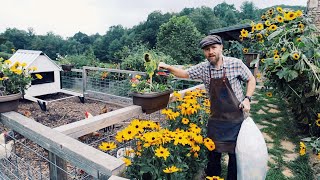
Victor Justin Rhodes walks through three core practices for homestead success: proximity and zoning, integrating animals with gardens, and composting systems. He covers container gardens, deep-bedding for pigs, pole-barn design, and sourcing wood chips, with input from Jeremiah of Roots and Refuge.
Chapters
Start right here outside your door. And if this is all you had, a porch, why wouldn't you jam it with this? Container gardens. Container gardens. And if you had a little something something next to your stairs, your sidewalk, I don't know, 2 square feet, why not plant something in that? If you had a little something something on the other side Why not jam that out? If you have a wall, why not do a vertical pallet garden? If you have a dock, maybe you grill, why not a GreenStalk vertical garden? This is like 36 plants in 2 square feet. And if you have a little spot next to your sidewalk, next to your road, maybe it's that little grassy spot next to your street, Maybe it's against the rules, but some rules aren't right and are meant to be broken. If you have a 1,300 square foot yard, why not raised beds? But notice they're out right there, right outside our door. Since you have 1,300 square foot, there's 6 garden beds— 6, 3, 4, 7 garden beds— only take up half of it. Makes perfect sense to have chickens right next to it. I'm cleaning up the dying leaves here. Where do those go? Boom! Talk about that in a second. Right into the chickens. It's pretty enough. This is a real homestead, just like y'all's. It's not perfect. If you have a chicken run, container gardens. And if this was all we had, this would be jammed with container gardens, and it wouldn't be flowers, it would be vegetables. Well, maybe some flowers, some, some. And if you have a chicken fence, why not plant, well, squashes? Well, that's cucumber right along the fence. They don't bother it. They don't bother that kind. There's a full-grown cucumber right there. If you're growing squashes or something, generally they're too hard for the chickens to pick if you harvest them right away. So you could grow those along the fence, inside or outside of the chicken fence. And who said mobile chicken coops have to be ugly? Most mailboxes are planted in the ground. Why not plant something around these lilies, which are spent? The end of season for them, but you could tidy them up and beautify them up by Pulling this stuff out. And where are we gonna put it? Not in the trash. Gosh forbid. Put it in there, let the chickens turn it into compost. If you're gonna build a fence for your property, make it a 2x4 if you've got a small property. Line it with raised beds— raised beds, uh, container gardens. I just taught you a very simple permaculture design principle of Where do you start? You start right outside your door, very literally. But I will also add, start outside the door of your heart. Grow what you love. Beauty loves to grow sunflowers, to look at the sunflowers. She loves green beans. Look at all these green beans. She want a little supper? What does she do? She comes out of her door and grabs a little supper. You accidentally pull a vine, that's not a problem. Get your beans. I accidentally pulled a vine, not a problem. We're gonna turn that vine into delicious eggs, delicious chicken. And what they don't eat, they'll turn and it will become compost and feed the garden. It's raining, I'm gonna have to hurry on this other principle. But another really nifty, simple principle is, uh, connection, proximity. Well, I'm giving you two, but the things that need a lot of attention close to your house— you visit chickens twice a day, opening them up, shutting them up at night, that's over 700 visits a year. If it's socially acceptable, put them in your front yard like we did. Let's make a connection here. Chickens go great next to your garden. Let me give you an example. Well, you just had the example. I just harvested some spent stuff. Look, this is some yellowing. We could harvest, clear that out. Look at all those tomatillos that have fallen and rotten. That's, that's, that's chicken food. We come in and now all of a sudden the garden is feeding the chickens, right? Okay, but notice the chickens are on deep bedding and they'll scratch that, they'll poop in that, and underneath that, look Look, I'm hurrying, so I'm not going to go in there because I'm so slow. But underneath that forms compost. See that compost coming? So you then scrape off the top, harvest that compost, and once a year before we plant in here, we put down all that compost. And the garden feeds the chickens. So think about— I'll give you two more principles there. I gave you the zone principle, plant plant what you visit the most close to your house. That's zoning, okay? This would be Zone 1. It's the closest to the house. Plant a walnut tree far away because you're going to visit it once a year to harvest the walnuts, maybe twice to prune it. Try and make connections so that if you understand that the garden needs compost and the chickens need food, well, you could put them next to each other and the extra garden stuff goes to the chicken, and you can put the chickens on a compost job next to the garden, and then all of a sudden this is one operation. This isn't two operations. I don't like to eat vegetables. I like to eat animal protein. So how do I get excited about planting green beans? Well, you saw this morning I turned that green bean vine into delicious eggs and chickens. Both of us are super excited. Okay, it's raining. I'm pushing the camera gear. I'm pushing y'all too much. So we talked about starting outside your door, uh, making a connection of proximity, and then— yep, I'm gonna give you a bonus. When Jessica and Jeremiah come they're thinking about doing deep bedding, uh, pole barn situation for their animals. We're going to talk about the only two management situations I know of for animals that we need to insist on that I see a lot of people don't. But this is very important, easy, and will lead to much more productivity. I can tell you right now, I'm so glad I put Randolph in this. I mean, it's tempting to do it myself, but I mean, well, less tempting when you can barely walk. But Randolph, somebody else, a specialist like in carpentry, will do a much better job than I could ever dream of and will do it much faster. So then I can focus the things I'm good at and passionate about. This is the progress on the rat-proof brooder, and I'm telling you I'm thinking we're going to be rat-proof for 30, 50 years. You'll be enjoying the fruit of this when you're 40 years old, huh? The idea here is a cage, basically a bulletproof cage that the rat cannot penetrate. We're gonna have wire over the roof, right? Wire down the sides, wired down the walls, metal roofing for the bottom. Heck, we can leave this door open. Cats won't get them when they're chicks. Rats, nothing, nothing, nothing. We could lock that and a human couldn't even get in there. We are done with small animal chores. Look who we have here, Jeremiah from Roots and Refuge YouTube channel. He's thinking about doing this, he's thinking about doing this pole barn, but this is one of two ways to keep animals. You're going to keep them in one spot, you, you, you do deep bedding. It captures their manure. It's vibrant decompositions. It's eating the manure and it's staying dry, and they're real happy. It's real close to the home. So what are you going to use your pole barn for, uh, Jeremiah?
Uh, I think we're going to do the similar— do a similar thing as far as building soil I'm assuming that wouldn't— and yeah, I may be wrong, but are you eventually going to clean this out?
Yeah, use it for gardening? No. Well, I'm going to use it for— you can use it for gardening, but we're going to use it on our pastures. We're going to get a newer spreader and just load this up, and we're going to take it to our, um, janky pastures. Okay, the ones that can't keep up with everybody else. Like, this is a much more fruitful pasture, and that will help keep it up.
I think Jessica was thinking, uh, as incorporating something like this with our hogs to build, uh, compost and stuff and soil for the garden.
This used to be straight up wood chips. Yeah, but it's not. I mean, look at this that's leaching out here. I mean, look at this that, that got wet.
It just gets cold.
It's already, it's already black gold. See, I mean, this is already very close. Okay, and so in the spring, in the winter, it was that wood chips. I mean, it was— it was this because we just put some— we just added some wood chips. It was this, right? And just time and manure and pigs turning it, right, does that.
So where are you getting your wood chips from?
Yeah, good question. Well, we have 75 acres, 10 of it is pasture, or that leaves 65 of forest, and we need more pastures. So we're, we're, we're pasturing our forest. So we're clearing out 70% of the— 70% of the trees and leaving 30%. Okay. And making these silvopastures. And we're harvesting that wood for firewood. That's how we stay warm. You see the wood boiler? We hire a crew to come in with their wood chipper.
Oh, so they come and chip it for you?
Yeah. Okay. If you don't want to hire a crew, you could rent a nice wood chipper. Don't get one of these like doctor whatever they're called. Don't get one of these janky— no, whichever. Thanks. No, we ever get it all together, get it all piled up, and then rent it. Yeah, rent it for a day or hire a crew.
The thing we'll have to overcome in that is that we don't have, uh, forest.
You're gonna have to call tree service companies near you. You're gonna have to call power companies and get them. And track— I, I'm in, I'm in need of wood chips. 'Can you drop it? We'll give you a tip,' whatever, right? Um, also you could call Landscape Supply Company, and worst case you buy wood chips. Yeah, which wouldn't be that expensive for the amount of compost you're going to get from it, right? As opposed to buying compost, you could do something like chipdrop.com and maybe get lucky. Yeah, I tried that in Arkansas.
We never really got one for the last 7 years, but that's what I've said that we Some people don't, right?
But this is it too. 2 pigs only need 60 square feet on deep bedding. So I did, I did 2 pigs on 120 square feet. That's only a half of a 12-foot by 20-foot carport. So this is generous for these pigs, right? Because we have— we had cows over there and sheep over here in the winter. But if you were just doing pigs, it could be much smaller and you wouldn't need as many wood chips, right? And that is the problem. People are going to have to— in a deep bedding situation, the problem is going to be getting the carbon. And so you got to want it. If you want it, you got to want it, as Joel says. And you got to find a way to do it. You know, lumber is really expensive right now. Yeah, but there's a bottleneck there, and that means dump truck loads of logs are not expensive right now. No, so you can buy dump truckloads of logs already branched, right, for your sawmill.
So there's a lot of phone calls and the research I have to do when I get home, but yeah, um, I definitely want to explore getting something like this put up.
Yeah, start with a foot of wood chips. Start with a foot. And the bottom layer, if you've got rotten logs, you could do that on the bottom. It doesn't have to be solid. So so you don't have to have so many wood chips. And then every day— look, look, Jeremiah, you know this, you keep pigs. Pigs tend to poop in one spot. They got a poop corner. So every day, let's do this now for demo. They've pooped here. Let's just cover it up with— let's just cover it up with wood chips. There you go. Now that's going to take you about, uh, 45 seconds to a minute. And then you have a waterer with a nipple on it, and you fill it— a 55-gallon lasts 4 pigs quite a while, almost a week. And then you could have an automatic pig feeder in here and, and service that once a week. And technically you could have a 1-minute chore every day. And what's happening is this poop and these wood chips are mixing together, and that's going to ignite. That'll be 100 degrees or more, and that's going to compost. That's going to turn into black gold. And who cares if it builds up on this one end?
And the whole, uh, pulley feed system— yeah, as the bedding comes up, you can raise up the hay distributor and all that.
Totally. I'm loving that you're out here, man, and asking these questions.
I wouldn't have thought of it.
That's totally a Polyface Designs from that book, Polyface Designs. Um, that's a Polyface design. Yeah, and it's just a pulley.
It's pulled way up because the pigs are in here and you just got a crank right there.
And what if our mulch was this high? I mean, uh, at the end of the winter, if we started the cows early, maybe the mulch would get 4 feet high, right? But we would lower that down when we bring the cows in this winter, or the sheep will be on this side. And we'll lower that down just with a pulley, and then we lift it up because the pigs are coming. So the whole concept— this is key too, uh, Jeremiah, a lot of people don't think of it— you have to— if you had a 12-foot by 20-foot carport, say half of it is in deep bedding for the pigs and the other half is keeping your wood chips dry, right? A tarp is good, but a tarp captures moisture at the top, right? If you can't afford anything, build a tin frame We'll just cover it with tin and then air can still get in here, right? We would measure the, uh, if the bedding was heating up. Our bedding got up to 100. I would have liked to get it to 130. Okay, so what we had was too much wood chips. We should have got— let it get a little sloppier. We should have had a little more. We were too clean, but you want to err on the sides of too much diaper, too much carbonaceous diaper. That's what Joe calls this, the carbonaceous diaper. Why is this so tall? This doesn't have to be so tall. I mean, it has to be tall enough to be able to get a tractor in there, has to be tall enough for a, what, 5-foot cow to be on up to 4 feet of bedding, right? So 9, 10 feet. But why is this so tall? Because I have to store 700 hay bales a year, so we need that vertical space for storing hay bales. Jeremiah and I are here sharing ideas. We're I'm sharing about deep bedding, but he's had piglets before. I haven't. And the piglets—
piglets, this is not—
I know.
And he's like, well, I got a couple of weeks. I'm like, you got a couple of days.
They're gonna— they're gonna get out of this in a couple of days. So what we really need is this. Yeah, you need this type of transfer to these wire fields. And I want to anyway, because look at all this mulch that's falling out.
I mean, you think of this—
look at this side.
I know you've got the wood, but like, like back there in the corner, very little coming out. It's not coming through.
Through. And this, I mean, this is just pouring out. Yeah, we like it to be also be beautiful.
Yep.
You know, we're washing off the concrete here. I'll have to get one of those gates that have the, the mesh, and we'll have to create something at the bottom to come up and meet it because that— the gate's going to be a little trickier to—
because there's also no wood underneath this. This is all just the—
there is, there's 6-inch 2x— okay, there's a 2x6 under there. Yeah, this looks permanent. I mean, you assume this was the pole on the ground. No, this isn't even screw— look, look here, here's how you look.
Okay, I mean, it's—
that's as sturdy as it can be just with these braces. All we got to do is unscrew. And, and so you're thinking about it, but not everybody might think about that. I am going to have to get material in here when I start over, and I'm gonna have to get this compost out, right? So there— and I think it has to be generous. I'm gonna get a tractor in here.
If you're not thinking ahead, you're either moving this by hand yeah, or moving it with equipment if that's— you've got access to it.
And I was, uh, lucky and we were thinking ahead. Yeah, if you can afford concrete, it's an investment because it'll be here 100 years from now. Yeah, it's expensive, but you put the bucket on the ground, on the concrete, you scrape it up. There's no guesswork, right? When you do this on straight up ground, there's guesswork. You dig into the ground, nobody can say we're leaching Right into the ground because we're on concrete.
No, we'll definitely do concrete.
Normally we move every day. Paddock got set up, it's too big, so they, they need to spend another day here. If animals are going to stay put, let's put them on deep bedding. Let's put them on wood chips, leaves, organic straw, something, something to absorb their manure and urine. And if we're not, that would be what you call— well, first of all, that'd be called what you— what Joel would call vibrant decomposition. Joel Salatin. If we're not, we need to move the animals regularly. Cows and sheep need to be moved every day. Those turkeys down there are getting moved every day given the size of their paddock. Those chickens down there are getting moved every other day. Uh, chickens minimum once a week. We've moved them out of the way for the milking, but we're going to move them back in here. That method would be called rest and sanitation. If they— if we were to leave these, these cows in here, they would eat just the good stuff and just keep on eating the good stuff, and then they would kill it, and the weeds would just thrive. But if we hit it, leave it, give this rest, and come back, we restore it. You increase your edibles and decrease your inedibles just by giving this rest. Now once it's mowed, once the cows eat it or sheep, you've got about 3 days. So minimum, promise me, minimum, move the animals every 3 days because this is stunted for a little bit. And if— but if you let it start growing and then you snap it before it matures, forget it. You might as well put a death sentence on it. I'm not sweating it too much that they're gonna be in here 2 days. I could have divided this paddock up It's a little tricky moving the sled on such a 30-degree slope in the rain, so I'm just gonna go 2 days. What do you say, Randolph? We got it going now. We do, we do. Oh man, you got the laser level out here. Heck yeah, that is cool. I was telling— I need to tell you one more thing. Let's do a cross beam across each one so that it can hang feeders and waters.
More from Justin






If I had to start my Homestead all over again, it could only pick one animal… 




