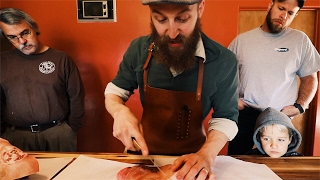
This content was created by Victor Justin Rhodes. This content was uploaded by Victor Justin Rhodes. This is a YouTube video titled "Do This (And It’s Unforgivable)." (created 2017-02-20) The excerpt is a diarized, informal instructional/demo segment in which Doug and two other speakers (labeled SPEAKER B and SPEAKER C) discuss and demonstrate pig butchery, making jowl bacon/guanciale, rendering leaf fat, food-safety practices (chilling, scalding, cleaning), curing bacon timelines, and cooking pork chops. The tone is hands-on and conversational with practical tips, light banter, and meal preparation at the end; guests and children are present in the scene.
Chapters
There are only a few sins that are unforgivable.
Jumping right into it, cleaning out the brain. Is that it? That's all there was to the brain? That's it. There's the better one from the other. Ah, there we go. What are you doing, Andy?
Cleaning out the head after the shot, any brain material or bone matter. This pig was eating when it was killed, so we clean out the mouth, get all this stuff out. 'Cause we're turning it into food. We're gonna cut off the ears in just a minute, clean out the ear canal, and then we're gonna take off the jowls so that we can make guanciale or jowl bacon. It could be turned into sausage, kind of depends on what you want to do. Well, what we're gonna do is we're gonna cut off the ear, and then it's very easy to clean out both sides of the ear canal. And you can see why we want to clean it out. Yeah. Now we're gonna take off the jowls, and we have 4 heads here. The jowl is right here we have strips of meat and fat, just like bacon. So that's why they call it jowl bacon. So usually we start back here, again right below the ear, and we run our knife, just make a line down here to where the lip is. As it opens up, there's a muscle under here, the masseter, which articulates the jaw, that we usually don't put with jowl bacon. But what we do is we put it in head cheese. And once we have this off, you'll see the jaw. So that whole hockey-puck-like muscle is the masseter, and it sits right on the bone of the jaw. And as we go through today, you'll see there are lots of places like this on the pig where it just makes sense. Yeah, seam butchery. Just makes sense that two planes of meat or fat, where they come together, you'll see them just open up. Thankfully, we have a history and culture on our side, and there are established ways to make all of this delicious. When you're cutting down there, you'll hit the table and you'll start cutting through the meat with the saw. So you want to try to keep it as flat as you can.
I appreciate your love and appreciation for this. Oh heavens, he's just enjoying this process. No matter how long—
every time you can just tell, he's just like, yeah, it's great, it's great, it's It's visceral and yet it's rewarding, and you can see that it's food already.
This is not a chore to you. This seems more like art to you.
Oh my goodness, no, this is— it's beyond a hobby.
It's a passion.
You were saying women are typically better at sawing. Why is that?
Uh, because they don't have anything to prove, and they—
this one's smiling behind you. Look at him smiling.
They take, they take instruction better usually in in usually male-dominated activities like sawing something. Mm-hmm.
Is this your first time cutting a pig?
Yes, actually it is. Oh, look at that. This is so pretty. These two folks took out the leaf fat, and so this will be chilled so it's colder, and then we'll grind it and then we'll render it for leaf fat, which is what you should use instead of Crisco. And I'm just cutting off meat because you don't want meat in your rendering fat.
You getting hungry? Yeah, just a little bit. You coming in? Come see what's going on. There's the bacon. Show's over, let's go home.
Yeah. Like, one way that we fight bacteria is we scald and scrape this pig. Okay. So this skin is easy to clean at this point. If we would have skinned this pig, there would be fat here, and fat picks up everything. So this is our first layer of defense. Okay, and then the other layer is yesterday we did as minimal like flesh cutting as possible. Like the stick we made in the neck was as small as we could make it. And the other thing is we chilled these overnight. Crystal had a freezer, we put them in the freezer to get them the temperature down. So once it's below 40 degrees, it inhibits bacterial growth. The other thing is we cleaned this surface Totally. We've washed our hands, washed knives, so we're not introducing an immense amount of bacteria. The other thing is most of the bacteria that develops quickly is actually beneficial bacteria like lactobacillus, and they would actually start consuming some of the sugars first. We have actually a really big window, much larger than most people think, where, where this would be bad news. Bone dust scraper. I'm not sure my butcher would use this one.
Because I get stuff back and forth.
It just picks it up. I mean, it's such a simple tool. Slicing bacon.
What are you doing, Doug?
I'm cutting all these valves out of the inside of this kidney so we can put this in some buttermilk or cream and fry it up in a skillet with some butter and salt. That'll soak overnight. Uh, some of the milk will help neutralize the uric acid in the kidneys. And then tomorrow afternoon, when we're doing some of the charcuterie, um, value-adding and learning about curing, uh, we'll fry up individual parts of the animal, including these kidneys, in the skillet.
Did you get a snack, buddy?
Yeah, it's a fun process.
We will make a hide. A hideout? A hide. A hive. A beehive. Good for you guys. Cutting bacon.
Thank you.
You can start here, right?
Right here.
This can go to sausage, and then we'll have this to work with for our bacon.
You're going to cure the bacon first, and then we're going to cut it into slices.
Yeah, but the curing process takes a while. How long? So, uh, depending on how you cure it, if you're not using nitrates or nitrates and you're just using salt. If you use the EQ method that we are going to talk about tomorrow, you're looking at 5 to 7 days minimum. But if you go north of that, 10 days or more, it won't matter because you've added the exact amount of salt to the weight of meat, so you're not going to over-salt it. So if you leave it in longer, you're not going to have to worry about over-salted bacon, which is the number one mistake people make when they start curing their own bacon, is they don't— they're scared, they're nervous that they're going to have botulism or trichinosis or something, so they just salt the crap out of it and then it burns their tongue. Like, they just can't— just can't eat it.
Let's see your finished beehive. Look at all the bees in this hive! 1, 2, 3, 4. We were talking about making our pork chops tonight for dinner and Doug overheard it and told me all about how to do it. So I guess you're the man to refer to, huh? He's the expert.
I'll tell you how to do it.
I made a few suggestions.
So then I said, well, come on, let's— we've got a few to spare if you want some. Come on, let's do it. First up, bacon grease in a hot pan. This is beginning very well. Okay, I thought I heard you right. You were saying stand it up on its side and you're just gonna hold it there. And what are you doing that for?
Well, it's helping rendering out some of the fat there on the back cap, fat cap, but it's also searing it a little bit. People don't talk about marbling in pork. You know why?
Because it doesn't exist.
It doesn't exist, but here it is. 99% of pigs live in confinement. There's no intermuscular fat. They just stand around all day long on a concrete slab. How am I looking, hippie?
So we are, um, feel nervous here. 2 and a half minutes.
He's terrible at time.
On the clock.
I know, I know. That's why I'm following.
Okay, they're saying this is good.
This is a minute. I'd put it for 3.
This is the pork chops from Warren Wilson College, from our home. We just brought it with us. We were not going to leave that at home.
That'd be a sin, wouldn't it?
That would be a terrible— to leave any pork.
Yeah, there are only a few sins that are unforgivable. Using the Lord's name in vain? Blasphemy? Leaving pork in the freezer too long? It's all right, that's, that's the boat.
Check it out, man. Are they making you— is that making you hungry, guys? Oh my word. All right, guess what we got here? Our first dinner guests. They showed us how to cook these pork chops. They look absolutely amazing. Whoa, you like that too?
Yeah.
Yeah. So a bit of pork chops with some veggies. You guys hungry? Yeah. Okay, let's do this. Kids at the table. Adults, can you control yourself?
I think we can handle it.
On the couch. I'll do my best.
Okay, see you guys.
Yes, thanks for dinner. Good night. Have a good night.
Thanks for the pork chops. Thanks for the cooking of the pork chops. Those pork chops were absolutely amazing, weren't they? They really were. I think we'll cook them like that. Yeah, we will, uh, from now on. And always think of those guys when we do it.