Eating Weirdo Stuff @ VERSALAND With Grant Shultz
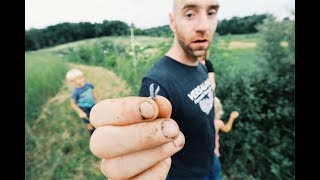
Grant Shultz gives a tour of VersaLand, a permaculture farm, showing off fruit trees like persimmons, chestnuts, and pawpaw while the group tastes honeyberries and eats Japanese beetles straight off the plants.
Chapters
So these are totally weird late season fruit, but you can still eat them.
They're nice.
Woke up this morning and you see that? Yeah, more rain. So what are you gonna do? Well, we're gonna film this evening. It's already stopped, so hopefully it'll dry out more. We can go on this tour. A VersaLamp. But what do we do while it's raining? Well, Josiah's taken to editing movies. I didn't teach him anything. They just asked for an editing app. They're shooting movies on this iPad. And oh my gosh, you're coming up with some pretty good stuff. Let's see the first movie you ever made. Including music.
Hmm?
Video.
Good movie, good movie, Josiah, good movie. See what else is going on. What you working on, Mom?
Looking for something on Amazon. We recently purchased—
let's show them, let's show them it—
5-gallon glasses.
A 5-gallon glass water jug, and I'm gonna get one of those things that goes like this, and so we can get the water out of it.
Yeah.
But I'm also looking for some sort of lid replacement for when this one is done. I want to make sure that I have a way to— when I'm taking this into the store to refill it, I need to have something on it to, you know, so junk doesn't get in.
You can go back and forth and not splash everywhere.
Right.
So, that's your lid replacement.
That's what I'm looking at. I'm hoping— I'm trying to research to see if it will fit this one. I don't know.
We'll see. Let's see what the kids are doing. Hey! This is the perfect time for screen time. Rainy day, we're all stuck in the bus. And DVDs, because you don't always have the internet. Are you going to join them? The weather has cleared up. Hopefully for a little while at least. What do you think, Grant?
I think so.
We're going to make it? Grant Schultz, VersaLand. What in the world is up with this big, tall, crazy fence?
It's a deer fence. It is a really inexpensive, fast way to make a deer fence. It's high tensile, 13 wires. There's 4 wires hot on it: 1, 2, 5, and 8 are hot with a StayFix energizer. And then the deer learn to stay away.
How tall does it have to be to keep away deer? Because that looks pretty tall.
Yeah, this is 10. This is, this is tall.
You got some cray-cray deer.
Yeah, and they'll climb if they get ambitious enough.
All right, you want to show us around your place?
Sure.
Deep tour.
All right. Chips and then that there. I live 8 miles from Iowa City, which is a pretty populous metro area. Wood chips, they're really good. Get as many as you can all the time. We've got hundreds and hundreds of yards here. Maybe you'll see the big giant pile tomorrow, but it makes really good soil. So we're always taking all the wood chips we can get and letting them compost in place. This is kind of a low spot here, so all the rainwater from up there ends up here. And after, you know, a year or two, you get this really good soil, high organic matter soil.
You get free wood chips.
Free wood chips.
Yep.
If you can, doesn't pay to make your own chips even if you've got logs and twigs.
Why not?
Oh, labor, wear and tear on the machinery. I mean, it's nice to have them, but if you can get them for free, take free, you know. These are the first trees planted here. This is persimmon trees, Diospyros virginiana, American persimmon. All right, these are, uh, 4 years old now. So I'm 6 foot and these are like 12 or 15 foot. Um, when persimmons— this is a telling point right there— when persimmons are young, they're real tender and they love to flop and break. Lots of leaf area, they're pretty heavy. So usually you don't want to graft them until they're about 3 years old to a selected variety. If you've ever seen the persimmon fruit in the grocery store, yeah, you know, big yellow, super sweet, you can put those on the American persimmon rootstock.
How far apart did you space them?
These are super dense with the intention of thinning them.
When are you going to thin them?
I should have thinned them last year already. So persimmons are— they're, they're dioecious, so they're naturally— they're either all female or all male.
Okay.
Um, so only females will ever bear fruit, most varieties anyway. But I wanted to see what growth rates would do because these are all seedlings, you know, which ones grow faster, which ones look the best, and then thin out the ones in between.
What do you got there, buddy? Um, You got a centipede?
Yeah, found it.
How cool. Yeah. All right, let's keep going on the tour.
It's a peach tree, talk about that. And then back into it, there's a, there's a hardy kiwi in there too.
Where's the hardy kiwi?
It's wound up in there. Oh really?
Climbing it? Did you do that intentionally?
No, it was an escapee. But these pallet boxes here, uh, usually used as nursery beds. This has got a bunch of hoses in it and soaker hoses in it. But it's really easy to overwinter, you know, chestnuts, seeds in there, walnuts, whatever. And then come spring when they're done stratifying, they'll just germinate right in place. And we can fit about 400 chestnut trees per pallet box, which is pretty, pretty nice and tight. And this is kind of like expanded nursery escapees. There's chestnuts in here. This is an Iowa peach, so it's a, like a Siberian Sea peach, grows from seed. There's fruit in here somewhere. This tree is only 3 years old and it's already this tall. If you look closely This is the hardy kiwi, naturally trellising. Hardy kiwi is going up. They're sweeter than grapes, like sometimes up to 40 brix. It's a really sweet fruit. They're in a real small grape size. There's a chestnut in here, 3 years old. Um, a bunch of apple rootstock and pawpaw. This is about the farthest north range you can get for growing pawpaws. We got a bunch of pawpaw in here. Dogo crabapple, really small, long. They're Russian. And they're really cold hardy too. What about this other stuff?
Is this weed pressure coming up, or is this intentional? And is it going to hurt it?
This is all herbs that just kind of took off.
Are the trees going to be fine?
They'll be fine.
Are you gonna have to mulch this?
It's already mulched underneath, but the weeds came in anyway. I'm not worried about it. This is, uh, anise hyssop licorice tasting.
Wow, look, Mr. Brown, a tractor! I'm gonna ride a tractor tomorrow, he says.
My, uh, my very first tractor when we planted out all the trees in the civil pasture was this thing. It was a 1960 Oliver 1800. She's 57 years old right now, still runs.
What? Start her up!
Oldie but a goodie. She's not gonna run right now. Come on now, not today, not today.
Why not? She pretty— is she a pretty hard start?
She's a hard start. You want to try it out? Yeah, see if it'll go.
Come on, let's see. Maybe we'll get lucky.
Maybe we'll get lucky.
Maybe we'll get lucky, Mr. Brown. He's going to start it up.
Is it loud?
Really loud?
You never know.
Already stopping.
Oh well, good try. Okay, okay. It's wet though. It's wet today. We were going to drive the orange tractor and the mulch machine, but we gotta cross our fingers this is gonna dry out more and maybe we can do that tomorrow.
But when we had a laying flock, they weren't really for eggs as much as what I would call ecosystem services— running around scratching up paddies and whatnot. So we get enough eggs for us, but it's not worthwhile to sell them really. But whatever they eat, they, uh, they make it a nice seed bed for volunteers. So we've got squash-a-loop here coming up. We'll find out what it's gonna be, but here's dinner. Oh yeah, how about squash beetles?
Go for it, eat it.
You want that one?
It's a bonus.
Not that one.
It's protein. There we go.
How about this? This is a delicacy.
Mmm, where is it a delicacy?
In restaurants everywhere.
They do sell them at the farm.
Oh yeah, they're about $3, $4 a piece.
You got, you got quite a bit of $3 bills there, buddy.
We can traverse this way. So Chestnut Nursery is over there, Seaberry and Persimmon's up on that ridge.
We're back at the Japanese beetle, guys. Yeah, I did it yesterday. Anybody hungry today?
It wants you to eat it.
It's right here. It's saying eat me. We're at VersaLand, folks. Grant Schultz, where we turn problems into solutions.
Protein. Mmm.
Yeah, Japanese beetles into dinner.
We're foraging.
And you're kind of standing far back. You afraid? You're afraid?
The majority of the silvopasture here is on 30-foot alleyways, so there's a row of trees continuous kind of wrapping around the hillside. On— there's 30 foot in between of pasture grasses, clover, forbs, all that jazz. And then the trees in the row is very much like Stefan Sapkowiak's setup. It's a, it's a multivariate replicate where it's like a peach tree and then an apple tree and then a chestnut tree, and then it repeats. So that as succession happens over time, as they get bigger, you can thin out every other one.
Yeah.
And you keep the same diversity in the row.
Just to remind people, 2 fruit trees, a nut tree.
Yep.
Oh, and then a nitrogen fixer.
No, but my nitrogen fixer is the alfalfa and the clover in the alleyway. It's not in the row of trees.
All right.
Yep.
Why 30 feet between the trees and not 50 or 20?
Great question. So I chose 30 feet because most of my livestock was smaller scale. So if I want to get as high in the value chain as I can, um, you know, this is for human consumption. So, you know, grazing beef in here is less of a deal, less of a concern, because I'm not going to earn as much per acre as I would with fresh fruit. So smaller livestock— hogs, chickens, geese, turkeys— that's what I've been focusing on. Okay, we have had beef cattle here, but it's been on the back side where it's, you know, bigger spacing and wider.
Let's get the kids.
The big reason why there's, you know, diversity and lots of species planted out here is that sometimes stuff dies. So, you know, Japanese beetles come along and kill something. Emerald ash borer kills all the ash trees. These are cherry trees in here, and they've been getting hit pretty hard by a fungal disease, just knocking them out cold. So I'm glad there's diversity. These elderberries are doing fine, ragweed's doing fine, chestnuts are doing fine, but the cherry trees in this pasture have been dying left and right. So diversity is good. This is a hybrid chestnut tree, so this is an American-Japanese-Chinese 3-way cross. They grow taller than a lot of the Chinese chestnuts. And the nuts are a little bit different.
Hey!
Prrr! But it's really neat to see when you plant chestnuts with this kind of density, there's so many of them everywhere that the Japanese beetles hit some of them and leave the others alone. So you see this kind of lace leaf action. This is what happens when the Japanese beetles eat the chestnut trees, and some of them bounce back and some of them don't. But the only way you'll ever find out is if you plant a bunch of them.
Honeyberries.
There might be some. They're little in here. This one's not so great. There's probably some that are still fruiting down the way.
Did you grow all these plants out yourself?
Yeah. Yep. So there's 21 varieties of honeyberries here, which is probably one of the most in the US as far as I know.
Why do you like honeyberries so much?
They're like a blueberry, but they don't need acidic soil. So in the Midwest, you've got neutral pHs. So they grow without all the extra work. And they grow fast. And they're pretty tasty.
These are obviously the flower blooms. And then are these the little fruits?
That's elderberry, guys.
Those either haven't just opened yet, usually they turn green. So these are, these are little fruits.
Oh, I see it.
They, they look very similar, like here, here. So they look very similar pre-blossoming, after pollination too.
So you're gonna have a huge crop off of these.
There's gonna be a huge crop off of this. Yeah, so selective variety elderberry yields so much heavier than the wild ones. If you look at the head on this thing, yeah, like that's, that's all going to be elderberries. Wow, yeah, this is coming along. So this, um, this variety is York. So all the elderberries get ripe more or less the same time, but they're— each variety is like a week off of each other. Um, this one's a pretty early ripening one. When we were planting all these trees out, this was just a bare field, so fresh, fresh hay field, planting the trees out in the transplanter. And when you look back, you would see see blackbirds landing on the trees behind you because they like to perch from the high point on the pasture. And you know, they're everywhere, you can hear them. And red-winged blackbirds like to kind of dive-bomb to protect their nests. So you'll be walking along and you'll just have birds flying at your head, you know, 5 feet away, pretty much all the time through here.
Let's get their song. Let's hear their song.
The whole point of alley cropping and silvopasture is mixing yields and having a lot of edge. And, you know, here we've got grass and red clover and alfalfa, so it's a good, you know, leguminous mix. And we like to cut a portion of this and then rake it onto the row, which we need to do now again. So that'll leave this mulch, you know, the grass layer here, to grow up, make the trees grow better. But when you mix that high nitrogen You know, with those wood chips, before you know it, you get black soil. And you know, these are pretty degraded, pretty beat up, heavy clay soils. So it's nice to see organic matter back, uh, growing trees on the hillside. So here we've got a pawpaw, sea berry, grape guild happening. Everything at once, all the time. So sea berry is actually a nitrogen fixer. Very few people know that. So it's producing a fruit yield. You can make tea with the leaves. You can eat the fruit. Then it's helping this elder— or this pawpaw grow. And it all grows up together. And when it gets to be too much, too thick, like it is now, you just start clipping stuff out, transplanting it, pruning it, and thinning it out. This is a Mazard cherry tree, just grown from rootstock. And you can see right away, you know, you've got life happening. You've got bird life setting a nest in there, right amongst the sea berries.
Yeah. Mr. Brown, you want to see the nest? Yeah. See the bird's nest?
See it? A little bit of a hole here. This actually was a spring that came back. So after cropping this for years and years, years, it was a soybean cornfield and tiled, and then we converted it back to perennial grasses. A spring reemerged here, which is pretty cool. So this is an elderberry, Sambucus canadensis, and each individual panicle, the actual fruit, is not real big on this one. But it's— there's so many. This is the Grand Champion. It's probably 15 feet tall, grows really vigorously. Small fruit, not really, you know, really big panicles, florets, but there's a lot of them, so it's a good yielder. This one is not that great of one. Honeyberries usually fruit early June. They're the first to fruit around here. We've got a couple straggler fruit here. Sometimes it will blossom again later in the year. These aren't very big.
Here's a couple.
Well, there's so many tasty. Yeah, there's a couple. Go for it.
Go ahead, you guys. Give them full review.
Honeyberries might be a little sour.
Yeah, it's a little sour, but it's not bad.
Are they normally sour?
Um, yeah, they're kind of like blueberry. Yeah, yeah, blueberry, raspberry.
Yeah, yeah. Let me see if there's—
you gotta pick them when they're ripe. If you get them too early, they're real sour. And the cool thing here, you see this? So if they get pollinated all funky, they have these really weird fruit because there's actually one blossom inside of another. So these are totally weird late season fruit, but you can still eat them.
But they're nice.
They're blue. You want this?
Oh yeah.
There's better fruit down the way. These are weird.
Here's one more. Here's one more.
These are weird.
Who wants this one?
Ooh, look at that one. What a weirdo. Ready? Look at that.
Okay, who's getting hungry?
I am.
You guys are?
Okay. I don't know how hungry you're gonna be. It's kind of late in the year. I'm just gonna eat them all because you guys don't want to come pick them up.
We're foraging this permaculture landscape for some food.
That's a good one. Show it to your dad.
Although some of them look a little bit weird. No, no, that one looks good. That's weird.
Honeyberries, when they get stressed from the heat, you see this, the leaf turned brown a little bit, so they get sunburned. They think they're gonna die, and then they, they reflower again later in the year, and they kind of put out some funky weird fruit that go unpollinated. So, you know, you get these weirdos late in the season. You can still eat them, but they're unpollinated. They're never like, you know, 1/10 the size of regular fruit.
How old are these? How old is this persimmon?
That persimmon is 3 years old.
Okay, so then our persimmons at home look normal.
So you see this, uh, they're not huge, this leaf blotch on here? Super common with persimmons. Okay, not a big deal, happens all the time.
How do you—
what do you do? Nothing, nothing. Prune it and you get a little aired out a little bit, it'll breathe better.
And then this person does not get huge.
They will get huge eventually.
Yeah, yeah.
Um, but they grow really slow their first few years and then they just take off. Mare's tail, it's a weed.
Is that weed gonna be a problem? Are you gonna have to cut it down?
Uh, I'll probably chop and drop it as mulch or just let it be.
So you'll come in with what? You'll come in with a rice knife?
Oh yeah, yep, a little hand side.
You all by yourself?
Unfortunately, so this chestnut tree is about, uh, probably 3 years old for these, you know, various growth rates. That's important to see, you know, young ones, but basically they're all the same age but they have different growth rates as far as height. Deer browse is a little bit of an issue, but if you look close here, so this is a male catkin, so this is the flower, and this will pollinate the female flower and create a chestnut.
Bye-bye, guys.
Bye.
It's getting a little hairy for them, too long for them, and we're about to traverse this jungle. Permaculture Jungle with Grant Schultz, VersaLand. Don't get lost, Josiah.
So here's a little, uh, this is a chestnut and burr. This is a baby little chestnut in here, and that's pretty cool to see on a 3-year-old tree.
Ow!
Now wait a minute, you got a deer bed, what about your deer fence?
So the gates are open on the deer fence right now, so the deer come and hang out in here. And that's really important to share is that deer love to browse two things: alfalfa, chestnut. Those are two favorite things to eat. Um, so you'll see like this little one down here, if this gets eaten a lot, it's never going to grow. As soon as they get above browse line like this they just take off because they're not getting munched on anymore.
Hey, what if the dill bed—
you're, you're kind of walking in it.
Oh, walking on it.
Going through it.
Oh, here's another, uh, here's more chestnuts. So here's the catkin. This is a male flower. This is already done for. And then here's the little baby chestnuts on the female flower, the burr. So these are all going to be chestnuts in there.
Nice. We're going to go up to the top of the hill to get a good view of the Other hill.
Yeah, the storm is going to bring some water. These grow a lot faster. This is all south-facing slope, good solar gain.
Facing the sun.
Persimmons, they warm up earlier in the year because it's all south-facing, solar gain, warms up, faster growth rates.
I think that wraps it up right there, folks. What do you think? I think so.
More from Justin






If I had to start my Homestead all over again, it could only pick one animal… 




