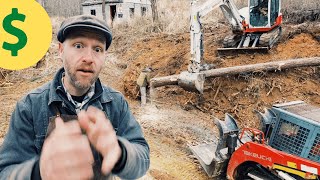
In this vlog Victor (Speaker A) walks viewers through a major farm improvement day that includes grading, creating an access road, building a loafing area, fixing drainage and a busted culvert, and preparing a new butchering/storage shed for a large upcoming bird and pig processing season. He coordinates with his dad, Fred (equipment driver), and Dan (the "Permaculture Shepherd" who handles the sheep), while family members like Grandma and Rebecca assist with other tasks. Victor reflects on lessons from the 2017 Great American Farm Tour, emphasizing that the "greatest farm" is the one you own and can improve, not a distant ideal. He discusses the evolution of the property over the past three years—from initial fences and a few chickens to a diversified operation with cows, sheep, pigs, and extensive pastures—highlighting the concept of "smoothifying" the land by clearing trees, re‑shaping banks, and optimizing pasture. Throughout, he balances practical logistics (gravel delivery, truck turn‑around, French drain considerations) with a philosophical stance on contentment, efficiency, and continual system refinement.
Chapters
Today is a big day on the farm. We're having the graders come and do all kinds of different work. Let's see, we're gonna create an access road right here because in the winter it gets boggy and sometimes we need to get in there with firewood or hay. Is Dad not just gonna put gravel right here? Yes, exactly. That's exactly what he's gonna do. See how wet this is during the winter. Fred will come bring this in and, uh, we'll have a nice little gravel road. The access road folks will drive here, and if the cows are in there and we need more hay, the driver can come by, pull way out there, probably have it done all the way to the, the greenhouse, and then gravel back to there so they could back in and deliver hay. We're going to create a loafing area in front of the pole barn so the, uh, the animals can get out during the day if they'd like to. I'm gonna deep bed that, and when they go out in the spring, that would be planted in like a pumpkin patch or something. We've got to bring up dirt and gravel up to the paddock so it can be easily accessed. We've got to get our gutter lines from our house because it's running off of the house to the pole barn and to the access road, and we've got to get that water not there but like in the creek. We've got a wet weather spring we need to sort out up there at our turnaround because big tractor-trailer trucks, if they're going to come in with their feed, it's hard to turn around if it gets muddy. There's a culvert that's been busted for years we're finally getting to. And there's some firewood we need to move. And where am I going to put all this firewood? I've maxed out our shed. I gotta think about that because he's gonna need to put this somewhere in order to level this out. There's a platform we need to make sure is big enough because we're going to build a shed that's going to be for butchering and storage. Like, we just ordered almost 400 birds. And that's pretty typical of us. Plus we do 2, 4-ish pigs a year. It's time for a, a butchering setup that we can leave up, not set up and tear down every time. One of the problems up here at the shed is we've got this wet area. It's always been kind of wet here. How are we going to lay a concrete pad here? We're going to talk to Fred about that. And see what we can do. I don't know if it's a French drain right here or what, but that needs to be done. The reason I'm doing this really is to establish our home, uh, our homestead, our farm. And one thing that we did when we came back from the Great American Farm Tour in 2017, touring all of America, showcasing America's farms— that was a 10-month journey and really a 10-month search for our place in America. We're about to move the sheep with the Permaculture Shepherd.
This is for my, my ewes. I will whistle my girls, they will come running to me. Come on, girls! They're a little slow this morning.
That's slow? Normally that's excellent.
Lightning speed.
What?
So they will come flock to me, and I'm gonna open the fencing, and I usually count. I go, "One, two, three.
Three, here we go!" Baa! Baa!
And we take off, and they follow me. I lead them into the next paddock. I lead my sheep. I want them to follow me. I don't want to be driving. When you drive them, you're putting pressure on them. They're less comfortable. They're more likely to veer off. They're going to follow me into the next paddock, and then immediately when they get over there, they're gonna say, Whoa, there's raggrass over here and that's where they're gonna focus on.
Do check out Dan's channel. I'll leave a link to it again right there. It's good. He's a wealth of information. I think it's like over 300 videos— sheep, pigs, chickens. I'm ready. Oh good, Grandma coming down to cream separate. Good thing because there's a lot going on and Rebecca has Oh, she's hurt herself somehow in the cool room when she was organizing an Azure order. There's an Azure, like, co-op bulk, bulk food, and she hurt herself. So Grandma's stepping it up. Rebecca's getting some rest. First thing I gotta do, I gotta pull up these blueberries if we're gonna fill this in with dirt. We have plenty of raspberries, we're gonna let them go, kiss them goodbye, but we are going to save these blueberries, try dry anyway. All right, let's just try to root them up. Oh yeah, a lot of soil came with. All right, we'll take as much soil with them as we can. Okay, there was fewer than I remembered. I don't even know if that was enough time for a time lapse, but anyway, we got our blueberries. We'll replant them with our other blueberries across the street. A long story short, the Great American Farm Tour, we never— we, we didn't find anything else. That was better. Really, we came home with the conclusion that where we are in America, this is our greatest farm. We were in search for the greatest farms in America, but then what we realized was the greatest farm isn't out there. It's right where we are. In your case, it's right where you are because it's what you It's within your realm of influence. It's what you have control of. There are problems everywhere. And there are good everywhere. No matter what you do. One big takeaway from the farm tour was that these homesteaders, farmers, and front yard gardeners were extremely content. And we saw this beautiful America that that you don't see on the news. We saw this beautiful and happy America, and we saw these people being content. And really, it taught us that we can be content where we are. All right, we got a nice little surprise. I had ordered our lumber. I did not expect it to arrive like before 9, but here it is. Maybe be the afternoon. That's a good thing because while they're grading, I can start doing my carpentry on this pole barn. Look at that, it's gonna be a good day on the homestead right there. Gonna get a lot of work done quick. Hey Fred, what are you guys doing? We are waiting on you. You bring me one of them? Where you been? Ah, it was trying to weather a little over in Illinois. It was about 32 degrees. Yeah, about 40 up here. I said we'll move and see what happens. Yeah. All right, so now here we are. When we came to this land, this is gonna be 3 years ago, I don't know. Uh, yeah, we're going on— or would it be— yeah, 3-ish years ago we've been back. So what was the first thing we did? I mean, basically it was just shell. I mean, there were no fences up, there was no gardens established. Well, there was this perimeter fence up. There was, um, 3 chickens and a little bit of a winter garden that our, uh, our, our house sitter— well, it happened to be Arun and his wife, uh, had maintained. What'd we do? Well, that year, oh my goodness, we got cows, we got a dog, we got sheep. No, no, we did not. Yeah, we got sheep that year. We get pigs. We got cats. We exploded with this food. You gotta get the food. First things first, here in a pasture we're gonna establish, actually gonna clear— have them clear this out. We need that. We could use that fill dirt, that weird pile of dirt here from a previous owner. We're gonna use it for a fill dirt over in our loafing area. And at the same time smoothify the pasture here and clear it up, silver pasture it. First, let's get this fence up. Only after we established our food— and by the way, that first year, of course, it was all the meat chickens, you know, it's the layer chickens, I don't know if I said that— but once we had that food and it was just, I mean, just slap it together strands of wire whatever it took to get going and get food on the table, homegrown food. But then you started realizing, you know, I'm working 3, 4, 5 hours a day in the height of it to make this happen. There's got to be a better way. Oh, okay. He must be just scratching and just getting the trees out of the way, and then he's going to go back and dig. That's my guess. We've got this bank that's way too steep. We've got a little bit of pasture there. A little bit of pasture there. With— for somebody who doesn't have enough pasture, there's a limited amount of places to get it. We're getting it anywhere we can. I'm gonna, uh, taper off this bank and we're gonna use that as our field dirt, and then we'll have— but once you get these big trees open, it's going to be really open, and we'll be having pasture this year. I'm just gonna push that tree down. Oh my goodness. Hey guys, stay back! Oh! Boom! That the better way is what I call smoothifying. We had our animals going, we had our gardens in place. Now how can we make it better? Better, quicker, more efficient. And here we are. We don't— we're not adding any new more animals. We're just perfecting the systems we have. An hour in, it looks totally different over here. Way more open.
Whoa!
I just had this realization the other day. It's like we're having a new— this homestead, even though we've been here long before the Great American Farm Tour, it's like we've— we owned it after we got back. We really dug deep with our roots. We even bought the place, like, from my dad's estate. We're even making payments on it. That's serious. We own it. And it's like we've come into this— it wasn't raw, but almost. We've got to set it up so that it works for us. Fix the wet areas. Establish the winter housing. Get the sheds in place. This is an exciting moment in our journey. They are done clearing the trees in the woods. Now we're starting to fill in this loafing area. So our pole barn is here. We need to raise this up, and, uh, we have a bank of dirt and rock right there. There's our bank, and then he's gonna have to go get some of that bank, some fill dirt.