Farming SALT From The Ocean
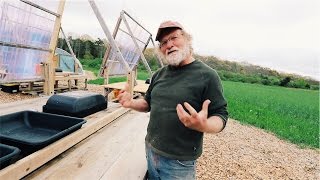
Chris at Pariah Dog Farm harvests salt from seawater using solar evaporation in black tubs. Over two weeks, sun and wind turn 3% seawater into salt crystals he jars and sells at his farm stand and farmers markets. He makes a few thousand jars a year, calling it farming the ocean.
Chapters
And so continuing to make a living from the water is an important aspect. And so to me, it's kind of a farming ocean thing.
Good morning, Massachusetts! Today we leave Pariah Dog Farm, but before we— well, we're going to go up to Plymouth, see, do some historical stuff there. But before we do, we gotta see the saw operation. This is Chris. Hey, Chris!
Hey!
What is your— you do this as a business? Is this just a hobby? What is this?
No, it's a business. It started out just as an investigation, making salt out of seawater.
What's the name of your business?
It's called Monomoyet Wild. What I do is very simple. I build a wooden table, just like a bench or something, and then I spread out these black tubs. These are just the kind of tubs, you know, you can just buy at a hardware store to mix cement in, and they hold about, you know, 7 or 8 gallons of water. And so I get seawater and I put it in the tubs. The fact that tubs are black is good because it absorbs sunlight. And then I'll put the seawater in that and just let the sun and the wind do its work, and temperature and humidity— those are the main things— and put it out. And it takes about— in, uh, during the summer months, it takes about 2 weeks on that order, 10 days to 3 weeks, so 2 weeks on average to make— to go from seawater at 3% salt to salt, 100% salt. At the day the salt comes off, this will be laden with salt particles that'll just be kind of damp and wet, and then a little bit of rich salt solution. And I'll scrape that out and just literally spatula it out into a container or bucket, and then I will take that and wash that with the remaining juices that are in there, the salt juices.
Yeah.
And that floats off all this, all the stuff that's kind of drifted in through the air, beetles and bugs in their season. Then I take that and I put it in little jars. I've got a jar over here, I'll show you, about 3-ounce jar. And, uh, and I just put the salt in there. Then I put it out on the, um, uh, on the farm stand. I have my own farm stand in Chatham.
Nice.
Pretty much only has salt on it and maple syrup in season.
You're the salt guy.
And so, uh, but I also, uh, farmers markets and stuff, uh, here at the farm, Pryor Dog Farm, Matt and Jenny take my salt and they'll, uh, to their farmers markets and their outlets and they'll sell it as well. It's just another product of the farm. I make maybe a couple thousand jars a year, trying to expand that a little bit. But part of what I like to maintain is, um, a real sense of doing it myself. Yeah, I'm not trying to grow a mega business. I want to provide, make a living by the ocean here on Cape Cod. We're in the ocean, making a living from the ocean. It's a very important part of, uh, sort of our history and our, our, our feeling. I was a commercial fisherman for many years in my 20s, in my about 10 years, and so continuing to make a living from the water is an important aspect. And so to me, it's kind of a farming ocean thing, and that's what I do.
Really appreciate what you do. Thank you very much. I should say, in case somebody's wondering what in the world these things are, They're not solar collectors or anything like that. They actually hinge down and cover this to keep the rain from getting in.
In fact, I'm going to hinge one down now because there's rain coming in. He's sort of the opposite. You'll see it come down. I can show you going up. And but, uh, we got rain coming in for a few days, so even though we don't have anything here, I like to keep the tables nice and dry. And this is how it was done, uh, in the 1840s after fashion. They had slide-on, slide-off roofs, but I wanted to make it something very simple and easy. So these roofs just drop down, and it's just a cheap plastic roofing, clear roofing. And so now that's ready to— if I had tubs full of seawater here, which I would normally do have, these would be protected from rainfall. So it can just stay there for a few days, and as soon as that sun comes the morning of the first clear day, these will go right back up.
Well, thank you very much, Chris.
Okey-doke.
Good luck with it all. Okay, Jenny. It's been real.
So much fun to have you guys.
We're gonna miss you.
I know. They'll climb anything, these guys.
Everybody give her a hug.
Hugs! Bye! Thank you! It was awesome.
Yeah!
The tree climbers! The big strong tree climbers!
The dog wants a hug.
Shae, does she want a hug?
Yeah!
Give her a hug.
Woo! Awesome.
Halfway to our destination near Boston.
We had to stop at Plymouth Plantation. Definitely taking time to do the historical sites on this tour. This place where we're at, the Plymouth Plantation, is a replica of what it was like in the 1600s when the Pilgrims came over. The native people here at the time— I believe that's what we're going to first go to, is the native village, the Wampanoag. Whoa, you would sleep in here? Have a little fire? Try it, give it a try.
It's fine.
What do you think, Mom? Our next house?
Yeah, I would be inside.
It would be chilly, and this is definitely not as cold as it did get.
I guess maybe they would wear more clothes in the cooler weather.
This is the Three Sisters garden bed. Have you guys heard of that? Corn, beans, and then squash. They plant the corn It grows up, you plant the beans, it runs up the corn, and then the squash suppress the weeds. You see, permaculture has been around for a long time. 8 to 10 people would have slept in there. All the living would have been done outdoors, so they would spend most of their time outside. The men every day would go and hunt for their food, particularly in the winter. And then of course they had this garden. In the summer. Little bit of stone raised garden beds here and some sheep. Musketeers, give fire! Musketeers, reload, give fire when able!
This place is kind of crazy.
I don't know if I could live back in here.
If I could have done it, it would have been really difficult. Do you guys think you could have lived here? Like, do you think it would have been really difficult? No. No, you think it would have been okay?
Yeah.
Do you think you could have done it?
Yeah, it'd be different. It would have been different.
I asked about their pee and poop. They didn't have any privies, and, uh, that's right. So they said that they just put it into their compost pile, and then I asked, well, what about bacteria? And she said, what's that? She stayed in character, which is good.
But if they heated up their compost pile properly, they shouldn't have a problem with it.
That's right. I asked her if she got sick, and she said, why would I get sick from my garden? That's different. It's kind of dark in here. Wow, y'all, check this out!
This is a room. Can you imagine? Boy, he's passed out.
Yeah, he is. Interesting fun facts are that the people who came here didn't necessarily know how to hunt and do carpentry and stuff like that. So they came here and they were like, you know, weavers, printers, and then they had to like really provide for their own survival. It would have been a very hard time. The gentleman was saying that out of 20 married women, only 5 survived that first winter. So that's not really good odds there.
We are back in Mabel now. I'm driving little tiny roads. We had a great time at the plantation. We're on our way to Boston, just northwest of Boston, and looking forward to a nice restful Mother's Day tomorrow. Happy Mother's Day, Beauty!
More from Justin






If I had to start my Homestead all over again, it could only pick one animal… 




