Going BACK To EDEN (for healing)
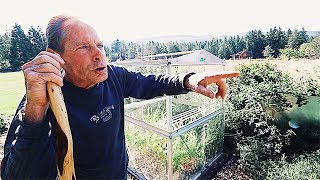
In this interview‑style video, host [SPEAKER A] visits Paul Gauci’s Back‑to‑Eden farm to explore his regenerative gardening system and its role in personal healing. Gauci explains the core practices of the Back‑to‑Eden method—heavy wood‑chip mulching, no‑till soil building, and integrating chickens to turn kitchen scraps into nutrient‑rich topsoil. He demonstrates the results: oversized, sweet‑tasting vegetables and fruit trees thriving on mulched beds, and describes how the method restores soil structure that would otherwise take centuries to form. Gauci shares his personal history, from growing up on a Los Angeles farm, serving in Vietnam where he was exposed to Agent Orange, to a spiritual awakening that led him to ask “the Creator” how to grow trees without water. This revelation sparked his adoption of mulching and a shift away from conventional tillage. He discusses the health implications of nutrient‑dense food, noting that a diet of simple, high‑quality produce leads to satiety with minimal calories, contrasting it with modern obesity driven by “dead food.” The conversation also covers practical logistics (sourcing 100 yd³ of wood chips from a local dump, using Italian heirloom seeds) and the philosophical view that gardening reconnects humans to the earth and to a divine source, providing therapeutic relief and a sense of purpose. The video ends with a demonstration of feeding chickens, highlighting how their manure, blended with wood chips, creates odor‑free, fertile compost that fuels the garden’s abundance.
Chapters
What, what role does the garden play in healing or maintaining from that?
The biggest role I can ever imagine.
Paul Gotti's famous apples. We've had apples and cucumbers and tomatoes. Kids eating Swiss chard, you gotta love it. I didn't know y'all liked it so much, I would have made more.
It's good.
Good morning, Paul.
Good morning. I just want to point out something cool about wood chips. You see my neighbor's cherry trees?
Yes.
You see the foliage in the back, the size of it? You see the branches on this side, how much bigger the leaves are? Yes. You know why?
Why?
The roots are getting the wood chips. It's so dramatic when you see these demonstrations of the power of covering. It's just—
even your neighbor's benefiting from this.
It's phenomenal. You can see the leaves are considerably bigger and greener on that side, you know, because the roots are getting the wood chips.
Do your neighbors think you're crazy?
Yes. Do you know why? They're well educated. They know better. Ah, they know better. Really? What I do won't work.
They know.
It's very interesting.
Even with all this fruit and for the years, all this fruit and bounty, as long as you stay here, you don't get it.
You get it here.
Okay.
You look at these trees here, they're 16 years old from like little 6-inch starts. Look at the size of that, man. It's amazing.
We're about to film some with Paul Gauci of this Back to Eden. Today we really want to find out what's his story, where is he coming from, and how do you end up with this? Just look, lightly mulched with wood chips, things thriving. Look how big that spinach is. You guys saw how big that Swiss chard was this morning, right? Look at all this. Beautiful. Now the cucumbers, they look that way because they're done. Oh, there's a cucumber. Jonah, you want to grab that cucumber?
Oh, there's one over here too. Huge.
That's huge. You want to eat that today, Josiah? This is part of our healing plan. This garden, something from this garden every meal plus snacks. And we came at the right time of the year. And guys, there's cabbages.
Yeah, right there. Yeah, go down about 3 inches and break it off where you have a good stem. Oh, a stem! Because I want you to find— see, the stem is actually sweet.
Yeah, this part.
Yeah, break that off because you're going to think that's going to be tough and stringy. Check out how sweet it is.
Wow, that's amazing!
It's sweeter than the rest.
That's crazy. It's awesome. What is it? It's cilantro. Okay, but it doesn't taste bad, like Sweet. You would imagine it would be like bitter.
Bitter, yeah. Weird. You know what I got about bitter?
What?
A very interesting revelation. I asked the Creator about bitter because when the film came out in 2011, it came out in August and I had farmers coming here all winter, you know. And in February, all I had to offer was, you know, cilantro and kale. And they're all saying to me, this is not bitter, this is sweet. And I hear something over and over nonstop. I said, I'm supposed to learn something here. So I asked the Creator, he says, you know what he told me? It was phenomenal. Look at my body language. When plants grow in compacted, mineral-deficient soil, ah, ah, ah, they're struggling to live, and they express their bitterness in their flavor.
Okay.
They're bitter because it was a tough life. Conversely, when plants grow in nutrient-dense, aerated soil, it was easy, and their life was sweet, and they taste sweet. What I'm telling people now is that The first thing you want to plant in your garden is fruit trees. I'm seeing things growing around trees grow so much better than anywhere else. It's amazing. You know what's so frustrating and scary for me? You see my potatoes over here? It's September and I want a harvest and they're supposed to be dying back. These goofy things are still blooming. They're acting like, "We're not going to stop." And it's just, I want a harvest. Would you please die back and be done?
So Paul, here we have this, this beautiful mulched, wood chipped garden, and we have you. Did you always do it this way?
No.
Okay, so how do you go from— so how were you doing it? How— what was life like before the Back to Eden Garden?
I've been— I've been gardening for 62 years. My dad had me up in the morning hauled chicken manure, I mean horse manure to our yard in Los Angeles, and my brother and I wore out shovels spading heavy clay ground. I mean, I understand. And then I came here with a tiller. And I'm hauling all this amazing stuff in my garden and losing it every year, not getting it. But because when we came here we didn't have water, we drilled a well at 213 feet, I couldn't grow trees, and so I asked the Creator how to grow trees without water. He says, come out to the woods and I'll show you. And that day changed my life. I saw how amazing the covering worked for holding moisture and maintaining a really porous, amazing soil. And what was so amazing to me is how brain-dead I was. It's working great in my orchard, but like an idiot, I'm tilling the garden. It was so crazy. 17 years into it, I'm pushing this stick down to make a straight row, and in 6 inches, I'm hitting this like cement hardpan. And I'm whining to God, I says, "How come my heart pan's not breaking up?" And he was totally silent, wouldn't talk to me. He says, "Go out in the orchard and weed." So I got in the orchard and weeding, I just had a sense just to kind of move this stuff, and I'm down to my elbow in this gorgeous black compost. And I'm getting up angry, just screaming, "What's up with this? I didn't do anything here." And I hear inside, "It works in the garden the same way, you didn't ask." I was so angry, I threw that tiller away and started covering the garden with wood chips. But again, it's just, it's so amazing how simple it is and you see it everywhere in nature and we don't do it. And we destroy the, you know, you'd have thought that the Dust Bowl would have woke us up to the total insanity of uncovering the ground. You know what I'm saying? That was devastating. And that was not like something hidden. And we didn't get it. If you fly across the US now in the wintertime and you look down below on a clear day, it looks like a cracked, parched, broken desert. It's pathetic. And 200 years when we came here, there was 8 to 12 feet of gorgeous topsoil. It's all blown and washed away because of cultivation. You know what's, you know what's really scary when you think about it? You know how long it takes in nature to build 1 inch of topsoil? How long?
How long?
100 years.
Goodness.
To build an inch. And I just feel so blessed because, man, I'm gaining major interest because I'm bringing this stuff in volume, in mass. And I'm really gaining ground. It is awesome. So I'm feeling really, really thankful.
How many inches can you grow in a year, or how long does it take you to grow an inch of topsoil?
I'm doing— I've been here 38 years and I've got a lot of inches. It's probably a foot, a foot in here.
Okay.
You know, so because I brought this stuff in mass, you know, huge amounts.
You bring it in with dump trucks?
No, I might— my pickup. Oh, you go pick it up? Yeah, I see— I have a place in Sequim that all the tree services dump there because it's in the center of town and very convenient. So I have like over 100 yards there. They won't come out this far, but I— so load my truck and bring it home.
Okay, and you have to go there and load it? Yeah, but they'll give it to you.
They dump it there. You can— if you went there, you'd see over in the back of my— it's an acre and a quarter property with a duplex on it. In the back, there's over 100 yards of wood chips just piled because it's in the center of town. It's very convenient for them to dump, and so it was dumping. So I just load up and bring it home. Okay, because the stuff's light, even I can, you know, it's not heavy, so it's so easy to move. You know, I have a big broad shovel and just load up my truck and, um, it's just, it's easy. This is a, um, a tip: if you come to a seed catalog and you find something headed Italian heirloom, okay, buy it, because the Italian culture is really into their food. Okay, it's a big deal to them, and if they're using it, it's going to be good.
Okay, that's your tip, huh?
Yeah.
So how many of these plants are adapted from Italian heirloom seed?
My zucchinis, Italian heirloom, and my, um, and my broccoli.
Okay.
And they're really good. They're excellent.
I can attest to that. We've had both the zucchini and the broccoli, and they're both really, really good.
Yeah.
So what are you gonna have for lunch?
I don't eat lunch. I have an apple in the morning. I go all day.
You have one apple in the morning? Yeah. And then what are you gonna eat for dinner?
I'm gonna have tonight potatoes. Okay.
And garlic from your garden.
Yeah, from my garden.
And is that it?
Yeah, probably. I'll probably have a— may have— might have a cucumber. You know what I'm finding is that, you know, you look at animals in nature like a horse, a cow, buffalo, their diet is very simple. One-course meal their whole life— grass. Yeah. And they don't eat a whole lot, you know. And what I'm getting is, since I've been observing this, is that when you have nutrient-dense food, you don't need a lot. Oh, my apple totally, totally satisfied. One day I was headed out to my chicken pen and I had a little plum tree over there. And there were 3 on the ground. So I picked them and ate them. When I got back to the house to eat my apple, I couldn't. I was totally satisfied, like you're not hungry. You don't need anything. And what's amazing to me, when I used to eat like, you know, 4 or 5 course meals and a lot, how now I eat so little and I'm not losing any weight. I have full energy, 'cause it's nutrient dense. It makes such a difference when you have nutrient density, the volume. You know, and if you look at, you know, what's happened to our culture, you look at pictures of families like 30 years ago, we had, you know, grandparents and parents and kids and grandkids, this huge crowd. There was no one obese. No, they're all thin. Today, obesity is rampant.
Why?
And the reason is people are starving to death on full stomachs. The dead food in the body says, that wasn't food, I'm hungry. And they keep eating because they're hungry, and the body can't get rid of all food, you know, through the defecation, so it packs it off as fat cells. You look at these poor little kids, man, it's just so pathetic. They're grossly obese, and their poor little bodies are trying to create all these, you know, cells that create bone and tissue and muscle, and there's nothing in their food. And they're crying out, "I'm hungry, feed me!" And they give them dead food and the body says, "I'm still hungry, that wasn't food." Let's now take our food scraps to the chickens and talk to Paul about the role of the chickens in the whole operation.
All right guys, you want to feed the chickens?
Yeah!
Here, Jonah, grab the bucket. Now what happened, Paul, that you're walking on a cane? If you don't mind.
I served in Vietnam and they used Agent Orange. To kill all the broadleaf so we can get through the jungles. Oh. Agent Orange is a neurotoxin. It affects the nerves. The nerves from the brain's not getting to my legs through the spinal cord. It's all been, you know— Yeah, that was a real hard experience. You know, as soon as I got there, I realized they didn't want to win the war.
Oh.
And it's really hard. You're loading really awesome young men on body bags and choppers that are killed for no reason.
I'm sorry.
It was not a—
How'd you know they didn't want to win the war?
As soon as we got there, we're going over the same place all the time, gaining no ground. It was totally frustrating insanity. There was no front. We weren't doing anything. We're just out being shot at and killing for nothing. It was— I'm telling you, you're 18 years old and you're loading these amazing young men in body bags on choppers and you're realizing they don't want to win this. Man, that's hard on the human psyche. That's really difficult. It was hard.
How do you think the garden plays— what role does the garden play in healing or maintaining from that?
The biggest role I can ever imagine. It so connects you to the Father who loves you. And when you— if you look at nature, everything on the planet is grounded except us. There's something about being attached to the ground. When I have my hands in the soil, there's such a therapeutic, amazing response. And I know I would probably not be here today if it wasn't for my garden. I get such relief, such solace, such comfort, such connection when I'm in the ground. You know, that's, that's my place of therapy, and I feel so thankful that I have it.
Good word. Okay guys, let's do this. We still got the chicken scraps right there. Come on, big guy. Look at this big strong guy. Come on.
You know, you look at the size of those broccoli plants. Now for me to have to chop that all up and break it up to compost that, it's a lot of work. What's awesome about chickens, you take everything there, they shred it to pieces, homogenize into the soil, and make amazing topsoil for me.
Yes.
All for free.
And then you come in here and get—
I take it out to my garden. And you know what's so hilarious? You see, I'm pushed by abundance at all levels. If you look at my fence in here, it's getting very short.
Yeah.
Because the ground's raising. Yeah. You can go in there and dig 2.5 feet into the most amazing soil you've ever seen in your life because they make so much.
You've got more than you know what to do with.
I have people coming here and hauling it out to their gardens because I can't use it all.
Nice, nice problems to have here.
It is. This thing about Bali is it's just so fun.
You sell any of it?
No.
You give it all away?
I give it all away.
Okay, do y'all feed them?
Nope.
Come on, they're getting hungry. Here, I'll get it. Here, let's do it over here. Come on, kids. Yes, but I can see. Okay, let's see it. Here you go, guys. And there you go. And you could tell These chickens come running to it. That they're used to eating scraps, and it's probably all they're getting.
You notice there's no odor here, right?
You have them on wood chips.
You know why? No.
Why?
The chicken manure is so lost in the yard waste, you can't find it.
Okay.
The, the ratio is probably 1 part manure to 10,000 parts organic life waste. Yeah. And you see, when you have things spread out There's no odor. You go in my chicken— you go to chicken pens, go inside, the ammonia will choke you. You walk in there and there's no odor because I have wood chips on the ground, the manure is homogenized into it. And then when I want stuff for my garden, I take it out of there and put in the garden. I got this, uh, what I'm so getting is that this everything, when it's done right, gives you this incredible abundance of resource all through recycling. It's just such a simple, amazing principle. Please close the gates. I don't get chicken Do you feed the chickens any grains?
I do.
In the wintertime when the ground's frozen and they can't, you know, they can't get anything, I give them grain. What's interesting to observe is if I have kale here and I offer grain, they ignore the grain. Really? They much prefer— you know, they know what live food is. And you see, everything in nature operates by instinct. You know, animals have brains, but they never let their brains override their instincts. Our challenge as humans, we have spirits, which is very similar to instinct, but we have a brain and we let our brains override our spirits and we make a lot of dumb mistakes.
The chicken scraps, vegetable scraps, all kinds of things get put in here. Grass clippings, don't pull on that, just grass clippings get thrown into here. So once the chickens eat the scraps down. They're dropping their manure, they're scratching it in, and look, you got topsoil. Okay, you got topsoil that he then goes, puts back, and fertilizes his plants and gardens with. Gives, gives a lot of this away. He estimates there's about 2 feet of that stuff in this pen. Thank you so much, Paul, for a great morning. It's a beautiful place, I can attest. It's part of our healing, eating of the Lan. So we thank you so much for sharing that with us, and we look forward to more from you tomorrow.
Bless you. Thank you so much.
Now we're gonna get some fresh food, like right off the stem, right? Yep. Where's the shirt? Blueberries.
Wait, stop.
More from Justin






If I had to start my Homestead all over again, it could only pick one animal… 




