Greg Judy’s Best "Medicine" for Sheep Parasites
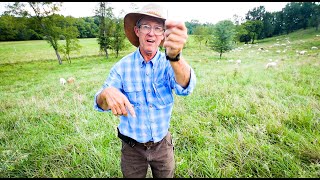
In this YouTube interview, host Justin Rhodes visits Greg and Jan Judy’s regenerative ranch to explore their sheep‑raising practices. The conversation covers a wide range of topics: the Judy’s farm history and growth from debt‑ridden beginnings to a multi‑farm operation; why they favor St. Croix sheep and avoid routine deworming; the detrimental effects of grain on hoof health and meat shelf‑life; how they use rotational grazing, canopy‑height grazing, and short rest periods to naturally control parasites; practical details on fencing, fence‑jump training, and moving flocks; observations on goats versus sheep; the role of giant ragweed as forage; and the Judy’s new YouTube channel that shares their regenerative methods. Throughout, the tone is informal, enthusiastic, and instructional, with a clear emphasis on low‑input, high‑output livestock management.
Chapters
Good morning!
Good morning.
What do we do first, Jonah?
Go check on Bayless. Go to breakfast, possibly the pit port. See monsters, grandma's possibly, the ICs, and the forest of pigs. Okay. And then, and then milk.
And then Ben and I will be here for a moment.
Yes.
So, all right, the boss has given me his orders, so that's what we're gonna do.
What is going on here? I have a question.
Yes?
Do you want to cook swell?
No, I don't think your fat pup wants to do that.
Okay, can you go get the pig bucket? Yes.
If nothing else, I'm enjoying the one-on-one time with the boys on the farm. Last time Josiah, this time Jonah. As I said, should we cook swell? Because he didn't have me cook swell when you weren't here, but I didn't know, so I asked him. He says you don't have to cook swell, just spoil them a little and give them 10 pounds of grain. Jonah said all that I'm here for is to boss and quality control, and I said, well, yeah, but also to spend time with him. Hey guys, you ready? You're looking bright-eyed. Free the birds! All right, now we're gonna free you guys. Pigs are fed and eating. Well, should we not leave that grain there? It'll be okay there. Should we put it— maybe we should put it underneath there. Let's put it under here just for right now.
Hustling.
Jonah said he don't need slow people, he needs people who hustle. I'm coming. Yes, boss.
Don't hit your head.
I won't.
Thanks, Liz.
Hey guys.
That one's huge. He's gonna get them.
Look at that one up on the thing.
I know, I saw.
What's she doing?
Oh, jump up there.
She needed some alone time.
Yeah.
Okay, out here at Grandma's posse. And Jonah just informed me that we are done, which is awesome. I gotta go check on Gideon. He was asleep. I was right. He's still asleep.
That's amazing.
And we woke up to that. That sunrise!
Also that sound.
What's the sound?
The sound of the city?
Do you like it or don't like it? Gotta take the farm on the road though. Swiss chard, eggs, sausage. Mmm.
Mmm, mmm, mmm. Avocado. Oh boy. I didn't think it would sit. This is cool! That's cool.
That's our hotel right there.
I see it right there.
See the shadow of the arch?
Yep, Papa. And I even see the room that we're staying in.
Oh cool.
630 feet in the air, man. Are you scared?
No.
What'd you think, Josiah? Even cooler the second time?
Uh, maybe. How was your first time up the arch, Grandma?
That was really exciting, and I love that the shadow of the arch was on the front lawn.
It was great.
On the road again, this time only 1 hour and 45 minutes. We knocked out it all yesterday, so we'll get checked in, relaxed. Yeah, you guys made it easy. Gonna go to Greg Judy's, guys. We're gonna see his epic sheep operation.
Okay, her udder is huge, y'all. Like, it's crazy. Like, it's huge. I'm gonna try to get a good look at her. Stud's kind of looking at me, which I don't really appreciate that. Holy moly, but she's still eating.
Hey girl!
Justin, it's huge! Wow, I'm gonna see if I can go in.
And we're with Greg, Judy, and Jan. Judy!
Yes!
I thought it was supposed to be hot here, Greg.
No, no, no, this is unusual. We usually have You know, when you get toward the 1st of September, you're looking at usually 100-degree temperatures.
No, no, this is nice.
And today it's, uh, 75, 78. It's not bad at all. So we're not going to complain about it.
No.
So these two—
are these the guys that sold to me?
There's, uh, some St. Croix rams in there and some Withers. Uh-huh. Uh, the Withers are actually about probably 3 or 4 months older than the rams.
Okay.
And, uh, so when you pick out your rams tomorrow, you want to make sure they have their working— all their working tools, you know.
Yes.
We had a guy come this morning, he said, I want that one, and he was getting a ram, you know. He picked it up, I'm like, he doesn't have much hardware down there. I don't think he's going to get your use.
You're helping him pick them out, huh? Yeah, I'm gonna have to trust you on that one, Greg. So these are the ones that are for sale?
They are.
Okay, you got any more for sale after I'm taking mine?
Oh yeah. Okay. Yeah, uh, you'll use, uh, the ewes are coming in in the morning. I've got a guy bringing them in. Okay, it'll be 135 ewes. Oh my Lord. Okay, so we'll make sure we put all the rams over here in this ram sorting pen. Okay. I sure don't want to booger up and get anything bred.
Can you share why you wouldn't want to feed a Sheep grain. A lot of— I mean, a lot— that's a shocker to a lot of people.
Uh, you just got to remember, when you feed a sheep grain, there's two things that happen. One is you're growing hoof. You better get your hoof trimmers out because grain grows horn and it grows hoof. And if you like trimming the feet on your sheep, feed them grain. That's what you're gonna have.
The only reason you don't do it.
And the other one is when you feed them grain, it makes the meat rot. So let me explain that. Yeah, when you get grain fat in a sheep, the mus— the intramuscular fat in sheep, or the marbling, and you get fat all through the meat, the shelf life on it just plummets. A New Zealand lamb, it's all natural, it's all grass-fed, and that you can put a chunk of that in your freezer and it'll be there for a year, no problem. Our sheep, the same way. But if you have a feedlot lamb And you butcher that dude, you better eat it because it's going to go rank on you probably 6 months. It just doesn't have the freezer life. Okay, so why would you do that other than, you know, the health benefits? Uh, grass-fed lamb's a lot healthier for you than grain-fed is. I had a pickup load of autumn olives.
Autumn olives.
I drug them in here and I threw them on the ground, and those sheep absolutely cleaned them up.
Yeah, they'll browse, won't they?
Oh man.
Are they as good as a goat?
Uh, no, because— well, I mean, let me repeat, they're a lot better than a goat. And a goat's a lot better. A goat's a lot better than a sheep. Now let me explain that. A goat, if you have more woody stuff, they'll climb up and get it. And they'll actually stand on each other's backs with their front feet to get up high enough to get it. And, uh, sheep, they won't stand on their hind legs. Goats will. Goats will graze on their hind legs so they can get higher, but the sheep— I don't think there's a goat out here that you can keep in with one hot wire. Now I may be wrong, but I haven't seen it. Somebody could prove me wrong, but my gosh, these sheep were keeping in with one hot wire.
So why did you go with the St. Croix?
I was St. Croix because I didn't want to worm sheep. I don't think worming sheep is sustainable.
Why not?
Because As you get older, time flies by. I got more things to do than some worm sheep.
You're all about valuing your time with things you want to do. So how did you find the sheep?
I found a neighbor that has stuck to his guns. It's a St. Croix. He never, uh, wormed them. He let them die.
Okay.
And the ones that died, of course, they didn't— they only die once. And, um, so the surviving sheep were the ones that he kept, and those are the ones he built his flock out of. And I was fortunate enough to get 7 ram lambs from him and some ewes, and that was our base of our small flock, and we just kind of built from there. But those rams, Jan and I isolated them. We turned them out, we gathered manure on them, we put them in a trailer, and then when they jump out, they poop. They poop. And we had ear tags on them, so we knew which one, which manure went with each ram. Took it to the vet And they, they put underneath the microscope and the vet called me up. He was hot. He goes, why'd you bring me? He said, I got more things to do than look at sheep that's been wormed. He said, you shouldn't have wormed these sheep before you brought the manure in. I'm like, sir, I didn't worm them. Yes, you did. He said, there's one that didn't have any. There was none. Wow. Not even 0.000, nothing. There was no—
that's unheard of.
There was nothing in there. He said, I've never ever seen that without worming. I said, I didn't worm them. For somebody that doesn't has a hectic schedule and is busy, or maybe they're getting older, they don't have the energy— sheep are your deal.
Really?
Oh my gosh. I told Jan after this last winter, I'm like, you know, we get older and don't want to fight the weather anymore, we just go all sheep.
Why are they so much easier than cows?
They'll feed themselves better than a cow will.
They'll eat more.
Their foot, they can push back snow. Cows, cows will take— cows will push their nose through it and eat. But a darn sheep has got a foot like a deer. They'll pull all the snow back and they can feed themselves. You can put sheep in woods in the wintertime and dry oak leaves and they'll come out there fat as a pig. You put a cow in there, she'll starve to death. This stuff right here, you just lock them in. If I lock sheep in this lane, they would clean all that stuff up. But we're moving our sheep fast and it doesn't happen. But sheep can make a living on stuff that cows can't. Okay. And so they're just a lot easier to, to manage. I was going to show you, these are all giant ragweeds in here. They're walking through. These are just the stems. Look at that, there's anything left.
So will that die?
No, it'll re— it'll revegetate. That's what I love about giant ragweed. Look, okay, look up here, look at all the stems.
So this, this weed is not a problem because Oh, it's a wonderful food.
Okay, it's not common ragweed, it's giant ragweed. There's a big difference.
See the stems over there?
Yeah, yeah, they're just— they just cleaned them. Okay, cleaned them.
Do you—
I'm looking at that, Justin. I'm gonna make an executive decision. We're gonna go move the sheep.
Oh, okay.
Yeah, if you look up through here, Justin, And you can see the graze line. Okay, this is— well, look at that, they just stripped that. Yeah, they're ready to move. So we're going to leave the rest of the posts in, and if y'all weren't here, I'm just go sheep, sheep, sheep, and they'd all come charging down this hill. Yeah, they're not going to do that with this group of people. No. So we're just going to reel it up, let them go through.
Look at that.
The closer you make your animals eat to the ground, the more parasites they're going to ingest.
Okay.
And so if you keep your animals grazing up here in the top part of the canopy, the parasites are not living on the tips of the plants. They're down here on the ground floor.
I heard 4 inches. Is that about right?
Yeah, because they're out of the sun. A parasite can't take sun on the body. It cooks him like that. So the people that are continuously grazing, not moving their animals, that's why they're That's why they got a worm. The animals are just loaded down with parasites. Tell them, Greg, how we went down to one wire. We didn't always have one.
No, two years ago you, you had three.
We had three. We had three, uh, starting out. The first one was actually a lot lower, it was right there. We had one here and we had one up here. Um, so we went with, uh, three wires for about three or four months. And the ones that got out, we ate. There would be one that would get out, we just eat him. Because if you go out there to get him, you don't know which one it is. It jumps back in the paddock. It'll run back. And so we'd just go out and we would process him on the pasture with a rifle, and he made a good eating experience. They'll train every sheep in here to be a fence jumper.
They'll train them.
Not only will they be a punk and repeat, they'll train them in Less than 7 days.
So that's why you do it so fast.
Quick.
Hey, Jan, some say Greg Judy's no-nonsense kind of guy. Is that true?
That's true.
That's true.
I've heard that more than once.
I'm gonna wonder when I'm gonna be shot.
You better keep those meals coming, Jan. Yeah.
So an animal actually eats with 5 mouths. You got 1, 2, 3, 4, 5. So when animals walk on forage and they've got manure and urine on their hoof and they're walking on the grass, they're not going to eat that grass. And so you can look out across your paddock, it looks like you've got a ton of grass out there. No, you don't. They've already fouled that. They need to be moved. And if you make them eat that grass that's been fouled, their animal performance is going to go down. They might start ingesting a few parasites. And the lower you graze that down, the longer it's going to take to grow back. So move them. I mean, this is just beautiful. Everything in here is recovered.
It's recovered its blade.
It's got a tip. Yep. If it looks like that when you come back, you came back too soon.
Did you?
It didn't grow back.
How long have y'all been doing this? Which, you, both of you farming like this?
Uh, Jan and I started in, um, I met Jan in 1997, and she helped me build all this up while we were dating. And we got married in 2001. So she stuck with me all that time, and we started with basically no farms and no money, and I thought my farm was history because I was tied up in court in a divorce settlement. And I was in debt and I'm like, no, that's perfect. And so I figured everything was gone. But yeah, I had a good attitude about it. I met a very good woman and Jan would come out and help me work on weekends and we started leasing land and running other people's cattle. And within 3 years we were out of debt. We had 8 farms. Leased. We paid off our other farms and we started owning our own cattle. And today we don't custom graze anybody's livestock. We own all of our own livestock.
Okay.
And I was able to quit my job in 2009, which is a goal of mine. And today we have 16 farms.
Congratulations.
And we own 4 of those farms. So yeah, I tell people when the animals generate enough money to buy another farm, they'll the animals buy the next farm for us.
What's your retirement plan?
Uh, this. I like doing this. Heck, if I stopped doing this, I'd probably be in the ground. All right. If you enjoy what you're doing, why would you— why do you want to quit? I mean, true. Sit around and get fat.
I had a bad experience with my first sheep, Greg.
Yes, you were telling me.
And talking with— go ahead.
No, go ahead.
Talking with you, I think I had two problems. One, I was getting them from a conventional chemicalized farm, and I didn't want to opt to do that, right? So these were maybe dependent on it, or, you know, bred even though they needed that to survive, right? And then I think I was coming back too quick, perhaps.
Absolutely.
Hitting it before it could recover.
Just remember, the best medicine you can give a sheep is what you and I just moved into. Is a fresh pasture. This has all been cleaned off. There hadn't been any sheep on here for 8 weeks. The sun has cleaned up the ground. There's no parasites in here. And so if a sheep is packing a few parasites and you put them on clean ground, they can shed those parasites. And if you move them, they're leaving the parasites behind them. They're not building up in the body of the sheep. This is our lifetime lease farm, and when I got this farm— Jan and I got it in 1999. It was all broomsedge. Broomsedge, cedars, and moss. The side of that hill was solid moss. There was no grass on it. And I'm like, man, I'll never get grass on that. But I have. But with good grazing management where you're tramping the stuff on the ground, feeding the soil microbes, good rest periods in between your grazings, and then in the wintertime buying purchased hay and feeding it out on the land, this is what This is what happens. I mean, there's a lot of money at our feet right here. I mean, there's a lot of gain out here. You can put a lot of fat on the animals with this type of grass. And that's what it's about. Stay focused on the grass. The buildings, the equipment, all this other hubbub, it's all just noise. This is where the money's at. It's in the forage.
It's— yeah.
So I think people overcomplicate it.
Yes. Well, I think what you're gonna— you're doing is gonna be more and more valuable in the future. You're developing an animal that is hardy on, on its own natural landscape, making the landscape better than it was.
Yeah.
So we appreciate you in doing that hard work of culling and— yeah, breeding the strong.
Thank you. Yes. It's been an adventure, you know. It's just a— it's a journey.
Yeah.
And we're still learning. And about time we think we've got it figured out, Mother Nature throws us a curveball, you know. So you've always got to be flexible.
She won't let you be too proud, will she?
No.
Good to see you again, Jan. Nice seeing you.
Yep.
Greg, thank you. It's a pleasure as always.
You bet. You bet.
Sorry, I wish we didn't get rained out. We would talk more.
But nice to meet you. You bet.
Tomorrow, how early can What time can we come?
Uh, you can be here at 6:30 in the morning.
It's light, we'll be here, we're going to haul them home tomorrow. Less stress, get them home as soon as possible.
Absolutely.
Now, people want more you. This— I got some good news, he's launched a YouTube channel. 5 days a week too. Yeah, you don't just— when he goes, he goes all out, doesn't he? Yeah, not just once a week, every day. 5 days, as if you weren't busy enough, right? Yeah, check out his YouTube channel, Wealth of of information. I'm going to check it out. I'm going to subscribe. I didn't know about this, so I'm going to be having to check it out.
Yeah, you need to hit that subscribe button.
Yeah, we'll go get you some. So this is what my folks love to do. How many subscribers do you have?
We started out in January, had about 20. We've got 4,200.
4,200. What's the name of the YouTube channel?
Greg Judy Regenerative Ranch.
Okay, I'm gonna link it and I'll put a card in the end of the video. Let's get you to 6 6 or 7,000.
Yeah, absolutely.
Okay, sounds good. If you guys are feeling real sussy, we'll get them up to 10. All right, go show them some love. All right, thank you guys. See you tomorrow.
Yeah, see you tomorrow.
More from Justin






If I had to start my Homestead all over again, it could only pick one animal… 




