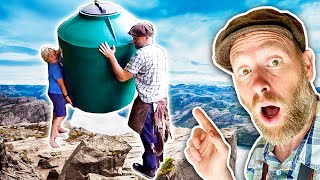
In this segment of the video, Victor Justin Rhodes (Speaker A) and Eric walk through the hands‑on construction of a gravity‑fed water catchment system for livestock on a mountainside. They start by noting a problem with snow accumulating in a walk‑in freezer, then shift focus to building a weir‑style catchment framed with wood and screened to keep debris out. Using an IBC tote as the collection bin, they drill and scrape holes, install stainless‑steel bolts, and anchor the structure into rock with tap‑cons and hydraulic cement that sets in minutes. They discuss moving a 225‑gallon tank up the mountain, positioning the spring box, and routing hoses along the contour to deliver water to pig troughs, using an OnX app for elevation planning. Throughout, they improvise solutions—cutting plastic with a saw, sealing cracks, and adjusting hose layout—while balancing farm chores like milking. The dialogue is conversational and instructional, highlighting low‑cost DIY methods (≈$10‑$15) versus commercial options (~$1,500) and emphasizing practical problem‑solving in a remote, rugged environment.
Chapters
Kids camped out last night. How was it, my man?
Good. No, it was so hard.
The boys are telling me there's snow in the walk-in freezer. That's not good. Holy moly, it is minus 27. Holy smokes, that can't be good because that's gonna build up and accumulate. Hey, good morning, Eric. What do we got here this morning?
Well, this is gonna be your stream water catchment system. So what it's going to be, we're going to frame it with wood, put screen on top of it.
Nice.
The sticks, debris, all that stuff will then just run right off the screen.
I like it.
Without being caught up. And we'll figure out how we can go all the way to this if we have to, but this right here gets clogged up with dirt.
Yeah, it's too fine, huh?
Yeah, it's awful fine.
Did you make this up yourself, Eric, or did you learn this somewhere?
My channel is based more on DIY. You can buy this for about $1,500.
Okay.
Or you can build it for about $10 or $15.
Now fine mesh over.
Fine mesh over.
And the water will just wash, theoretically wash the stuff.
Well, basically it'll be like this and it'll be coming down.
So what is this thing called?
A weir. A weir? It's called a weir.
Okay.
We'll drill holes just over top of the bin in here.
How you gonna get this thing through the rock?
If we have to, we'll drill it and put stainless steel bolts in.
Oh, okay. And we're gonna put holes in this. This is the IBC tote bottom, and, uh, the water will flow over and drip down through into here. And this is just a felt. It's just extra security. We have drilled holes, we're scraping the extra plastic, and that's ready You ready to hike the mountain?
Pretty much.
I gotta go milk, so we'll catch back up in an hour. We have a very interesting problem this morning. I go to milk and there's nothing in this. She's barely got any milk. Sure, I squirted a few, but there's nothing. Well, the good news is milking's cut short and we can get back to this water project. 225-gallon tank, Jesse. We made it to the top of the mountain once again. We've got the top of our line there. Eric's looking for a place for the spring box and the tank.
We move it down here, we anchor the collection thing here, down here where my feet are, put the plastic up to here and catch all this right here. Because at low level like it is right now, it's going to naturally flow through that lower hole. Yeah, so we'll capture all of that.
I gotta go down to PT. We're gonna leave our tank here. Eric's gonna be working on the water collection.
Uh, we'll be back.
It's the big boy, 62 pounds. We've had our training, we've had our lunch. Let's go see what's going on. Just hiked up the mountain, third time today. Looks like he's got his trough in, hasn't connected it yet, but he's got his trough raring to go. Taking a water sample. What are you gonna do, cut it to fit?
Well, I'll cut some of that off so it comes up in here a little bit more, and then I don't see—
well, the Leatherman's not going to work for cutting that plastic. We're gonna have to go down and get us a saw. All right, let's climb this mountain again. That's all going to do it, huh? Oh yeah.
While you were gone, we screwed this block of wood in here. It's screwed into the drum here, and what we're going to do is drill and put tapcons in here and screw it right into the rock. That allows us to do— screw this fitting direct into it. Hydraulic cement, and it says it sets up in 3 to 5 minutes, and they ain't kidding.
It'll stick to that plastic too, huh? Yep. Well, that flowing water is putting a wrench in our buckets. Gonna come out tomorrow, put more hydraulic on it, dam that up a little bit better, stop that flow for a second. That's gonna hold, huh?
Well, everything but that one little crack right there.
You're already overflowing, my man. Coming out? Yep, you're already coming out. You did good. Now it's getting crazy. Taking this red tape and trying to go parallel on the top line here. All the way over to the pigs. I've got my OnX app showing me the contour. This is crazy. It's insane. Look at this rock though. Definitely gonna have to go to the right of this rock, drop some elevation. So we're gonna stay contour as best we can, and if we have to go veer. We're going to veer downhill. Put down my last red mark. You see where we are? See the pig stuff down there? Now we're going to need to straighten out the hoses and drag them up through there. We're going to get water to these pigs before they leave. I mean, it's going to be just before they leave. They leave in a week, but still, there'll be animals behind them.