He Grows Fruit 8X more Nutrient Dense
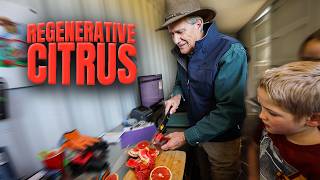
A farmer grows citrus eight times more nutrient-dense than conventional fruit by feeding soil microbes every two weeks with compost tea, kelp, and fish hydrolysate. Lab tests show organic matter nearly doubled and fungal diversity surged. He sells direct-to-consumer and donates to food banks.
Chapters
We are at a regenerative citrus farm. Yes. Okay, before now I didn't even know that existed. So I may be the only one.
Really?
There may be a couple.
You're pioneering this?
Uh, yeah, it really is.
So what is a regenerative citrus farm?
So I'm growing citrus, it's certified organic, so that's a lot of focus on what we don't do. Regenerative, I'm rebuilding the whole ecosystem in the soil, so just like you do with animal manure, I do by adding microbes and feeding them. And so I've got a complete transformation of the soil. And it grows a healthy tree, and I've had the fruit analyzed, and it's 8 times more nutrient dense.
Wow.
Went to conventional growers, picked their same fruit, same variety, same day, squeezed it and sent it to a lab, 8 times more nutritious.
Than organic or conventional?
Than conventional.
But you go even beyond organic?
It is beyond organic because the whole life in the soil is completely transforming the tree.
So that's not required in organic certification? Nothing about the soil?
No, but the soil obviously would improve with organic. But I really focus— actually fertilize every 2 weeks, I fertilize the tree and And then I feed the microbes. I see. And the tree, and then the microbes. So that's all seasonal.
Okay.
Yeah.
Well, you might show us some specifics of how you do that in a minute, but what is this ice for those that don't know?
So last, last night it got to 27 degrees.
Whoa.
And it— that'll kill a citrus tree. And so we turn on every tree.
It'll kill the whole tree, not just the fruit?
Um, it'll— these are honeybells— it'll burn them back and If it got down to 20 or in the— so every tree has a, has a microjet sprinkler.
Okay.
And the well water is 65 degrees, so I come out at midnight or whenever it's gonna start to freeze and get the water going on every single tree. So I've got to have a, a big well.
You get— and And then did every, did every tree work? Did every tree survive this? Yeah. So everyone worked? So before the storm came, or the wind cold came, did you come out and check every—
check— came in, checked everyone?
Yeah. How many were not working?
Uh, just this last time, about 10.
And they're easily fixed?
Been— yeah, you take either— you take the little green nozzle out. Yeah, that got clogged up.
Okay.
Or you replace the whole thing. You know, a mouse might eat— here's right here. Might eat the—
So you got to tell me, is this kale growing in here? Do you have to— I do. Do you have intentional undercrop here?
I do, yeah. So I plant 10 species of COVID crop in the spring and then another different 10 in the fall. So right now it's daikon radish, kale, turnips, 3 kinds of— that's a great root system. So this is—
and what's the purpose of all the different ones?
Yeah, so every, every one feeds— really grab that feeds the microbes differently.
How far do you get— let it get wild before you cut it?
It'll go— I let it go all the way.
Oh really, all the way to maturity?
In March, it'll— the whole grove will be 2 feet high.
It's— wow.
I got 3 kinds of clover, Austrian winter pea.
I'm wondering if you could have some sheep come through, or would they eat your citrus trees?
They probably would would be rough on the tree.
They totally eat a persimmon tree. I found out that the hard way.
You know, a lamb tractor, just like you do chickens. Yeah, you could— would work. I don't quite have the energy.
Yeah.
All right, Ben, I don't live on the farm, so, you know, that would be— okay, that would be an every—
yeah. So did you see Permaculture Orchard? Have you seen that? He does the same thing but with fruit trees, or— well, apples.
Yeah, it's, it's, it's very similar. Yeah, what I'm, what I'm doing.
Where'd you learn this?
My whole career has been in agriculture, but it was traditional agriculture. I worked for the ag chem industry, and this daikon radish will get this big by—
And what's the purpose for the radish in the soil? So what does it do?
It's every plant, all the COVID crops, about 40% of their sugars and nutrition, they excrete it back into the soil and It's God's design to feed the microbes, which in turn dissolve the minerals and feed the tree. So I'm just bringing back the original, the original system.
So when this is done growing, then how do you replant it, or do you not?
I will in March and April. I'll begin mowing it and roll it all over into the tree and have a layer of mulch about that deep. Yeah, so that'll be That'll be fertilizer for the tree and it'll feed the microbes.
And then do you plant more?
Then I plant more, yeah. So then in the springtime, in April.
And how do you plant it?
In the winter?
With the grass here.
In the winter I just throw it.
Oh, okay.
In the summertime I haven't had much luck with that, so I've last year got a no-till drill.
Oh.
And put the COVID crop seed, but I can't get up close to the tree.
Can we see that drill later?
It's not here.
I rented one. Oh, okay, you rent it. And when you mow, are you using a scythe or are you mowing with a machine?
I do, to get up close to the tree, I use a scythe.
Do you really?
Yeah, I really do.
You have that here? Yeah. Can you demo that?
I sure could. This is daikon radish. I mean, they're delicious. Chefs in Atlanta use them in dishes.
And you're just using it solely for, uh, cover crop?
Yeah, because a lot of my nutrition I pump through the irrigation. Those little emitters come out 6 feet. Everywhere the ice is, that was water last night.
Okay.
We thought about putting a strip, maybe some, uh, just ground cloth, and then planting some vegetables in here. In the summertime, you know, something unique. Cantaloupe or little baby watermelons just to give us a summer crop.
But up until now you haven't done a second crop?
No, other than this, the COVID crop.
Okay.
Even daikon radish and kale would.
This is much more beautiful than the typical orchard where you come in and the bare— the ground is just absolutely bare underneath.
Oh, it's terrible.
I did these trees.
I did a research trial and I left treatment, bare ground, you know, sprayed Roundup, the whole thing. And, and then I did DNA analysis on the soil, and you could actually see what was in the soil dying off. And I've got a— wow— some little information that kind of visualizes that. But it's, it's incredible. So the organic matter has increased 1%. Here from 1% to almost 2%, which doesn't sound like a lot, but it's, it's huge. That completely changes what grows here and the nutrient levels and how well it's going to do. These were honeybell trees last winter. They're real sensitive to the cold. They froze back to about this far, and I've got about 100 of them. And I thought, well, I'm going to have to just pull them up with a tractor. They're, they're probably almost dead. And then I decided, no, I'll just— I'll leave them. And I pruned them back real hard, and they're so healthy, they completely came back and they bloomed. And I picked about 400 pounds of fruit off of them, which is— I couldn't even believe it, that they came back enough to bloom, fruit, and, and be harvested. So this, all this growth is just one season.
There wasn't anything here.
So that's, that's how healthy the, the trees are by, by growing in this way.
What do citrus farmers typically struggle with the most?
So Florida, the whole industry has almost been destroyed by a new disease called HLB or greening. It's carried by a tiny little insect, and we don't have this insect in South Georgia. Oh, it hasn't come up here. I We think the cold. And so we haven't had the disease yet. It showed up a couple of farms. Yeah, we don't know why. The insect may have been brought.
So are we going to lose citrus in Florida?
80% of it's gone almost. They've closed 200 packing houses. There's only like 8 left.
Are we going to lose them all?
They're fighting so hard to stay. I really think that the health of the tree would make a significant difference. That this, if it gets here, that insect could move further north. If it comes, I'm optimistic that my trees are— wow, these trees are 3 and a half years old. Um, if I grew them conventionally, they'd actually be bigger. Okay, it's, it's forced growth. I call it hollow growth. Hollow growth and hollow fruit.
We might find some ripe fruit here pretty soon.
Oh, it's all ripe.
Um, oh, it is?
Oh yeah, yeah. What's left on the tree— grapefruit's interesting. It will stay, it'll hold on the tree all the way through April. So from November to April, a lot of varieties, and be okay when they're ripe.
Oh yeah, yeah.
This tree had a scale insect about 15 trees. I don't know. Got this.
You like grapefruit?
Oh gosh, I love it.
So you like a bitter fruit?
Just— I've just learned because mine out here, the flavors—
how do you eat it?
Unbelievable. Um, I do it differently. I completely skin it and then I, with a knife, scoop out all the plugs.
Okay, we'll have to do that later, huh?
I eat 2 whole grapefruits.
You're gonna show us how you do it later? Yeah. That's all you eat for breakfast?
That and a bowl of cereal with blueberries, with, uh, blackberries on top.
And then what do you eat for lunch?
Peanut butter and bacon sandwich.
Okay, so you hit your citrus early in the morning? Yeah, for breakfast. Well, then you're good.
To be honest, I eat it all day, and then I'll have a Shiranui, which is— they're unbelievable.
So what is your biggest struggle then?
The biggest struggle is doing it organic and regenerative. The trees are so much slower to grow. So I've got some varieties that still are real small. Instead of conventionally where you just throw the fertilizer at it, it's bare ground, it soaks it all up, and this tree is pushed and gets big. So I'm behind conventional.
I finally see a hole. There's your organic stamp of approval.
Yeah, that was probably a grasshopper.
How do you fend off anything like that? Do you have to?
No, I don't. So you asked my biggest challenge. It's leaf miner. There's a— this is an insect. It tunnels in the leaf. You know, conventionally it's easy. They inject something through the drip and it controls it, the insecticide. But I can't do that. And the organic things, insecticides that are approved, that are safe, neem oil, and they're not near as effective. So I lose a lot of my—
You just take a loss?
Yeah.
Don't even put anything on it?
Well, no, I continue to spray all the organic stuff.
Oh, you do?
It's just about half as effective.
Okay, and you still lose?
If you slip, yeah, so I lost production on that.
Okay, so can you do this? Do you recommend this kind of COVID cropping? As opposed to mulching wood chips? If somebody were on a small-scale homestead scale?
Wood chips wouldn't do much, but if they could do compost— see, you're trying to get the microbes. Now, your wood chips, after they've been soaked with manure, if they were allowed to compost, you're building up all that microbial life.
I see. So you're doing the COVID crops for the microbial life?
That's right. They feed the microbes.
Do the same ones work for apple trees, pear trees?
Absolutely.
So which ones do you recommend? So if somebody wants to have 10 trees?
Yeah, so it's whatever would grow in their area. So in the wintertime, hairy vetch is incredible.
Yeah.
Clovers, kale, turnip, daikon radish. And then I've got some grasses. I've got black oats and cereal ryegrass in my mix, and it'll, it'll all—
Yeah, so this is interesting because we've been wood chipping our, uh, fruit trees just to keep the, the grass from just overtaking it and choking it. They're young. That makes me wonder if we should rethink and do this.
And actually, I agree with that. Right around the tree. They don't need the competition.
Okay.
Uh, initially, and that's probably at first.
Yeah, these are more mature.
I learned that.
Okay, well then we're doing the right thing.
Um, but you could plant out because these roots— yeah, these roots come all the way out to here. So you could do, uh, yeah, I think other crops all around.
I like this. And then when the trees are even higher where the sheep aren't going to get the bottom, planting this, because sheep would probably—
the sheep would love to eat this stuff. I know, even chickens or ducks would. Yeah, would kind of be a great mower.
And if you did geese, you wouldn't even have to feed them. No, you could— this, this could be all they need.
Would, would they mess with the trees? Geese?
I don't think they would. Do you guys think they would mess with the trees? I don't think they would. A chicken would mess with the tree, perhaps. Would rabbits?
My thing is, would I need to fence? I guess I'd have to fence in the hole.
But see, good— well, no, because then the goose— if you fence in the whole thing, the problem is the goose is going to have a favorite place, so you're going to have to rotate them.
You got to rotate.
Yeah, but you could keep them in a net, uh, an electric net, right? And move that once a week.
It'd be neat to have something that would clean out around the tree, but there's not much of a market in America for geese anymore.
But I mean, you could do it for bug control and just to weigh them out and just for— and you could eat a Christmas goose and a—
right. The, the COVID crop is going to grow up over that sprinkler, and so in a month that's going to start to be a problem. Yeah. And I'm going to be out here with the scythe or— yeah, weed eater, just, just keeping it— yeah, keeping it open.
So yeah, that's it. Yeah, I like geese or ducks because geese, they don't, they, they don't scratch, so they won't till. I see you're trying to stay away from tilling.
The fungal growth in the soil— bacteria feed fungi, and then fungi transport the nutrients to the tree. And if you till, that's what breaks up.
Okay.
Especially, they call it mycorrhizal fungi. Yeah, I inoculate with it, but it's, it's hard to get. Yeah.
And you know what, for you and living off farm too, you don't want to get ducks either because there's— they're so messy, you know. You're gonna have a hard time keeping their water up and clean. But goose, they're going to be your least maintenance.
A chicken house with auto-opening doors, would they, would they come back in every night on their own?
Uh, yeah. And well, they wouldn't necessarily have to either though.
Well, I'd worry about predators. Well, you would have—
that's— you're gonna have this net and you're going to have this electric net, right?
Will that keep things out? Yes.
And geese themselves are guards. That's why we have geese, to protect the chickens from these things, because they squawk and carry on, and the predators don't like the drama.
But would the chickens leave the site if I just move the house around? Would they stay within? No. And go back—
the problems with chickens, you need to put them in a net, because on this small of a scale, they're gonna have a favorite spot. That's going to be their favorite tree, and they're going to always go there. And all the poop and all the scratching and all the eating is there, and they're not gonna go spread the love. This is cool.
You will see.
I've got— these are all so much warmer. Yeah. Okay, so why, why are the limes in the greenhouse? You know, I know nothing about citrus.
Yeah, so limes would—
this cold last night would have killed, okay, these lime trees, even if you wet them. Even if you put the ice on them? Okay.
Yeah, so, so they're in the greenhouse.
Oh, look, my foggy— I'm fogging up.
Oh, I bet.
Timeout.
So the limes are already blooming. That's the bloom. Beautiful. It's purple. And then these are little limes already growing.
Are limes natural, or did we make limes? No, they were natural with mixing things.
So this is—
didn't Austin tell us limes were— or is that lemons?
Lemon. We breed them, we do. We cross them.
Like, uh, is that a lime or a lemon?
Well, this lime is a Rangpur, which is a, a lime bred with a mandarin orange. It's an incredible flavor. All right, this one is a kefir, and it's, it's really grown not for the lime. It's not even really edible. It's the leaf. It's a double leaf. And it's used in Thai cooking.
Okay.
So I had an offer from New York City. A guy needed 20 pounds of leaves per week. That was his market, which I don't even have enough trees that, you know, that would strip. But it's, it's neat. There's a— it's got a— it's incredible.
It's a wonderful Flavor tastes like paper. He doesn't need 20 pounds a week. You're not gonna put in an order, competing order? What do you use limes for?
I put them in everything I drink. These ram pores, oh my goodness. Um, put it in iced tea.
Okay, we got ram pores later.
Um, they are done for the season. Okay, they are There's not any left.
Ben, you like them? I do. What do you do with them?
Uh, I put them in my tea. Yeah, they're good.
Your sweet tea?
Sweet tea. Everything we drink.
Y'all from Georgia?
From Georgia.
Yeah, I'm from Florida, actually.
Well, you do like sweet tea, or do you like iced tea? Love it. No, without sweetener. Sweet tea. It's gotta be sweet. Okay, well then at least you're Southern.
This is interesting, Justin. This was a research trial.
Oh, one piece is not organic.
So, right, so this was the conventional I was talking about. All right, this had, this had Roundup and a handful of fertilizer and a bunch of pesticides.
Okay.
And the other part is organic and regenerative.
Okay.
And you see, it's just— so this is after 3 and a half years. These—
oh wait, so this whole section is— yeah, not organic.
That's right. Okay, so the next 2 rows and then It's a replicated trial, so then I did the same thing 3 more times, again and again, to get data.
But you still did the COVID crop? Well, are you bringing it back now?
I'm bringing it back.
Okay.
I tried— I'm now certified organic, so this is not, and I can't even sell this fruit as my crop.
Is it? Yeah. Was it hard to get certified organic?
I mean, for 3 years I couldn't put any chemical, even little things. Can't control fire ants with what you know works. Can't use Amdro, can't use wasp spray to kill wasp nests. This is a sheer—
are we about to open that? Is that what you're doing?
Yeah.
Here, boys, let's try this. Is this an orange?
This is a mandarin. In California, they've named them Sumo.
What's the difference between a mandarin and an orange?
Mandarin is, uh, easier to peel.
So is orange—
is, is tangier.
Florida having problems with everything then? The orange, everything, the lime, citrus, all citrus, all the citrus.
So we're gonna get you guys' opinion. This is the most unbelievable I'll wait to hear what you said.
Oh, it's clean. Is it? So you've never had such nutrient-dense citrus, I'm sure.
It's soaked.
It's like you can feel the nutrients going to you.
You just see your body just—
yeah, you could almost eat this as a dessert.
It's a tart-sweet combination.
What do you eat for breakfast?
I don't really ever eat breakfast.
Okay.
I eat about one.
That's the new, the new way.
I had a banana today though. That was good. I've been eating like 4 Sharonnus every day.
For what?
For Sharonnus.
Oh, these?
Yeah.
Why so many?
I don't know.
Well, for us they're free.
They're not free for him, they're free for us.
You only have them from now till when?
These are really done.
So, so November 15th, not have them.
November 15th till the end of January.
So that's it. So you got to eat it. Yeah, that's the way that we're supposed to eat fruit, I think.
I think so.
Gorge on it when it's in and be done for the rest of the year.
Well, we were, we were farm sitting.
They went out of town. We were farm sitting all last week. Yeah, so we're out here, well, turning on the irrigation at midnight and eating them 3 or 4 cherries.
Yeah, that's, that's the bonus for being the farm sitter.
Hey, we got more inside the, uh, it's actually USDA certified package. It's a shipping container.
Yeah, so it has to be dedicated. Yeah, look at this.
So this is the last of the Shiranui. So I got a, I got a customer for them and I'm going to deliver them on, on Monday.
Where's your customer?
Um, close to Columbus, Georgia.
And how did you find them?
We actually searched organic markets and all over Georgia. And we're trying to find 3 or 4 together in the same place.
Okay.
And then this is what happened. We were afraid of the freeze. 26 degrees for 4 hours will freeze fruit.
Okay.
And then it's ruined. Then all you can do is juice it. So we came in over last weekend and we picked all the rest of the grapes.
Really? So you, you were telling me earlier y'all picked 3,000 pounds of fruit. We did, before the cold came.
And we did in one day.
So Ben, was you helping him with that?
Yeah, we're out here a lot.
Did you get sore?
Do I—
did you get injured? No.
I got 4 different kinds.
Flame is a red, and then Pink Frost, and then I've got Ruby Red and Okay, are you going to be able to get offload these before they go spoiled?
I sure hope so.
Okay.
Yeah, um, I'm taking tomorrow, I'm taking about 100 pounds to a, uh, food bank.
Okay.
And I'll take 100 pounds every week to the food bank.
And that's what will happen if, if you, if you don't sell it all?
Yeah, if it, if, if I don't, I'll, I'll take it all.
Tell me about these boxes. You sold these And, and you got a computer out here. How you getting internet out here?
So yeah, I've got, uh, I've got a little Wi-Fi.
Okay, you've got a little hotspot.
These are my standing grapefruit orders.
Nice.
So I've got— but most of them—
so using Shopify—
Michigan, Ohio, Colorado, Tennessee, Utah.
Oh, you're shipping all the way to Colorado?
Yeah, so they're in the middle of a cold snap, I don't want the fruit to freeze on the UPS truck.
That's right. So I've—
I just emailed everybody and said, hey, as soon as the weather passes, I'll ship all the fruit out. Look at this. So this is—
this is custom touch, man.
So you're watching other people's weather. So these are the last of our lemons.
You don't get that when they're getting from the grocery store.
These are Meyer lemons.
Was everybody okay with you delaying?
Yeah.
Oh, everybody's fine. So, so this is what you sent me. That's how we found out about you. Yeah.
So this is, this is our box.
Are you sending a CSA share? Is that what this is? Or people are just ordering?
They're just ordering online. They find me online and it's squeezed citrus. Okay. And this is my whole concept, is the microbes in the soil on the roots.
Yeah.
It's nutrient-dense.
So people are also finding you with Google search?
They are, yeah. About half of my sales just organically come in, people looking for organic citrus. I mean, it's just, they naturally find me.
And they want to buy directly from the farmer instead of going to the store?
That way they can be confident that what's in it. I mean, I have—
Well, now you know, even Whole Foods is putting a pill on organic. Produce. And so you—
I don't—
people are having to go beyond Whole Foods, and I'm not big enough.
Yeah, they are. I mean, if really to get the best food, people should go to a farmer's market.
Yeah.
And get it from the farmer.
Okay.
And it's going to be regenerative. At the farmer's market, it's not just organic, it's, it's almost all of it would be regenerative.
Yeah, it would be What makes it regenerative?
If the, if the soil is being brought back to life, to me that's, that's the bottom line. That makes it—
soil's getting better. It is, yeah, because of what you're doing, I would say, as opposed to getting worse.
Yeah, constantly better and better.
Yeah. They go to squeeze.com, squeeze citrus, squeezecitrus.com. Yep, powered by Shopify. I see. Yeah, that's a slick way to do it, isn't it? Yeah, we use Shopify.
Let me pop open one of these grapefruits.
Oh, what's up with this? You draw these?
No, this is the Georgia Department of Ag. These are their safety guidelines. So anybody—
so don't pick one up that's falling on the ground.
Don't pick it on the ground. If you pet your dog, you got to go wash your hands. Okay. And here's how you wash your hands. Of course we need to know that. So that's my— that's a flame grapefruit.
He's going to show us how. Hey, anybody want a grapefruit?
Yeah, grab me, grab me one out of the end.
I like how you jump to it, Justin. You miss the farm already, don't you? No, it's only been one day. No, they need to break.
Here's how I do it, Justin. I don't think anybody else Does it like this?
Where'd you learn how to do it?
I just— I made this up.
I guess if you have all-you-can-eat grapefruit for 3 months, that's right, you figure out how to do it.
So this is what I do every morning. I do 2 of these, and that is pure.
Do you put honey on it or anything?
No, it doesn't need anything.
Just learn how to cut one up, Beck.
Now this—
she, she, she, she'll do that and then spoon it all the way around, cut, cut along this cut, and then put a little honey on it. Scoop it up.
And everybody does.
And that's the way— that's the right way.
I just do it this way, and then I get a whole bowl full of just plugs, and it's, it's just faster.
Yeah, go ahead, go ahead.
My kids don't—
why, you don't like it?
I'll try it.
Come on, you like better fruit.
I was telling Lane, I was like, just put some honey on it. Mm, so good.
Yeah, she knows about that.
Mm, so good.
You eat some.
Can you feel the density?
I can. Penetrating my soul.
Which variety is that?
The Rios?
Somebody wrote me last week and they said, my whole house has the flu, so we're eating all your fruit again. You know, it's just— I had it analyzed and it's 8 times more nutritious than conventional food. Wow.
So is that because of the practices you're doing to make it the way it is?
Yeah, it's all— to be honest, it's all the microbes in the soil. So I— the COVID crops feed them, and then I feed them. I actually add— inoculate with microbes constantly, probably 4 or 5 times a year, um, to build it up. And then hopefully it'll be self-sustaining eventually.
Yeah, animal manures would add to that too. It feels like a or something?
Any, any manure, especially ruminant manure, it's already got the microbes in it. Oh, you know, ruminant manure, it has like a trillion different species. It's just, um, that would be incredible on the soil. I would love to have a little sheep tractor, you know, lamb tractor or something to be able to—
well, there's a chick— there was a chicken tractor for sale down the road and I called down, I was like, hey, there's this chicken tractor down here.
And my wife—
Justin says this is a good idea. Yeah.
And my wife said, uh-uh.
I heard my mom in the background, we're not getting any chickens.
Have you seen my mobile metal pen? Oh yeah, the chickens or sheep in every once in a while. Yeah, you could make one that's the size of your aisles. Yeah. Um, do you come here every day? You have to come here every day.
I just— just— yeah, I do.
All you'd have to do is come every day and move it once. Course, you'd need more than one to keep up with your mowing. All right, well, what else you want to do?
Is that it? I'll show you. Oh, we want to show you real quick the irrigation and then the— okay, the little shed where I—
okay. And then we're gonna have a grand finale of the site.
So just to keep the trees alive, I wouldn't need much water, but for irrig— for freeze protection, I've got to have 300 gallons a minute. So I've got a 6-inch well. I mix my fertility It's just a little electric pump and it injects.
So that's how you—
and so I put it in and it broke it up.
Who built this?
Irrigation systems.
You built this system?
An irrigation company.
Okay.
One company drilled the well, one put in irrigation, and then I designed and built the injection.
What do you put in the injection?
Um, seaweed. Kelp, fish hydrolysate, which is fermented fish, and then any of the minerals that are needed. I buy an organic source— copper, iron, zinc, molybdenum, manganese— and I, I mix them all up separately, and I test the trees to see which— what's needed. It's It's probably a little more complicated than it needs to be. And somebody on a homeowner basis, they could buy a simple organic fertilizer and accomplish most of that.
Yeah, so they can make a compost tea too and spray it.
Oh yeah, and that's compost tea is down those— the totes are compost tea brewers. Okay.
Oh, okay.
Yeah, so I brew my own.
Okay.
I'm not very good at it, but I'm learning. The barrel back in the back is all fish hydrolysate. So I just put out a gallon or two a week, and that's, that's where it's getting that nutrients.
And this is just your barn?
It's just my barn, yeah. Okay, it's the whole thing. This is all the fertility: copper, iron, zinc, manganese, humic acid, silicon.
Why don't you just stick with your conventional background?
I just believe that our food is not— when I found out, I mean, Planting the Grove, I thought I would grow it organically. I was thinking for economic reasons, and then I started reading all the research, which a lot of it is brand new, and that we have destroyed everything I'd been doing in my career developing new pesticides. It was destroying everything that was in the soil, and that along with the synthetic fertilizers and tillage, and we've pretty well wiped out all the life in our soil, and our food doesn't have, you know, it's not even nutritious anymore. And now we have a health crisis. And so I'm really determined to try to, just like I learned how to do research and document everything, I'm trying to document how I'm growing Citrus better, and then having it analyzed was— I was hoping for 50% improvement, maybe 100%, and it was 8 times more. 800% more nutritious. So, wow. When I do something, I mean, I, um, I make compost tea and then I look at it on the microscope to see if it's alive and see what's going on, and kind of rank. And then I tried different recipes to try to get it. And then when I go out about every couple of months and take leaves off the tree and I get the analysis back and it tells me that, hey, I'm real deficient in silica and zinc and manganese. And so then I grab that.
Okay.
These are all deficiencies. So I know the tree is suffering by not having those. So trying to get it exactly the right nutrition is what my goal is.
What's the soil doing right now in the winter? Does it chill out?
Yeah, it does. But to be honest, I keep, I keep feeding the microbes. I mean, all this irrigation to control the— is probably tough on them, but after this settles down, I'll go back in. And feed the microbes. So it'll be, uh, you know, okay, seaweed, fish, some molasses. It's one of the absolute best things. Some people just put out sugar. They'll mix up sugar in the, in the tank, and then they'll feed the microbes.
Wow.
So, and I've got a— actually have a picture of what the sample that I took. This is what I took a year ago. I went to another grove Same day. These are Page mandarins. These are mine. And this is the conventional.
Same fruit.
Same fruit. I bought my trees from these people. I mean, it's exactly the same genetics. So this is when you grow it regeneratively. And this is conventional. This is just Roundup, bare ground, a bunch of pesticides. This is what went to the lab. I juiced it, froze it.
It's just there. That's all it is. They just get to the store, it's just something. It's, and it's just there.
It's hollow.
That's all there is to it. There's, that's all the priority is in conventional.
There's very little nutrition in that. And then, I mean, the analysis showed this was 8 times more nutritious than that. And then I did the same thing with grapefruit. Went to a different you know, one of mine and went to another grove, and then I averaged the two together.
And wow, it's—
they analyzed 26 different things, flavonoids. So if it's flavonoids, then you don't have flavor either. So that's why I think everybody says, well, you know, I go buy a tomato, there's no taste. No, I can't look—
I mean, the tomatoes are the worst for that.
I, I throw away half of the fruit that I buy. You know, it's not, uh, there's no flavor.
Wow.
Cantaloupe, oh, that's the worst. This is the DNA analysis of the soil. So after 3 seasons, this is a visual of every dot represents a fungal species. This is my regenerative treatment. There's probably 300 different species, and we think of it as being negative, but it's, it's not. They balance, they control things. And then here was the conventional. After all that, 3 years of Roundup, all the fungal species died out, and the only one left was a puffball. 89% of all the, all the fungal population was this one puffball. It's just absolutely worthless. So this is basically 3 years. I pretty much sterilized the soil.
These are your 3 tricks: organic practices, cover crops and inoculants, which are all your amendments you just showed me over there, the liquids.
Yeah, that's, that's everything that I do.
Okay, what is this?
Brunswick stew. So Brunswick is a town in Georgia. What? Um, yeah, yeah. And so it's our wintertime food. It's got corn, tomatoes, and then whatever meat you got. So this, this one's got chicken, barbecue pork, and hamburger.
Okay.
Um, it's— it kind of tastes like a light— everybody makes it different.
Brunswick stew is pretty famous, isn't it? It's a thing.
It is here in Georgia.
Okay. Okay. Is it a thing, Rebecca? Have you heard of Brunswick stew before?
I've heard of it, but I thought it was just like beef stew.
So what makes it Brunswick?
Um, I don't know. Brunswick, it's just what we call it.
All right.
But everybody makes it different.
You're right. Okay.
We put barbecue sauce in it, so it tastes— it has barbecue sauce taste.
Okay, cool. You're talking us up.
This is the Rhodes box. Yeah, well, he's got the grapefruit box.
Yeah, they're gonna love these. Well, they're not oranges.
Mandarin.
Mandarin. Yep. What you got in there?
Grapefruits?
We end up getting all the ones that look like this.
Yes, you get the ones that— this is the family fell on the ground, huh?
We call them the uglies and they go under here and then we take them home and then we all eat them.
You got to do a site demo before we leave.
Yeah, we got a few minutes. Yep.
Okay, thank you. And hey, folks want to get— apparently you ship all the way to Colorado. Absolutely. Ship all the way to California, Washington.
Can't sell in California, it's a citrus state.
All right, where do they go?
Squeeze, uh, squeezecitrus.com. Yep.
Okay.
And they can order right off. Right now it's into the season, I'm doing 40% off.
Oh sweet, what?
Yeah.
Okay, well they need to order right now. You got a subscription?
Pardon?
You got a subscription or is this pick and go?
It's, uh, they would use a code. We did Polar Vortex. Okay, is the discount.
All right, let's see. Oh, this American side.
This is the real thing.
You're not even the European side.
I don't even know the European Oh, I'm American.
I still got my grandpa's American scythe. So you know how to preen and sharpen it?
Yeah, absolutely. Um, I wanted to show you this too.
Do you preen this one, the American scythe, and that blade?
I don't know what preen is. I just—
that's hammering it. Oh, hammer the blade instead of—
maybe I'm using the wrong word, but this is how I measure my, my soil.
Okay.
This is— it's a penetrometer. So out here there's not been any wheel traffic.
Okay.
And it goes in, you put 200 pounds of pressure on it.
Okay.
Right here it goes in 6 inches.
So you go in until you have to—
until it stops it at 200 pounds of pressure.
But I come over here and the test is how far can I get down?
That's right.
Without putting more than 200 pounds of pressure on it.
That's right. The microbes, it's the roots from the COVID crop, the roots from the tree, and then the microbes. They're all make— the soil is actually fluffy.
So I have a feeling you're going to get to go pretty far down in here.
Whoa.
So at 200 pounds it goes. So what? Yeah, yeah, yeah. So this is, this is the—
he just pushed that 3-foot rod down into the ground. Yeah, with less than 200 pounds of pressure.
That's right. So that's the proof that the microbes are there, that the roots that deep—
yeah, how deep will they go?
Oh God, I don't know, 6 feet? I think they'll go 6 feet. Yeah, but it's—
geez.
So when you walk across Okay, when you come to the row, it actually goes up about an inch or two.
Oh, you didn't do that? That's not from—
and it's—
you're building soil.
I'm building— I've already added about it.
You've added topsoil. And now it's interesting how you said this about the pathway. That's how damaging compaction can be, just driving on it.
It's not even compact. This is just the way the field was.
This— oh, so the compaction isn't so bad.
Well, the compaction would be out here in the wheel row. Now this won't even go in at all. Well, that's where the tractor or the gator goes. It's, it's wet from all the irrigation.
Okay, I can't believe you just stuck that in that whole ground. How many years did it take you to get to that?
The second— by the second year.
Okay, well, that's hopeful for people. So if people have a homestead, they want 10 trees What are you going to tell them to do? How old should the tree be? Are we buying bare root?
So whatever. I think, I think apples are bare root, but citrus— okay, citrus, you buy them and then you knock all the soil off, so they are bare root.
How old should you buy them? When— how old?
They're about 18 months old when you buy them.
Okay, so a little tiny thing.
Any tree? Yeah, it's a little— oh, these were tiny.
And then, and then what do they do? They plant the COVID crop right away? Or they do mulch.
You— I would mulch around the tree for the first, uh, first year and a half.
Okay.
And I would— after you're a couple feet out, then you put cover crop and you start building this soil. All right, look at that.
Jump on that cover crop, y'all.
Let's just—
we're on that.
So this is, this is rye grass, peas, kale, and then just turn up, cut it.
You're going to show us in a minute. You're just going to cut, let's drop is what permaculture calls it.
Yeah, somebody named it chop and drop.
Chop and drop. Yeah, yeah, chop and drop.
But the challenge is there's an irrigation line on top of the ground. Yeah, so I have to be careful. I'll cut right through it. Okay.
All right.
But when it gets— okay, when it gets taller—
but you could also use a string trimmer. Yeah, but it kind of slings it as opposed to just making a nice— it's It kind of shreds it, which is maybe not as good as a mulch. You just kind of have to come back and rake it back.
By springtime it'll be this deep, and this is a lot more effective.
Okay. And you'll do this whole field with your scythe?
No, I'll do it where it's deepest.
Okay.
And then we go— and then we go in with the— but when this is—
then you go do the rest with the string trimmer?
Yeah.
Okay, so the homesteader does the COVID crop, and then what They could make a compost tea, they could make a— what would you advise them to?
So any compost, whether they make it themselves like your manure, let it compost, let it heat up, go back down, then it's absolutely full of microbes and nutrition that the microbes need. So that's what we're trying to do is bring the soil back to life.
And then what sprays would you say?
So once the tree gets healthy and you got microbes, you don't need many sprays.
So let's just use sprays as a backup then.
Yeah, so I don't use any fungicide. These trees don't have any disease. The insects that I've got—
So you do use some insecticide because you had that, what was it, that worm?
Leaf miner, yeah. And the problem with the leaf miner, it was invasive. There's no natural enemies. So, wow. Um, for most of the— I have a lot of beneficial insects.
Okay.
But it's not the ones that would control leaf miner. It's only been in the US for 15 years.
All right.
So that's, that's a challenge.
What do you think about that American size? That's nice. That's what Grandpa Henry would have used.
You want to try it?
And then your grandpa, plastic There you go.
Now we're talking.
You just need a couple of these guys.
I need several of these guys. I need several of these guys. My grandson's 12. Oh, he's out here all summer with me.
Yeah, there you go. That works.
He's not big enough to do this yet.
That works.
This will wear you out in about—
Oh yeah, it will.
About 20 minutes.
That's why nobody was fat back in the day. That's right.
20 minutes.
That's about all you can do with this. Yes sir, yes sir. Yeah, thanks for having us. Thanks for lunch. That was a bonus. We didn't know. That was awesome.
More from Justin






If I had to start my Homestead all over again, it could only pick one animal… 




