His Ideal Homestead | WITHOUT Owning the Land
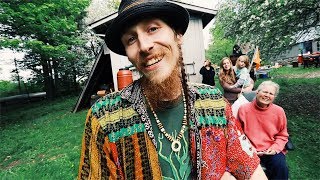
The video follows host SPEAKER A as he tours a small Vermont farm run by Desiree and Andrew, who farm a parcel of land they do not own. Their arrangement, advertised on Craigslist, trades affordable housing and shared responsibilities for labor, creating a sustainable, low‑cost land‑sharing model. The tour showcases a variety of low‑input, regenerative practices: raised‑bed vegetable production (garlic, carrots, peas, celeriac, squash, tomatoes), a hugel‑mound terracing system on a natural slope, integrated poultry (chicken tractors, breeding, on‑site egg production, using chickens for tilling and fertilization), orchard care (apple pruning, grafting pears onto hawthorn, harvesting wild raspberries and blueberries), goat pasture management for brush clearing and manure, a DIY humanure composting toilet, and community gatherings where local homesteaders exchange seeds and ideas. Throughout, the hosts emphasize that ownership is not a prerequisite for successful small‑scale farming; collaboration, skill‑sharing, and creative resource use can substitute for capital. The video ends with a meetup where participants introduce themselves and list what they grow, reinforcing the communal ethos.
Chapters
Many of you guys are looking for land, but he's found a way to have it without the money. Here we are at today's farm feature. Yesterday when we were at Carl Hammers, he pointed out that only 30% of the world is getting their food from conventional agriculture, but it's doing a lot of damage. It's taking more from the earth than it's giving back. It's polluting water. It's But that means the rest of the world, 70%, is on small steads. It's people growing their own food. It's small-scale farms. That's a good thing. He also said if it went up to 40% of the world was consuming it from conventional agriculture, we would have gone too far and we will not be able to recover. I was happy to hear that, and I think that's why we should celebrate this. You guys, the people who are growing their own food— could it be that this— tell them your name.
Desiree.
Desiree and Andrew are quite possibly the greatest American farm. Okay, you guys, this is a small farmstead. You guys are living the dream.
Yeah, definitely.
They've got an interesting story. We'll get into it a little bit. They don't even own this land.
Not at all, right?
But they're able to cultivate it. Many of you guys cannot afford land. I understand that. Where we are, land is $64,000 an acre. I don't know what it is in Vermont. What is it in Vermont?
I'm not even sure right now. I haven't been in the market.
Probably just as bad or worse. So you guys want to give me a quick tour?
Yeah, for sure. Okay, definitely.
Yeah, so our first spring here, this was a crazy wild forest takeover. We decided to put in a few raised beds just on the edge. We didn't want to really impede because we didn't know what was growing here yet. So we put in these beautiful raised beds which we've been amending every year, and we've got fabulous soil this year. We've got 3 different varieties of garlic growing, including one that we had cultivated the year before, so this is our second generation. Really awesome. We've got carrots in the back that we planted last fall that are still jamming, spring peas that we planted a couple weeks ago that are almost ready to be on trellis. And we've got celeriac around the edges. If you'd like, we can head over towards the greenhouse.
It's getting really warm in here already today. It's been as much as 90 degrees in February in here with no heat. We filled this one end with, with hugel mound, basically hugel build, and tons of wood chips. All by hand, we filled in this half. This back half is at a slope.
Okay, yeah. So to make this area level, because we're on a natural slope like this, tell people what you mean by hugelmound to make this level.
So basically at the bottom we laddered some larger logs to help slow down the flow on the contour, and then added slightly larger material and larger material, some soil and some just you know, topsoil and dirt layered within, and then tons of wood chips, just tons and tons of wood chips.
Where do you guys get your wood chips?
Uh, on site we actually had a forester come and take down a few trees that we needed taken down, and he chipped them on site. And then we just had loads dropped off by the people that keep up on the power lines.
Okay.
So we flagged them down on the road and said, hey, here's our address, here's the spot to drop them. We've got red curry squash over here, some luffa, a few varieties of hot peppers. I've got some really fun varieties of tomatoes. I got Indigo Indigo Rose. So the Indigo Rose is like a really dark outside, and you open it up and it's got a beautiful pink inside.
6 of the 8 ladies in this chicken tractor were hatched right here on the farm.
How are they in their life?
Um, eventually in our stew pot.
So they're gonna be hatched here on the farm and harvested.
And harvested.
How does that make you feel?
It can't be described. Even, even some of our old layers You might have to stew them a little bit, but the flavor is phenomenal. I don't know, I love them.
Yeah, so hatched on your land, harvested on your land. That means you hatched them. That means did you breed them too? You breed— you bred them? Oh my gosh, it looks like you're just grabbing what you can get a hold of to build these things.
We call it obtainium.
They probably only cost you the poultry wire.
Yep, yep, basically. And I would say, yep, yep. And really, there was— yep, a bunch of nails we got from a yard sale and Yep, you're looking at $5. Yeah, I was gonna say under, under $40 probably would be the estimate. Probably way less than that. Yeah, $30.
They're cultivating and protecting wild raspberries. You got wild blueberry patches. And what kind of trees are these? These are your, these are your plums. 1, 2, 3 plum trees. Oh my word, look at that beautiful apple tree!
This is the most gorgeous apple on our property, I believe, because I've been starting to prune on these trees. Okay, um, there's a lot of dead limbs in here and tons of suckers and uprights that I took out the first year. This year I made a couple of larger cuts on some of the larger uprights at the top.
This is a hawthorn bush. Most people in Vermont would just mow this down, right?
Yeah, most people would want to mow it down because it has these spiny thorns on there. You see these sharp points? Yeah, that's not fun to run into.
In fact, So does it have a human— does it have a use?
Hawthorn makes hawthorn berries, yes, which has a medicinal use.
Okay.
However, we took a grafting class with Michael Phillips this spring because we wanted to make sure we were taking care of our apples properly, particularly reclaiming these orchards back here. And we learned through that class that you can graft pear trees on the hawthorn. So we tried that this spring, and check it out, successful.
So far so good.
Yeah, look, so this is where— so this is your hawthorn bush right here. And then you took part of a pear, part of the pear limb, and you grafted it onto this by Michael Phillips' instructions. And it looks like it's working because you can see some sprouting.
And those two are Yuri pears and this one is a Patton pear.
Good for you guys. Another nice chicken system. They have them completely enclosed. Probably the only thing they bought here, I'm gonna guess. Well, I had an advantage, I took an earlier tour. Poultry wire, the stakes. She told me you were able to trade for the net on top. The chickens are in there doing a very special job. They're tilling up this area. Guys, can you see? Can you see the difference there? Tilled job, not tilled job. Fertilize. Can you see the fertilizer in there? Let me zoom in there. You see that? All right, tilling, fertilizing. Then you're gonna move them out On to the next job. And what are you gonna plant in here?
Yes, this is actually mainly— this year we're gonna try to focus on getting forage for the chickens. Okay, hold us through the winter.
Cool. So you're gonna plant food for the chickens? Yeah, after they live here. Good for you guys.
And other greens and stuff that we can actually dry and add into our feed during the winter.
Another chicken tractor. It's business on this side. Oh, party on this side! They've got some silkies in here to sit on their eggs. Can I open it? She's supposed to be sitting on some eggs.
Look, she's sitting on some eggs.
That's a good use for a silky there. They like to go broody on this thing. And they like to sit on eggs and hatch these guys out for them. Oh, looks like we got some new additions here. Lily, you want to pet the goats? They've got their water out here. They're staked out on a swivel tether.
Move them around and get—
oh, they're square.
We want them to take down stuff. It's really amazing, actually. We've got the forest that's taking in on our pasture, and we bring them around and they eat down those new saplings, and then they produce manure for us. So, and then in the end, they will produce meat as well for us.
So Have you ever had goat meat?
Yeah, yep, actually really enjoyed goat meat.
Okay, good. What's your favorite goat dish?
Um, like a kebab style sort of—
Shawarma.
Yep, she loves shawarma, definitely.
A very special garden shed. Because we're having a meetup here tonight, they've converted this garden shed into a compost outhouse. Looks like you've built a level baloo here. You got your toilet seat on, you got your bucket and sawdust in. Hey, you guys have warmed this up already. Oh yeah, broke it in this morning. Breaking it in. Got some hand wash there. Buckets for more sawdust, right? That's all there is to these things, guys. It's just a beautiful box built around a bucket. A toilet seat put on there. This box— does the lid come open on this box? Look, the lid comes open on the box so you can access the bucket. All you do, 2 scoops for number 2, 1 scoop for number 1 of sawdust.
Yeah, yep, yep.
And then you go put it in a humanure pile.
Yep. Then we have a couple of bays that we can work that for for a while, turn it into good stuff.
One of the coolest things about this property and about this situation, like I said earlier on in the movie, many of you guys are looking for land, but he's found a way to have it without the money. And she's, she's got land, but she's found a way to have help on the land and companionship and social life. It's really a great situation here. Well, I believe what they've arranged, and you guys can correct me if I'm wrong, But you've got— you've, you've gone looking for land, found a listing on Craigslist. You had listed on Craigslist that, hey, I'll do a trade. You could come and work this land and you can stay here, but you'll give something. Do you mind tell us briefly what the arrangement was? What you were— what were you needing, and then what were you needing?
Well, I need— I was just moving into this property, so I was needing help taking care of it. And that's really all I thought I was gonna get. I put a little blurb on Craigslist: I need help taking care of the property and running the wood stove.
Okay.
And, um, in exchange for affordable rent. And if you want to grow some food, that'd be great. But I didn't really expect it to happen.
Okay, and what were you needing?
I was needing better housing situation and land. And at the time, I also was trying to develop myself professionally in caretaking, both for land but for people too, and people with ailments. And my partner as well was just, just had finished up a degree in, in alternative medicine and also wanted to help in that respect. So once we did get to talking some more, we realized how many needs that we were going to be able to fulfill for Kate here and how that would help us in our development. So yeah, thank you.
So guys, there doesn't have to be an excuse You have land, do something with it. If you don't, you can find it. I believe there are many, many situations like this across the land. So just go for it. Just plant. I'm cutting right here. Next cut, we'll be back here at the meetup. Meetup time! Look at this crowd, y'all.
Their favorite part.
We've got a big line. They want to share with you their name, where they're from, and what you're growing.
Go!
Shannon, Aiden, New Salem, Massachusetts. We're growing chickens, pigs, bees. Turkeys, ducks, meat birds.
Oh my gosh, that's about it. What else are you not growing? I guess that's what I could have asked you. What are we not growing? Cows.
Cows, we want a cow.
Okay, good luck with that then.
Thanks.
Hey, Stefan and Heidi. We grow veggies, fruit trees, and rabbits.
We came from Quebec, Montreal, Quebec.
Nice, that's like this whole other country.
Can you say your name?
Say I'm Wyatt and we're growing I like garlic. Garlic, and we're from Greensboro, Vermont. And we're from Greensboro, Vermont. Nice, good job, buddy. Uh-oh.
This is Avi, and he grows cows and pigs and chickens.
And I'm Carrie, and I grow grain for whiskey. Nice. Uh-oh.
I'm Jonah, and I'm from North Carolina.
And what are you growing?
Cows, chickens, vegetables.
Nice. Hey, Sean Montague from, uh, Burke, Vermont, and we grow chickens, and the only thing we do interesting is potatoes from True Potato Seed. Nice. So this is Ignacio. Okay, good to meet you guys. I know you. I know you too. How we doing? Good. We're what?
Al, Livia, and Gina.
We're growing chickens, pigs, ducks, and vegetables. Nice. High five. Hi, Tom and Sue from Westford, Vermont. We grow vegetables, chickens, ducks, and geese. Nice. Excellent.
Hey, I'm Andrew from Marshfield, Vermont, and I grow apples and chickens and goats.
Now look, man, I've had a long day. That shirt, man, it looks like you've hung out at the party side of that chicken coop, buddy. He's never left.
I'm going back, okay, for sure, the rest of the night.
I'm Kate from Marshfield, Vermont, and I'm growing Good King Henry, which is an edible perennial. You can eat it like spinach. Or asparagus.
Nice.
Hi, this is Noam and I'm Jess. We're from Danville, Vermont, and we raise heirloom apples, Icelandic chickens, and Icelandic sheep.
Cool.
Okay, is that it? You want in? Come on.
Hi, I'm Linda Marie and I'm from East Washington, New Hampshire. We raise primarily alpacas but also poultry, pigs, We have a few horses and there's sheep. Oh yeah, I forgot the sheep. And we also shear.
Yes, guys, this is giving me chills. Do you hear what everybody's growing? You remember what I tell you earlier today? These are the greatest American farms.
More from Justin






If I had to start my Homestead all over again, it could only pick one animal… 




