Honey, Quit Buying These 5 Veggies
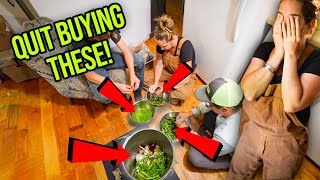
In this informal, day‑in‑the‑life vlog, Victor (Speaker A) and Rebecca walk viewers through a packed homestead routine that blends vegetable harvesting, crop planning, livestock care, and on‑the‑fly problem solving. They discuss why they avoid buying certain vegetables, harvest broccoli, potatoes, carrots, onions, garlic, and peas, and immediately preserve the broccoli by blanching and vacuum‑sealing it. The pair debate planting strategies for corn, cantaloupe, and other crops, emphasizing transplant timing and weed management. Livestock tasks include moving turkey poults, caring for piglets, and coordinating cattle and sheep grazing. A recurring infrastructure issue—water leaking into the root cellar and a clogged gutter—spurs improvised drainage fixes. Family members (Josiah, Gideon, Henry, Connor, Jonah) are assigned chores, and the vlog captures moments of riding a pig, fixing a tractor, and cooking a taco‑soup using the fresh harvest. Throughout, the hosts balance the pressures of video production, a home remodel, and seasonal constraints, highlighting the realities of sustainable homesteading.
Chapters
Hey Rebecca, broccoli, potatoes, onions, garlic, carrots. Don't buy any of it.
Okay. Oh, I thought you—
That should be all the vegetables we need. Beet greens, beet greens, beets.
La la la la la, let me be free.
Happy day. Welcome to another day in the life. Where's their entrance? They're not out. They are being moved. They were way up there. They made the full loop. We're coming back to where they started.
Modern-day cowboy right here.
Okay, well, you can get in. What? Modern-day cowboy riding the dirt bike. That broke over. Oh no, no more milk again. Second, third day in a row. Yeah, we got some yesterday. Oh, the fence wasn't turned back on. Well, that'll do it. Look at this grass. This is the second time around this season. We just had phenomenal spring, lots of rain, lots of warm sunshine. The sheep are body deep in clover. Herd's different than the cows. Sheep doesn't— the timing of the killing of those 3 steers yesterday was strategic.
What?
What?
He just ran down the hill and then back.
He can't decide if he wants the fresh grass salad bar or his Alfalfa. In the spring we have grass in abundance, and we decided, hey, let's grass finish these steers. And then, you know, as spring starts slowing down, you know, coming into summer, grass starts slowing down, we'll harvest them and we'll take some pressure off, off the pasture. And we have— we might have gotten away with an even smaller paddock to slow down our rotation. Grass is growing slow. You graze slow. When grass is going fast, you graze fast. So bigger paddocks. What?
Big paddocks.
Big paddocks when it's going fast, because you have to give more time if it's growing slow till you return back to your original spot. Who is that, Lily? Trying to sneak some horse feed. That's Ryder. She's looking great.
Maybe she befriended—
yeah, now that Peaches is gone. Blaze is buddied up with them. On this last day of our work week, like any day, we're trying to do the most important thing we can to grow more of our own food.
Not necessarily.
Yeah, how so?
Well, we have— I have a lesson today, which is not—
well, during that, during that block of time, we're gonna do the most important thing to make you a better horse rider. The water going, you get the electricity going. Here's a year's worth of turkey for our family. Put out on pasture. These guys are just— half of them are 2 weeks old. We got a dead one. Okay, let's, um, let's get this stuff up and move them. We're using the chicken tractor as a brooder. Look at that, they do like the warmth. Look at that. One death is not alarming, it's quite normal. A little stressful cries.
Oh my God. You're here, right?
You're— last year when it, it worked out, didn't it?
It did, it did work out last year. It did not work out this year. We have a couple options. We can cover this back up completely and just start corn in blocks. Yeah, and then transplant.
Um, Too late? How about July?
No, because they started it late last year.
So I think the most important thing to do today— weed. You said it, didn't you? We're gonna weed and let's plant cantaloupe. Don't hit your corn.
Oh wait, this is corn?
Yeah, that's corn. That's your corn right there. Maybe you shouldn't weed if you're not gonna know that. This is why I wished we would have started seeds and then transplant. We're supposed to transplant everything but garlic and potatoes. That's it. Everything else you start as seed. You have no failed spots. See, we didn't have germination here, and so this is just going to be bare dirt. And then we can't tell because it's— the weeds are just as young as the corn. When you transplant, your plant is 4, 5, 6 weeks ahead of all the weeds.
All right, it's nice in the wind right now. It's cold.
I don't know if it's not too late. You guys might want to start some corn seed. Look, our onions are showing promise, starting to bulb. I honestly think we ought to be harvesting some broccoli today. We'll see what the beautiful one says. I think what we decided to do is keep the corn we've got growing and just start some new corn seeds, and then we'll transplant them out. And we've got more water in the Root cellar. Water's been coming down the wall. My little makeshift diverter isn't working. Josiah just dumped a load of wood chips into their poop corner. Pigs tend to poop all in one spot, and this is it. Guys, get out of your poop. Come on. We've also gotten wet by their waterer tractor. Tractor cannot do that. It's raining wood chips. We bounce around. We may have had a plan today, but we're putting out fire.
What happened?
I don't know. It has happened the fourth time. Made new trails, and buddy, it gets muddy. What's the plan?
Pull it out. That's the plan?
It's like golf. All you got to do is put in that— but that little ball in that little hole. We need a lot more tightness than that, right? Are you going to pull it that way?
It might flip in there.
Put it in neutral. Could you get up there? It won't climb up there. Why not?
Do you not see how much trouble I had to get down here?
I slid straight down the hill. Oh, you did? Okay.
Turn the wheel.
I am. Go. Start backing it up.
We're getting out of the ditch. You can get in there now.
No, go a little further.
Okay, it's going to roll into me. No, it won't.
Okay, that's good. We got everything out safe and secure. Wow, that's slippery. Dang.
He's going to go for a white. If we can't do white, then we're going to do like a brushed nickel.
And that's for the threshold. Yeah, take this. That goes right here. Yeah, the edge of the tile. Yeah, front entryway coming along. Bumps, sunflowers, flowers coming along nicely. Is it time to get them though? There's no eggs in that one. No eggs in that one. We got them yesterday. How they doing with all these chicks? We put these chicks out with these mamas. Somebody vacuumed this already. Now they're blowing it out.
Am I vacuuming it?
We can keep on vacuuming. Trimming this out, or we can try to keep fixing this. I say we try to keep fixing it. I tried to move this over, but it straightened itself out with the pressure of water, and the water is just running and it's going. This didn't work. This was supposed to be up like that, and the gutter can't be over here because of this wall, and the water just comes in right there. Not the prettiest solution, but maybe it's a temporary solution. We We still got to plant cantaloupe back. I think I'm going to dig it out right there and water tube it, and we're going to get the water, the water pressure off of it. Yeah, water's coming down, but it shouldn't be going down in the root cell.
So if the kids want to plant the cantaloupe, have them plant it, and if they don't, we'll just toss it.
Are you going to the house?
Yeah.
Can you tell them that?
Yeah. I need you guys to plant the cantaloupe if you want it. If you don't want it, I have a place for it. If you want it, if you don't want it, I'm okay with that. I'm gonna tell Connor. Well, you're—
he's gonna help, I hope.
You want cantaloupe ground? Yeah. Okay, can you plant it right now?
Can I eat first?
You can eat first. In those two rows next to the sweet potatoes. So you're gonna have two rows of corn, which we're gonna, I think, cover. And I'm gonna buy more corn and we're gonna transplant it because it's just not working out.
Oh, I do this, comes down and it goes over the right, right over there. Definitely not the prettiest solution. We're gonna have to think of something else. I think they make a something or another to keep it from rain from coming and falling off the edge, and maybe the roofing guy can rig something here. We need more rocks or something, but this is only going to be a temporary solution. This is the Jerry's solution: shingle, siding, a rock, and a block. Put the end in the gutter. Put it right down into the hole. No, in here. We're gonna see if this gutter is clogged up. We've got a hose dropping water down in here. Does it fill up and come gushing out, or does it drain? And yell if it starts gushing out, okay? That gutter used to drain right here, but there is definitely not anything there anymore. I think we might have tied it into that other gutter and put it in the PVC pipe under this road. I think it comes out right here. If we get no water here, that's not the case. Are you still running water in it? Okay, why did you leave? Are you sure? Why did you leave? Why did you leave? How could you leave us?
Why would you leave us?
How do you know water's still going in it? It's been 5 minutes, nothing's coming out of there. Surely it would have gotten here by now. Going somewhere. It's not going up out here. Bizarre. Looking at this air outtake, that's probably where we have a leak. See, even if we have water here, this root cellar shouldn't leak. Next, we'll grade so the water doesn't slope down into here, it slopes out. And we'll dig this up and we'll be prepared to patch any gap that's probably leaking around that. The hole there, does that mean we've had overflow and water's gone through or what?
There's a hole there.
We'll find out when we dig that up. I'll admit there's a pressure to make the best videos possible, to make every video a viral video, but you know, every day is not a viral day. This is the reality of homesteading. We're planting cantaloupes. I mean, we'll try to make that as exciting as we can. And we have a lot of obstacles to overcome to get to those cantaloupes, and they're not necessarily the most exciting obstacles. But hey, but that doesn't mean every day is not special. But every day isn't winning the lottery. I mean, if you don't think every day is special, just try missing one of them. This is the biggest one.
This potato's almost ready.
Look, there's a big one right there. Look at that, that gum.
Look at this one.
Yeah, potatoes are in, peas are in. Get your pea. Whoa, they are! And looks so pretty. Rinse that off, you can eat it. Got potatoes, we've got carrots, we've got broccoli, we've got onions, we've got garlic. It's gonna need to be my job, it looks like. To make sure we actually harvest that and use that. Hey, Rebecca! Broccoli, potatoes, onions, garlic, carrot. We should probably harvest the beets or peas now because the weeds are going to take over.
I know, and we need to clear those beds so that we can tarp them so that when we get our— because I'm starting like all of the winter squash and stuff.
Hey boys, let's have a harvest. Hey, don't everybody jump up and down for joy. That's all they know. This is exciting. We didn't do this so much last year because of Jonah's injury and the remodel, but we're back. Let's get these broccolis before they bolt. Look at this broccoli head. Goodness, you cut the broccoli. Yeah, you could. Okay, you could actually pull the whole thing because We're done. I think this is our most successful broccoli.
I know, ever.
Look at this. We're a little too late actually on this one. This one's starting to bolt. Where are we gonna put this all? Well, eventually we're gonna— well, we'll freeze those peas.
Henry, look, only pick the ones that are really fat like this. Don't pick the ones that are skinny like— oh, this one's— what do you want around the cart down the aisle? Some are really skinny, Henry, and these are the only ones. See, this one, it's skinny, only has one pea, so we had to get the one with lots of peas.
Oh, Rebecca, yes, do you want to just cut off the heads or can I harvest the whole plants? For what? For broccoli.
Harvest the whole plants.
Oh good, the animals will love you. We're gonna have to braise and freeze—
not braise, what do you do?
Blanch. Blanch and freeze. Beauty's having a shop of appliances. I can't wait till we get our life back. We get back in our house, we will have a kitchen for processing all this broccoli. Apparently the appliances she wanted are missing, so she's having to hunt some more. We just got the electrician lined up, so we gotta find something or we'll be delayed even more. And so far the electrician's lined up and the appliances for like early July, so we're not— it's looking like August on this remodel. Pull the whole plant. Yeah, you got a little one.
A big carrot! Big carrot! A bean one!
Wow. Just leave it until it really has a problem. We can pick up the plants. But look, this is all going to produce again, and these might do it again too. Yeah, but okay, you're gonna come out here and get them and then blanch them? No. Oh my gosh, no. Well then why are you, why are you taking charge? Okay, then we're ripping them all out. Look at all this broccoli! Holy smokes. Next work day we're gonna put a tarp, a silage tarp that can do just one row. There's oftentimes that we just need to cover one row, not a whole bed or a plot or anything. Josiah's going to do a little drainage job. Gideon, get back down here! Also, if we would have planned it right, we seed time, we've been a little preoccupied with getting burnt out of our, uh, the, the guest house while we remodel, having to move to the farmhouse. Not excuses, just reality. Our seed time planting would have had us putting, uh, you harvest and then something would have got transplanted back into here. What we figured out is we're going to cut silage tarp Oops, not today. We— I think we got our work cut out with harvesting this, processing all that harvest. We got a lot of garden waste, man. I wish we had— I mean, I wish it was 3 days later, we're gonna have pigs back in the pig port. That kind of stuff can make all the difference. Housing pigs next to your big crop gardens, chickens next to your little, little gardens, eliminating the need for a long transport. Not much more satisfying than that— feeding animals fresh food from the farm, returning broccoli abundance into bacon sausage.
Can I ride on the pig?
Sure.
While she's eating?
Hopefully she doesn't eat you. She don't care. Get on her like a cowboy. Come on, she's not gonna buck, she's a pig. She might spin. There you go, ride them, cowboy.
Oh my goodness, but his reins— I'll ride him.
Turn it into soup. Turn it into pizza. I figure it's easier to clean up the house after the wagon than to trudge it in. Gideon's shelling peas. Good job. I'm gonna try my hand at a taco soup. We're kind of tiring of the same thing over and over again. Taco meat into some taco soup. This is how you carry things. Oh, I just picked the corn out. Ask your mom, that might be okay in a taco soup. Will that be okay in a taco soup? Yeah, do it. What I've done so far is I fried some more onions and then I'm just warming up our, you know, breaking apart our leftover meat. Got a frozen beef broth, that's a 2-cupper. I think I am gonna fry more onions. Hey, we got a big crew, okay, we got a big crew shelling now. Where'd Gideon go though? We're not sure. Gideon! This is gonna be some wonderful color. Boom! I thought they were gonna be, uh, more tomatoey. How's my first soup looking?
It's looking so good.
Now we're gonna put the leftover Mexican rice in there too. Okay, was that just yesterday? Boy, we live a lot of life. Liver that we put out yesterday ended up being too thick and we couldn't just break it from frozen. So we had to let it thaw a little bit. This is— and now we're cutting it, and it's actually working out pretty good. Now it's in squares, and we can just freeze it. They'll freeze in individual squares. The soup turned out nice. At least it looks nice. Is it good? The tofu tempeh soup, you like it? Best tofu. I love it. He loves the soy-based product. Look at all this, Beck. Will that take us long to blanch that? I don't think it will. What is blanching? Well, you're gonna find out, buddy.
It's where you, um, dip it in boiling water for like 2 to 3 minutes. I have to look up what— how long.
Why do you have to do that before you freeze it?
It stops like the enzymes and breaking down, and it just makes it fresher.
I got the vacuum seal stuff over back, although that's probably a month worth of broccoli. Okay, is it good enough for the soup master?
You nailed it.
Okay, look at him. Did he just roll over?
He did. He did.
Yeah, wait, he's been— has he been doing that?
Yeah, first time.
First time. I mean, no, first time. How is it, Lily? Uh, killer. Is that a cool way to have a leftover Mexican?
Yeah.
We got a cart full of broccoli this afternoon. You got a plan, Dar?
I'm trying to figure out first process. Yep.
Cleaning it, stemming it. Good job, Henry, bringing in the ice. Walk me through the process.
I had the broccoli, I cut it up, washed it, then I have my little blanching baskets over there. Hot water boiling. I'm getting my cold water. I need to get the ice. I'm gonna put ice in here, so I'm using my milk pail because I don't really have any good bowls over here. I'm gonna dip this down in here, let that—
3 minutes? 3 minutes. You cook broccoli?
No, you don't.
Broccoli is cooked in 3 minutes. Okay, at a boil.
I'm just gonna do 2 minutes. Let me just sit here and wait, stop it from cooking.
And then while that's sitting in there getting nice and cold, You do another one?
Another one. That's why I have two baskets.
Nice. Where'd you learn how to do all this, Beck?
Um, the internet.
She's very aware.
What are they doing in there?
Big old fan. Cool it off. Dry it, dry it. And I'm turning that off. It's been 2 hours. When we go to vacuum seal it, it pulls so much water out of there it fills up the water tray here and it won't seal. Too much water that goes in across this line, and of course it won't seal with water in it. That's a shepherd's pie coming.
It's in the oven.
Oh, right up the lamb. Put in our peas, put in our carrots.
So the only thing to do—
our onions.
The only thing that's not— oh yeah, tomato.
I don't have tomatoes. Soon though.
Soon. The thyme.
Yeah, yeah, look at that. The potatoes are—
we didn't have butter or cream. Yeah, so how do you stir about butter and cream and the potatoes and sour cream and Parmesan. But a lot in that is hard when we have one milk cow going.
Well, and the other one's due any minute.
Yeah, she's due like the 12th, maybe it's the 6th.
Soon.
I can't remember. We need that within the next week. Well, in the— and we gotta make sure our fences are hot.
It's the other problem. Yeah, only on a homestead. It's a cow tail. It's a cow tail laying there. So I'm marching over to the cabin to freeze these broccolis. So if we freeze them individually on trays, then when we go to put them in bags, they won't be any moisture on them. Do that until after dinner, we'll bag them up. And it's done, and everybody loves it. How do you feel it came out?
I think— I feel like it came out really well. I haven't had it yet. It's really hot. Henry is chowing down already.
So ease, ease of creation.
It took me a long time.
It's an easy cleanup. Yep, it's an easy cleanup. It is.
It's—
you do one frying pan and one baking pan.
Hard in the beginning. It's not hard, it's just a lot of components.
Yeah, Henry loves it though. It's all from the land-ish.
Most of it.
Let's try it. Watch out. Come here, Henry.
You want to watch?
Sure. Just wait. Just wait.
It's going good.
Wait, wait, open it, open it. It did it! Look how vacuum sealed. Oh, look how beautiful it is. Are you doing the vacuum sealed broccoli dance?
No, I'm an influencer. I'm tapping.
I'm really impressed. That's how we do it, baby. That's how we do it. We harvest and we preserve.
I like it.
Same day, get it done. Don't put it off. Now that broccoli is frozen in its freshness. A couple of hours old.
They say that frozen is actually best.
Yeah, happy day.
More from Justin






If I had to start my Homestead all over again, it could only pick one animal… 




