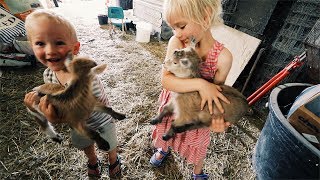
In this vlog, Victor Justin Rhodes and Rebecca Rhodes visit Antiquity Oaks Farm, a 32‑acre homestead that began in 2002 as a city family’s experiment in small‑scale agriculture. The hosts contrast the surrounding industrial corn monoculture with the farm’s hopeful, diversified practices. Deborah Nieman Bailey, the farm’s owner, recounts the farm’s evolution from a family‑run operation to a partnership model that includes a market‑garden collaborator and a summer kids‑camp that teaches children animal care and farm work. The tour showcases a variety of livestock—Nigerian Dwarf goats raised for high‑butterfat cheese, bachelor geese, lambs, chickens, and a peacock—along with low‑tech infrastructure such as a mobile goat shed, a “henmobile” egg‑harvesting contraption, and sheep‑mowed plots. The vlog highlights sustainable, animal‑driven solutions, community engagement, and the farm’s role as a hopeful oasis amid industrial agriculture. The episode ends with plans to visit the Caterpillar museum and Mark Twain’s home, linking the farm experience to broader American cultural landmarks.
Chapters
For miles and miles and miles, there is soy, corn, monoculture, pesticides, herbicides, GMOs. But here there's hope and a peacock. It's 7:30 PM. We have arrived at our destination. Tomorrow— a viewer told us about this while we were at the meetup. Tomorrow Tomorrow we're gonna go to the Caterpillar headquarters. You guys hear that? The dirt mover headquarters.
Not the headquarters.
She says it's not the headquarters. It's the museum. But anyway, we're gonna see a lot of cool Caterpillar big dirt mover kind of stuff.
Yeah.
Yeah. I know you're excited about this. I will buy that. What is that?
Like what type of—
What is that? Caterpillar is those yellow dirt movers. The excavators. We had a crazy busy day today. First, we said goodbye to Darcy.
Don't be a stranger. I'll stick to you. No, we won't. I got your text. We'll be texting. Good, good.
Come on, do it again. There we go.
Bye. Oh, look at Dominic. He's got— oh, sorry, not everybody's here. It's okay. I'm saying goodbye to my husband.
I know.
Hi, it's nice meeting you.
You too. And then we drove by miles and miles and miles and miles and miles and miles and miles of cornfields. Then we got to a place of hope in the midst of the cornfield. This is the kind of stuff I'm talking about right here. Let's get our host over here. Come on down, come on over. Tell everybody who you are and what you represent.
I'm Deborah Nieman Bailey and this is Antiquity Oaks Farm. And we started in 2002 as a homestead. We were a family of city slickers who had absolutely no clue what we were doing. We made every mistake in the book imaginable.
Um, you got a peacock on your roof.
Yes, um, he likes to get all the attention. So we came here in 2002, and at that time our kids were 9, 12, and 14. Obviously they did not stop growing as much as I thought that would have been cool. They grew up, moved away. Now it's really just us, and we realized that we needed to either get some partners to keep this thing going, or we were just gonna have a very nice 32-acre park for ourselves. Because when you've got 5 people and you do like an hour of chores each in the morning, that's not a big deal. But as soon as those people start going away, Now all of a sudden what used to be an hour in the morning, an hour in the evening, is 5 hours in the morning and 5 hours in the evening. And we couldn't really do that. We realized we needed to find some partners, so we started doing that. We've got a market garden partner now. We have another partner who runs a kids camp in the summer for 5 weeks. It's a sleepover camp. The kids come here and basically run the farm for the whole week that they're here. They learn how to feed the chickens and the goats and the pigs, and they move the chicken tractors. And then they get to do a lot of fun things too, like one of the groups last summer painted a mural on our Hen Mobile, which I think looks really cool.
Looks like somebody gives these guys some treats. What are they looking for? They're so excited to come see you. What are they gonna find?
They're not gonna find anything, actually. They just really like us.
Really? No treats? No special treats?
Yeah, we don't have any special treats. It'd be kind of hard to have the treats for this many.
What kind of goats are these?
These are Nigerian Dwarf goats, and we We have them to make mostly for making cheese. Okay, so they've got the highest butterfat of any breed. It averages 6.5%. Okay, which is really awesome because all that butterfat and those milk solids mean you get a really high cheese yield.
Look, somebody else is wanting a treat. What are they expecting from you?
Those are the two biggest camera hogs on the whole farm. Hey, so they always come out when we You do.
Nice picture. Hard to take a bad picture.
I'm enjoying these animals.
They're beautiful. Taking a picture of the peacock or the turkeys?
I did both.
Okay, that's Rebecca.Rhodes on Instagram, y'all. Oh, what do we got here?
So those are our two bachelor geese. We used to— when we came out here, we wanted everything, and so we had pairs of geese, you know, we had pairs of geese for breeding and everything. And unfortunately, all of our females wound up getting eaten by coyotes whenever they were setting. So, um, we're left with these two lovely bachelor geese, and probably 80% of the people who see them ask if they're swans.
That's what I said. That's the first thing I said, because look how big they are.
Are they friendly? They are really. I mean, every now and then they're cute.
Check out that mobile goat shed. It's just on skids, cattle panels. And a tarp. You like your mobile shed, buddy? He does. Is that the interpretation? What's that bottle for, Lily? Milking a baby goat. Are we gonna milk a baby goat?
We're gonna give a bottle to a baby lamb.
Oh, wrong way, guys. Walk on the other side. This is where they have been.
This is where they came from.
Yeah, laden with fertilizer. Good for the yard, bad for the bottom of the shoes.
We hatched those in an incubator a couple months ago. The boys will be dinner and the girls will be layers. And they are a crazy assortment of mixes. I love that one in the front that's a cross between a Silkie and a Delaware. This is one of our gardens. We've got 3 different gardens on the farm, and this is our greenhouse behind me. And that's Sarah, our garden partner, who is working in the garden.
What's involved in a partnership for those that may want to do something similar? They got some land, they want some help. Using it?
Well, basically what we do is like we provide the land and the equipment and the seeds and all that stuff, and then, um, the partner basically provides the knowledge, labor, and enthusiasm.
Okay.
And then we split the profits.
Oh, okay. He's just following us along.
I know, it's hilarious. Okay, who's got the bottle? I see Lucy's shedding her hair on the fence. Or the sheep are, because they're hair sheep. So hold it up like that.
Are these— are these lambs still nursing their mothers? Uh-huh. But they'll always take a little extra, huh?
Yeah, well, it's because there's 3 of them.
So 3 of them to 1 mama.
Yeah. So we saw when we had them in the barn, that poor mama was standing there all the time, like she never laid down. Every time you looked in there, she was standing there. And they were nursing, and like as soon as one quit, another one started because they only have 2 teeth. So I'm sorry, I don't have a bottle.
Is that not the prettiest eggmobile you've ever seen? I believe here though they call it the henmobile. Look at that paint job! Wow, what's it like in there, guys? How do you like this little henmobile? Do you guys realize that chickens don't like tall grass? You see how this is cut down? Just the way the chickens like it. Look how it's going down. No machines, just sheep mowing the plots, getting them ready for the chickens. Because why do the work when you can get an animal to do it? This is a cool contraption to harvest the eggs. Josiah, show us how it does. So you just You just unattach it, the hinges open, and the eggs roll down to here. Deborah, thank you so much for what you're doing. You have a beautiful plot of land here. You are a glimpse of hope in all the midst of this industrial act.
Thank you.
Maybe we can change our world around. Maybe we can waste this fertile ground. The time we have may never come around. The time we have can surely be right now. Oh, oh, maybe We should hold against the odds. All right, Deborah, thank you very much.
You're welcome. I'm so glad you guys were able to come by.
And after that, we left this place and we drove through miles and miles and miles and miles and miles of cornfields. And here we are after a big day at the RV park. Kids cleaning up, mama making pizza. What kind of pizza you making us, honey?
Well, this is cheese for the kids, but you and I—
okay, you can help her.
Papa and I are gonna have Italian sausage from Michigan.
So tomorrow's vlog is gonna be all about the Caterpillar dirt movers, and then after that we pick up again to travel. Where do we travel? Yeah, we travel to Hannibal to see the Mark Twain homeplace. Guys, if you haven't figured this out by now, this farm tour is mostly about farms, but it's also about America. And I can't think of anything more American than Mark Twain. Aye aye aye aye aye.