Horse logging Our remodel
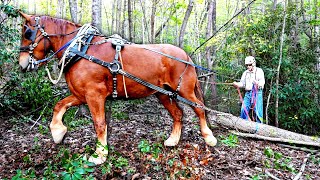
Forester Ian leads a two-day horse-logging operation to harvest timber for a home remodel, using a draft horse named Copper to pull logs downhill on steep terrain. They select red oak, maples for flooring, and black locust for decking, calculating roughly 1,200 board feet for locust and 1,400 for rough lumber while practicing selective thinning to preserve the oak-hickory forest.
Chapters
Horse loggers are here. Henry's driving. You're a crazy driver. He acts like he's not. You glad to feel better? You gonna stay and hold her brake?
I think I am.
The horse loggers are here scouting. We're looking for maple hardwood floors and locust decking. Can you imagine locust decking? That's going to be a beast.
That red oak is going to be our crop tree. It's a healthy example of a red oak, right? It's straight, it's got good form. And in terms of long-term forest management and forest health, we want to try to promote oak and hickory in this part of the world because we've lost a lot of it through what's called mesophication. Fancy word meaning basically that, you know, the oak-hickory forest has kind of been replaced by poplar and maple and, you know, other species due to, you know, all sorts of things over the course of the history in this region. Oak in particular is very important for wildlife. It also has a lot of value for, you know, silvopasture and, you know, that kind of stuff. So we want to keep the oak and we're going to cut the two maples around it. That's just some real quick and dirty silviculture, the art and science of growing a forest, in this case a hardwood forest. You can see the one on the left, if you look further back and go up a little bit, Jeff, you see the mushrooms up on the stem. So that means that that tree, at least in that section of it, is starting to decay. And so before it, you know, loses its value for, you know, a wood product, we can select that one out and try to saw it and see what we can get. Something to get good firewood if nothing else. But um, we hopefully will get some good decking boards, right? So look at our little friend.
Oh, you see the tear at all?
Yeah.
Cool. The funky part probably stops right up in there somewhere.
Yeah.
And then you got a section of, you know, 2 or 3 straight logs that are straight and nice. We will definitely take this one, and we can feel good about it because we know it's not going to get any It's just gonna fall down. That's right. Yeah, so, you know, it'll serve a purpose, right? This is the existing deck we're on right here, right?
That's right.
And then there's going to be a new deck out here.
This is where we'll need the locust deck, and then we need locust decking there as well, right? Yep. You need to know the size of the decking.
Yeah, I need to— where's the reference on the sizing?
Ian's calculating deck space so he knows how many locust trees he needs to cut, and floor too, so he knows how much maple. 700 square feet in the decking up here.
There's not that much, but I like to always— I gotta have overage.
So can you off— you know then how much tree you need?
Yes, I like to—
how much tree do you need off top?
Yeah, I like to double it for, you know what I'm saying? Because when you get the raw log, if you just saw out 700 board feet of rough lumber, you know what I mean, it's not gonna be enough because you gotta rip it and you gotta edge it and all that. So minimum is 1,200 board feet just to be on the safe side.
He's wanting to know— this is not—
that's tile.
This is gonna be a locust deck, right? That's gonna be—
yeah. Yeah, and I would like the whole way across, Rebecca.
Yeah, we want to make this as wide as we can. We're not 100% sure.
So you're saying— so this is about an inch and a half?
Yeah, and this is 5'5". Yeah, so I'm gonna say that this is 6 feet. I'm pretty sure that's gonna be 7.
6 by—
what's our width here? I don't know.
We're gonna have to add all that up. No one said there would be math.
You're gonna have to add the inches separately unless you know.
Yeah, okay, I'll just call out the feet.
38.
Is that— does that seem right?
Or it would I felt like it was wider. I mean, I would like to do 8 to 10 at least. I mean, 10 would be ideal.
We'll just say around 1,400 to— we'll say 1,200 to 1,400 board feet of rough locust. And then the flooring. So you want flooring where?
No, sunroom is tile and all the bathrooms are tile.
That makes sense.
Um, and then everything else is wood floor.
We're going on a tree hunt. What are we looking for? Red maples.
All right, you can hold up right here for a minute.
Okay, yeah, okay, yeah, you see something I don't see that he lights up over here.
There's one right there. And see, we got some hickory right here.
That's hickory that looks almost like a walnut.
Yeah, well, they're in the same family. Again, forest management, silviculture. This is a good little spot to cut some maple because it'll release these hickories.
Nice. Look who's here, Ian. Have you met Copper before?
Hey, buddy.
And all we need is one horse. He's strong enough to pull them big trees out? Yeah, because we're going mostly downhill. Oh, okay.
You know what I'm saying?
Yeah.
And we're not going to use— because we're pulling flooring, we're not pulling big timbers like we talked about doing in the beginning with the big pine. Yeah, so we can use a single horse to pull short logs down a short distance to the skid steer.
All right, does Copper like pulling logs?
Does it— you know, a guard dog like to work? I mean, I think, yeah, there's part of them that feels like this is what we're doing. Yeah, you know, this is where the herd is.
They're obviously made to work.
Oh, they're—
poor Lord, look at them.
This is the only breed of common draft horse in North America that was developed by farmers exclusively for farming and agriculture, silvicultural purposes.
He just said— he just said back and Copper comes out. Good Lord. I told you he'd make Captain, your riding horse, look like a little horse. Yeah, look like a pony. What's it like having a horse on the hauler? It's good. Does it feel right? I wonder how much that guy eats. Yeah, look at that monster.
He's feeling better.
He's brushing and getting the debris off so that he can put the harness and things on. The horse be comfortable. Lily, grab a brush. He said you could help her. Did you learn how to approach him like that, Lily? Yeah, she knows he's gonna be a little nervous. He's gonna pick his hooves next, make sure there's no rocks.
So see these raised things here? That's called, uh, Borium. Okay, another trade name is Drill-Tec, but that gives them a little extra traction. I have to ask them to pull a heavy load.
A little spot right here, you can get some rocks lodged in there, which will give you some problems.
This is what they did before tractors. You didn't just come out here and turn a key. Now the good thing about this horse over a tractor is its fuel's right here. Probably takes a lot of fuel, doesn't it?
Called a trace, and this is what we're gonna hook to the chain, which then hooks to a single tree, which then hooks to whatever you're pulling.
Got a blinder, huh? Are these how you're driving him?
Yeah, this is how I communicate Left, right, go, stop.
Look at this.
How you holding up, Copper? 3 logs down.
3 logs down. Yep.
Are you able to keep up with the horse?
Oh yeah.
Once the horse loggers get the logs out of the woods, we got to get it down to the log pile with this. That'll speed things up.
It really makes sense because we could just drive all the way up that hill, get it, and bring it down.
Well, it's actually better because this would have to track on that steep hill and this would tear it up. So the horses, they just don't tear it up like that. You'd have to carry logs 12, 16 feet wide. They just wouldn't fit. You don't want to go? I thought you loved tractors.
I think he likes—
he jumped at me. He likes the idea of tractors. Get them all three, close it, and then tip it up.
There you go.
Just go with those two. No way we'd get the track loader up in here. The horse has the advantage because it can go in narrow spots.
Copper, come on! Oh, it's a huge log!
Horse pulls it like it's nothing. And give Copper a little break while they work up a tree. Is that dogwood a good hitching post for you?
Yeah.
Lily, you want to take water down to the horse? We're in another patch of forest on our farm. They're gonna need more maple over here. Just say they're gonna need a trail cleared. I was just gonna do it with the chainsaw, but he's like, let's do it with the mini axe. We want a trail here. One day anyway. So the orange is the middle of the trail. That might hold you up for a little bit with the track loader. We basically got to get this cleared before tomorrow, and they want to— and they want to come over here. Yeah, see, here's your orange trail. So then straight up through here, huh? This is the end. If you get here, you can get in here and get his maples. Oh, Lily, you're gonna have a friend. She said that's how you make a friend with a horse, give him a snack. He figures it out even with the bridle on, huh? Are you afraid it's gonna— he's gonna bite you? There you go. Just found out Ian wants to get the horse over on the other side where we need to clear our trail.
We need to hurry up so that we're not the bottleneck.
Pretty sure based on our conversations earlier, it's so that the horse will get used to both sides today and it'll be super familiar with the farm tomorrow. You want to stay here with the horse? He's gonna chill at the Dogwood until he's ready. She's just tickled pink to have a horse on the farm right now. Now chainsaw and Mini X, one of the greatest combo in machines ever. You got to dig beside it and behind it. Go up as high as you can on it, push it over, keep pushing down. All right, he said if I cut it, see if you get the stump out easier, but I need to get this little stuff out of the way first. This morning, before the horse gets here, we're gonna clear path to these logs that Ian has fell. Just try to keep these guys moving as soon as possible. We got yesterday only a quarter of the way done, and they're only here for 2 days, so we got to ramp it up somehow.
Doesn't take much to make room for a horse. He thinks he's a small horse.
So what I'm doing right now is called bucking for grade. So we got felled timber here, so before I buck it into logs, I want to assess what's the best use of each section. This is called kind of a pistol butt. There's a bit of a sweep on the end of this tree. It kind of grew and then all of a sudden made a dog leg to get light. So I'm going to cut off a short section of this that's more like for, you know, like a live edge slab or, you know, a tabletop type rustic furniture thing. Practice a form of forestry that we call conservation, or I call conservation conservation forestry, other people call it that. It's basically the idea that we're trying to make it regenerative, make the forest, you know, a healthy, intact ecosystem always. It does involve, of course, cutting trees, but we try to do so with a lot of intention and practice good silviculture, the art and science of growing a forest. In terms of conservation forestry and good silviculture is that, you know, we're not out here high-grading the woods or, you know, just cutting the trees that we need for the project. We assess which species in this forest was, you know, an appropriate sustainable choice to thin out. Eastern forests are mesophying, meaning that they're becoming less oak, hickory. We're trying to sort of conserve the, the oak-hickory forest type as much as possible. We use workhorses to do that as well as machinery and then selective precision timberfelling.
And the good news is we were able to get twice as much done the second day as the first. We got in a groove. And even better news, we didn't finish and they're gonna have to come back. Yes, that was fun! Let's do it again soon.
More from Justin






If I had to start my Homestead all over again, it could only pick one animal… 




