How Cows IMPROVE the land - ONE Simple Trick
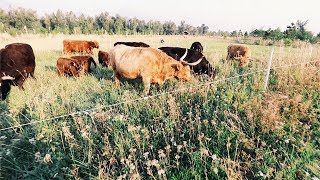
The video documents a hands‑on farm tour at ABC Acres led by Tim Southwell and guest Justin Rhodes, featuring a group of visitors (including children) who participate in daily livestock management. The hosts explain why they move cattle to a compact paddock each day, describing how concentrated grazing creates a living mulch, boosts soil microbiology, and concentrates manure for natural fertilization without chemicals. They demonstrate feeding chickens on cow pats, a technique that uses chickens to eat maggots and dung beetles, thereby breaking the fly‑maggot pest cycle. The tour moves through the multi‑livestock system, showing goats, alfalfa paddocks, and Kunekune pigs, highlighting the pigs’ small size, grazing ability, and low grain needs. Throughout, the hosts promote the farm as a regenerative‑ag, permaculture‑based destination offering tours, work‑alongs, Airbnb stays, and recreational activities. The group also watches a solar eclipse, noting animal reactions and sharing the experience. The video blends instructional content on regenerative practices with promotional and experiential storytelling.
Chapters
We move the cattle every single day for a few reasons.
One, and—
Hi guys, Tim Southwell here with ABC Acres. Really appreciate you taking part in a livestock feeding today. So we're gonna go around the farm, we're gonna move the cattle, we're gonna feed the chickens, the pigs, the goats, the turkeys, and a little bit of everything else we have going on. So we're gonna be moving the cattle this morning. We usually move our cattle every single day, but we're moving them into a small paddock today. So we're actually moving them this morning at 8, but we're also gonna be moving them them about 11:30 today. So I'm going to jump in and do that really quick.
What do you think about those hairy cows, huh?
Crazy.
What's your first thought when you see that hairy calf?
Hey, look how he's pulling.
Look how he's attracting them with his mineral sled.
Let's go, let's go. So we move the cattle every single day for, for a few reasons. Um, one, in an open stock grazing system where you might see cattle parked out on a large tract of land, the cattle are always eating the most delectable, tasty nuggets, if you will. And so what happens is the unsavory stuff has a chance to really grow up, germinate. So imagine in 5 years, 3, 5, 7, 10 years, the pasture maybe has more undesirable plants and edibles in it as opposed to the delectable ones. So by putting them close together in a small compact pen, they're actually competing against each other to mow down the lawn in uniformity. At the same time, based on them being in close proximity, they're trampling down the grass, and so that puts biomass, organic matter, on the soil. And by doing that, it acts as a living mulch which holds more moisture in the ground, thereby developing and building the microbiology below the soil surface, which is what we're trying to do. More so, we're getting heavy manure, heavy urination in this location, so that is building are fertilization-based. We don't use pesticides, herbicides, fertilizers. There are machines to do that. So we're into building healthy grass systems, and this is just one tool.
What is y'all's name and where are you from?
I'm Holly Burns, and we're from Marshfield, Massachusetts, just south of Boston. Yeah.
Have you been around farms before?
I have. She's kind of.
Kind of.
On a scale of 1 to 100, 100, you know everything about farming. And one, you know absolutely nothing.
Where are you?
Two.
Okay, this is the beginning of the tour. We're gonna see how that changes by the end.
Okay guys, we're gonna open up chicken coop one. So I'm gonna ask you children to come forward with your cups. We're gonna give them a little extra feed this morning.
You want to do it, Mr. Brown?
So many helping hands.
Okay, come on. Here, Jenna, get Miss Cup. Get the cup, buddy. You're gonna feed the dinos.
You're gonna feed those dinosaurs.
No, one for you.
Yeah, they don't want to come out.
One for you.
We turned off the cut the hot wire so it's not hot. But I'm going to ask you guys, when the chickens come out, they're going to seek you out, and we're going to head over. See those white stakes right there? I just want you to find some cow pies and just sprinkle them on all the cow pies, okay?
Y'all know what a cow pie is?
Yes.
Good morning, girls. Good morning, girls. Come out and play. Oh my goodness. Find your cow pies, put them down. You're doing a great job. Yeah, if you have the proper I'd like to actually step the grain in a little bit, make them work for it. Okay, certainly don't need to do that.
Let's see it, buddy.
Okay, let's put it on that one. Give me a little bit more. There we go. I like to do that, and then I just like to push it down a little bit so they really have to kind of work to get it. And so you'll notice as we walk back from coop 1 along the pasture that they grazed last week, you're going to notice that there aren't any cow pies. You're not going to be able to see them because they obliterate them so and distribute them over about a 9 square foot area, if not more. You may pet the chickens if you would like. Absolutely.
Are they fluffy?
We've got Buckeyes and Cuckoo Marans and, uh, Barred Rocks and Buff Orpingtons and Americanas. A little bit of this and that.
There you go, honey. Good job. Hey, Lily, is it strange to you that you're putting, uh, feed on manure?
What?
Jenna, what do you think about putting feed on manure?
Fun.
Why is he doing that?
Um, so the chickens spread off the manures.
Hey kids, how would you guys like to eat your food off of another species' manure?
Nine.
Nine. No, no. But these are chickens, right? They love it. They love it. You guys don't believe they love it?
Look at this.
You want to put some down, Mr. Brown? Can you put some down? Put some down.
Good boy, good boy.
Save some. Show them, show them a pie. Come over here, buddy. Oh, all in one spot, huh? Oh, you put it all in one.
Let's ask them.
You like eating off the manure? Yeah, you love that? Why? Well, what one's Oh, and all the maggots. You like to eat maggots? Yeah, you love that? Okay, well, you're in the right place.
Venture down our goat-pig paddock system. We're actually going to put our goats away for just a minute while we utilize the alley between the paddock systems. This is alfalfa, and so we're going to use the alfalfa to get the goats into this pen over here. So you guys can just walk in. Come on through. Come on, keep on walking.
Don't turn your back.
Very safe. They're very safe. And then just walk into that. Yep, they're very happy. And so this allows us now to do the work for the hogs and the chickens in the alley without having these guys—
Yeah, do we come out?
You will come out.
Yep, there we go.
So this is our paddock system. That's Paddock 1. Here's Paddock 2. You can already see it's starting to rebound. It's starting to grow. It's been rested now for only, you know, 4 days, uh, Here in this paddock we have Kevin Bacon. So come on in, I'll just ask you not to let anybody out. Okay, how you doing Kevin? Anybody want to pet the pig? We can get up there, we can pet Kevin Bacon.
Come on, somebody pet the pig.
He loves scratches. You can just put that on the ground if you want to.
Come on, who wants to scratch the pig? He's got plenty of grain right now, he's not going to eat you.
Come and pet him. Here, you want me to hold your cup?
Oh wow, he lets you go right up to him.
We're gonna dump that, and I'm gonna get one of you guys on filling that up, okay? And so, Samuel, what I'm gonna do is I'm gonna start the water up. I'm gonna ask you to go down there with the hose, fill up the water trough, and then I'll probably just have you dump a little, just keep it flowing in there to create a little pond, and then we'll, uh, we'll be done with that. Now, you guys are— you guys could come in here. I will tell you, they're big, they can push you around, but once the grain's on the ground, they're very friendly to be around. You see how— yeah, see how they've got this, the remnants of the mud on it? I was talking about that wallow, right? So we come out here at 1 o'clock in the afternoon, they'll be pasted in the mud. And matter of fact, I'll get someone to fill that little wallow up here shortly so they're all comfy. And we're gonna see temperatures of mid-90s today, tomorrow, and Wednesday, so they're gonna need every bit of it. We do come out here during lunchtime and fill up, make sure their water is good. We'll re-wallow them, we'll spray— they love it when they get sprayed down, they'll dance in it. And so it's I'm sure it feels good.
So might keep them cool, is that why?
Yes, exactly right.
That piggy tried to bite me.
One of the things, um, that piggy didn't try to bite you.
So why do you make the chickens eat their food off the cow paddock?
Oh, that's a great question. You know, I'm sorry if I didn't allude to that earlier. So we found out that when the cow pie's on the ground, the flies like to come in and they lay their eggs in it. And then days 3 or 4, there's little maggots crawling around. Oh, and then they hatch out and fly off and they go land on a cow again and the process repeats itself. So if we put this, the grain on the cow patty, when those little maggots are crawling around, the chickens go in and eat the grain. And as they open up the patty, they see the dung beetles and they see the maggots and they see all sorts of creepy crawlies and they peck them out. And that puts their belly full, it makes them healthy and strong, but now there's no flies coming out to go to the cows. And so they break the pest cycle. That's a great question. Other than that, I wouldn't want to— I like— I wouldn't want to eat food off of a cowbell.
Hi girls!
I need to get you guys some grain, don't I? Some feed. So we don't usually give them this much grain, but I like the fact that you guys are so interested in the poultry and you want to feed them. They're going to be a little fatter today, and that's okay.
Have you had their eggs yet?
We have 3 dozen.
So on a scale of 1 to 10, 10 being like I've died and gone to heaven, 10.
10. No, 11.
Best eggs you've ever had?
Yes.
You can tell the difference?
Delicious. Delicious.
How do they compare to store-bought eggs?
You know, there's so much yellow. They're so yellow. I mean, that was the cool thing. Even remember, like, your pancake? I made pancakes with them, and even the pancake batter was a golden color versus, you know, store-bought eggs.
We found one blue egg.
Yeah, well, no, the insides when you cook them and everything, they were just so yellow and just rich tasting.
You are welcome.
Is that it, Tim?
That is it, Justin. I think everybody's done a fantastic job.
Thank you. So folks watching want more of you, where do they do?
Well, you know, we're, uh, we're at abcacres.com, uh, we're on Facebook at ABC Acres, we're YouTube at ABC Acres. And so I would encourage people to go out there and check us out, reach out to us on the contact page. And, you know, we're really trying to showcase a destination experience here at the farm, trying to showcase regenerative ag, permaculture-based operations for both livestock and edibles, and make it a full experience from livestock feedings to work-alongs to farm tours to self-guided this and that. And we'll even get you on a horse and ATV and fly fishing if you want. So the full package.
How much do you know about farms now, scale 1 to 100?
5.
5, okay, we doubled. We doubled our knowledge. Good. Pop quiz: why does he move the cows every day?
So that the flies don't get them.
Okay, that's one reason, absolutely. Why does he throw the feed for the chickens on the manure?
Um, so that we can get rid of the pests. Go ahead.
Um, get rid of the pests?
Yes, to get rid of the pests.
Why does he like the Kunekune pig versus other pigs?
Because they're better, smaller.
Okay, nice job, Samuel.
They're smaller, they're great grazers, browsers, they don't need as much grain.
Is that what you're gonna say?
Foragers, they don't—
not as much overhead.
Yep, they don't need as much grain. Absolutely. Okay, I would say, I would say so. You more than doubled your farm knowledge here today. Yay!
Congratulations, y'all.
Excellent job.
Thanks for your help this morning, and enjoy the eclipse, right?
Yes.
Yeah, eclipse in how many hours?
Not starting now.
2 hours. 2 hours. Did you check? I just checked.
It's not happening, y'all.
Don't burn your retinas.
This is what it's all about right here.
Eggs.
Is this from their farm? Eggs from their farm, pork from their farm, and waffles made from a waffle maker on their farm.
I was pretty excited to see the waffle maker.
Yes. So a blend. We've got the farm fresh stuff and a little bit of comfort food with the waffle maker that we can't really do on the road, right?
And these.
And these, yeah.
And look at this, guys.
If you ever want a vacation on a farm, come tour this place, stay in a really nice Airbnb, this is it, wouldn't you say?
Is this place refreshing?
It's very nice.
Let's see some of the views at this place. Holy moly, that's your view? Are you kidding me? You're gonna love doing dishes in here. Look at that view out the window. Walking down the hall, you got a view even out the hallway. Look at this permaculture yard, this beautiful yard. There's even a view in the bedroom down to the bottom. So nice. Oh, look, the bathroom isn't without its view either. The eclipse is starting. Okay, everybody gets to see it with their special glasses. Look at the sun only with the glasses on. He's closing his eyes.
Okay, I'm like so scared. Oh wow, that's crazy.
How are the cows reacting to this?
They're like, super strange. Like, they'll be really still and then all of a sudden they start like running around and stuff.
They're like, wait a minute, wasn't it just dark?
I have to say it is like really cool. Like, the temperature has dropped and it's like, it's like dusk.
Yeah, they're getting frisky.
They're all like, it's so funny because some of the other ones are like looking at them like, why are you acting like this?
They've been good. They're feeling good. I mean, you probably won't be able to be out here with short sleeves on.
I know, it's really chilly. Look at how it's like so— it's like so strange.
I guess it's winding him up too.
Yeah, total dark everywhere.
No, 95% here. See how it flipped? Yeah, kind of looks like a moon.
It's so weird.
So I got the camera on it. You can see the eclipse up above the bright light. I don't know why it's lining up in real life. I don't know why it's not lining up on the camera.
All right, it's— it's— we're on the other side of the eclipse. It's still eclipsing.
Yeah, but cows have calmed down. What just happened?
The eclipse!
What does that mean?
That means the moon went in front of the sun.
What did you guys think of that eclipse?
Cool.
Was it exciting or boring?
Could you guys actually see it through your glasses?
Yeah.
Crazy.
Mr. Brown, was that the craziest thing you've ever seen? Yeah. Tomorrow, more of ABC Acres. They got some crazy permaculture stuff going on, like fedge. What the fedge? We're gonna find out tomorrow. But if you want more of them now, Make sure you check out yesterday's video. There it is, and down in the description.
More from Justin






If I had to start my Homestead all over again, it could only pick one animal… 




