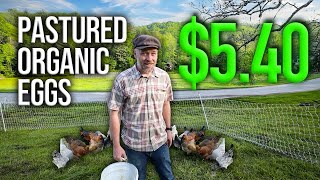
In this hands‑on vlog, Victor (Speaker A) and his partner (Speaker B) walk viewers through their small‑scale, organic, pastured‑egg operation. They begin by describing their brooder setup (deep bedding, pine shavings, 1 sq ft per 4 chicks) and a recent rat predation loss. The core of the video showcases their custom mobile coop system – the “Chickshaw Mini Me” and a larger “Turkey Shaw” – detailing wheel balance, hitch attachment, capacity (up to 24 chickens or 36 turkeys), and how the design enables easy relocation to pasture behind cows. They also reveal a self‑cleaning nest‑box built from milk crates and half‑inch wire mesh that lets manure fall through, eliminating routine coop cleaning. Predator protection is handled with a Premier One Intellishock 120 energizer and 12‑ft‑spaced, 48‑in‑tall poultry netting on drivable posts. Feeding strategy focuses on soaking grains for 12–24 hours to break down anti‑nutrients, which reduces daily grain intake from 1/3 lb to 1/4 lb per bird (≈15 % feed savings) and, combined with pasture grazing, yields a total feed reduction of about 30 %. They discuss pasture management tactics such as spreading feed to encourage roaming and manure distribution, and the use of guard geese for added predator deterrence. Finally, they present a cost analysis: with tax, shipping, and feed costs they estimate $5.60 per dozen organic pastured eggs (≈$0.78 per lb), comparing it to retail prices of $2.20–$5 per dozen for conventional or organic free‑range eggs. The video concludes by weighing the financial viability against the lifestyle benefits of fresh, omega‑rich eggs and reduced labor.
Chapters
Where the Pastured Posse begins. 1 square foot per 4 chicks. Raising some guard geese. I've learned it takes about 18 pounds to grow one of these chicks up to laying eggs. We have these guys on deep bedding. It can go up to 18 inches. I like Tractor Supply fine pine shavings. That absorbs their, their, uh, manure. No more than any of a half-inch opening anywhere in this brooder. We've had a rat kill. Is it 100 he killed? I don't know. Austin, you'll have to play back to that video. An absolute massacre. Little holes in the side of these chicks, not one alive. Some shoved in the corner over there, some shoved in the corner over there. There's a big hole right there underneath the wall. The boys said they saw a rat. You came out here and there was a rat in there? Look at that. There's my hand, and she had 1, 2, 3, 4, 5, 6, 7, 8, 9, 10 10 wrap babies, man. Ongoing replacement chicks is crucial to keeping in pasture eggs. In this video, I'm going to show you we as a family grow our organic pastured eggs for— I don't— I, I haven't calculated it up. I'm gonna have to go to my future self. How much did we grow these eggs for? Future self, I've been doing a little math on the computer. With tax and shipping, we're at 78 cents a pound, New Country Organics. We're doing a quarter of a pound every day, and then we get, let's say, 3.5 eggs per chicken a week. We're looking at $5.60 organic pasture eggs. Now I know a lot of you are saying, ah, well, I paid $2.20 for eggs. Well, for you, you could probably buy cheaper feed and that number would be down, but this is organic. Are we saving money raising eggs, or are we doing— just doing this for ourselves?
I would be— but I would I would be— I would be paying between $8 and $10 for a dozen of eggs.
That's organic, free range.
Yes, but they wouldn't be soy-free. Wow, that's not an option.
Okay, right now I'm in a bit of a hurry. We got them cooped up. This is going to be our pasture posse. This is trick number one. This is Chickshaw Mini Me. Makes moving chickens easy. Two wheels, center balance right where all the weight's going to be. Up to 24 birds in here. It's high enough so that the chickens could get under the coop during the day and get shelter. Also makes it easier to pull. Place to attach a hitch. I'm gonna do that in a second because we're gonna climb this hill, go way over there, and we're gonna put these guys in pasture behind the cows. We got self-cleaning nest boxes just made out of simple milk crates. This roof hinges up, reinforced with hardware throughout, half-inch wire cloth. That means nothing can get to them. Hang with me, I'm going to show you how you never have to clean out another chicken coop with If you use a coop like this. Look, the perches are the floor. We got 1/2-inch wire mesh and manure falls through. You want to clean your coop? This is all you got to do. Just clean the coop. Let's go get the machine. I suppose some of you need to move with a machine. By all the time. I'm going to demo that. I'm going to borrow the hitch attachment to the Chickshaw 5.0 with the Turkey Shaw, our flagship build. I may put it out there later. It will hold up to 36 turkeys. They're ready to go. Probably already laying an egg, so we gotta go. Thought through everything with this, with this design. Ease of putting on the hitch to just running the hitch underneath the frame. That's because you want to lift these legs up during a move. It goes those legs up off the ground. Okay, we're getting there, we're going. I'll tell you the exact net I use. This in just a second. These people kind of fine, but I'll do that as we work and get this out. Yay! Premier One Intellishock 120. Get the most powerful energizer reasonable— energizer— energizer. This is the Premier 1 poultry net, 12 meaning 12 foot between posts, 48, 48 inches tall, 3, not sure what the 3 is. SSDP, DP is drivable post, not sure what SS means. Drivable post means you could hammer these in. What? Oh, S I bet is a single stake as opposed to a double. I like this net. Because it's real easy to move. If you're gonna move birds frequently, the 12-foot span is nice because it's real easy to put up. The one stakes is nice. You could drive it if you had to. Always 48-inch net for chickens. They're notorious for getting out. If pasture can save you 15%, here's another easy way to save another. That's tomorrow's ration. That breaks down what you call the anti-nutrients. Just letting it soak at least 12 hours, it'll soak till the next time we feed them, so usually about 24 hours. And it makes that easier to digest. The ant breaks down the anti-nutrients. Just like in humans, it's better if we can soak grains before we eat them. Same thing with chickens. And so if you break down the anti-nutrients, it's easier to digest, it goes further because it can go 15% further. So if you go from needing to feed a chicken 1/3 a pound of grain a day to 1/4 a pound a day. That's when growing at home takes it to another level, when you can do something that you're not going to get in the store. Correct. And for us, growing—
that's actually a lot of what we grow.
Just having the eggs fresh, all the omegas. They're eating bugs, they're eating grass. Even labels saying free-range, is it? Well, pasture, you know what I mean?
Because there is a— there is a pasture-raised at Whole Foods. I just looked it up. And they're selling for $5 a dozen. And then when you look at the package, it says it has access to— that is different. Access to is different than like living on grass.
I've soaked the feed. One good thing about doing soaked feed out in the pasture, some is there on the ground. They'll get it, they'll get it all. We're going to encourage— continue to encourage stirring of the manure. Feed all your feed in one place, they're going to concentrate. Only a little bit's here. You're gonna— if I fed it all here, we'd get all our manure overload. Most of it there during the day. So we spread the feed out, we spread the water out, we put the shaw somewhere, and it makes them walk everywhere and roam everywhere, dropping their manure everywhere. Later. By the way, look what the chickens did to the manure. They spread that holy cow squat love. They've eaten that fly larva. They spread the fertilizer. Thank you, guys. Thank you, thank you. And by the way, having them on pasture eating grass and bugs can save you 15%. So that with soaking is 30% savings. If you're going from 1/3 pound a day, that's what these guys need, you can cut that down to just 1/4. It's getting dark. The chickens are getting up. I'm not gonna shut their coop. That'll drive yourself crazy if you have to put your chickens up and out every single morning before, you know, you have to wait till dark, sometimes 9:30 in the summer. You have to get up dusk, sometimes 6 o'clock. You might need some more sleep than that. So we're just gonna make sure the fence is hot. It's hot. Good night. Then I'm gonna come show you how to move them in the morning during the broad daylight. All right, these chickens, good morning to you. We're out at first light, probably 3 hours ago. We weren't enslaved to having to come and open them up at a certain time. So how do we move them? A note to self: don't encompass the trees because the chickens are just gonna get under there. They love mulch. They're just gonna spread that mulch, and now weeds are going to be able to grow around that tree a little better. Which is not good. So yeah, we won't encompass trees.