How I Trained My First-Time Milk Cow (Step by Step) In 3 Days
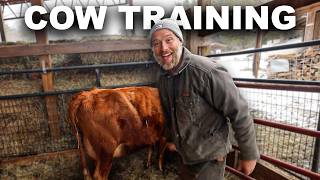
Victor Justin Rhodes trains an unhandled heifer to milk in three days using gentle pressure instead of coddling. He builds a stanchion and funnel, moves the cow from alfalfa luring to hands-free milking, and shares safety tips like avoiding leg-tying and preventing kicks.
Chapters
Happy day! In this vlog, I'm showing you how I trained a first-time heifer to be a milk cow, to be milked. Maybe most importantly, I'm going to share with you what did not work and wasted a lot of my time— gentle training— versus what did work, which is gentle pressure. Give you the step-by-step to save you a lot of time, all while we're doing the vlog. First, let's check on the boys in the igloo and get the cows out of the front yard. Yeah. Nothing like waking up to some cows in the front yard. Okay, we're gonna have to go get the boys sooner than later. They must, they made it, they're not here. Wonder how the igloo held up. Light a bush. Okay, there's your fire. Can I go get the boys now? Light the dog bed. Can I go get the boys now? I don't wanna go with you. Well, why did you want a fire? Okay, are you gonna stay? I'm gonna go check on the boys real quick. Sunrise before screen rise, as Holistic Hilda says. I think the snow is probably weighed down the vents. These cows got out. First, let's check on the boys. How'd y'all do? Good. Are you warm? Warm enough. Are you dry? Yeah, the top of the roof did melt a little bit, get the sleeping bag wet, but otherwise it just melted a little bit. It's dripped? Yeah, probably from your heat, maybe, or just that it's not freezing outside. This is solid piece now. It's icy. See if we can herd them behind the house back to their fields. Hey, Henry's calling me. Can you herd them back? That'd be impressive, dude. You get a bonus if you get them back by yourself. Let's get Henry before he becomes a disturbance in the house. He's moving them. Henry, we're not putting cows back. Do you actually want to do that? Okay, okay, well then you get dressed and you go up there and say hey to the boys. Wow, he's gotten them over there across the creek, which I think is the hardest part. Hey, going right over. Lucky day. That's how nature feeds its animals in the winter— gravity-fed running water. Wow, that was rather uneventful. Gideon got 3 of them. Did you find where it was down? Yeah. Where was it? Okay, good job. First I tried a really gentle approach, and I started a very long time ago. She was unhandled, so we just started feeding her alfalfa and got closer and closer to her as we went. We had to get our collar on her, so we just got closer and closer as she 8. No matter how many times we tried or how long we went, she was sort of getting on to us, and it was actually getting harder to get the collar on her. Top these pigs off. Since she was— she's smart and she's getting on to us, let's, let's see if we can't lead her into the stanchion, trap her head, and get the collar on. This would be really lucky. There you go, there you go. Oh my gosh, last chance. Okay, let it— let her get through. Let her, let her start eating some. Okay, why didn't I do this a long time ago? This is going on like this. Surprise, she went all the way in. Me too. Let's go pretty tight. And that works. Eventually she's just going to be tied up to the side-by-side. And we're going to be milking her out in the field. So we thought we'd train her like that, and we could get her to come over to the alfalfa. We could attach the leash, but the more we did it, the harder it was to do. We, we were going backwards. Then it was time to go on vacation. I said, I'll do— I'll start training her again when I get back. I have to. She's due February 1st. We got back, it soon snowed. I said, I'll train her after it snows. It was February 1st, and she had this baby on her due date. So we tried to lead her in gently, uh, maybe we would get lucky. And because she is crazy for alfalfa, but I saw that wasn't gonna work. You remember what we ended up having to do with you when you had a calf? Wow, this didn't end at all how I thought it was going to. There was a struggle, but it wasn't the one I thought it was. I knew that it was going to be a struggle to train her. She's never been milked. This is a new mama. This is a heifer calf. Essentially, we put up a gate like this in front of the stanchion to be a— to funnel her in. It's solid, she can't jump through it. A net to be a bigger funnel, get her inside the big net, we can herd her inside the chute, and then she'll go in the stanchion. And it worked. Also, what we had to do with Crazy Aunt Phyllis— remember Aunt Phyllis? She kicked me in the nose. Yeah, when we first got her, we had to train her to our system. And she's wild and crazy and we just set up a chute in here. Yeah, you got. You got a little bit of a crazy eye. Hey, hey, hey, hey, hey, hey, hey, hey, hey. That didn't work. She was so nuts. What we learned you could do in that case is put a tarp over the gates like this, and then they can't see it, and it's more of a. a blind barrier at least. So in the worst case, you got a Phyllis, you can do that. What we took, lessons learned from the past, and it's not so much about general approach as it is gentle pressure. We got a big homestead to run, we got other things to do. We can't be fooling around coddling them for half an hour every day for months on end. Just apply some gentle pressure. Work with her. She's afraid of us. Use that gently. I don't have a stick. I'm not hitting her. I'm just gently applying that pressure, and it's working, and she's going in. I'm going to show you now step by step what's happening. This is going to be the third time milking her, and I'm going to try it without assistance, and I'm going to walk you through each step. Okay, number one, prepare. We have some alfalfa here. This is like y'all's coffee. It's a drug. To this. All right, this is like crack. They're, they're not crackheads, they're alfalfa heads. They're coffee addicts. Now, it's not enough to lead her in it. Fear at some point outright overrides it, but it is enough to show her, hey, once I get in here, I get my drugs. When she's released too, she's gonna eventually over time associate this stanchion, this milking as something good. Alfalfa. I've got the leash, I'll set it in place. And we've got a physical— let's just call it a funnel. It's in there in place. You'll need those three things. You'll need those things. You'll need a stanchion. This is a classic hold the cow head in stanchion. Let me show you some tricks to it. It's 4x4s, 2x6s at the bottom, bolted so that our 2x4s here can pivot. That's about, that's about 9 inches in between this, and it's probably about 4 feet tall, the head gate part. And probably the top of this is 18 inches, so the bottom of it is just 12 inches, giving you an idea of spacing here. It's probably 2.5 feet across maybe. And this is a really cool trick. You have a little board on a hinge, so you— we're going to open this up, just teaching you how to build the stanchion right now. And then she can figure it out and get her head in, and once she does, you can collapse these and the boards come down, and then these can't open. And she cannot get her head out until you do this. Now this is supported in here in our deep bedding. You got a bar across there, you got a bar across there. She's kind of getting in the drill. She might do this if you don't have deep bedding. And let me show you what I would do if perhaps we were out in the field with the milk sled. Maybe it's not winter. We have a stanchion on our milk sled. Now you could do a stanchion into T-posts. So here's the same deal— stanchion, okay? And if, if I were to have to train her out here, I would take a gate and attach it from here to here, and then I would do another one from here to here. I would do a T-post to support it. And notice how it gets wider opening here and it narrows as you run her in the chute. And you use her fear of you to your advantage. You can just be behind her and she's going to go forward, and then when she gets in there, she gets the reward of the alfalfa. If you have more complications, you put the chute here, you run a temple grandin, you run a bit of a spiral, and it gets wider and wider. Okay, so then out here it's, I don't know, 15 feet wide, and you run— you know, it could be from there to here— and you run them into this chute and it gets more and more narrow as it goes around. The animal likes to go around instead of straight and curved. Time out. Or sorry, uh, what was that? Does that make sense, Minty? You're probably gonna be a lot easier. You're already letting us pet you, hmm? You're already letting us pet you, but we ain't gonna fool around with anything but just training you to a stanchion, hmm? We're just going to train you to a stanchion. Everybody's going nuts for the alfalfa. The sheep. You can get the sheep to do anything. See, we've got our gate fancily tied up. Alfalfa gate stanchion. I think that's it. Oh, leash, just in case. I'm going to show you how to do this as if you're all by yourself. Don't have children. Maybe she'll go in. Okay, 3 days. 3 days. Sorry, didn't mean to scare you. Send me scary. I get a little carried away there. Austin, you remember what I told you to title this thing? Uh, the name of video is How I Trained My First Time Milk Cow, parentheses, Step by Step. No. Call this how I train my first-time milk cow step by step in 3 days. I think it's worthwhile because she didn't act a fool. I didn't even need to use this. I'll just walk you through it. You could go— would you rather go back to the live action or would you rather walk through it? Go back to the live action, Austin. The last times we milk her, show them some clips. Day 1, day 2. I might try. I might try. Let's go. We got her in the stanchion. More alfalfa coming. Do you need me in there? Maybe. Just one second. He's really close. I'll explain what happened there and what— why it worked. We had a stanchion— or sorry, we had a gate. It's more open, it's more broad. Okay, we get her in this general area, we get the calf over if we have to. They get kind of crazy about their calves, especially the first few days. She's already chilled on it, she's already okay with leaving it a little bit. If you have to, put the calf over there Put a collar on the calf, tie it up near the stanchion, have somebody hold it over there. It could be because there's not all the kids about that she went in there too. Hold this, uh, gate open, she gets in there, you use— she's in there, you, you, you just kind of use this, closing it, making it tight, just ready to jump out of the way if you have to. You don't want to die for this. You know, first day we had to leash her and then kind of coax her through. Second day, we didn't need the leash and we're just kind of pushing her, pushing her. And then eventually you could even, you know, there's no— she can't even turn around. She has to go through you or through this wall. Go to the alfalfa. Good choice. Stage 1, prep. Stage 2, getting her in the stanchion. Stage 3, milking her out without getting kicked. You saw on the first day, we just weren't taking any chances. We left this gate on her as a squeeze, you know, it kind of squeezed her. She's only got so much movement, she can't kick through these and get me. One of our family members had said, oh, we could tie her legs if she's kicking. I don't like that. I don't like that because, uh, I've done that before and the cow has tripped and fall, and then you have a fallen cow in the stanchion, frantic, scared, can't get up. It's scary because it's like a horse, if they break their legs It's over, you're eating them. Thank you. How to milk a cow without getting kicked. Get up right beside her. This may seem scary. You wanna— ah, she just stepped on my foot! It may seem scary to get close, but if you're out here and she kicks this way, she's like— when you saw Flossie kick me, right? Okay, unfortunately Flossie was not showing any point of aggression that day, or possible aggression. So that's why it's milking like normal. When you first milk, you have the advantage of going in on the defense. It's like if I punched you right here and you're far away, I could get you. But you know, you see the boxers, they, they clinch and they grab each other because you can only do so much damage from close up, even though it's scarier. Let her know I'm here. You gotta squirt the first few out. All right, see? And you don't stop. You don't stop until you're done, not her. Or else you show her, oh, I'll kick, and it's over. You don't want to show her that, okay? See, I'm still real close. She might knock me over, but I'm not gonna at least break a bone. And maybe I'm just milking with my right hand today so she gets used to this. Both hands. All right, see, this is the third time in her life she's been milked. They come from a long line of milkers, so it's in their Genetics to do this. She pees or poop, just hold the bucket away. And they give you a little bit at first. It's colostrum. It's colostrum-y. The sooner, right after birth, it's got the most amount of colostrum. Then it, it wanes, wanes, wanes. And then she'll, uh, her— it'll, it'll be what you call, uh, milk comes in. In a few days it'll just be like explosion of milk. She's not even rushed to come out. She kicked me a couple times today. I think that'll get less and less over time, and when it does, we might just tie her up to the side of the stanchion instead of in it, just as she's eating her alfalfa. Eventually she'll just be milking in the open in the field like everybody else. Notice I didn't quit when she kicked me. Don't. You cannot. That's like if you get kicked off a horse, they say you got to get right back on. Or that— or, or the horse wins and you lose, and, uh, you got to show— you gotta not reward it. So the reward is you got in the stanchion, you got your feed, and now the reward is when I'm done, when we're done milking, The reward is you can get out. Not when you're kicking. And if she were kicking at the end, I might wait until she was more calm. I might rub her udder. I might sit down there until I get progress and then reward her, her by releasing her. Some tricks if she doesn't stop kicking is to just stay down there, keep rubbing her udder. You've got to milk her out, so because she's in milk. So put the gate up eventually, or just stand there beside her and just with one arm milking her. And you might have to milk it onto the ground, and that's okay during the training process. Some common mistakes and safety notes: one, you wait till she has the calf to do this. It may look like that's what we did, and I guess we did, but we didn't not work on her, okay? We didn't not feed her some alfalfa in a pan, try to get her to put a collar on. It is still good to be working on her getting used to you. In the future, whoever gets this calf, whoever gets February, I would suggest, yeah, get her some alfalfa, try to get her used to you, try to get it to where you can pet her, get a, get a, uh, get a collar on her, get at least where you can get a collar on her. I would just start training to the stanchion. I think we're too ambitious trying to get her trained just to the field. Let's train her to the stanchion first. And you saw how easy that was. And we could do that before the calf comes, like we did with Vanilla. Inconsistent timing— once you're on this, you need to do this every day. She's in milk, she needs to be milked about the same time every day, maybe an hour-ish in difference. Come out here, same routine. It's the alfalfa, it's the stanchion, it's this gate. Cows like habit. Don't give up too soon. It's very frustrating. It's part of it. All good things come, come with a price. It can take 7-14 days till she gets used to this routine. I said she got used to it in 3 days, probably because of our preliminary work. Don't give up. Give it 7 to 14 days and you're good. Don't take it personally. Don't milk in anger. They don't speak English, but they do speak energy. They know when you're angry and it— and or nervous, and it transfers over to them. So take some deep breaths. Don't take it personally if you get kicked. I mean, you are grabbing their udder. Imagine if that were happening to you ladies, you know, and getting milk out of it. We're a totally different species. We're the dominant species. We're milking it, okay? It's going to be an experience for them at first. Key takeaway here is just Good management, gentle pressure, right? Harriet, get in. Can you get her some water? You're good, Mama. You're gonna be a good milk cow. The boys are ready. I'm ready. Are you ready, Harriet? I think it's time to blend the cows. We've been separating them just for them to get used to each other. You think it'd be all right? Uh, we wanted mom and baby to bond. Harriet is third on the pecking order, so we didn't want anything to happen. I think this calf is spry enough to keep away from the cows, not accidentally get stepped on. Cows are pacifists, and they'd know better than to kill their own species. But she don't even care. I thought she'd at least go smell her. Look, vanilla goes smell her. See, like, big deal. Honey goes right for it. You go right for it, honey. You're waiting in line, Vanilla. Don't get stuck in there. Did you fart? Hey, don't you know that's global warming? That's a joke, by the way. That cow farts, but she sure does make— look at all this. Hundreds of pounds of compost a day on these cows. 50 pounds of manure every day mixed with these wood chips. That's a lot of compost. I think you're making up for your farts. All right, we're gonna have to shut them out because what's gonna happen is— come on— they're gonna get in there and get stuck.
Come on.
They didn't think nothing out of that calf. The calf's not alarmed. Add to our colostrum collection. Done showing you the heifer training. Don't leave though. Hear that noise? You'll want to see what the boys are doing on the bookshelves, and we're going to do same things outside with the cows that are often neglected but super important. Some thick colostrum from day one. I'm excited about it. I think we— once we get a quart, I have plenty enough to make me some colostrum custard. That might be today. Whoa, whoa, that's today. I think we're good. What are y'all doing? Up building shelves. Yeah, that doesn't look like shelf constructional. Hey, you got one side done. Next side, except this one's got to go all the way to the roof. This is where I like to keep my salt licks. Henry, you want to go with me to do minerals? No, I want to ride my bike. Okay. Taking care of basics. This Redmond's salt on a rope, excellent. The way this works, there's been a hole drilled through the middle of this rock of salt. It's just pure salt mined from the mines in Utah. I would say they need it. Ike's trying to eat it. How about let's get this chore done? If we get done in enough time, We'll start that colostrum custard. 16 different minerals. Whoa. All right, man, my work cut out for me if they all look like that. They're not gonna eat that. Now that'll become compost. Best way for marking your minerals: mailbox lettering. You screw it in, they can't rub it off. Markers don't work. Too cost prohibitive for branding kit. This is what we found for now. You can only do 2 minerals, kelp, and then salt's over there. Don't worry, we got you some minerals. She's given so many minerals to that calf. It's very important that you make sure she can get all she wants. Look at all these, and she'll know which one she needs, which one she doesn't need. 3 more, huh? Yeah, I know you would think that they were dying. I cannot wait. We're gonna have a Florida ceiling library like the Biltmore House. One more to go. That's gonna have to wait till tomorrow, hopefully, Lord willing. The creek don't rise. Supposed to be more snow, hopefully. We're putting these books and those books on shelves tomorrow. One more treat for you guys. Hey Jonathan, how's it going? Good, how are you?
You're off to a good start?
Yes sir.
We got the Quick Plant fabric. You said, uh, you wanted something for onions, so I grabbed one of our, um, 4x8, so it's 4 rows in a bed with 8-inch spacing. Heck yeah, that's a a great pattern for—
what else would be good for onions?
Um, you know, uh, head lettuce, you could use lettuce, um, you know, kale, lots of different stuff. Yeah, yeah. Uh, well, kale, kale, you would want a little more spacing, so you'd probably want to do like our 2x18 spacing. Um, that's better for spinach.
Yeah, you could do— yeah, I mean, definitely do spinach. You could do more than one 8-hole for the spinach.
Yep, so it comes, okay, you know, ready to roll out. Um, yeah, the holes are burned in it, you can see that here.
So it's, uh, that's game-changing.
It's really, uh, intended for like roughly a 30-inch bed. Yeah, and you have some margin that'll blend out into your pathways to keep those, yeah, weeds from getting crazy there.
And, uh, yeah, this, this, this changes the game because virtually zero weeds. I mean, there's some does come up through the hole. Yep. And two, we used to have to burn our holes, and it almost made it not even worth it.
Yeah.
So now you've just come in.
Yeah.
And now we got holes, I mean, pre-burned.
There's plenty of people that have spent hours and hours and still do, you know, burning their own holes.
Yeah.
But it's just a mess, and then you're, you know, potentially exposing yourself to those fumes. And, and a lot of people do it directly on the soil, which to me seems like a bad idea, like lay it down and then burned and you're just kind of— yeah. So this is a solution where you can just get all that dirty work done for you. We produce this in our facility, so we've invested a lot of, of years and, and money into the machine that actually produces this. So if you ever come and, and visit, you'll have to check it out. It's pretty, uh, pretty cool.
Made in America, Tennessee.
Yeah, so we buy the product because there's no manufacturers of the woven landscape fabric in the US, um, unfortunately, at least None that I'm aware of, and I've talked to a bunch of people. So, uh, so the— this product actually comes from India. Um, so we import it and then do the processing and distribution from our facility.
So yeah, we used this last year and it was absolutely a game changer to get our feet back on the ground after the hurricane.
So my family, um, has used this extensively, and we have obviously lots of customers in it. It's a UV-treated product, so it's stable. Um, you want to make sure you buy from, you know, a reputable source because I've seen people— in fact, we had somebody locally that had purchased some of this from, you know, just some cheap online source, and it just completely disintegrated within like a year, I think. And so then you're dealing with a real big mess because you get all those little fibers that are breaking down. We definitely don't want that. But this stuff will last for years and years.
So with yours, the plastic, is it— the leaching isn't such a big issue?
Yeah, I mean, there's— you're gonna get a lot of controversial takes on that for sure, but The— what I can say confidently is that it has UV treating and it does not degrade like a polypropylene that would not be treated.
That's it. Cat doesn't take advantage of the box. He's like a chipper.
I mean, the other interesting thing about this is it's not just about weeds. You're actually benefiting the plants because they're not fighting for nutrients.
Yeah.
And then this also actually retains a lot more moisture in the soil, keeps the soil—
yeah, it sources more mulch on the soil too, keeps the soil temperature cooler.
So we've consistently, from our personal experience and also hearing from customers, um, heard reports of higher yields and crops just— yeah, you guys experienced that from what I remember with your sweet potatoes.
Oh yeah, potatoes, they were great.
Massive. Yeah, and my family's experienced the same thing. Uh, highest yield broccoli Yep.
Okay, I got to show you what your high tunnel's up to this— oh, I can't wait to see it this winter. Jonathan and his company not only donated a high tunnel, they came and installed it after we lost ours to the hurricane. That was the greatest gift we could ever imagine. Got us back on our feet for our garden. Been amazing. Now look what it's doing in the winter. Yeah, it's awesome. That's not on, by the way. Check it out. Oh, they're happy. Feel how warm that is? Yeah, of course he knows. I wish you guys could feel this.
Oh yeah, you're gonna stand back like a mean old goose. You can feel the heat just radiating out. And it doesn't look like you've had any issues with the chickens like pecking the plastic?
No, no, no, not yet. We're prepared. We'll just put another layer of tin if they start doing that. Yep. Yeah, and it might be that we need to raise it up and we'll have to put something down, poultry wire or something. And then we'll just build the bed back. They're adding soil by breaking down the wood chips, and then we'll just build the beds back. Jonathan, a good guy. You can check out his stuff at farmersfriends.com/justin for all the stuff we use from him, from silage tarps to high tunnel to weed fabric. Definitely check that out. We're going on a podcast together, that'll be out later. Happy day.
More from Justin






If I had to start my Homestead all over again, it could only pick one animal… 




