This content was created by Victor Justin Rhodes. This content was uploaded by Victor Justin Rhodes. This is a YouTube video titled "How I’m covering my Garden without Mulch (Annoyed)" (created 2018-12-24). It’s an informal farm/homestead vlog featuring a primary host (Speaker A) with others present (Speaker B), a guest clip from JM Fortier, and family/helpers (Jonah, Randy Kleiman, Aunt Phyllis). The content is a hands-on demonstration and discussion of no-till and garden-covering techniques—using silage/black tarps to smother weeds and protect beds when mulch or cover crops aren’t available—along with scenes of pigs, chickens, and cows helping, measurements for tarp coverage, reflections on one year of building the homestead, and a mention of a 12 Days of Christmas email giveaway. Tone is casual, instructional, and on-site.
Chapters
Just happened. People said it would happen. I don't know if I believed them, but it's happening. A chicken is on a pig. Watch, it's gonna go picking and scratching. What a fun relationship, those two. A chicken on a pig. I've never seen it before. They said it would happen. It happened. There's also something else today that I've seen it, but I've never done it. Chances are you haven't done it either, but it's going to be really handy, especially if you don't have certain resources.
Good morning, cowboy.
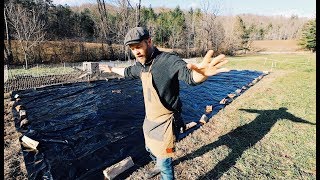
Good morning. How much can I put in this? Okay, they don't have much scrap, so give them 4 pounds of grain. Nope, that's my low tunnel plastic. This is probably it, way back here. I'm gonna make it. They make it close enough. You see, I have this problem. The pigs and chickens doing a wonderful job tilling this area. They were here 2 weeks, tilled this 1,200 square foot area in just 2 weeks. They're on to their new job, but this has to be covered. Mother Nature loves to be covered. So if you're like me and you want to cover your gardens and say, hey, mulch is your first choice, but you couldn't get in here with the mulch trucks— it's way too muddy because that path, huh? Yeah. And I guess you could use hay, but you got to have a really seed-free hay, and hay is kind of expensive. That kind of hay is expensive, unsprayed. Unseedy hay can be hard to find. I've got a little bit spread out on there. Yes. Yeah, no, I haven't, but I can if you come. So we're gonna do silage tarps. I first saw those at JM's farm up in Canada, JM Fortier.
We never till and we use black tarps to clear the beds.
Wait a minute, you never till? How do you never till?
We don't till. We just, when we're done with this crop. Now we're harvesting here. We do intense biointensive, uh, production here, so we are creating super healthy soil because we don't turn it, we don't rototill it. And then we can gang up the crops really close together.
Yeah.
So that the leaves, they form a canopy, so it creates like a cover, which is good for the soil and the insects and the animals in the soil. And when we're done, we just put a black tarp over it.
Ah, that's the test. What's gonna happen here? You've been done? You're gonna black tarp it? How long do you keep the black tarp on it?
Well, it depends what was there before, but you see that when you remove the tarp, it just kills things that were there.
Wow.
Cool.
So once this is dead, and it's almost dead, another week, then we just use another tool called a harrow, which is about an inch, and we just recreate a new seed bed and then we plant right back into it.
Okay. And then my friend Casey Oswich reminded me of that more recently. It's just a wonderful accessible way to cover the ground, prevent weeds from coming, keep it soft, get it ready for planting. You pull it up when it's time to plant and just go. So we're going to try that. We'll also try mulch. Why not try a couple of different things, experiment, and see what works out better. Yes.
You help me get the pigs?
Sure. Where's the cookie? Oh yeah, okay. All right, here, I'll get the pigs, you get the chickens. We're gonna do the silage tarp, but we're gonna have to do it later. First we got some things to do. Hey, why don't we go move the ICs, check on them, check on how they did with the blueberries? This right here is where we first moved the blueberries. Randy Kleiman was pointing out that The leaves are long gone. The leaves are long dead. We don't need to worry about those. Let's watch out for the roots with these raspberries. Jonah, do you think maybe we could put them— maybe we could run the fence long and just cover this entire patch and just leave them here one day, two days? No shelter? No, they'd have their shelter. Come on, see you guys. Pants inside out, is that the style? Yeah, socks, socks upside down and over the pants. Okay, we've had these cows 10 days. We're just still getting used to each other. This one is not kicking me anymore. How you doing it, Nellie? Got it, kind of. I got her. She's starting to know the drill. Are you doing okay? I'm gonna get you to Mama. Good morning, Aunt Phyllis. Go see your baby. Hey, hey, hey, Laurel, you gave it your best effort. Plus, he ain't never done that. Every day we get a little better at this, don't we? Cows and cowboys. Mr. Brown, try, try some yogurt, buddy, and tell us how it is. So smooth. Oh yeah, you got some on your shirt too. How is it? Yummy. The question is, are you gonna eat all that? Is everybody gonna eat all their yogurt?
Yeah.
Jonah putting berries in his. I think it's a hit, Mom. We just realized something. The Great America Farm Tour. We rolled home today, one year ago, December 23rd. I laid down somewhere in here. I'm gonna lay down right there. Okay, this is all we had. 10-ish acres, 3 chickens, 3 chickens, family of 6. Started over, built this homestead in one year. Mind blown what can be done in a year. It's absolutely incredible. Among many other things, we got more chickens here, herb garden, keyhole garden bed. We have established 1, 2, 3, 4, pretty much 5 animal garden miracles. Well, that's just right here. We had Couple of pig gardens here. Oh, we had two animal garden miracles down there. Oh, we got all these crop chickens down here. We got pigs, sheep, a cow, more cows, a dog, kittens, built a greenhouse, built low tunnels. It's been crazy. All right, let's cover this. When you can't get mulch, cover crops won't grow. Let's cover this. This is actually 24 foot by 100 foot, so that's perfect. Actually, my gardens are 24 feet wide.
They're not 100 feet long, they're 50 feet long, so I just need to cut it in half. Perfect.
Just gonna double check my measurements, make sure we're 24 wide, 50 feet long. Yes, we got it covered! In closing, my thoughts on this: I'm excited to have the ground covered. I'm sure with the black tarp it's going to keep it warmer, it's going to encourage worms. That's a good thing. I'm discouraged because I couldn't add organic matter like mulch or cover crops because cover crops aren't going to grow this time of year. But it's what we had. It's what we could do. Realistically, we couldn't get trucks in here this week. Realistically, we needed to get this covered. So this is our solution. I hate, hate that it's plastic. I would love to get away from plastic. That's why I would encourage the mulches. But you know, the mulches are more labor-intensive. They do add organic matter, but you know, the animals help us spread them, but they don't spread them all the way. We have to spread them, but it is a good workout. So there's pros and minuses to this. So I think moving forward I'm gonna try to use mulches as much as possible, get a nice workout spreading it, have the animals help me spread it. But I gotta get a— I gotta get away to get in here. It's just too wet being winter. It's always wet here during the winter. That would be the goal. But also, you know, let's see how it goes when we come back through and it's time for the planting in here, it just might be so smooth because this is going to smother out lots of weeds, zap the energy from the bigger weeds, the bigger roots. This is going to be really easy to work with come planting time. So we're just going to see. I might change my, my thoughts after the, uh, after we've come through again. And speaking of balance and design and trying to work with nature to minimize Input maximized output. Guys, the 12 Days of Christmas is coming up. You know that, right? 25th starts the 12 Days of Christmas. I've got 12 little gifts for you guys. Should I surprise you? Should I surprise you? Because it's coming out tomorrow. Those of you who are already on my email list, you're good, you're in. I'm gonna send you a little something. Those of you who are not, you can sign up tomorrow. And get it, get the first gift, drip out one gift every day. I've got 12 of them, something I already created. Sort of give you a hint with the, you know, working with nature, maximizing output, minimizing input. I think that's enough hint. I don't think I need to tell you. That's coming tomorrow. If you're not on my list, you can sign up for it. Yeah, yeah. Christmas Day begins. Merry Christmas. Coming. Got a gift for you.
Hello, hello, hello, hello, hello, hello. Go jump in that bush. Get mad. Hit the wall. Climb the wall. And then—
Okay.
Head over there. I'm recording. Jump up. Go. Bush. Um, hold the dog. Everybody could do that. All you need to do is— You know what people can't do? They can't ride a doggy howie! Best idea! Go!