How Joel Salatin uses PIGS + Chickens to Fertilize his Farm
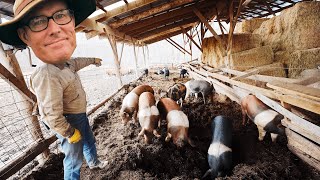
The video follows a winter visit to Joel Salatin’s Polyface Farm, showing how the farm uses a deep‑bedding “carbonaceous diaper” system to manage chickens, pigs, and cows. About 800 laying hens are housed on 18‑inch wood‑chip bedding that is left untouched for the season, with occasional stirring and the addition of whole‑grain to stimulate digging. Cows and pigs are moved onto the same bedding, where they dig for corn kernels buried in the wood chips; pigs work from the top down while cows work from the bottom up, creating a leader‑follower dynamic. Every fourth bedding layer is “junk hay” to balance the carbon‑to‑nitrogen ratio (≈30:1) and prevent overheating. Manure and urine are absorbed by the bedding, which ferments in a low‑odor, low‑heat environment, producing a nutrient‑rich compost that is later removed with a front‑end loader and used to grow vegetables. Salatin explains how the system scales both up (1,000 cows, 5,000 layers) and down (under 30 acres) and introduces the “carbon shed” concept for storing and drying bulk wood‑chip bedding. The video ends with promotional information about Salatin’s books, Polyface Designs, and upcoming shipping schedules.
Chapters
On our way to Polyface this morning, picking up a U-Haul. We're at the U-Haul in Lexington, Virginia. My assistant Heather, bless her heart, she knows how to get a good deal. It's cheaper to rent it. Makes sense. A lot closer to Polyface than from Fletcher, North Carolina. So it's here. That's a good thing because we've been driving like 4.5 hours. If it wasn't here, I don't know what we would do. All right, next up, driving to Polyface. How's the drive so far, Jason? It's good. You are a good, uh, chauffeur, buddy.
Good, we're almost there.
You're doing good. You feeling, uh, tired yet? All right, what time did you wake up? Woke up at 2. Okay, tell me you went to sleep at before midnight. At 9. Okay, good. So got okay sleep.
Okay.
Jason, we're almost there. I'm excited. Yeah, never been there in the winter. Have you been here in the winter?
No, not at all.
Interesting. Yeah, books there, books there, books over there, books everywhere. Jason is my official sound guy, B-roll guy. All right, let's go in the shop. Let's see what's going on. This is the operation, huh? Yeah, man. Hands sore yet?
Yes. We are almost done.
Is this it?
I think so. A little bit less than that.
We got 6 boxes, so it's gonna be 5 pallets. Okay, so I mean, we could put 3 in there, and if you want weight in your trailer, we can get them on there.
Let's do it.
How you been?
Good, good, good.
First time since such a sale.
Yeah. Oh man, we need some straps.
I didn't come prepared for that, but somehow I have 2 straps, only 2 sets. You're gonna be carrying one of these back on the horse trailer. You ready for that, Jason? That's, uh, they estimated 2,000 pounds, but I figured a 2-horse trailer. Yeah, it's probably rated about— I think it's 2,400 pounds this trailer is rated. So I'm with Joel Salatin, Polyface Farm. And how many chickens you got in there, Joel?
Uh, there should be about 800. Okay, yeah, we figure 3 square feet per bird. Okay, and these are, uh, these are 20 feet by 120 feet, 2,400 square feet. Yeah, divided by 3 is 800.
I noticed you got to walk pretty close before you smell anything in there. What's the secret?
Secret is deep bedding. Yes, deep bedding, carbon, carbon, carbon. We call it the carbonaceous diaper.
So, uh, yeah, that's about 18 inches of wood chips right there. Yes. Uh-huh.
Okay, yeah, it's about 18. It's built It's built so that you can come up, you know, not quite 2 feet, but certainly 18 inches easy to get your weight up.
So you put 18 inches in there once, and then did you— have you added bedding as the season progresses? No, no.
All we might do if it caps and they can't— they don't stay ahead of it, we might just go in there with a potato fork and just kind of stir it a little bit. Just to help them keep up with it.
Okay.
But no, generally we put in the one, the one big batch, and then they, you know, they kind of keep it churning through the winter. We also, we add whole grain to the bedding, and they eat about 75% of it, and 25% of it filters down in the bedding, and then it sprouts. And that stimulates them to, uh, stimulates them to dig in the bedding to get fresh fresh grain sprouts.
Okay, and then in the spring you'll just come in with a machine, right, and haul all this out?
In the spring we'll just open these doors, come in with a front-end loader, haul this out, and then we'll plant tomatoes and peppers and squash and stuff in there—
vegetables.
It's the second day and Fred's here bringing some rocks.
Gonna dump his— I think his last load.
We'll put this really nice rock wall in. Chicken's down. Now we're up here at the cows. This is going to be as much for you guys as it is me. Because as you know, we're about to put our cows and sheep on the deep bedding.
We started those cows on this side. Okay, so this is the, this is the bedding buildup. So they're digging for the corn that's buried down in here, and they've already, you know, they've already come across here.
Yeah. And for those that don't know, you do do a layer of corn as you add wood chips throughout.
So you can touch that, or you can smell it. Oh yeah, then touch it. See, it's warm.
Yeah, it's warm.
The pigs, of course, they start, they start at top, and they return it and get lower and return and get lower. So now they're, they're working down. So what we did, we started here with little pigs and let the little pigs go down as deep as they could go. Then we brought up the big boys.
They're going at it, and they're going on.
So it's kind of a leader-follower. You can see the corn he's eating. If you come around here, you can see the corn he's eating right down in there. He's getting that corn, and pretty soon he'll root up another.
Oh yeah, I see the piece. I see the kernels. Yeah, you gotta think your earlobe might taste a little better than that corn.
And see, he'll— I mean, the amount of work. When these guys finish, then we think that those guys will be done over there and we'll just flip them.
Those cows?
Well, we'll clean this out. Okay, clean this out, bring those back over here.
Okay.
And restart, and the pigs will do that, and they'll come back over.
Okay.
Oh, look, the word of the motherlode got around.
Yeah.
So you put down your wood chips, uh-huh, and then you let the cows manure it for a bit. And then you, what, about a week?
It depends on how many are in here and what the weather's like, but yeah, usually a couple times a week. Bed a couple times a week, and about every, you know, about every 6 inches we throw on, you know, a couple tons of corn.
Okay.
And the cows tromp all that in. And also every 4th bedding we use old junk hay because if you use only wood material sawdust, wood chips, shavings. If you use only wood material, the carbon-nitrogen ratio is so high that it gets too hot, and so it fire fangs. You notice how the color is so nice on this? Yeah, the color is really good, and part of that is because— so The, the forage would be like rained-on hay, moldy hay, just junky hay. And so every fourth bedding, we just put down about twice as much hay as the cows would eat. They eat about half of it and poop on the rest. But that hay, you want carbon-nitrogen ratio to be somewhere about 25 or 30 to 1. Well, the wood material is going to be somewhere between 250 and 500 to 1. The junky hay is going to be about 35 to 40 40 to 1. So, so that we call that, we call that softening it. It softens it and brings the CN into ratio so that you get this wonderful gentle, uh, gentle heat as opposed to a fast, you know, a fast fire-ish type of heat that then turns a lot of it into ash rather than, uh, into the bio, you know, the biological activity that you want.
That makes sense. So that, that's sort of the end.
This is the end. Here's the beginning. Yeah, here we're feeding the cows So this is the, this is the build, the build out. And, um, so these, these feed boxes are, are just hanging on these pulleys, and you can see a winch. There's a winch right there.
Yeah.
And we can just winch these, winch these boxes up as the, as the bedding builds up.
And so This bedding, this was the hay layer. Yeah, you had mentioned what your fourth layer is. Hay.
Put a hay layer.
So this is a hay layer.
Yeah. So, okay, so here's the, here's the corn. And see, it's not very soft because it just, it just got put in there. Okay, smell this compared to over there. Yeah, see, it almost smells like silage. Yeah, because it's fermenting.
Yeah.
So the cows are tromping out the oxygen, and this whole, this whole pack is fermenting. Ah, and that's what ferments the corn. And, uh, and of course this carbonaceous diaper. But, but you notice it didn't smell.
No, there's no odor.
There's nothing leaving here.
No.
And, uh, so the cows are, the cows are naturally dropping, you know, manure and urine that is, if it gets dry, it wants to vaporize, and if it gets wet, it wants to leach. And so this carbonaceous diaper binds those.
There we go.
There we go. So each of these cows is dropping 50 pounds a day. So with, with 60 cows in here, that's 3,000 pounds of sloppy goodies a day. So it takes a lot of material to soak, uh, to soak all that up.
Your tour in the winter is very short, but right, you get to rest, you get to write books.
That's right, that's right.
2021, what's coming?
What's coming is, um, is, uh, homestead animal happiness. And so the whole idea of that is You know, when I first started speaking around, I'd get done because, you know, we started as a glorified homestead. Yeah, we had, you know, 10 or 12 cows and the fertility was awful. We didn't have any grass and my first eggmobile was, you know, 6 feet by 8 feet and so on bicycle wheels. And so when I'd get done with my presentation, people in the audience would say, oh, that's, that's sweet, but how does it scale up? You know, all the guys here, I gotta get going here. And, uh, now, you know, we're running 1,000 cows and, you know, 5,000 layers, and, and the thing is gone. And I get done now and everybody says, well, that's amazing, well, how does it scale down? I've only got 5 acres or 10 acres or whatever. And so for me, I can move seamlessly between kind of that, that homestead world and the commercial, you know, larger-scale world. I can do that easily. What I've found is that most people can't navigate that, that terrain easily. And so what I'm doing is I'm taking all these concepts and I'm scaling them down in language and, and type to enable the homesteader, the small acre, what I call the small acre person, you know, anything under say 30 acres, the small acre person to be able to take all of these concepts and adapt them to small scale. So this is the carbon shed.
Okay.
This is the carbon shed where we store everything. And the beauty of this is that it actually, it actually heats up in there and dries down. So the, the idea is that you don't want, you don't want to put in wet chips, right? Because you want all of the porosity the porous spaces to be able to absorb urine.
Okay.
And, and if, if it's already full of water, you know, because you're storing them outside, or, or they're, they're fresh green, and so we push them in under this roof, and, and, and, uh, the, the packing, it actually heats, and the heat then dries them down.
Okay.
So that's a, that's a cheap, simple, if, you know, again, um We let time be our friend.
Yeah.
And so it's cheaper to build enough storage to be able to get these in a couple months ahead of time and let time dry them down than to need to use 2 or 3 times as much because they're already— because they're not dry, or to try to dry them artificially.
Obviously. Jason, how do you think it went?
I think went really well.
Polyface in the winter, it was awesome to see. It's awesome. Pigs digging through that. We caught the pigs digging in the compost, apparently a rare event to catch on camera. So excited about that, guys. That's a glimpse of Joel Systems in the winter. I mean, if I were to put the whole thing on there, it'd probably approach an hour. So what I'm going to do with that extra content, if you want the extended tour. I'm going to throw it in with all you lovely Polyface Design customers. And if you guys want in on Polyface Designs and you're not, now's the time. Get in there and you'll get that. We'll create that bonus and get it to everybody and any bonuses we make in the future. So many builds in the book. Great way to make your homestead or farm better. You've seen me implement it on my farm. I can't say enough good things about it. I'll leave info on that down in the description. We've got a trailer load of books. There's 4 in that U-Haul. There's another run over the weekend. These are all past orders. Anybody ordering during the month of January, forward, we get to ship those in February. Joel needs some time to catch up on shipping out all the, all the other books that, that he's sold. Stuff like that. So if you're seeing this, you want in on that next order, those are going to start shipping in February. We're starting to ship our own out, so they'll go through my assistant's hands, Heather. So get in there. There are plenty this time. There's no like rush in order. I think Joel ordered something like total of 10,000, so he's got over 5,000 left. So just get in there, enjoy the bonuses, get building. 2021, here we come.
More from Justin






If I had to start my Homestead all over again, it could only pick one animal… 




