How Joel Salatin’s Farming Style CAN Feed the World
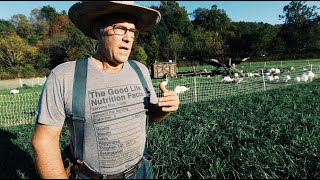
In this on‑location interview, host Victor Justin Rhodes walks through Joel Salatin’s farm in Swope, Virginia, while Salatin explains how his intensive rotational grazing system transformed a barren, thistle‑covered landscape into a thriving, clover‑rich pasture. He recounts the farm’s history—from a 1961 arrival after a failed venture in Venezuela, through early hardships with few cows and limited equipment, to the breakthrough of installing a permanent one‑strand electric fence that enabled daily cow moves. Salatin describes how moving cattle every day dramatically increased stocking rates (from roughly 1 cow per 10 acres to nearly 1 cow per acre), boosted soil health, and multiplied earthworm populations, providing tangible evidence of regenerative soil. He also shares the financial and lifestyle strategies that made the transition possible: living frugally, cutting expenses, saving a nest‑egg, and leveraging low‑tech solutions such as a chipper, composting, and homemade fencing. Family legacy is a recurring theme; Salatin reflects on his grandfather’s tinkering, his father’s dream of farming in a developing country, and the multi‑generation journey that finally brought the farm to life. He touches on personal health anecdotes about drinking cow‑water and microbiome talk, illustrating the farm’s holistic ethos. The conversation concludes with a preview of the upcoming On‑Farm Mother Earth News Fair, a large community gathering intended to showcase sustainable agriculture, connect vendors, and invite thousands of visitors to experience the farm’s model. Throughout, Salatin’s tone is conversational, enthusiastic, and proud, while Rhodes interjects with curiosity and admiration.
Chapters
Yeah, you got a lot of clover here.
Oh yeah, yeah.
Goodness.
I mean, this, this is, this is pasture.
This is premium. Is this the original land?
Okay, so it didn't look like this when we came, I can tell you.
That's what I was going to say. So look, this is what, 50% clover? Yeah, 60, 70.
Yeah, plantains.
There's bugs everywhere.
Yeah.
Plantain. What else?
Well, fescue, orchard grass, red clover.
You've grazed something right here.
Yeah, yeah, this is where—
what was here?
The sheep and the turkeys have just come through here. So what did this look like if we would have walked here back when you could have walked the whole thing and never set foot on a piece of vegetation?
Are you serious? Now what year was that?
1961. Okay, we, uh, we arrived back in the States Easter Sunday 1961.
Do you remember that? Because you were young.
I remember that. I remember the ship, the ship ride back, uh, on the ship. And I remember some of the trauma there in Caracas just before we left. But I don't— I mean, I don't remember. Yeah, just, you know, little stuff. Yeah, it's just big stuff.
And for those that you don't know, that your father's dream was to farm in a developing country. That was Venezuela for him.
And he wouldn't have, you know, as he was developing his dream, he wouldn't have minded whether it was, you know, Peru, Bolivia, Colombia. You know, that didn't really matter. It was just the idea was to go to a developing country. He saw that as a new frontier, you know, open markets. I mean, it didn't work out not because the farm didn't work, it was because the political instability You know, we couldn't get, we couldn't get protection. And so we ended up, you know, as the guerrillas came in the back door, we left the front door and lost everything and came back to the States. There was no, there was no place for us there. Of course, now looking back, we're actually grateful because if we had stayed and been successful, we probably would have been successful with Dad's genius. Okay, yeah, we probably would have been successful. Well, look where we'd have been today. Who would want to be in Venezuela today, right? And, and, and, and we'd have had, you know, at least, at least we lost little, or lost—
that's true, we lost it.
Okay, we didn't lose it, you know, when it became something significant.
We're with Joe. We're about to go move the cows this afternoon.
You know, we got here and I mean, there were 16-foot deep gullies. There were rocks. A lot of these fields, I mean, you could walk the whole farm and never set foot on a piece of vegetation. There was that much bare ground between. Thistles. I remember thistles. As a kid, I mean, when we made hay, it looked like it was a snow blizzard, you know, thistle seeds. And now you'd be hard-pressed to find half a dozen thistles on the whole place. And, you know, at the beginning, I remember very well when I was early teens, we had, you know, 10 or 12 cows. And barely had enough to feed them. And as, you know, as a 12 or 13-year-old, I started driving the tractor and raking hay, and I would rake 10 swaths, 10 swaths together to get a little windrow you could barely see. And I mean, today, one swath is all a baler will pick up. Now, I mean, now we make as much off of 1 acre as we used to make off of 12. Wow. It's just mind-boggling, you know. And I don't say this proudly. I say it gratefully and humbly that these systems work. That they just work, you know. And when the naysayers, oh, you can't feed the world this way, or, you know, you know, you can't keep stuff healthy or be productive or blah, blah, blah. You know, it just— don't talk to me about that. You know, I've, I've watched it in my lifetime. I've watched it. I mean, you couldn't find an earthworm field. The ground was brick hard, like clay brick. Now it's, you know, it's, it's soft, resilient. You come out here in the spring with a tape recorder And you can catch the sound of the earthworms sucking in as you walk across the field. There's that many earthworms. So yeah, it's been a big change.
Joe couldn't fit us all in a four-wheeler. That would have been awkward anyway. We're catching him though. He's going to be setting up. He likes to move them cows. This isn't the first time I've come. I've only been here so many times. This is the second time I've moved cows with him. So he's got a Premier One solar energizer right there. Yeah, IntelliShock 60 Premier One. Well, don't touch it. Don't do nothing with it. He might have turned it off on his way out.
One of the Dad early on got ahold of this Andre Voisin grazing stuff. At that time, there wasn't Gallagher and Speedrite and Premier Fence and stuff. And so he actually created a kind of a portable fencing, made spools out of Masonite with little reels on them and stuff, and we started. Now, we didn't move the cows every day back then. We moved them, I don't know, once every 2 weeks and thought, boy, we had really, you know, arrived. And started moving them around, and then it wasn't until after I graduated from high school, one summer home from college, this would have been like '76, '78, '77, I took one month in July and by hand I dug and went around all the field perimeters and put in permanent electric fence, a one-strand permanent electric fence. That was the breakthrough. Then, then we were able to just cross fence, you know, like, like rungs on a ladder.
Yeah.
And then we were able to go to daily moves. And when we went to daily moves, everything changed. Everything changed. And that's why I always tell people, you know, when they've got What do you do about this weed? Or what do you do about clover? What do you do about, you know, this, that, and the other? My first question is always, are you moving them every day? If they're not, I got nothing else to talk about. I mean, that's how, that's how profound I think it is.
That's the foundation.
And how profound it was for us.
So this is where the cows have been. I studied a little bit, Jonah. This disturbance, you notice a lot of the grass is still there. He didn't let him eat it all the way to the ground. Huh?
You notice all that white stuff is gone?
Yes, so that's probably somewhere like where they're going. Yeah, we'll see. And then this is what it looks like after. So there's the cows. I'm betting that's today and this is tomorrow.
When I put in the— when I put in all the posts for the, for the field outlines and we were able to go to daily, um, by that time we were moving them like every, oh, 4 days maybe. And then when we jumped to the day, everything changed. I mean, that was just as dramatic as night and day. Night and day. And then suddenly, you know, things started to thicken up.
Daniel Rizza, when he came to my farm, he said, "Justin walks faster than a New Yorker." I think Joe's got me. You can't even see him. Can you even see him? Could your people see Joe way out there, Jason? You got a better zoom than me? No, no, I can't even see him. Nope. No, he took off somewhere in there.
One of the first big machines we bought was a chipper, and we began chipping tree limbs, treetops, and from firewood because we always, you know, we burned firewood. I mean, early '70s was the Arab oil embargo, you know, Jimmy Carter, Arab oil embargo. So everybody went to wood stoves, and so did we, to quit using petroleum. Well, this meant we had a bunch of treetops because we were burning that big old leaky farmhouse. You know, we burned a lot of wood. And so we started, we started doing the chipping and using that as bedding behind the cows so that we, we could start spreading that material. And then we began composting that. And, um, and I mean, that was like, that was like just spreading green paint on the field. I mean, it was just dramatic. So You know, we— with what we were doing, we could see, we could see what brought results. Moving and feeding the soil, that brought results. And so we just knew, well, we got to do more of it. We got to do it better. We got to do more of it.
You guys, do you guys know how fortunate you have it? Do you know? They're so ready for this move though. How many cows could you keep per acre back then when you first bought this place?
Yeah, back then, uh, probably 1 cow to about 10 acres. Yeah. And today, yeah, it's about 1 to 0.9 acres. Wow.
Yeah, good for you.
No flies on them, right?
You're so right, very few flies. Gosh, the neighbors around here though. Did you see any other pastures? Like this?
No, not at all.
But that's actual grass. And I guess they're eating the dry stuff too, because look— before, after. Yeah, like it doesn't stink. No smell.
Like nothing. There's still cow patties.
Grandpa's perfect garden. Mm. What— how did Grandpa inspire you? What— where have you found perfection? Well, if not the garden.
Yeah, well, so I described what this place was like when we came, and my grandfather, my dad's dad, was in Indiana, in Anderson, Indiana, and he always wanted to be a farmer but never could be. But he was very much a tinkerer, and he was a machinist, and he actually designed and built— he had a lot of engineering in him. My dad did too. And He designed and built the very first walking garden sprinkler, you know, that reels up the garden hose, walks through the garden, called the Sprink Reel, got a patent on it, and then somebody just changed one part and, you know, of course patents aren't worth squat. So anyway, he didn't make his million with the Sprink Reel, but the point is that he was an early— he was a charter subscriber to Organic Gardening and Farming magazine when it came out in 19-whatever, '48, '49. And so, you know, appreciate what our life was like here. It was thistles and brambles and weeds and open ground and gullies and rocks. We'd go up there and visit Grandpa, and I mean, his garden was just immaculate and lush and grapevines and compost piles and soil you could just stick your hand in, you know. And so as a child, the juxtaposition of our scarcity and his abundance, you know, it's one of those things at the time I didn't, I couldn't have articulated it, you know, I was a little kid. But as I've grown older, looking back, I've realized what a profound juxtaposition that was in my life at that time. And it was just, and I realized it didn't have to be scarce, it didn't have to be poor, you know, that if we did what Grandpa was doing, we could have that abundance too. And so what's cool is that I lived, I've been able to watch that scarcity turn into abundance. And that's pretty neat to have lived through and seen.
That's cool. What would Grandpa say if he was right here with us? If Grandpa could come and see this?
I think he would weep. Yeah, I think he would. And so would Dad. He died in 1988. He was pretty young. I mean, I was only 31. And, but, so I mean, Theresa and I had only gotten married in 1980 and we'd come back to the farm September 24th, 1982 is when I left outside work and came back to the farm full-time. So we'd only been here, I mean, he died in February '88, so we'd only been here fall of '82 to February of '88 before he died. We're talking about 5 and a half years. We were doing what he always wanted to do But by the time he could do it, he was too old to jump on what he knew. You know, the cycles of life are real. And I mean, it took him and mom working off the farm 10 years to pay for it. Then by that time, he was into his mid-50s, and then your energy starts to wane. You just can't make that. And he had kids coming up to college. So cash was still important, necessary, and so he didn't get back full-time. So as Therese and I, you know, left our town jobs, came back, lived in the attic of the big house, drove a $50 car, lived on $300 a month, wore, you know, junky clothes, and only ate what we grew, never went out, never went to the theater, we didn't have a TV, still don't have a TV, But as he saw the land blossom, as once I got here full-time and there was a full-time person here, what changed was what I call slippage. We were here for every calf that was born. We were here for when the green beans needed to be weeded. We were here for when the carrots needed to be thinned. Okay. And as you know, in farming and husbandry like this, timing is everything. You know, if you, if you miss pruning those grapes by a week, it can cost you a crop. If you, if you miss helping a cow have a calf that's having trouble, if you miss that by 60 minutes, you've got a dead calf instead of a live calf. Timing is everything. And so, so the thing that we did not understand, did not appreciate that would happen when I came back full-time, was that by being here all those, that slippage would stop, those leakages, that slippage. And so it ended up that we didn't have the expenses and the leaks in the system that we had had when everybody was working out, you know, when Dad was working in town, Mom was working, I mean, schoolteacher, and of course we kids, we were in college or we were in high school, you know, whatever, okay? There wasn't anybody here, and so you just, you know, you weren't able to keep up with stuff.
So Jonah, he's probably gonna open it up there is my guess, because there's nowhere to open it here. So let's go up. You're pretty unintimidated. This is cool for a group of steers. Are these all steers? Well, I don't know if they're all Deers. Maybe there's some heifers in there. Your dad wasn't able to make the leap and go full-time on the farm, right? You were, and then you found all these benefits because you were here on the farm, and you're saving, you know, you're having more abundance because you're here. But how— what's the secret to making that leap?
Oh yeah, it's a great question. So, so first of all, let me, let me give my, you know, honor to Mom and Dad who lived who lived a little below their means for a generation. Most Americans right now are living above their means, so they lived below their means. Okay, that's a big deal. All right, and so they lived below their means, which meant that when I came to adulthood, the land was paid for with off-farm income, but at least it was paid for. So I didn't have a mortgage. I was able to start with a clean— it wasn't a business, it wasn't a going concern, it wasn't generating a salary, but at least there was not indebtedness. We weren't starting from the hole. We could at least start, you know, from zero. That's a big deal. The second thing is that Teresa and I did work out for a couple of years, and by living frugally, you know, eating out of the garden, cutting our firewood, driving a $50 car, not going anywhere, having no TV, you know, all those things. And I say, you know, I say Look, I don't think having a TV is evil, but I think it's a time-sapper. It's just a time-sapper, and people don't realize you can easily burn up 7, 8 hours a week is not even much watching time. Well, what if you did marketing calls? What if you launched a business? What if you took a class? What if you watched a good YouTube educational video? You know, I mean, there's a lot of things you can do in 7 or 8 hours a week anyway. By living like that, we cut our living expenses down that even though we neither one of us had high-paying— I was a reporter for the local newspaper, she taught school for a semester and then worked in a cash register retail at a fabric shop because she knew all about sewing and fabric and all that stuff. But neither one of these were high-paying jobs. But because we lived so frugally, we were able to save half our paychecks. So we did that for 2 years, and by doing that, we accumulated a nest egg that we knew we could live on for at least one whole year, maybe more, but at least one year. And as soon as we had what we thought we could live on for a year, we pulled the plug. And here was my thinking. My thinking was— so remember, I was at the newspaper, I was reading the One of the perks of working at a newspaper is they let you read it. And of course I was doing articles on businesses and all this stuff, and I realized there were always people needed in restaurants. I mean, every business person I talked to, masonry workers, construction, they were desperate for somebody who just knew how to work, thought about what they were doing, showed up on time, and didn't give anybody any lip and put in a full day's work. Well, I was all those things, and it started to dawn on me, man, everybody would love to have me work for them. And you know what? That, that was liberating for me because I realized if we, if we don't make it, if we run through our nest egg and I have to go back to work, I don't mind doing anything. Even though I got a college education, I don't mind. I'll push I'll push concrete, I don't care. And I realized I could take a dishwashing position in any restaurant in town and in 6 months I'd be assistant manager. That's not prideful, that's just saying the bar is so low for people that if you've got some savvy, you can go pretty fast. So as soon as I realized, if it doesn't work, I'm not afraid to do anything and everybody would love me. The golden chains, they call them golden chains, that paycheck that fell away. And we said, you know what, let's make the break. And so we did. And you know what, that's what happened. We made that break and we found out, wow, that I think it was close to $10,000 that we had instead of going through it in one year, It took 2.
Mm-hmm.
Because you know what happened? We didn't have to buy professional clothes. We never had to go to town. So instead of filling up the gas tank in our $50 car once a week, we filled it up once every 6 weeks. That's a game changer.
Yeah.
And so what happened was our expenses went way down, our slippage went way down, so we were able to stretch that little nest egg into 2 years. And by the 3rd year, we were starting to break even. Yeah, on the farm.
See if you can find his water. Let's see how he's doing his water. So he's got a big 100-gallon tank. Yeah, he's got an automatic float valve on it. Jonah, I wonder what he'll do with this. I guess he'll probably just— I don't know if he'll empty that and put it over here. I'm curious to see what he's going to do. So you went— when you had your break when you were 10 selling eggs, and you had the two older ladies at the store, and they fed you pound cake and pickles. And what was it, pickles and pickle and potato salad? Is it still your favorite?
Oh man, oh, potato salad with sweet pickles in it. Oh man, I just get all woozy over some potato salad with sweet pickles. Just have spares of that.
Nice.
Okay, we're ready to move.
All right, where do we go?
They're going right up to this gate up here. All right, okay, honey pot.
You got heifers in there too?
Yeah.
Are all these destined to be hamburgers?
Hamburgers and steaks and all sorts of things. I'm gonna go ahead and dump this so it can start filling up.
You need help?
No, I'll be fine. We did cloth diapers. We, you know, we, we did— I mean, we— I say we breastfed. I mean, but I mean, I'm thinking back the way we raised our kids. I mean, We never bought one single jar of baby food. We had the little mill, you know, and they ate what we ate. Talk about cheap, you know, that's cheap. And we never had a stroller. We didn't have a backpack baby carrier. I mean, I look at all this contraptions that people feel like they have to have when they have a kid. You know, it's thousands of dollars. We had a little Johnny Jump Up on a spring, you know, we hooked to the, to the ceiling, and, and, and, you know, they could kind of jump around this little Johnny Jump Up thing. But, you know, it was a $10 thing, and it was fine. But, you know, the kids played— I mean, the favorite thing they played with was to open the kitchen cabinets and play with, play with the Tupperware, all the Tupperware, you know, and all the different colors and shapes and sizes. They don't need a bunch of highfalutin, you know, educational tools from, you know, Mattel and Playtex. Simple stuff— blocks of wood, And then you've got the great outdoors to go and build forts and, you know, use your imagination. Now if you guys can hold back here.
Yes, sir.
I'm gonna open this gate because it'll distort there coming through.
Sure.
So if you can just hold up right there. Yep. Come on, girl! Come on, girl! Come on, girl!
Come on, girl! Yeah. Do you ever grow tired of that?
Never grow tired of that. Never, never. It's an adrenaline high every time.
How many years have you been doing that?
Oh, I don't know, 50 years, I guess. So cool to have that much, that much, uh, whatever being, wait, voluntarily respond to your— whatever, to respond to you. Yeah, positively.
Is Teresa, your wife, as frugal as you are?
She's more frugal than I am. Yeah, I always tell people, I said, I say, man, you want the one secret to success, marry a woman more frugal than you. That will, that will protect you from from a multitude of sins.
Nice. You happy with this graze? Is this a good estimate?
Yeah, no, this is good. This is like a 50, you know, probably 50% or so. I mean, notice the mulch on the ground and, uh, yeah, yeah, they've, they've taken the best and stomped everything else pretty much. So yeah, I'm very happy. This is, this is a good, this is a good graze.
Your, your father envisioned something big happening here. He already sensed it. It's what you wrote in your book. Um, is this it? Have we arrived? Is this the big he felt in his heart, or is there something bigger coming?
Uh, no, I think this is bigger than he imagined. Okay, I'm confident of that. Yeah, bigger than he imagined.
Nice. And I think if, if Grandpa had a garden, if Grandpa's garden was Perfect. I would imagine he would look out here and say this is a perfect pasture.
I think he probably would. You know, my uncles, my dad's brothers and sisters, my aunts and stuff, they now tell me, they say, well, you know, their dad, they're all passed away now, but what they've said over the years is said, well, it took our family 3 generations to get back to the farm.
Yeah, that's—
in other words, he wanted to farm, but then there was a depression and he had to go work in a factory in order to make ends meet. And so he always wanted to get back to it. Dad always wanted to get back to it, came close in Venezuela, and then it got taken away from him. And then I was able to get to it. So they see it took 3 generations to get back. I'd take that as a true That's just, it's just a great way to look at it. I get all, I get all kind of teary about that. Yeah.
Yeah. How'd you know how much to give them today? Did you actually measure today?
Yeah.
Or are you getting to where you can eye it?
Oh, well, I mean, I'm giving them about 1.9, just a smidgen under 2 acres.
Okay.
And that is roughly 200 yards long, 45 yards wide, 9,000 square yards. 10,000 would be 2 acres.
Hmm.
Just a little under 2.
Well, you picked up farming at about 10 years old and started showing interest. What about your son Daniel? I know that— and, and for the folks that don't know, he's here, he's here full-time. Yeah. Can you remember the moment you knew, hey, this guy's going to be around and take over this place?
You know, we don't have a moment like Dad and I have a moment, um, partly I think because I wasn't working working in town, so we were just together all the time. Dad and I's moment was I was in high school and he had, you know, he was an accountant and he had a client that was a realtor. And this realtor just offhandedly told him, well, Bill, you know, your place out there is worth, I don't know what, let's say $400,000. And, you know, we bought it for $49,000. Well, Dad, remember, Dad was always ready to go to the next, the next big thing. You know, and so he said, well, my lands, if it's appreciated, we could sell this and go buy 2,000 acres in Missouri. So that was his kind of, you know, ready for the next, you know, the next big thing. And I got wind of it. And I remember the conversation was right out there in the lane, what we call the dog leg there. I was in high school and we had this little—
This is it. This is where you had the conversation.
This is the spot where the conversation was, right here. We call it the dog leg. Because the road comes up and makes this bend in the road.
So was it casual?
Was it like, yeah, no, it was good.
Did you happen to be walking through here and he just brought it up, or did he say, hey son, let's go on a walk?
You know, I can't remember that particular, that much particular. I think we just intersected here. Probably I'd come from doing something and he had come from somewhere else. This is a common intersection on the farm. You know, somebody's doing chores over here, over here, somebody doing chores over here, and we just happened to, whatever, meet up at this point. He just touched me with this idea and it got my attention. But yeah, it was right here.
Did you answer him right away? Did you say, let me think about it?
No, no, no, no, no, no. I said, well, he just asked me, he said, do you want this place? That was his question.
That was it.
That was it. And I said yes. And that was all he needed. And he said, I'll never mention it again. That was our discussion. Daniel and I never had one that big because I never was interested in selling it. You know, it was not that. But yes, certainly when he was up in, you know, 13, 14, he was younger than I was, I think, when that reality really hit. And he just took to it, had such a love for it. If you guys want to do something, I've got to roll that one up. So if somebody wants to reel it and somebody pick up the stakes, and I can put this out.
Jonah, you wanted to jump right in, didn't you, buddy? Proud of this guy. And he knows how to do it. He's got this reel. Why weren't you tempted? Like your father. He was interested in taking that because he could have bought more land for the price he sold here. What makes you love Virginia or this land so much?
Well, I mean, I grew up here, so all my childhood memories are here. And I've written about this, I think, in Family Friendly Farming. There's not a square yard I can go on this place that I don't have a memory of being there with Dad. And that's a pretty special thing. That's legacy. That's legacy stuff. And I think too often we just get enamored of the grass is greener on the other side of the fence. Boy, if I just was over there, you know, at that place, it rains better, or, you know, there's not as frost or not as much snow or whatever. And I think there's a tremendous advantage in trying to bloom where you're planted, where you have connections, you have a reputation, whatever. Bankers know you, businesses know you, people in the community know you. Putting down roots, you know, putting down roots is an investment in not just connection, but it's something you can leverage. You can leverage it in the future. I mean, you know, Dad never did, but in my lifetime now, I've actually carried a couple of caskets for the neighbors, you know, and Daniel will do more. And so there's a value in developing those linkages, that connectiveness in a community. I mean, I don't worship this place, and you know, and I'm with Wendell Berry too. I think to steward well, you have to love well. Know well. And in order to love well, you have to know well. And you can only know so much land, and it takes a while to know something. Yeah, I know every wet spot, every dry spot. I know where the warm air tunnels are in the fall, where the cold air tunnels are. I know where the drifts pile up. I know where the, the wind makes eddies around a tree or a building. I mean, I know this place. Uh, I mean, I'm just I'm one with it, you know? And I don't mean that all mystically and weird, but I just know this place. And I think Daniel knows it better than I do. And I think that that has a lot of value.
Do you have a memory in this field with your dad that comes to mind?
Yeah, well, uh, yeah, um, one of my special ones is, so we had, um, early on we didn't get a hay baler, we actually bought a hay loader, a loose hay loader like You know, they usually pull with horses. And because Dad had this idea of making loose hay and then dumping the wagon and setting it up like a bread loaf on end, you know, boom, boom, boom, boom. And so here we were one day, he was driving. This was in the, you know, '86, maybe 1986. And round balers had come. I mean, round balers was the new— that was the new big thing, you know. And so all the neighbors that were real farmers, they got a round baler, right? I mean, that was the new big thing. So we were out here one day, and of course, here we were, we were using this old hay loader that, I mean, you could make any part for, very, very simple machine. And we were using a hay loader. Dad was driving the tractor, and I was back, you know, of course, putting the hay moving hay around on the wagon, these beautiful, you know, loose stacked wagons, and the neighbor with his brand new Vermeer hay baler went sailing down the road with his big round baler. Dad yells back at me from the tractor seat, he yells back at me, and he points at the Vermeer baler and he says, old! He points back at me with the hay loader, new! You know, that was his You know, that was his humor. You know, he thought truly that the hay loader, that with his design of this dump wagon thing, that we were actually going to be on the edge of something, you know, really, really slick. And we were doing the innovative new stuff and the baler. It was just fun.
That's fun.
Yeah. Now, the final thing you have to do is get your microbiome fed.
Okay. Oh my goodness, nice!
I'm gonna feed your microbiome. Can I? Sure, this is good well water with a little bit of cow slobber in it.
He's looking at it.
I drink it routinely.
Okay.
And I haven't been sick in 15 years.
If Joel did it.
What does it taste like? It's good. It's like good water.
There's nothing wrong with that water. It's good. Microbiome. Jason, come on, peer pressure. You can't cup it either, you just stick your head in there. Yeah, that's actually the best water ever. Yeah, that was good tasting water. Now next you're gonna be drinking out of chicken water.
Uh, I don't think so.
His microbiome is strong enough.
Notice I didn't drink of it before I moved them. Oh, I mean, oh, that's right, after they've been drinking for a day. I drink when it's fresh. Just, yeah, just disclaimer. Oh yeah, a little bit. Yeah, I'm okay to be weird, but There's only a certain degree of my weirdness.
Only so much will accept, Joe.
Yeah, only so much will accept.
It's funny because Rebecca, at lunch, somebody dropped some food on the ground and she's like, somebody should eat that, it's for microbiome. What is this microbiome stuff? Here we are drinking cow water. So I guess I was warmed up to it a little bit. Rebecca says you can eat food off the ground. It's good for you. And she used the same terminology to improve that microbiome.
Microprions, whatever they are.
If folks want to get more of you or see this farm, what is the— what would you say the best way they can do that?
Well, I mean, we're, we're open 24/7, 365. Anyone's welcome to come anytime from anywhere in the world to see anything, anywhere unannounced. So that's our transparency policy. But what's really exciting to me is what's going to happen next summer, July 17th and 18th here. We're going to host the very first On Farm Mother Earth News Fair. And we're going to have— there's going to be 300 vendors. We're going to have, you know, Elliot Coleman's going to be here, Darren Dougherty from Australia, probably the number one water guy in the world. It's going to be a marriage of Stottman Grass Farmer, Acres USA, Mother Earth News. So commercial, homesteading, farmsteading, large-scale, small-scale, livestock, plant, energy, you know, the whole spectrum. And we're hoping that we get 5,000 each of those 2 days, a total of 10,000. And that's what we think our limit is that we can handle. I would like for this to basically put a stake in the ground. You guys can laugh at us. I mean, you guys, I mean, that's pretty generic, okay? You guys can make fun of us, say that it's all hokey and silly and whatever else, but look at this baby. There are a lot of knees that haven't bowed to Baal that are questioning the orthodoxy that are ready to build soil and grow things and be self-reliant and not just take whatever Chase Manhattan Bank says.
I like it. We're making a stand. We're making a stand.
We're making a stand. We're saying right here, right now, you come and look at this and talk to these people and see what brings thousands of people out on a dirt road in Swope, Virginia Virginia to, to come and fellowship. Maybe you're missing something. Maybe you're missing something.
This could be a historical moment.
Yeah, yeah.
So we've already booked our, our, our vacation stay. We're already booked. We're coming.
Good. Well, the scuttlebutt in the community— I haven't, I haven't verified it for sure with the Chamber of Commerce, but the scuttlebutt is we're getting secondhand from people that, that the rooms in Stanton are already starting to— okay, starting to fill up. We got 1,400 rooms in Stanton, and if they're already getting full and tickets haven't even gone on sale yet, that's a good sign.
I think so.
I'm pretty excited about it.
I think there's gonna want to be a lot of people that want to take a stand with you. We're gonna take a stand with you, and we'll see you then.
Yeah. Okay, looking forward to it.
Thank you.
Yep.
More from Justin






If I had to start my Homestead all over again, it could only pick one animal… 




