How Mark Shephard’s Farm THRIVES on Neglect (Extended Version)
Mark Shepard transformed his 110-acre Wisconsin farm from annual crops to 98% perennial plants using "strategic total utter neglect." He breeds plants by sowing massive seed mixes and selecting the hardiest survivors, then sells through a nursery, Organic Valley, and his American Hazelnut Company.
Chapters
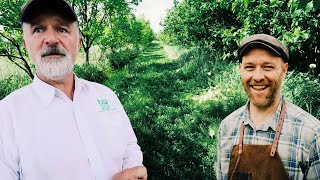
I'm here with Mark Shepherd. You won't believe this farm. We got to walk around here a little bit last night. This is absolutely amazing. I found Mark through Jeff Larton, through the stun method.
You remember that? I sure do.
3 years ago. Yeah, sheer total utter neglect, orchard thriving on that.
Orchard? No, farm.
Okay, okay.
Farm. And it's not just, not just, uh, apples or anything. And I guess we have to clarify that a little bit. It's not like sheer total utter neglect, it's strategic. You got to know when you can neglect something totally and when not to.
Okay.
But, um, part of The whole overall gist of the story is I got bit by the permaculture bug probably way back in 1986, I think, when I first encountered a clip from a, like, an Australian public television series, The Global Gardener. You can find it on YouTube these days. And in there, Bill Mollison said that by observing nature and imitating those systems, we can create systems, food-producing systems, that, that are ecologically sound and economically profitable. And I thought to myself, well, that's, that's it. That's like the Holy Grail of agriculture and civilization, is if we can design systems that are ecologically sound, there's no problems except for what you'd find naturally normally on planet Earth. And then if they're economically profitable and you pay your bills with it, you know, all the better. And so, uh, through a long story, my wife Jen and I, we eventually, uh, got a piece of property in southwest in Wisconsin, 110 acres of land. And when we got here, much of it looked like this over here.
This is your neighbor?
This is the neighbor.
Okay.
This is, uh, this is 60 acres of— right now it's corn, soybeans, and hay. About a third of our farm was corn, beans, and hay. It was all managed as the same unit. The guy who lived here died or whatever, and then they chopped the farm up into several pieces. Um, so about a third of it was in abandoned corn stubble, and two-thirds of it was, was grass that was grazed as close as this on, if not closer. So it was a very degraded landscape, erosion gullies through several of the different valleys that go down through it. And in 20 years, by following natural principles, by observing nature and imitating natural plant communities and going through the successional process strategically, we've gotten to a system now that we're 98% perennial, whereas all of the products coming off the farm, they keep growing back year after year after year. And we actually do produce like our own food. It's not really all that difficult if you actually design a system to do that. And it's not going to happen with 2 or 3 berry bushes in the backyard. You know, we're big people, we eat a lot. And so, you know, we've been a commercial operating farm since then, first selling certified organic produce.
Wow.
And then as the different layers of production came along, we've sold, bought and sold everything throughout the years. Right now the big ones are the produce, the nursery, and now that I've gotten gray hair in my chin and stuff like that, I do a lot of teaching and designing for other folks. Let's go walk around my place and we'll see some things.
Let's do it. Look at the difference. Okay, so your neighbor, does he absolutely think you're nuts? Soy?
Yeah, probably.
Perennial.
This is all GMO soy and corn.
Yeah.
It's the BT corn and Roundup Ready soy. They have to drive this big huge $100,000 tractor across that field 6 or 7 times during the course of the year, and if they don't plant their crop again next year, it doesn't come back. So one of my thoughts on sustainable agriculture is that if you have to plant it again, that's not very sustainable, is it?
No, no.
So we strive for perennialism in all that we do.
What's your most expensive piece of equipment?
Most expensive piece of equipment, um, is actually the tractor.
Okay.
Um, but that's— it was, it was even the most expensive equipment once upon a time.
Are we talking $100,000?
No, no, no, no.
Okay.
First one I got, $10,000. First one I got was, uh, it was, um, $1,000. It had a, uh, seized engine. Why on earth would you buy a tractor with a seized engine?
Okay.
Because then for another $1,000, I could get one with a destroyed transmission, and then you have the neighbor swap the two, and now you get a whole complete tractor.
Nice.
We can go down the other end where we'll get better sunlight for the camera. Okay. Most folks who are getting started in, you know, permaculture, perennialism, or organic, or whatever you want to call it—
what, what part's unique?
The, the economic structuring. Okay, and part of what permaculture teaches us is we are to observe. Yes, learn the system conditions, what makes the system work, whether it's highly effective or ineffective, and then use what we have learned from our observation to put together a system that, that, uh, that unfolds earth care, people care, and some sort of equitable system that redistributes surplus back into the system and helps others to do the same.
Yes. What's this tree, for those that don't know?
These are hazelnuts on this side, chestnuts on that side. And you'll notice there's some that are dead, which is really fascinating. We'll get to that later.
Okay. So what was your observation here?
Well, the observation was that across the board, right now, the most modern statistics, 80% of all people who file IRS Schedule F, which which is farm income.
Okay.
80% of them get the majority of their income from something other than agriculture.
Oh my gosh.
Of the people who file IRS Schedule F, the net income at the end of the year is about a $1,500 loss.
Oh my.
So all of this hoopla about let's set up a farm and we'll figure out how to be profitable, profitable, profitable. Well, it's like gravity. It's real. It's a force. If we learn how to work with gravity, we won't fall down and go boom. The fact that the, the deck, the economic deck in the USA is rigged and agriculture doesn't pay— get over it, okay? Now let's design a system that includes agriculture, provides our food, fuels, medicines, fibers, uh, okay, you know, some modest income. Any income from the agriculture here is used to reinvest back to this whole permaculture model, that it reinvests in the system because the farm isn't the real estate. Okay, the farm is a business that actually produces agricultural products for sale, whether it's flowers or herbs or cows or, you know, whatever it is. The real estate is the land base that the farm operates on. And I don't know what the percentage is, but a very high percentage of farmers, people who farm, don't even own the land that they're on. That's no big deal. Yeah, so you rent the land. So how we have things structured, the real estate is owned by a real estate investment company. This is New Forest Limited Partnership. Okay. Which is managed by a general partner and owned by limited partners. Then the farm rents land from the real estate. The business, which is a nursery business— this is actually some of our nursery rows right here.
Okay.
Growing young little nursery stock. There's a dead one at the end there. So know what that means? If there's one in there that dies, yeah, we don't ship it. Okay, then weed out the weaklings. Um, so then the, the, um, the non-farm business leases land from it. The, uh, the residents who live in the structures rent from the landowning company, and that's, that's part of how it all works together, so that the, the nursery produces things that support the farm, and the farm is doing the reinvestment back into the real estate, which benefits the holders of the real estate. So by separating out things by function has been very helpful because then we see a bigger picture. Whereas if we only saw the IRS schedule of farm, we're wondering why we're broke all the time because farming isn't paying, instead of realizing that the deck is rigged and that's why there are subsidies, loan programs, loan deficiency payments, countercyclical payments, countercyclical loss payments, all these different other programs to keep farmers on the land producing cheap ingredients for the industrial machine to make huge profits off of. That deck is rigged. And now if we've got— let's take the— in the sustainable community, a very large percentage of folks who are running organic operations are using what's called slaves to do the work for them. And it was called interns, where people will show up and do work and receive no wages in return. Oh, but wait, they're getting an education, a place to stay, good food. It's like, well, there were people in Africa that we taught them, you know, Christianity, English, they gave them food and a place to live, and they didn't work for pay either. And that was made illegal back in the 1860s. It was called slavery. The big difference now is that interns can legally leave without having their feet cut off. That's the only difference between slavery now and then. So that structuring, that economic structuring of the whole enterprise is very important to keeping it all together here through the 23 years that we've been here. Well then, strategy. If this was all crop fields or pasture when we got started, how do you get started in a perennial business that's modeled after nature when you know that the perennial plants are going to grow, are going to take years before they mature? First order of business was to identify what are the local natural plant communities around here, and we're in the heart of oak savanna area, which had an overstory of oak, chestnut, or beech, understory of cherry, apple, shrub layer of hazelnut and plum, then raspberries, blackberries, currants and gooseberries in the shade, grapes climbing all over the whole mess, green grass grows all around, animals all over the place, and then decomposer organisms that decompose leaves and wood and living free in the soil and stuff like that. All of those are perennial crops. All of those are foods that are recognized by human beings. All of those have huge industrial markets that you can't grow enough hazelnuts to satisfy the market right now, period. So it's, it's, we're not having to teach people to eat different foods. We can feed them the foods they're accustomed to. And because we're designing our planting systems to mimic nature, nature has never spent a dollar producing a hazelnut. So if we get close to nature and maybe spend 50 cents to produce a hazelnut, whatever, whatever the number is, as close as we can get to nature, the lower and lower our costs are. We can actually sell our products into the wholesale market and pay the bills, which is what we've been doing for 23 years. We're not fabulously wealthy by any stretch of the imagination. We don't get paid well for our product. Get over it. We're farmers, you know. We, we are the producers of commodities that others make money off of. That's not where my big bang comes from. The big bang comes from developing this asset into a beautiful ecological paradise that's really easy to, really easy to manage and work. Okay, one of the first strategies, look at this field here. This is a, out of the 100 acres, the 110 acres that we've got, we started with one of the agroforestry techniques called alley cropping, where you plant a row of trees on either side of the crop field. So if we saw the crop fields earlier, all that guy's got to do is plant a row of trees between the two, you know, between the corn and between the beans, and you know you're not going to make any money off it for the first 3, 4, 5 years, but eventually you will. It's not in the way because you've designed it around the machinery, the shapes of the fields and all that. Then you can grow your crops in between. Well, as the years have gone by, we've filled in the alleys more and more with more perennial crops as we've as we've gotten income from other sources besides produce, we could do less and less produce. So this was in acorn squash last year. After the squash came off, it was the wettest fall on record, and it was too wet for us to get a cover crop of winter rye in the ground. And so it just lay exposed all winter, which I don't necessarily like. And then I put on a small grains crop. This is triticale, which is a wheat-rye cross. Purely for the soil building. It's got clover that's broadcast on the top of it, and then when the triticale is more mature, I'll mash it all down, the clover will come up through it, and then when the clover turns brown and sets seed, I'll mash it all down and all the trit will have resprouted again and come back up through the clover mulch. So in that process, we've put about 20,000 pounds of hard, dry, woody organic matter right into the soil. Which, you know, we're told that if you put too much mulch on a system, you'll rob the nitrogen from the system. Well, that's great. Yeah, for how long? Until your decomposer rate catches up with the load that you've put on it. We've been doing this for 23 years right now. If you stand here too long, you're going to decompose because the decomposer organisms go like crazy. And we'll put, you know, it'll be 6, like 6 inches of mulch, that'll be gone within 6 months. It just gets eaten right up. It's both roots below ground and straw above ground. So this is alley cropping with an annual crop, which is cereal, cereal rye. We got another patch over here I'll show you. Yeah, then we get some real pretty, pretty fields otherwise, because we're not just doing, uh, annual cash crops in between. Our big produce items have been acorn squash, green peppers, and asparagus. Just another field of of grain, beautiful, between rows of chestnuts. And so once upon a time, we were getting our, our alley crop as the only source of income. Then all of a sudden, we're getting the alley crop plus the tree crop, well, plus the shrub crop, then the vine crop. And so it kind of gets additive through the years, what we are, what we're, what we're yielding. And then we now have options to choose. Do I want to even grow green peppers this year. It's like, no, ah, I don't want to deal with 10,000 pepper plants that we've got to start ahead of time or hire somebody else to start them, and then the— all the hoeing and the tilling to get those in the ground. It's like, screw it, we can, we can draw off of other parts of the system as time changes. This is alley cropping with an annual, and over here is alley cropping with a perennial. And you can do this on a smaller scale, home, or backyard. Um, the widths of the alley crop, the asparagus here. The widths are determined by the needs of the alley crop plant, by the equipment that we use, and the eventual maturity of the tree crop on either sides. And in about another 10 years, these chestnuts will probably close all but the middle 10 feet of this and it'll be under dappled shade. The asparagus patch has been producing We've got a total of 2 acres of asparagus going on. We get about half the asparagus yields that you could ordinarily expect with organic asparagus. Oh, that's terribly disappointing, isn't it? But I've got no expenses. I'm not digging 2-foot deep trenches, filling it with horse manure, and then putting the crown in and spreading them out beautifully and burying it with a little soil and bury it progressively week after week after week, then mounding it up and keeping it weed-free and mulching. No, screw that. Yep. I've seen asparagus growing wild on the side of the road. On the side of the road, they hit with a road grader, herbicide, mowers, snow plows, all that kind of stuff. They abuse it. So why not treat it like the asparagus on the side of the road? Yeah, plow a trench, uh, put the asparagus crowns in the ground, bury the trench, and walk away. So whatever comes out of there is virtually carefree. So then if I get half the yields but zero expenses going into it, I win.
Yes.
And so in, uh, the 20 years— that 23 years that we've been doing this, it's been somewhere between 1,500 and 2,000 pounds of asparagus a year. It's not bad. No, for very, very little cost. I mean, it's still— it's still here.
There it is, it's thriving. Is the plan—
in another 10 years, when you— when the chestnuts start to close in, it'll be a 30-year-old patch, which is kind of up at the upper end of a very— a commercially viable, um, asparagus patch. At that time, I can either decide, eh, I don't want to pick asparagus anymore, and then we'll let the grass continue to grow and use it for grazing for livestock, or we can plow it all up and plant GMO soybeans if we want. We've got options that we wouldn't have had otherwise.
Yeah, so cool.
There's another place over here. This is really fascinating. Uh, I mentioned the plant community of the oak savanna. We're also just south of the, um, it's like to call the tension zone between the changes, major plant community type changes between the oak savanna region and then we start going into pine barrens which had pine, that same mix with a lot of pine thrown in it. What this is right here, this is a 20-foot diameter circle. It's meant to be an example for folks who want to do this in their backyard, front yard, of the indicator species, the oak savanna indicator species that I mentioned, but it includes pine on the north side because pine's on the north side of this plant community type. And the pine that we're using here, this is a Korean pine which makes pine nuts. But in the center we've got a white oak, we've got chestnuts on either side, there are grapes growing below, the chestnut's going to be climbing on the messes, hazelnuts around, wild rose, raspberries, wild plum, cherries. And then because folks in a suburban or urban environment might have landscape code that says you have to like take care of it and be neat and all that kind of stuff, come here and see. So you can peek in under there first. Actually, I'll go in, but you peek in under here first and you see we mulched it with sawdust mulch. And you know, if whatever it is in the in the suburbs that you're mulching with, go ahead and use it. But then we've inoculated them with, um, edible stropharia.
Nice.
And so we almost always have some kind of mushrooms to eat. So right there, it's 100%, uh, regionally adapted plant types that are perennial. They've been living with each other between 6,000 and 900,000 years depending on which reference books you're reading. They belong here.
Yeah.
And I've treated them with what? Sheer, total, utter neglect. And we get chestnuts and apples and grapes and raspberries, roses. The roses are just about finished out blooming. Some of the sweetest smelling. We use the wild prairie rose, edible mushrooms, on and on and on. So that's kind of, that's a mini example of what the whole farm looks like. The difference on the farm is we now take that circular form and stretch it out in a rose. And we'll have to get to it, but the other patterning that you see on the farm, it is originally based on the Keyline cultivation pattern, which I won't bother to get into too much here, but it's a way of arranging your fields on the landscape so as to spread the water from High in the valleys to lower down on the ridge so you can evenly distribute the water that falls. One of the problems with the Keyline design system is it's a simple system, really easy to follow, and it doesn't work on a complex landscape because there's too many complexities in the landscape to be dealt with in a simple strategy. So it's a modified and adapted form of the Keyline design strategy. So our fields are bordered on the downhill side by a swale and a berm. And then so we have like an alley, swale, berm, trees, alley, swale, berm, trees, alley, swale, berm, trees, and then they grow through the years. And we're in one of the oldest parts, most, you know, first planted here. And on the right-hand side we see black walnuts that were planted. These are direct seed. We just went out and picked black walnuts and we shoved them in the ground. So those taller trees over there, and some of them have walnuts.
Wow.
Yeah, the idea there, you know, because I was 30 at the time. The idea there was when I finally hit retirement age to be big enough and would have some retirement income by harvesting nice sawlogs. That area in there has never had a piece of motorized equipment in it at all. It's only been maintained by animals, cattle and pigs. And they do the pruning for me on the trees. They'll rub on the trees, they break the branches. People say, oh, you can't put animals in with your trees, they'll kill the trees. It's like, well, if you leave them there too long. Yeah, we want them to be in there long enough to eat all the grass down, so they do the mowing for us. They fertilize— 72 cow pats and 35 gallons worth of urine per adult cow per day. It's a lot of fertilizer. And then there's no weeds anymore because they just ate them all. Then they start to harass the trees because they finished eating the grass. Well, then as soon as they start to harass the trees, you move them before the damage gets too great. And if there's— if they kill your trees, it's your fault. It's not their fault. They're just being cows. Then on this side of the trail here, we've got an example of a later transitional form of alley cropping. And we saw previously the rows of hazelnut with the cereal grain in between. Well, this was produce instead. 5 rows of zucchini would fit in this alley here. So we have a row of chestnuts and a row of chestnuts, 5 rows of zucchini. So we're cash flowing off the zucchini. Zucchini. Well, these are some of the first chestnuts that I grew. Then as the, as the branches started to come out over the zucchini patch, we went down to 3 rows of zucchini and grew that in the middle. Well, then the trees got a little bit bigger, went down to 1 row of zucchini. Then it wasn't worth the time or the effort to prepare the soil for the zucchini, to do the weed control, and then the harvest. It just wasn't worth all the effort of having all that labor into it. And so I looked around at the other parts of the system, what kind of weeds were showing up in the chestnuts. The weeds that were showing up in the chestnuts were elderberries, mulberries, grapes, and raspberries, and gooseberries in the shade. It's like, um, what should I do? I should, I should now maintain my chestnut orchard and get rid of all those invading species in my chestnut orchard, right? It's like, no, no, no, no, I went, I planted, you know, mulberries and elderberries and raspberries and grapes and currants instead of gooseberries because I don't like gooseberries, but— and they're cousins, they're really close cousins. And so what we have right here is, uh, this is a 23-year-old polyculture that's been producing just fine for 23 years, and there's plenty of grass underneath for grazing the animals in. This is, this is primarily where we'll finish the pigs, uh, is they'll go through the season rotating around here and there, uh, eating mostly grass, and then in in the fall, we'll put them in this block of chestnuts and they'll eat chestnuts. So if we get about— I have no idea how many chestnuts we get, but it's claimed that you get about, you know, somewhere between 1,500 and 2,000 pounds of chestnuts per acre. That converted into hogs— pigs have a very good feed conversion ratio, you know, those pigs are doubling in weight in about 30 days, and it's grass-fed hazelnut chestnut finished pork. Pretty good stuff. And these, of course, are some of the oldest hazelnut bushes around here. These are all American selections. You know, there's probably some European in some of them. So they're a shrub type. They're resistant to the disease Eastern Filbert Blight, which is why there isn't a large hazelnut industry anywhere other than Oregon and Washington, because they're based on European hazels. Wow. And so we have smaller nuts. The husk called the Enveloper that sticks to the nuts. We have a machine that you run it through that we invented that looks kind of like a combine. It rubs the husks off and the nuts get cracked and sorted and separated and they're used more for right now they're being sold. I'm part of a, one of the founders and part of an aggregating company called the American Hazelnut Company. You can look them up online where the members own the company, and we sell our product to the company. And right now I think the main sales are whole hazelnut kernels, then hazelnut oil, and hazelnut flour. So you run the nuts through the oil press, and the flour that comes out has had the fat removed from it, and it's being used— there's at least one pie crust company that buys our hazelnut flour for pie crust. So that's where that goes. And another thing that I hadn't mentioned is, whether you're a homesteader or a small farmer or whatever, is why on earth should we try to do everything all at once, all by ourselves, usually with very little money? Let's all join together. Other agricultural census statistics, the average person who does farmers market or CSA, you know what their gross receipts are? $1,000? Well, $25,000 a year.
Oh, a year? Yeah, yeah.
And so that's not a business for anybody, you know. Yeah, there are people that are surviving on that, but you know, come on, you can do a lot better than that.
And that's gross, that's not profit.
It's not— well, that's not kind of the fact that you're making all the sales calls, you're packing all the product, you're making all the deliveries. If there's value-added products, you're doing all the value-adding. So now you not only are you the farmer, you're also the marketer, you're also the distributor, and you're also the value-added company. You're doing 4 different jobs at once and you're getting $25,000 for it? That's ridiculous. So why not stay a small farmer, join with other small farmers, and start either a cooperative, an S corporation, C corporation, LLC, whatever you guys want to call it, and start working together? Okay, if we work together, if you got 5 $25,000 farms, there's enough revenues in there. If there's 10 of us and we decide to slice 10% off the top. That means we've got a full-time salary of $25,000 for one person to now start doing, you know, the sales, the marketing, the aggregation processing. And so, uh, what's been instrumental to our, um, being able to stay here is, uh, early on we joined a little, uh, vegetable distribution co-op down the road. At the time there were, uh, 23 members of the vegetable co-op. It started with 65, and it didn't really work well for a number of years. It dwindled down to 6 when those 6 said, hey, you know, we're also doing dairy on the side. Well, what if we contracted with a cheese plant to make cheese out of our organic milk? And then our salesperson at the desk— because, you know, we've got X percent coming off the top to pay for the salesperson— let's have the salesperson now sell the vegetables during the summer season and sell cheese during the winter season. It was the first organic cheese on the market, and it took off, and the rest is history. So we were grower number 24 of this small little farmer's co-op down the road called Organic Valley. It's the largest farmer co-op on the planet. Last 2 years, it's been in excess of $1 billion a year in sales. Over 2,000 farmers involved in it. So we can all stay small farmers, but together we're now a monstrous company.
Okay.
My ownership shares of Organic Valley have been generating a passive income for 23 years. My 401(k) is through, through the company. I get pool distributions when my asparagus pool or the squash pool, pepper pool— we, the farmers, get together in the fall and we kind of set target prices. We got to get paid this much or else we can't— it's not worth doing. And so then the sales team, when they're selling all the produce, they're doing their best to exceed that target because when they exceed the target, the percentage that comes out to fund the department is more, and then we get a bonus. We get a bonus kickback. So we get an individual product kickback if we exceed the pay price, and then when the whole co-op as a whole is profitable, we get another kickback. So wait a minute, I'm selling my produce wholesale prices, so it's terrible prices. Then I've got a retirement account, my membership shares, my pool bonuses, and my overall co-op bonuses. And so remember when I was talking about the fact that IRS Schedule F doesn't really pay? It doesn't really pay. This amount of money that I get for selling my produce doesn't really pay all the bills. Well, neither does this, neither does this, neither does this, neither does this, neither does the nursery business. Altogether it adds up and it works, and they're, they're all synergistic with one another. They all tie in. And so now, now we've got this American Hazelnut Company thing going on, and cross our fingers, it does well and really takes off, there's another profit center coming in from owning a piece of a company that's buying my products and making them into some other value-added product. Where we are right now, you happen to have gotten here at a beautiful time of year. These are some of the oldest chestnuts here. I mowed this path because I knew you had like sissy town boots and you wanted to go for a walk and not get too wet. And they're blooming. The white, long white catkins are the pollen-producing catkins, and the little green— they're not really visible as spiky burrs yet, but the little green balls in with the white flowers, those are the females. They have a little couple of tufts of yellowish-white hairs coming out of it, and those will be the green— little green balls will turn into these big huge spiky burrs full of chestnuts. Now, when I got started here, I called Michigan State University for some information about chestnuts because Michigan is one of the larger states in the country growing chestnuts. And I said, well, I want to grow chestnuts, you know, where do you live? Wisconsin. And the guy's like, oh, okay. I said, well, you know, well, what, what, what should I do? He says, well, first of all, you go find the of named varieties, grafted named varieties that have a proven production record over 20 years or so, and then you plant those named varieties in your orchard. And you plant the rows, you plant the rows 30 feet apart, and you put each tree 30 feet apart. So it'll be about 50 trees per acre. So I'm kind of doing the pencil on the back of the envelope and kind of adding this all up. So I got 50 trees. It just didn't seem like enough. And when you get on 110 acres, that was just like grass and abandoned crop field, and you're thinking 50 trees, just, they just disappear, you know. So I got these little trees in the ground, and like, they seem like a million feet apart. So I said, okay, well, what are the named varieties in Wisconsin that have the 20-year proven track record that'll work? Was, well, there aren't any. It's like, well, gee, thanks for the help, my friend, you know. And then, well, then what am I supposed to do? Once you got those proven track record varieties, then you take care of this, this orchard. You do these many fungicide sprays, these many herbicide sprays, these many pesticide sprays during the year for 7 to 10 years before you start to generate revenues. So, and you can go online and look this up, look at the Michigan State University chestnut enterprise budgets. It's around $4,000 to $5,000 an acre to set up with only 50 trees, then $3,000 a year for, you know, 7 to 10 years before you generate revenues. Revenues. Now wait a minute, if my startup cost is $5,000 an acre plus $3,000 maintenance cost, but if you go 5 and then 3, 3, 3, 3, 5, 6, 7, 8, 9, so it's so $30,000, $35,000 per acre before I ever generate revenues. I couldn't afford that. It's just myself, my wife living in the house that we're building around us with a little baby and another one on the way. We can't do that. And so we had to figure out how to generate revenues, and that's where we, you know, we bumped into the alley cropping idea. Let's grow stuff in between. And that's where our cash flow was coming from, was in the alleys in between. Well then, okay, what about the variety problem? How do we deal with the fact that there are no known varieties that do well here? And so once again, I go back to the permaculture thing. Let's observe nature. How does nature produce enough plant material so they can survive, you know, windstorm, fire, tornadoes, grazing, browsing, earthquakes, volcanoes, pests, diseases. Well, a tree puts out like a zillion seeds. Every seed is a genetically unique individual. Out of those zillion seeds that go into the ground, they're usually really close to one another. There's competitive effects between them, there's synergistic effects between them and other organisms in the soil or whatnot. And the ones that are most suited for the site, the weather conditions, the disturbance regime— for real, no fake, I mean all the bugs that come at them. These trees have to survive somehow. That's how nature does it. And if nature didn't work, this planet would have been a bare cinder when we got here. It works really, really well. So we figured we'd imitate that. So at first what we did is we got a wide diversity of chestnut genetics and did this for all the different woody species we're working with— pine nuts, hazelnuts, apples included. And you plant a zillion of these different varieties, most of them seedlings. Um, because we're told, oh, don't bother to save your fruit seeds because it doesn't breed true to type. It's like, excuse me, when was the last time you took an apple seed and put it in the ground and it turned into anything other than an apple? Our seeds breed true to type. They don't look exactly like their parents. That's the whole point of sexual reproduction. You don't look like your parents. Your brothers and sisters don't look like you. That's the whole point. We want the genetic variations that show up and survive right here with Stun. Strategic total utter neglect. So what you'll see in here, there's a lot of trees that are dying, and the reason why is because we have some trees that are American chestnut, which is susceptible to chestnut blight. We have Chinese chestnut that isn't cold hardy enough for Wisconsin. So how do you start growing chestnuts when the two varieties that you could use won't survive in Wisconsin? We have a lot of European chestnuts that also are not cold hardy enough here. And then I got a whole bunch of different hybrids, which are already crosses between Chinese and American and European and American, that sort of thing. Well, we breed them and you just put them in the ground, and the ones that die don't get to reproduce. You know, if you look at just the one back there, this one right now is not contributing to the gene pool, and that's perfect. And so when all of a sudden the disease comes through, do I get all freaked out and, oh, I gotta prevent the disease? It's like, no, that's reality. I'm not going to prevent reality. So let's take an apple orchard for For example, 100% of all of the problems in an orchard are because we're trying to create reality through our idea of orchard. An orchard is purely a human construct. This is some idea that somebody came up with once upon a time. So what we do is we take this plant, an apple tree or pear tree, whatever, out of its natural context of living with the real world, put it in a block all by itself. Now we've concentrated apple in one place. What does it do? It attracts all the pests and diseases that attack apples. And so when a pest comes in, so, oh no, we have a problem! Well, the problem was caused by the fact that you had this idea of orchard, and it's not real. It's false idea. That's not how nature works. So what we do here is we let things go as wild and natural as possible, and when a pest or a disease comes in, you let it run its course. With pests, for example, In order to get good pest control, the pest has to come in. So let's say it's a chestnut pest, they come in and eat the chestnuts. The population booms because there's no control mechanism in place. You need enough pests in order to feed the predators of the pests. So if I sprayed to get rid of the pests, I'd never have enough pests to feed predators, and, and then so on up the food chain. So what will happen in the early years, you'll have amazing amount of pest pressure, and then it drops down. Does it go away? No, it's always here. We always have the pest. All the apple pests in the world we have, but you get a lower level than you would have in it than in the early years. Same with the disease. Now with chestnuts, it's really fascinating is with chestnut blight in American, it's, it's shown that it's the genetic resistance within the plant. Same with Eastern Filbert blight in hazelnuts is it's something genetic within the plant that allows it to survive against that disease. So my idea in the early years was with the Chinese genetics, let's get some Chinese genetics in here to be disease resistant to chestnut blight, some American genetics in here to be cold hardy, and you cross the two and then we'll have these chestnut trees that are adapted and survivable. What I'm finding out is the ones that look more American, it's almost, it's almost, you know, here anyways from this one little experiment on 100 acres, like tens of thousands of trees, if it looks like an American chestnut, it almost guaranteed that it's gonna, it's gonna get the blight. It's just what's happened through the years. Whereas if it looks more Chinese, it's more likely to resist sometimes for a period of time before it succumbs to the disease. Now, how can I ever know that my plants are resistant to a disease unless I have enough disease around? So I want to make sure that there's enough disease around to properly infect my, my other trees. And so you'll see a lot of dead trees, and they kind of thin themselves. They just get the disease and they die back, and then they don't contribute their susceptibility genes back to the gene pool. We keep saving our seed and keep rolling forward. And we've got some really productive trees. We got some duds. And when you got a dud, you cut them down, you put them, you know, put them in the wood stove, keep you warm in the wintertime. Or you, uh, you know, inoculate them with mushroom spawn and grow mushrooms.
You never have to come in here and mow this?
I, I do just before harvest.
Okay, but you're talking about just this lane? You're talking about just where we're walking? Or do you mow around the trees too?
No, no, no, we'll leave— we'll leave in the trees.
Uh, how about when you start them from seed, right? Are you just putting them out, out here, or are you starting them sometimes in a nursery?
What I did at first— these seeds, the currants. Yeah, in the understory, currants are very shade tolerant. And look at the grapes climbing on the currants.
Do you plant those, or does it come?
Yep. Okay, planted those.
Cool.
And, um, so I've— I started with, uh, screen-protected nursery boxes with a half-inch diameter hardware cloth on the bottom and the top, make like a sandbox. A good place to go, if you go to— haha— Little House on the Urban Prairie, Chestnuts and Hazelnuts for the Future, it's a blog post from years back where I think the guy, he most accurately described how I do a nursery bed. He did it in a 5-gallon bucket. I do it with, with you know, 2x10 boards and, and buried in the ground. So I'd have a high-density, like a 4x8 area. I can put 1,000+ chestnut seeds in there, let them grow for a season, then the next spring you plant them out. And one of the first things we select for in our chestnut trees is early reproduction. It's called precocity in a plant. And so with chestnuts, if they don't reproduce within 3 years, cut them down, because I want the ones that reproduce really fast. I even have chestnuts here that are disease susceptible. They get chestnut blight. But I still keep saving their seed because they produce seed right out of the ground. So imagine a chestnut tree that sprouts and puts on a seed right away. That's productivity. We can breed plants, woody plants, trees, just as fast as we can breed annual plants. And here's a question, it's not a trick question. I asked this guy the other day. How long does it take to find trees that will reproduce in one year? One year. Wow. How do you find them? You plant 10 million seeds, and if they grow and they flower, there you go. Now you have your rapid kickstart to tree reproduction. You can't do this— back to, back to my Michigan State University thing. So they're telling me to put 50 trees per acre, so I did that. Okay, so now I've got my 50 trees per acre. The second year I had two of those trees, because a lot of them were seedlings, because there are no grafted varieties that will survive around here. Two of those trees flowered the second year, and they were like 800 feet apart. And it's like, chestnuts are mostly wind pollinated, they'll never pollinate 800 feet apart. I had to put trees closer together in the row. So the first year I was at like 30 feet apart, then the second year is 30 feet apart, and that was when I discovered the first ones blooming. And the third year I went and I filled in the spaces halfway, so now everything's 15 feet apart. Then started up on the ridge, putting them in 6 feet apart. Then I started back up from the bottom of the ridge, going like 3 feet apart. And then by the time I shifted to the, to the north ridge, we're going double rows, 3 feet apart, with a stem density of around 4,000 stems per acre. How could I do that? Because you look at the cost of these plants, it's costing me— if I'm buying wholesale, I gotta buy 1,000 plants at a time, I can get them for $5 a pop. That's like a fortune. Well, So if I was saving my seed from my early ones, and if you take, if you take these trees that produced in one year, right, put those seeds in the ground, you've automatically concentrated the seeds that reproduce really fast, the trees that reproduce really fast. Then you keep planting those in a block together and you keep saving the seed. So that means in year 2 you've got trees, year 3 you've got trees. Well, then year 4, maybe one of these 50 to 100 trees that you have is producing 5 nuts per tree. Now you're concentrating the ones that produce a heavier yield because there's more seeds in the gene pool. So as you go along the line, you're concentrating fast reproduction, heavy yield, pest and disease resistance. And how you know for pest and disease resistance? Because you're not spraying anything, you're just letting it turn loose and go, go wild. What is happening and does happen is you lose traits here and there. Well, that's why we keep bringing in prize bulls every once in a while of the grafted select cultivars, put them out there and let them pollinate. So just after a few years, we start saving our own seed. Now, when I was saving my own seed and planting my own trees, I'm doing my best, I'm going to run this nursery and all this stuff. And so I'm thinking nursery in my mind is another concept, right? It's got to look like this and all this whatever, you got all this infrastructure. And, uh, I couldn't afford that, so I just would plant them in a row and do the weed control. And I had these scraggly little trees, they're perfectly healthy, wonderful trees and all that. And then when I would order trees from somewhere else to get these big monster trees. And one of the places, one of the nurseries that I worked with that produced the most beautiful trees, I finally talked to the guy. I said, okay, if I got a deal for you, uh, in the fall you buy seed from people who've collected it, and that's an expense for your business. He's like, yep. I says, well, what I'll do is I'll provide you with seed free of charge. Now I've got his attention, so we start talking. And then I say, okay, and when these guys are ready, when these plants are ready, I'll buy every single one of them. So he's got no cost going in, he's got a guaranteed sale coming out. Now he can take my seed, I turn into a little tree that looks like this, and he can turn into this monster tree in one year because he's got all the tools, all the equipment, the right soil, all that kind of stuff. And he's got a no-expense profit center. The only thing is, it's like, okay, but I get a smoking deal. I get the wholesale of the wholesale prices on this. Yeah. And so then what plants I don't need here to replant are then the plants that I sell, the surplus that I sell. So this is back to the whole permaculture idea of when we have this surplus, it now goes out to help others do the same. And so there's been people buying Forest Agriculture Enterprises nursery stock for, you know, 15 years now, and this is where it comes from. Real live, real life. And listen, listen to the birds. I hope the birds woke you up this morning.
Yeah, they're beautiful. You got a lot of wildlife here.
Grapes and elderberries. I mowed this row of elderberries last year just to kind of start them over again.
So the tree— let's say a tree dies. Yep, you need to replace it. You've had your nursery man grow it up. How then do you just— do you just move some grass out of the way and put it down, or what do you do?
Move grass out of the way? What do you mean?
What do you do to take that tree from the nursery?
Oh, you just take a shovel and step on it, um, right in among it. Yeah, well, there's, there's, uh, there's raspberries and elderberries, and here's, here's a replacement chestnut, you know, right here. You just shove it in there when there's a hole. You just shove it in with a shovel. Now, what is interesting, um, who was it who said— is it Toby Hemingway, I think, uh, is, is who, who wrote that at a certain point in time, all of a sudden your system will pop and things will just go better. And it was probably like 5 or 6 years in that, uh, you know, at first trees would just die left and right and left and right. It just wasn't happening. And all of a sudden, at some point in time, you could just stick a tree in the ground and grow great. And I think a lot of that has to do with succession. Our site has gone through succession over time— more organic matter, more soil life. There's no more toxic sprays. And a lot of this— the trees, their roots have associations, you know, with all kinds of, you know, soil life underground, not just mycorrhizal fungi. So that now I kind of jokingly say that, yeah, if I ever drop a tree, you know, on my way out somewhere, it just hits the ground and it starts growing.
Um, no mulch.
I don't mulch. I tried it first. What I'll do at the most— you saw that little nursery row up there? That's it. At the most, they'll get mowed on either side.
Mowed on either side, but never in the middle?
No, why bother?
Okay, cool.
You know, there's this myth that grass kills trees. Tell that to the trees of the world. Tell that to the savannas of the world. Uh, Yes, there's competition between the grass and the trees for nutrients and moisture. So what? You know, as long as a tree— and if the tree dies because it can't handle competition, guess what? I'm not interested because it can't handle the competition. But just if you just stop and look at this for a second, look at what we got going on. We get elderberries and raspberries and chestnuts and hazelnuts and currants and grapes all grown in the same place. Most people would look at this and say, well, this is a mess. This is a mess. It's a diseased, overgrown mess. And yet I can get 300 pounds of beef out of this. And even if, even if I, if I buy a, a cheap steer in the spring at the sale barn, conventional sale barn, for $500 in the spring, and I let it come out here and eat grass and drink water that fell from the sky, uh, and it gains 300 pounds in the course of the year, even if I sell for the same price at a buck a pound, I just gained 300 pounds. I just made a, like, a 60% return on my investment. And it's mowing my grass, fertilizing the trees, it's breaking branches. So I got a beef return, I get a pork return, I get a hazelnut return, a currant return, chestnut, elderberries. A big one in each one? No. Am I getting the yields that a real on-their-game orchardist— and, um, uh, I'm gonna butcher his last name— Michael Phillips and Stefan Sikoviak. Sorry, Stefan. Those guys are masters at their craft. They are like some of the best fruit growers that I know of. They are so in tune with pest and disease cycles and all that kind of stuff. Probably either one of them would come here and throw up because this would make them sick what's going on. But that's not the point. My yields are probably only 10% of their yields, but my costs are a hundredth of theirs. And so if you do the math on that, my margin is a lot higher. The amount of work that I have to do goes way down. This is typically the time of year anyways, um, that I go to the boundary waters and I disappear off in the woods for a couple of weeks or so because it's a hotter part of the summer. You know, the animals are doing fine and then the trees are doing fine. They're just ripening their crops. I'm out of here. Why work, right?
So, your animals nearby Actually, we don't have any this year.
Yeah, we got some guineas and chickens, but that's about it because, um, because we didn't need to. We've got— okay, we got freezers full of meat. What do we need to raise more meat for? But typically we've raised cattle and hogs primarily.
Okay.
Anywhere between, you know, a half dozen and 25 or 30, you know, steers, and then anywhere from a half dozen to 50 pigs. And the marketing on that is It's interesting because of how the laws are structured, we decided not to get licensed to sell meat. So what we do is we sell the animal. This vehicle lane is actually the old State Highway 56. It's a state right-of-way. Used to be where the road was, so it's now, you know, half a mile north of us here. This area was settled in the 1830s. By Europeans. It was already settled here for who knows how many thousands of years prior to that. I'll tell another story associated with that. When the Europeans got here, this place was covered with ash trees. It was a thicket of ash trees, and so that's how it got its name, Ash Ridge. In 1939, this was a community of 400 people, and as agriculture simplified, they eroded all the soil, washed it all away. The niches available for people, the economic niches for people, went away. And so currently right now the sum total of the residents in Ashridge, Wisconsin are myself and my wife, Bud and Dee Hill, a retired couple up the top of the hill, and a truck-driving couple. So there's like 6 people in a place that used to have 400. Well, when the Europeans first got here, they had to clear out all this brush, and so then they constructed a road to get down to, you know, the nearest village, Viola, which is, you know, almost 10 miles away. And so what this is, if this is the road going to town, this is the brush on the side of the road. So since the 1830s, they've been cutting it with axes, pulling the stumps out with mules and horses, burning it, grubbing out the roots with Norwegian bachelor farmers, and then later on as things progressed, everything on either side was then corn and oats and wheat and stuff like that. And then dairy cows and grazing. Well, then as, as technology progressed, then they come by with the mower, the brush hog, and they start brush hogging on the side of the road. Well, then technology advanced even further and they have what's called a wet blade, and you put a little herbicide in the tub and it applies herbicide as you chip the crap on the side of the road. Human beings have been fighting against nature here for over 150 years and they've lost. Every single time. So this is an ecological model. This is an ecological model of sustainable agriculture. And what we have is we have 2 different species of hickory, we have cherries, we have grapes, we have mulberries, we have wild plum, we have butternut, we have hazelnut, uh, we have elderberry, we have, uh, wild rose. We— there's 10 different edible food crops right there. There's 10 different food crops that we can grow in the same place with 150 years of trying to kill it. So if you're planting— think about this— if you're planting food plants and you're trying to keep them alive, you're doing the wrong thing. We want to have systems that are so resilient that we can try to kill them and we can't get rid of the dang things. And so 10 different woody species up above. Well, now what if we're grazing cows? Pigs, sheep, uh, yeah, I was gonna say cattle, but those would be cows. Um, goats would like to do a lot more browsing than the cattle and the sheep would. Uh, in under, under the ground in here, in the spring, you can find morel mushrooms. There's, there's, uh, wild asparagus growing in here. There's gooseberries growing in under the shade. I'm already up to 16 different food plants in a system that they can't kill. You get that? Yeah, that's sustainable agriculture. So I'm Not saying that we're going to design our farms to look like this, but these are the principles that nature operates by that we need to observe, understand, and then imitate. And then we can make it easy to plant, easy to maintain, easy to harvest, that sort of thing. But there you go, that is 150 years of stunner.
That's it, that's it.
Sheer, total, utter neglect and abuse. It's been abused for 150 years.
Stunner, huh? And this is it. This is the original, or you've planted something there?
Nothing. I've done nothing.
Nothing.
Oh, there's raspberries, and you'll come and harvest.
Stop.
Whatever's in there, sure, you bet.
And you keep it? It's your stuff. Well, you can't get rid of it.
It's an example. That's right, it's an example. You're exactly—
it's your study.
Here's, here's, uh, elderberries getting ready. Wow. Grapes. Look at the grapes right next to those.
Oh my gosh.
And so we got nettles for greens in the spring. So there's 17, 18 There's bloodroot, which is a natural antiseptic that's going on in there. So it's 19.
So all you're doing is saying, what is like this that I could intentionally do over here instead, without the work?
Instead of wildcrafting.
Yeah, which—
this is wildcrafting. If we go out here and we, you know, find stuff and we pick it when it's ready, uh, we'll, we'll do a hyperactive wildcrafting situation where we just saw we're up in the chestnuts, where we've got the chestnuts and the currants and the elderberries and the grapes and the raspberries and the mulberries and the grass all in the same row. So if we got 6 above-ground woody plants and then 5 different types of livestock moving through it, this 6 plus 5 is 10. 11, folks. Um, that's very similar to this. Okay. And you saw how crazy and woolly it looked, except that that was designed and this wasn't. That was designed for our convenience, really. We're the ones that want things to— what do you look at?
Wild designed.
And that's what's really great about this. Think about the zombies. When the zombie apocalypse happens and you got these people— bluebird just flew by— going down the road, they're gonna be looking for— they go by miles and miles and miles of corn and beans and there's really no food out there. They can't really harvest it anyways, you'll die of malnutrition if they eat just corn and beans. They're looking for somebody who has a garden, so they're looking for some happy homesteader that's got the potatoes and the tomatoes and the zucchinis and the, yeah, 50 different varieties of this, that, and the other thing. Ah, there's a garden. So they go set up camp, they, you know, enslave your children, you guys get in the movie. Whereas they drive by here and they go, that's just a brush on the side of the road. They drive right by. That's some security. They don't realize it was surrounded by food. Oh, watch out for stepping in holes.
And it keeps— who cares? And if they did rob you, they move on and it comes back.
What's one of the interesting things about the oak savanna, which we modeled the system after, is that the savanna biome worldwide, it doesn't matter what particular species type was a savanna, they're totally adapted to fire and aggressive browsing and grazing. And so if the Canadians invade someday and they burn all of our crops, ours come back next year just fine, thank you very much. Let's go this way. And speaking of grazing and browsing, the savannas of the world are actually the, they're the biome that produces more mammal biomass than any other biome that's out there. Classic is like the Serengeti, you think about the Serengeti with the diversity of wildlife that's out there. Now imagine this, this is the Upper Midwest USA. It's humid, it's temperate, not as hot as Africa, not as cold as the Arctic. Well, it is cold as the Arctic for a shorter period of time. Um, what was the dominant grazing animal right here before people got here?
Buffalo?
Good guess. I'll give you one more guess.
Wild horses.
All right, one more guess.
Wild cows.
If you go to the Field Museum in Chicago— oh, hang on a second, I gotta smell my— just love the smell of milkweed flowers. This year is the fewest monarch butterflies that I've ever seen. This year, pretty disappointing. Last year was gonzo with monarchs. If you go to the Field Museum in Chicago, Field Museum or the Geology Museum at University of Wisconsin-Madison, they both have parts of this creature. They assembled the bones of the Boas mastodon.
Yeah, I've never heard of that.
The Boas mastodon is the skeleton that put the argument to rest that human beings were here, they hunted, slaughtered, butchered, and ate mastodons. Boas, Wisconsin is over that ridge 5 miles. Is where they found this thing. We are in the elephant savannas of North America.
Oh, elephants.
This should be teeming with elephants, with 2 species of giraffe, 2 species of giant armadillo, 9 species of ground sloth, camelids, you know, horses, all these different, you know, deer, elk, both grizzly bear and black bear, all could have been here for as long as, you know, this place has been here. These are the same plant community types that fed those animals. These are the same species that have been here, you know, ever since those animals were here. So, you know, the whole Pleistocene megafauna was supported by these type of plants. Just real quick, let's come over here and check this out. Notice where we are. This is a ring of hybrid poplar trees and white oak trees. About 20-foot diameter. The hybrid poplars all came from cuttings from the same tree, and they're planted real close together with the intention, of course, of having them grow together. So we're growing a hollow tree. This is, this is a Winnie the Pooh house. We're in the Hundred Acre Wood, and this is, you know, the house at Pooh Corner, I guess. And people have spent like the summer here. People come in camping every once in a while, and eventually if it closes in, imagine a bunk bed over here, bookshelf with like all the Winnie the Pooh stories and the Bernstein Bear short stories. Mom and Dad step outside, they sit down at the picnic table, they have a nice little dinner while the kids go to sleep and live inside Winnie the Pooh's house. So there's always odd spots here and there on a, on a piece of property. It's great. Um, the smells are just incredible. I smell more, uh, Look at this. Okay, are you people in your bus— are you Dr Pepper addicts? No.
Are you?
Must have been from the last tour.
Let's see how your friends treat you, Mark.
That's right. Oh well. So if we look across this part of the farm here, this is— we've been through an area that's been dominated by chestnuts. We have other areas dominated by chestnuts as well. We have other areas dominated by apple trees. So we grow the entire plant community, the oak savanna plant community, on every place. However, we'll go heavy on whatever the species is that we want to harvest the most efficiently. So here, this we call this the It's the hazelnut savanna. And if you look across the valley that way, this one big huge gigantic dark green clump of tree vegetation, that's 3 big oaks. They're about 60 feet apart. The grass underneath it, look how it's a little bit greener. It gets greener earlier in the spring, stays greener later in the fall, and it dumps thousands of pounds of white oak acorns every single year. And the deer hang out there and gobble them up, the turkeys hang out there. Well, in the hedgerows along the fence line between us and the neighbors is wild crabapples, cherries, you saw the stuff, the grapes, hazelnuts. So this was an oak savanna because those trees, their trunks are like 3-foot diameter plus. And so that means they're probably 300 years old, 200 years old. So this, this was oak savanna. So let's imitate that. So here we see some larger trees above the shrub layer. The larger trees are either white oak or chestnut, and then all the shrubs that we see are hazelnut out there. So instead of just the wild hazel, they're now the selected hazels that we got from all over the place and we've done selection on. And if you look carefully, you'll notice that the rows tilt uphill on the left, they tilt downhill towards the ridge. So the valley in the middle is where water would naturally want to accumulate, but the, the row pattern is such that up the top of the valley, the row is higher, and then it goes out towards the ridge. So anytime water tries to come to the valley, it keeps going back to the ridge. And what brings it to the ridge, we have these little swales and berms all the way through the whole system, which we can walk through some of them. There's one immediately in our— to our right in here.
Okay.
So the water that ordinarily would be down in that valley runs through this when we get a big rain. Yep. You know, now not everybody needs any kind of swales and berms or water catchment channels and stuff like that. You know, if you have a really sandy, gravelly soil and the water just falls right in, you know, you don't really need them. But if you have any situation where if you get rain on frozen ground or really rapidly melting snow in the spring— I know, Robins, we're scaring you. Then you can at least capture that rain and spread it out and get it to, you know, excavations where you have a little hole in the ground, like a little pocket pond to store the water. This is some of my fancy state-of-the-art high-tech equipment. I haven't cut hay in years because I haven't had to.
You run your— when you have livestock, do you keep them through the winter?
Most of the time, no. Okay. Most of the time, no, because it's really challenging to keep water liquid in the wintertime.
Just buying them in this—
just buy them in the spring and sell them in the fall. And I'm not looking to make a fortune doing that. I'm looking to mow my grass and fertilize the ground.
So here's the oak trees.
There's some of the oaks.
We're running by the oak trees. You just go get acorns from that big tree over there?
Not these. Most of the other ones, yes. But these are burr English oak.
Oh, okay.
Crosses. And and a couple of them, this one down on the end here, you can eat them without leaching them at all. Ah. 6. Okay. If you eat 7, you cross over and enough tannins, it'll just dry your mouth right out.
Okay.
And so minor leaching, that's the sweetest acorn that I've got. So what's really fascinating, you know, when you edit the whole video clip here, Go ahead and show an aerial view of the farm.
Okay.
This little spot right over here is the point around which the whole entire farm was designed. Ah, so at this point here, you see this water in there now? Okay. All kinds of frogs and stuff. Um, it's intentionally designed to be undersized, so when it rains it'll fill up, and then off either side there's a channel channel that goes off in that direction. So this water here, before we did this, would have gone 600 feet in a linear direction. Okay, 100 feet down. This valley was carved with erosion gullies when we got here. So now instead, it hits this, fills up, and it goes out to the ridge and goes around the shoulder of the ridge, goes 1,200 feet before it's discharged horizontally, you know, level across the shoulder in a level sill. Okay, it sheets across the ridge. So now the ridges, which are usually the driest parts of the farm, are my wettest parts of the farm, the ridges.
Slow, slow fall here.
This is less than 1%, less than 1-foot drop over a 100-foot run.
So it goes right where we were just walking.
It's to the left.
Oh, I see.
This other one will be easier to see over here. So the disadvantage of having those water management swales, one is that you'll have lots of, you know, weeds growing in there, but your animals can graze it. Well, if you got crops that fall in there, like, like currants or chestnuts, the pigs go clean them up. So it's not really a hassle if you've got the right kind of system that works with it. Okay. And then transportation is when you set up the water management design on the ground, we have to adapt to it, because if we don't, we have to build structures to cross over berms and stuff like that. So you can notice everything's an alley, swale, berm, trees, alley swill berm trees, the whole entire farm you see.
And eventually the plan here is for the trees to grow up over and replace your need for an annual crop.
Like I said, we have 110 acres. Once upon a time, our income was 100% annual.
Okay.
And we've transitioned now that we only have 2% of the land is in annual crops at all.
Is your goal 100% or 0% annual?
Well, Well, actually, if we're going to imitate nature, there's always a certain— okay— amount of disturbance. And I'm not out to eradicate annual crops. Okay. Uh, I'm out maybe to help humanity become less critically dependent on the need for annual crops only. Let's add perennials to our diet. Now, now we've got some resilience and stability, so we can have our annual crops. So you bread addicts can go ahead and eat bread.
So you have a nice— so you have a nice steak for dinner. What do you eat for sides right now?
We're heavy in kale and beet greens, mushrooms.
Okay, um, all perennial.
Yep, yep. And then just— we just wanted to show you quickly, this is a 20-year— 20-year-old, never been maintained swale and berm system. We go down through here.
It's very— it's barely even noticeable, guys.
So this water, when it hits this, the crown of this hill, will go this way. Okay, goes down in that valley or goes down in this valley. Instead hits this puddles and channels out to the edge. Go out here.
Hey, what's up with the windmill while we walk Windmill.
Well, that right there is the, um, all right, this is— we got to go behind the story, I guess, with that. It was in 1982, I think it was. I was in college years and all that stuff. I said, you know, this, this renewable energy is what it's all about, and, um, I'm gonna commit to myself that I'm gonna go 100% renewable energy. I will not be grid connected ever again. Well, it was pretty convenient being a college student. Everything's in my backpack. I'm not connected to the grid. I got no electric bill. So then my wife and I homesteaded in Alaska for, you know, 8 to 10 years. Depends on whether you're counting summer to summer or winter to winter. So if you're counting winters, we're only there 8 years. If you're counting summers too, it was 10 years. Alaskans would only count 8 years. So while we were up there, we got a tiny little solar panel that we still have that charged the car battery. We had a light and CB radio, and that's all that it did. We generate our electricity. Every residential structure in the USA can power itself and can heat itself and/or refrigerate itself in the summertime if it's in a hot climate. Every household residence can heat itself, power itself, cool itself if it's designed that way with renewable energy. And so our house is off-grid, is It's wind and solar electric. It's got the battery banks. The water is all roofwater catchment. Think about roofwater catchment. A 10 by 10 surface of area will generate 62 gallons of water in a 1-inch rain. So we have a 25 by 30 house. We're permaculturists. We put a rain barrel under the gutter. And the first 1-inch rain that came, 850 gallons of water is force-feeding this little barrel. It's now gushing, overflowing, and getting into the basement of the house and making a big mess of things. We learned, we learned by personal experience. It's like, wait a minute, we didn't design according to reality. We came up with our concept, let's put a rain barrel out and let's catch the water. It's a great idea. Well, how about design to reality? How much water falls from the sky? How much comes off of this roof? How big of a storage do we need to put it in? How long do we need to store it? How do we need to deliver it? So we've got, we've got over, it's got like 3,500 4,000 gallons stored outside, another 1,500 gallons downstairs. All our house, it's all, all water. The— we've got passive and active hot water and solar thermal heat in the floor. Well, that was our house. That was fairly simple. Well, we knew that as time went on, we would need to start gathering, storing, and processing things. So we went to build a, um, the packing shed, which you may have taken a picture of or whatever. And in there, we've got a side cider press and some hazelnut processing equipment, a juice room. I used to make— used to be a licensed winery and made hard apple cider, and that was a whole different set of series of videos. And I still wanted to hold by the same ideals, like we have to, we have to generate its own electricity. So when we refinanced the farm in order to get the financing to build the building, we just included in it putting up the wind turbine. And so So, uh, there it is. It's, uh, probably not putting it out right now, but its peak is 10 kilowatts of electricity per hour. It's probably 2 or 3 right now, and that's enough to power everything up there. It's grid-connected, and because of the crazy laws, the electricity has to go to the power company first, and then that's a credit that goes to our account. Then they sell us electricity. City back. We can't just run this directly to the, uh, to the building. Um, and so that's just stupid laws. It should be fixed. So we're a net producer of electricity. We're a contributor to the, uh, electric grid. So there's no, no nukes here.
But do you get paid for that when you give more than you take?
Yeah, that's something that we're, we're in not-so-friendly negotiations with the power company, is that when I I have a surplus of electricity I produce over what I use. Yeah, they just put it on a credit on my account.
Wow.
And you'll never use it this month, but the first month that I use more electricity than I produce, they want me to pay them right away. It's like, that doesn't really have a credit. Fair business. I'll just hold a credit for you, my friend, and you guys have the accounting system already set up, you can keep track of it. But they don't like that, and I'm not interested in playing the court game with those guys. Oh, smell the chestnut blossom, that's really pretty. So this is our— the whole swale is coming along the side here, big triangle, like about a half-acre triangle bringing the water to the point. And here we are out on the ridge.
You got your—
okay, well, the ridge is the thinnest soil on a landform. It's the stone stoniest form, uh, stoniest soil on the landform, most eroded.
Okay, now you can see it.
And you look at— if you look at the ground, you can see all the— yeah, I guess you can.
I mean, look how it comes to a point.
And this is the ridge point. This is out at the ridge. And then you see all the berm on this next berm down. Oh yeah, perfectly level. So in the springtime, this fills up This is a lake. Okay. And then it sheets over and goes into the next alley. And what you'll notice about the next alley is asparagus coming up this way, and then asparagus coming around this way. Well, why did we stop, and why did we not put asparagus here? Well, we did. This was flooded out. This is asparagus rotting on the ridge because it's too wet on the ridge.
Okay.
So what should I do?
Wet on the ridge.
Should I drain it? It's like, no, no, no, no, no, I'm going to build a pond up over there. That's just going to dig that one in. That's a pretty good view there.
Oh yeah, this is a good— can you guys see that coming to a point on the ridge?
And it's, it's designed around the radius, the turning radius of the tractor. Ah, and then every time that the tractor can't turn, it gets a little tighter. I I pull up a little bit more and there's another spot for a ridge pond or a specialty planting or Winnie the Pooh house. And it's probably about time the honeybees will start waking up. The asparagus is just past its peak bloom. There's sunflowers on that one. The honeybees just love the flowers. And the— although the asparagus flowers are yellow to me and you, when they get all the pollen on their legs, it's orange. The pollen is orange. So it kind of baffles me that a flower that looks yellow can have orange pollen, but it is. So here's both chestnuts and asparagus in the same, same place. And it didn't cost me, you know, $5,000 an acre every single year for 10 years before I got yield. With, um, you can do anything at a certain scale. Go up the value chain. Uh, stop buying from retailers. Buy things in wholesale quantities. It's less per unit. And if it's more than what you need, you now have what's called a business because you get your $50 business license from the state, you know, a nursery dealer's license.
Yeah.
And you buy, um, nursery stock, say apples for example. You buy your 500 apple trees, um, because you need 100, or maybe you need 250, maybe you need 400. So you—
okay, I get it. Yeah.
Yeah, you buy a whole bunch wholesale and you sell others at just below retail prices. So then you're, you know, the people who are buying from you, they're happy because they're paying less than retail.
Are you buying little apple trees or are you buying— are you growing your seeds?
Well, the re— I'm doing both. But the reason why I use that example is because that's where I got started. I needed 400.
It's a great—
I needed 400 apple rootstock and, um, I looked looked at the price break for 500, which like significant if I got 500 instead of 400. So I talked to an apple orchard guy down the road, said, hey, you want 100 apple trees? He's like, yeah, you bet. So I looked at the 500 price, I'm about to call, and I said, wow, to get 1,000 is only like $150 more. So I bought 1,000. Now I'm stuck with this problem that when I sold the 100 to Mike, uh, his 100 paid for mine And so all of my trees got, got to go in for free. Well, then his, uh, well, I sold his. Well, then I got 500 trees left over. I'm basically at break-even here. I got to do something. So I started selling. You know, you talk to a bunch of friends and so on and so on, and word spreads. And it's a great model, uh, to help you get your place set up to afford the numbers of trees. There's probably half a million dollars worth of nursery stock planted on this farm, and it was all done either at no cost or at a profit for the nursery business. So the nursery business is, is we're saving our own seed, having another nursery grow it out, and then we sell what we don't plant here. And that's how we would generate the revenues to— and put, of course, put the extras in out here.
Brilliant.
Put the extras which was in here. So back to the seed and the seedlings, some of the things that we have done— this is really too cold for Asian pears around here, and so, um, that whole thing was started with seed. We bought, uh, you know, a zillion— I don't know, maybe 2 zillion— Asian pear rootstock that the commercial Asian pear growers use to graft onto, planted that all out, and then You let that grow, and then a couple other, uh, different Asian pears from the grocery store, which are like USDA Zone 8 California-type Asian pears. Save the seed and grow those and graft them onto the roots and see which ones taste good. And then the ones that taste the best, we propagate and we graft onto others.
Nice.
Hi, Bunny! Hi, Bunny! So out of the, uh, probably 1,000 Asian pears that we got out here There's two of them that the root itself, the seedling rootstock, is just fantastically delicious. Cold hardy enough to withstand 40 below zero wintertime. And then one of the seedlings that came from seed is, is, uh, it's smaller, it's brown, it seems hard as a rock, but you just put your teeth into that and it just explodes with the juice. It's the most amazing Asian pear I've ever had. Oh, of course we don't spray anything. We don't spray anything. We'll graze out in the apples when we get the cows around. One of the things I like to see, it's really nice to see, is all the flowers that are around. Different flowers at different times of year because a lot of the predator insects, it's the larvae that are the predators, and the adults have to sip nectar from shallow blossom flowers. One of the biggest, you know, helpful predator insects is the hoverfly. It looks like a, like a bee, and it just hovers. That's the seedling rootstock Asian pear. That's just fantastically delicious. This seedling Asian pear tastes like lousy really not feeling all that appealing. And so that top will get cut off and we'll graft the tasty one on top of it. But if you see stuff that you want to film, you can come back with her and have her talk about it. Okay. There's a, there's a row up here. It's also— this is seedling apple. This one right here, we call it Lace because it was originally marked on the side of the road with a bootlace. It produces apples. Very few pests and diseases bother it. Doesn't look like there's a lot of fruit on this here. You can slice it and put it on the table. It doesn't turn brown and it'll dehydrate. They've genetically modified an apple to do the same thing, and it's patented, and every time you buy an apple, somebody makes a million dollars or whatever it is. Hmm. I don't know, maybe they genetically inserted scorpion venom into it or something. We don't have to do that. Start planting seeds. This is the, this is the Asian pear that came from a seed. See the different colored foliage? This is the root. That's a seedling, so we'll let that grow to see what its fruit is like. If it's any good, then we'll graft it on the other ones. But the different color foliage up on top, that's came from seed from a grocery store Asian pear. And look at all the pears on that branch, and these are delicious. And I got this whole row grafted to these guys, so we got maybe 40 or 50 of them. We're coming into our backyard. From the back side. And you can see down there a little mini windmill, our photovoltaic solar panels. And starting in this area right here, our zone right around the house, I think the last time it was counted, there's like 130+ perennial edibles and medicinals that we planted out here. And we've treated them with, you know, strategic total utter neglect. Stun.
Wouldn't expect anything less.
And the cherries— it's been a really wet summer. We haven't had a crazy gonzo cherry year. I mean, and we're done picking, and so now the ones that are on the tree are starting to rot. There's grapes trellised on our plants. And another thing that the kids got to get into are the mulberries. Oh my goodness, when the mulberries have fallen off the tree and we have pigs, pigs won't be anywhere else but under the mulberry trees. So we got the currants growing in the shade. Under the mulberry. Grapes trellis on the mulberry. Apples, schizandra, chipmunks, Arctic beauty kiwi, apricots, which also don't grow this far north. The apricots are probably getting ready to fall from the tree. If you see way up there, look at this bunch up in there. Wow. Little apricots. Looks like the, uh, critters got at it already, but look at that thing. Oh my goodness. And what do you do with this?
Plant it.
You go throw it somewhere and give it a chance. So I'm gonna go give it a chance right over here.
It's rolling.
Oh, so, um, I guess what I forgot to finish earlier was talking about the pigs. Instead of being licensed to sell meat by the retail cut and having to go through the USDA inspection process and all that sort of thing, we sell an animal. And so customers will call wanting, wanting pork, and they pay a deposit, which allows me to buy the piglets. And then we'll raise them, put rings in their nose so they don't plow up the pasture. They eat grass all summer. They eat, you know, raspberries and currants, mulberries a lot. I mentioned the mulberries. Then they finish on apples, chestnuts, and hazelnuts. Then I make arrangements with the butcher to have them slaughtered, but it's your pig, so the slaughterhouse knows that you're gonna call and you put in your cut list. You say these many bratwurst this much sausage, this much bacon, these kind of chops, 5, you know, hot dogs in a package, or whatever it is that you want. And you pay for the processing fee, and then I get paid cost, um, plus for, for me taking care of your pig. We're not selling meat, we're selling pigs. I'm gonna spit out a cherry. These are just beautiful. One of the things, you know, we're here, just briefly mentioned it quickly. This tractor is converted to run on straight vegetable oil.
Oh, sweet.
Um, now I could have bought a kit on my own and tried to figure out how to install it on my own and, and, you know, troubleshoot it on my own and all that kind of stuff. But when you collaborate with others, you can do things that you can't do alone. Yeah. So within Organic Valley, there was a group of us called the Farmer Renewable Energy Program. Our group is called FREP. And, um, so as a group, we contracted with the company that made manufacturers of conversion kits, brought their engineer over, and then we went to the shop at Organic Valley, and in the shop at Organic Valley with the technician who designs and installs these systems, with all of the tools right there, in the course of a week, uh, converted the whole internal fleet at Organic Valley to run on straight vegetable oil, and personal tractors and trucks and cars, a bunch of people. Well, now going to the store down the road, the, you know, the Chinese restaurant, and get the fryer grease, it's a really cute idea, but that's not a fuel system. So we've got growers within the group that are growing camelina or sunflowers. We have a truck with an oil press on it, and the oil gets pressed and gets filtered. And then the oil— some of the folks sell their oil to a potato chip company where it actually produces food by cooking potato chips. If you call potato chips food. Then the oil comes back to our group. This other guy filters it and dewater it and then distributes it to the farmers. So we're producing our fuel. That's a fuel system. Not like a cute little idea where you go get the fryer grease. And so that's the tractor, quick, brief, another, you know, non-fossil fuels that actually doesn't take food away from people. So then here's the place in the background. We can take GMO corn and beans and at a profit over the course of 20 years convert it back into a restored an ecologically functioning oak savanna with all the indicator species and the flowers and wildlife that go along with the oak savanna.
Thank you, Mark, for your time. Thank you for what you're doing here. It's absolutely beautiful.
Welcome. Let's do a left-handed shake. Cool. Thanks for being here, Justin. Bye-bye.
Mark, if people want more of you— if people want more of you—
I'll have to gain weight.
You'll have to gain weight. Where do they go? Well, what can you offer them?
Well, Restoration Agriculture Development, we're, we're consulting and design and installation firm. We do everything from farm and homestead design to earthworks installation. We do a lot of aquatics, aquaculture systems. Interesting statistic: in the USA right now, ponds that are 1 acre in size or larger that have been constructed, built ponds on people's farms and whatnot, if we were to do intensive of ecological aquaculture in those ponds, we'd have enough protein to feed everybody. So why aren't we doing more of that? So we do a lot of that. That's restorationag.com. Then the tree and shrub nursery where we're selling our cold-hardy, pest and disease resistant seedlings. We also— we're a networked nursery, whereas we have other collaborators that are doing similar things in different regions. And so no matter what the edible woody crop species is, we have on-the-ground selection in that region. So if if you're, for example, from Georgia and you order pecans from us, we're going to give you the Georgia cultivars, not the, you know, the Northern Iowa cultivars, though they will have been bred and selected near you somewhere. That's forestag.com. But ongoing educational information that's online, much of it is free. We're called the EconoNomics Action Team. That's a contraction of the word ecological and economics. We do between 12 and 16 live webinars every single week. That— be a member of the Eat Free community. I think it's ecolonomics.org to go join there. And there's different levels, there's more information available to you. We have thousands and thousands and thousands of hours worth of archived webinars on how to live this way, everything from finance to aquaculture to controlled environments, greenhouses, you know, chestnuts, hazels. I've done a forest ecology curriculum, a graduate-level forest ecology curriculum that you can participate in online, so go check that out. All of our instructors are doing what they teach. We don't have people who've just like researched it and are repeating information that they've heard. We're not just like an empty blog site where we're sending out these really cute posts. We're people who are living this way and teaching others how we do it.
Cool.
More from Justin






If I had to start my Homestead all over again, it could only pick one animal… 




