How Polyface Makes $60,000/year on 20 Acres with Pigs
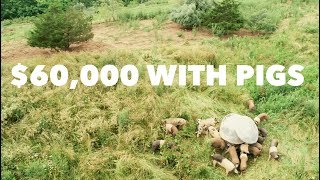
Polyface Farms runs 300 pigs across 20 acres in rotating paddocks, spending about an hour daily on labor and generating $60,000 net profit per year without owning the land. The system uses simple infrastructure like wooden gates and movable water lines, requires no routine antibiotics, and improves soil while keeping per-pig profit at $200 to $250.
Chapters
In this video, I'm going to show you a 20-acre pig raising system from Polyface Farms that actually nets $60,000 a year on an average of 300 pigs on land they don't even own.
Oh my gosh!
Oh my word! We are— whoa, it's a bumpy road. Good thing we brought this amazing Barbie Jeep. We are at our feature for today.
It started this morning on a whiteboard lecture with Joel on how he would do this on a 5-acre scale, and then of course you can scale it up to 20 acres. Basically, you take 5 acres, divide it up into 10 half-acre paddocks, You move your pigs through that in a season. By the time they get to the last one, you move your pigs every 5 to 12 days, and by the time they get to the last one, you can bring them back up an aisle and start again at the first one, the first place that's had enough rest. Hey, we worked with this great guy named Matt who showed us how he moves the pigs.
Hey, hey, nice to meet you.
You're early. Yeah, yeah, making a joke. So Pollyface is on Lombardi time.
What's that?
When Lombardi, the Coach Lombardi, said to be there at 6, he meant 5:45.
Oh yeah, I was in the military, so I guess, I guess 15 minutes early is kind of a standard.
On time, right? We just met with the gentleman, Matt. He's gonna take us up there. We've got to follow him up the trail. Good thing we're in the trail-rated Barbie Jeep.
That's right, we got the Barbie Jeep. Put her in 4-wheel 4-wheel drive if we have to. Hopefully we don't have to.
So what we're hoping to get here is a more classic textbook look. It's a little more easier, Jules was saying, to see what he was talking about this morning with the various paddock moves. Weren't there— how many paddocks were there?
Yeah, there was 10 paddocks.
A general rule of thumb of 10. If you're moving every 5 to 12 days, by the end of time you get to that 10th one, you can move them back to the first one.
So we're gonna see that in real life right here.
Did he say—
yeah, he's got 200 pigs.
And this used to be a briar patch.
Okay.
When—
so Polyface rents this, and I guess he's hired by Polyface as a contract farmer, I think.
Contract farmer.
Okay.
One in there. I mean, you saw the little ones down there on your right-hand side. Those just arrived, um, and these are getting ready to butcher.
Okay, these guys over here are going to the butcher. Yeah, pretty soon.
Week or two, I'd say. Okay, we generally look— I think Polyface likes them around, but, you know, the range of 300 to 400 pounds.
Okay.
And generally right in the middle is like perfect. Um, so they're getting pretty fattened up, and I'd say another week or two and they'll be ready to go. So I'll go ahead and hop in here, grab their feeder, and we'll get it moving.
Okay. It was great being there in that open field where you could actually see the different— you could see multiple paddocks in one place.
Put it back up.
One thing that was super encouraging there that you could see for sure is the successions.
Here's where they moved to, here's where they were on. Here's what it looked like the week before that, and you could go all the way back to 5 or 6 weeks. This is where they are, this is where they're going, and had once been. It's just amazing how it just recovers like this, but I guess we've seen it happen ourselves.
That's what they don't— they're stirring up the weed bank here, the seed bank, but not the weed bank.
He's dropped his feeder right there. The tractor went through right here. You would think you would just be able to open up, have a gate on this electric wire. But because this is sort of an invisible barrier that they haven't even been able to touch, rub up on, they're going to be hesitant to go through there even if that wire is not there anymore. They're filling their feeder up with grain. I noticed it was empty. These guys had eaten it. So like they've been telling me, they're, they're going to be ready for a move. That's part of the secret. I've noticed there's trees in every paddock, and the pigs are enjoying them. There's not a— there's not a wallow in this paddock. They don't create wallows. If they happen because of rain and whatnot, then it happens, but they don't go setting about creating them.
Let's take this out of here and then I'll let them through up there. There's a gate.
Okay.
The thing with the water— what's really important about this setup, and I'm sure Joel or Daniel probably told you guys, is the wooden gates.
Yeah.
So pigs, you saw how I had that fence down and they wouldn't cross it. It's even, even if I completely chopped that away and that, that wire wasn't there, they wouldn't cross. It's like a mental barrier. It's like, it's like the elephant that gets chained to a little post when he's young, and then when he's older, he still doesn't— he doesn't understand. He could just rip it right out of the ground, right? So the, the reason we have those wooden gates is because if they can physically touch it and then see that it's not there, then they'll go through it.
Neat.
So we're gonna see it in action right now.
Yeah, we'll take this out of here and then we'll go ahead and let them through.
All right, you took the chain off of this thing?
Yep, took the chain off and swing it open.
And it's no longer on hinges, you just— no, do a chain freely.
We just chain it to the post.
Okay.
And then I go over here and I take the chains off this one to replace. So what I do is I leapfrog the gates.
Okay.
So I always have one here and one on the back.
Sorry. And notice he's all alone. There are 50 in here.
Um, yeah, I mean, the groups are generally around 50, and this is smaller, some are 36.
And this is about a half-acre paddock.
Yeah, half-acre. Yeah, that's about right. Whoa, you can do an acre.
But so this is where they are.
This is where they were.
This is where they were a week ago, right? Holy smokes. Okay, so did it— now wait a minute, a little bit of regrowth there, and then back there is where they were. So this is coming back nice now. What the heck?
How are you ever going to get rid of that? So when— after they finish going through, we bring in a little bush hog and we just knock down all the thistles. You see they're starting to—
especially you got a seed, huh?
And so we try and get them all knocked down before they spread everywhere, and then you get something nice like that instead of—
I know, right? Look at that.
Okay, that'll be that high, super green.
And you'll hit that again one more time this season?
Yeah, yeah.
And then it'll get rest all winter?
Yep.
Cool.
So when I move them, the first— for usually the first couple moves, you need a few people. Um, because they're just not used to it. So you just get like 2 or 3 people, walk down to the end, and then push them up.
Okay.
These guys are used to moving, so it really just takes one. I do a sweep down the paddock just to make sure none of them have been scared over the line or anything.
Do you guys, uh, do any worming?
No, we— oh well, Natural. Uh, we don't obviously don't use any antibiotics, right? Pesticides, anything like that. But do you know, like, charcoal?
Okay, and that's only if they get sick, right? Yeah, but you don't do any preventative. So I was asking them if you did any deworming. They do do charcoal. Joel was telling us that this morning, but only if they get sick. And what's the percentage if somebody gets sick? What's the chances you're actually going to save them with charcoal?
Um, you know, I couldn't really actually give you a real percentage, but we don't have very many die.
Okay.
Especially when they're out on pasture.
Okay.
Um, they seem to really take care of themselves. Uh, but yeah, sometimes in the winter in the barn when they're in a little bit more cramped quarters, they're in there— obviously we're giving them food, water, and we have that deep bedding in the barns.
Yeah.
But they're a little bit more cramped, they don't get as much exercise, not as good nutrition because they've they don't have the fresh pasture to be on, we'll give them some charcoal and they seem to do pretty well.
How do you get charcoal? You make— we make it just burning it yourself and harvesting it.
Oak is really good, white oak specifically. Um, yeah, just get it super hot.
Do you mix it in their feed or do you give it free choice?
Um, you can actually dump it straight in and they'll just eat it.
Okay.
Um, but yeah, if you mix it in with their food, they'll definitely You'll be sure that they get it.
Here he goes, he's just walking them. He's getting some stragglers there, but they know the drill. I'm gonna leave him bringing up the rear. Get you guys a shot of this dialed-in system. Look, are you serious? It's like we're herding cows right now. Are you serious? They're cramming against the roof.
Look, I'm serious.
This is amazing.
One guy moving 50 pigs. No bucket, no nothing. They're heading down to the feeder. They're picking out on this huge grass.
This is what's possible with pigs even if you don't own the land. The average in this county for renting, $37.50 an acre a year to rent land in this county. That's the average. Joel came to an agreement with them for $100 an acre, and that was partly because the landowner was nervous about pigs. They're going to stink, they're going to tear up the place, so they settled on $100. Joel on this 20 acres is able to do 200 all the way through and 200 halfway through, so he averages— let's say that's an average of 300 in a season, 300 pigs.
So I always move their water last, specifically with this type of water. Um, when you pull this plug, it's going to drain and it's going to dump all that water. And if those pigs are still in here, they're not going to leave. So I mean, it's going to create like a giant water slide here and they're just going to lay in it, and then you're going to have real trouble getting them to go into where you want to go, especially right here at the door, right where you want everybody to go. Crazy muddy. I mean, it's heaven for them.
Yeah, this is an easy water move because It's right there. And I noticed you just drive over this with the tractor. I mean, you lowered the insulator, drive over with the tractor, psychological barrier, something coming. Okay, so this is where the water has been before. Oh yeah, you've just had a lot of traffic here.
Yep. And we had a little bit of a leak here during the winter. It ran for a while. Uh, we don't have to start during the winter, but yeah, this is what they'll do.
This is what happens if you get a leak.
Yep.
You get your first customer, buddy. You guys have got this system dialed.
Yeah, you guys really do.
Cheap system too.
Yeah, that's probably the whole thing. I mean, I'm sure if Polyface really wanted to get high-tech, yeah, they could. Yeah, they have the means. Um, but they're still in the area of showing people that they can just—
yeah, like the big expense here is land, but you could also lease land for $50 an acre. Do you know what they're paying?
They're actually paying some of the most expensive on this land right here, but the amount of— it, it's just— people don't know what we can make off these pigs. I mean, you can make $1,000, $2,000 off one of these pigs.
Nice. So there's $50,000 worth of pigs in there.
He can gross $1,000 per pig at the market for selling it by the cuts. $1,000 per pig. But That's gross. What's the net? Like, there's expenses putting this stuff up, there's depreciation on tractors, everything considered. There's, uh, labor, everything, feed, feeders, water, water line, everything considered from equipment and the depreciation of that equipment to the feed, everything considered, they net $200 to $250. So let's say $200 profit, 60 $100,000. That's a great living for somebody on land you don't even own.
What did this look like before you guys got started out here?
Uh, it's pretty much a giant briar patch that was above your head.
Okay, that's crazy tall because, you know, I would think if you're going to a landowner, they're not doing much with their land, they might be scared of pigs coming in, right? But if they could come and see that this is the work, this is what's gonna happen.
Yeah, and you know, maybe you're not like Polyface and, uh, this is maybe the only thing you're gonna do. And how you going to get a tractor? And well, even if that tractor is $17,000, or let's say it's $20,000 and you, um, appreciate it, depreciate it over time, say it's gonna last you 20 years, so you expense $1,000 a year. Onto this truck, you're making $59,000. You know what I'm saying, guys? That's how maybe you can justify a tractor. And maybe the marketing aspect is more difficult. So if you don't— if you aren't an established farm, it's maybe going to be hard for you to sell meat by the cuts.
Maybe you have to pay a little bit more for your feed because you're not buying as much feed.
There's some margin here. Pay a little bit more for your feed, having to buy a tractor, or getting to buy a tractor. So then you're— I mean, what are you, down to $50,000? This is an amazing opportunity.
It's nice, peaceful, and quiet. Yep.
Doesn't stink.
If the landowner was to say, okay, you guys have to go, this stuff isn't that hard to tear up.
Yeah.
No, just the way the posts are the most permanent thing that you have out here.
That's right. You haven't invested a lot or any in permanent.
Yeah.
I mean, you might come and pull up your post. Would you?
Right. I mean, you could, or I mean, if you didn't care, you could just leave them. It's, it's not treated wood or anything, it's just a locust post. It'll last a long time because it's locust, but you would pull pull up your wire, you could probably pull out of here in a day or two and pull up the water line, get ready. We have a cistern up there that feeds this whole thing, sort of like a pressure tank.
Yeah. And if you're leasing land, say you're leasing land in Virginia and for some reason, oh, your, your family, rest of your family's in Michigan and you want to move out there, right? Okay, let's go find some leased land in Michigan.
Yeah.
I mean, the post didn't cost Joel anything but labor. Yeah, cut them off his own farm. It's, it's a pretty simple system.
Beautiful model. Yeah, yeah. I want to show you guys the succession, the half-acre paddock. Okay, grass, plenty of it. This is where they just got moved there. This is where they were. So some moonscape, not a whole lot, some more where their feeder was. There are some briars and weeds about to go to seed, but he said They're gonna go in with a bush hog and mow those down. So they were there for a week. So a week ago they were in here. This is what it's gonna look like. Are you serious? This is— this, this, that is what this is gonna look like. So they were in there for a week. This is a week ago. This is just a week old, guys.
This is a week old.
There's, there's still manure on the ground. There's still visible manure. Hasn't even been absorbed yet. So you guys ready to see 2 weeks? Boom! Oh my gosh, look at the line I just crossed.
2 weeks.
What? Matt, did you guys mow in here? No, not—
none of this has been mowed yet.
So they didn't mow this, so that's why the, the briars are still here. You won't mow this, or will you? It's too late to mow this?
No, I think it's, it's still mowable. See, most of these haven't seeded out yet. Those have a little bit of—
okay, but I mean, at some point you don't, you don't want to cut the grass, right? Or do you?
Um, so like most animals, they don't really like the super stemmy long stuff. Okay, they like that fresh, you know, maybe 3-week-old grass, nice and green. So if we came through here and you, you can raise and lower a bush hog, so we could chop all these off maybe 6 inches up Okay, and then it would give the grass a really good head start to get above it.
And ideally maybe 3 weeks before they come back in here, right? Okay.
Yeah, so they started up here.
Okay, so then this is what— this is— so we're a week old there. This is 2 weeks since they've been in here.
A week old with the thistles, 2 weeks old, 3 weeks old.
Oh, okay.
This is 3 weeks old, and then the 5th one down there is—
so you gotta see, you get You guys got to see 4 weeks old right here. 4 weeks old, it looks like if you came here, you wouldn't even know. If you were a landowner, you wouldn't even know pigs were been in here. It doesn't sting. Does it stink? Correct.
Nope.
Doesn't smell here. This is 5 weeks old.
Yep, that's the first paddock. And that wasn't— that, that grass that's growing there wasn't there when they started in here.
It only came in after they left because they, they brought it up from the seed bank, right? Yep, it's just—
and that's good stuff.
Wait, show me this good stuff. Okay, so will you mow this before they come in here?
This one is not that bad. The thistles in here are pretty much non-existent.
So you're saying—
probably won't.
Okay.
I, I— we, we never let it go long enough to see how long it— or how tall it will get, but it'll get pretty big.
Do they like the, the— do they like the fescue?
They'll eat fescue as long as it's young.
Will they ever eat this pigweed?
I don't think so.
Why do they call it pigweed?
I guess pigweed—
pigs bring it up, but they don't eat it.
There's some stuff that animals will eat if you chop it and let it wilt, like cows.
Oh really?
Joel's told me that cows will eat thistle if you chop it down and let it wilt.
Isn't that something? This is 5 weeks.
5 weeks.
Oh my gosh, 5 weeks, and we got grass. We got grass up your shoulder.
Yeah, and that's That's this beautiful stuff.
Is it fair to say this is richer than when you found it?
Definitely.
Okay, the pigs— that the pigs are, are bringing up the value of this land, not taking it away, right?
Adding value. Oh my God. And making you money.
Oh my gosh.
So I thought, what's the kicker here? Okay, how much labor is it average? About an hour a day. I mean, some days it's 20 minutes, other days it's 2 or 3 hours. You know, depending on what you're going to do— string trim underneath the electric wire, uh, whatever. It varies. So Joel thought an hour a day.
The big labor with pigs is specifically here is the, uh, the paddock prep. And that's— the paddock prep is key to keeping pigs.
And you mean the paddock prep initially setting all this up? No, just maintaining the daily Like, so the—
well, weekly, I guess you would say. So I move these pigs about once a week.
Okay.
Um, what I do is I come in— well, you saw, they weed whack it, tighten all the fences, and then electrify it, and then let them in.
Like, this needs weed whack?
That needs weed whack. So that will drain your battery like crazy. Okay, so when you're gonna weed whack that, um, they won't be back on this end for a while, and so none of this is hot. I always weed whack the charged lines which run on the outside of the paddocks.
Okay, so the reason how you didn't get— how you wouldn't make this hot is there's a jumper line right there. Yeah, so somewhere down there you've disconnected the jumper, right? Right. This is textbook. This is more textbook. There's like— if there's the 10 paddocks in here— hey Matt, are there the 10 paddocks?
What's that?
Are there 10 paddocks this way?
I think there's a little over 10 paddocks.
A little over 10 paddocks. Okay. So it's almost his textbook, uh, teaching. Half an acre each. Let's get the drone in the air and look at these things. Okay, I just put up the drone and it just started raining, so that's a wrap. I mean, we did it, we got our footage just in time for rain. For the rain to come. Now we got a bit of time to edit and put out these vlogs.
Well, I hope you were as inspired by that as I was. This is really encouraging for farming, that it doesn't have to be this low-income drudgery, high-risk type thing. And as for the landowner and this land, it doesn't have to be— the system was not stinky. And actually, when they got this land, it was all briars and and brambles, and now it's these beautiful grass pastures. So it just shows you could make a great living doing this and leave the land better than when you found it.
More from Justin






If I had to start my Homestead all over again, it could only pick one animal… 




