How to Butcher a Chicken (without Equipment)
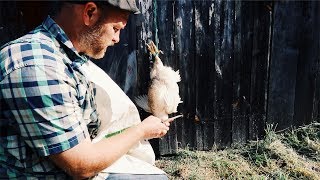
Two presenters show how to slaughter, scald, pluck, and eviscerate a chicken using only a kitchen knife, bucket, pot, and rope. They suspend the bird upside-down to bleed out in three minutes, dunk it in 149-degree water, hand-pluck feathers, and remove organs without puncturing the intestines.
Chapters
In our last video, we showed you the Maximus butchering setup. What if you just have a few chickens? What if you're on a really tight budget? Did you know you can pretty much just do it with things you have in your kitchen? A knife— you can use a kitchen knife. We're using some kitchen knives here, okay? This is just a multi-purpose, I think it's like 6 inches. Everybody's got a bucket laying around, right? Everybody's got a bucket, everybody's got a stovetop with a pot big enough for a chicken. And does everybody have a hay string? Could you guys find a hay string or some rope or similar so you could do this chicken butchering? Absolutely no extra cost to you if you're doing a few. If you have a few friends that would be interested in this and learning where their food comes from, 15 birds this way. So let's show you the old school way of doing it. So I take my chicken, I have a This, this, this rope is tied in a loop. You can put your chicken's legs in there and let that catch. It's gonna be really low, okay? And then let's just catch it, okay? Upside down sedates them a little bit. It calms them down. You want to turn them around, grab their feathers. You hold their head right here and you cut right above their jawbone. Where's my bucket? Obviously I would hold the string up a little higher so I'm not bending over, but you can do it. Hey, this is a minimus. Butchering. It's going to take about 3-ish minutes to bleed out. You need to hold them because you don't have— that's one reason you would have a killing cone is to keep them secure, keep them comforted, keep them sedated. That's why we hung them upside down. With this string, it's going to be multi-purpose. We'll dip our bird in our scalder. We'll also hang it back up to pluck it. If you're not doing 200 birds a year for inevitable, you're doing 15, a dozen a year, you got some friends, do this way. So after we've let it, let it sit for 3 minutes, we did the string, the minimalist killing right here. That wasn't that much harder than if we had the cones. The cones make it a little bit easier because we don't have to hold the chickens. Um, it's a little easier to put them in it than to tie a string up, but not that significant. You at least have a kitchen stove or you have a pot You have a pot. It doesn't even have to be this big. We've heated it up with propane, but you could do it on a kitchen— why couldn't you do it in your kitchen? Unless the missus don't want you in there, then you're gonna have to get a camping stove. But anyway, we dip this. We have that string. It's best if you can dip those legs, but this is a minimal chicken butchering. That's really hot water, you can feel it. So it might not take long to do this. The way we know that it's done, we're just dipping it with our I'm not having to touch that hot water with this. Is we can't— normally if you're dipping the legs, you can try to peel the legs, but the legs aren't— we aren't even really dipping the legs and these legs are already starting to peel. The one way you can really test for sure is pull the wing feathers, and they came out. Okay, they came out real easy, so it's ready to be plucked. So guess what, guys? There ain't no machine in the minimalist world. Come on, let's have a party. This was the pot. This was a little more difficult because you have to— well, you have to have a thermometer and you have to regulate this temperature versus the Maximus scalder. Anybody in here? We have it set to 149. It's cooled off a little bit, but guess what? It's gonna bring it back up automatically. Hang it somewhere, it could be back on the barn. Y'all, I got friends! Start plucking! Oh, it is warm. Yeah, come on guys, jump in! So who's, who's gonna butcher after, after this workshop? You are? Okay. You're gonna be more of this setup, minimalist or maximist?
Well, I've looked at some of the pluckers that are on Tractor Supply, or have a friend that lives up in North Dakota that grows them. He made his own.
You see, you've gotten the easy part. The hard part about hand plucking is these little feathers. But isn't this fun? Aren't you guys having fun? Oh yeah, time of my life. They're having real fun back there. A lot of hands in there. The greatest joy watching. You did? You have some friends that would do this? I think so. I think so. Okay, they wouldn't look at you like you have 8 heads when you invited them? Emergency room nurses, no problem. Keep it going, keep it going. Yeah, you guys, yeah, just throw them on the grass in the minimalist situation. The feathers go into the grass, it'll be just fine there, it'll decompose. We would put our blood— I see the skin yellowing. Yeah, so we— our water got a little hot. That's the trick with the minimalist situation, you can't get the perfect 149 degrees. It's harder, it's harder to get to 149 degrees. I believe this was a lot hotter than that. We only, we only, uh, so we only scalded it for like 20 seconds and that was too much. So we would cool that in, in this situation we would add water to that for our next birds. But then here's the trick, you might add too much water. The more chickens you do, the more it's going to cool off. So you're going to have to, you have to watch your temperature more in a minimalist situation. But This was free. Yeah, and maybe you just want to— one fresh chicken. Maybe you just want to kill one at a time like they used to, you know, go kill one for supper. Well, before we get outside, you don't want to spend 2 hours setting up all this equipment. You just want to grab a string and a knife. So you guys want to pluck that until you feel like that you would be comfortable with that in your fridge. Let's pull it off and you rinse it off and you process it. Just like anything else, you might not have a setup outside. You might have to go inside your kitchen, but maybe the missus wouldn't mind so much. That looks like that— it almost looks like grocery store meat right there. If we're going to eviscerate this the minimalist way— the maximus way, we cut this with stainless steel shears. Minimalist way, we pull the head off. In that case, it was pretty easy because they cut into the neck a little bit. We want to get rid of this neck, neck skin. Just slice, never poke. Put it on each side. Slice the neck skin as we go, put it back on its back, grab between. We're just pulling that skin right off. We just pulled that skin right off there. At this point, while it's on its belly, we can cut along the chest here to not pierce the bag. We want to cut it with the groove, so we would cut this way. Maximus, minimus, we would leave that neck on there. Still on its back, let's get its legs. Bend their legs up against the way it naturally bends. Do a little slit until I can see in there. You can cut the cartilage, but don't cut the bone. Pinch right above those keel bones. Cut right above the vent. Slide it till you see air. Put it over the edge here. Pull it up. That— see, that way there's some manure coming out. Open up this cavity real good. Now you want to reach in on either side. There's connective tissue. See that connective tissue on either side up against the rib cage? We're breaking that, we're breaking that on top, we're breaking that on the left side, we're breaking that connective tissue. And then we can reach up in there and pull all the guts out along with our windpipe. We left our heart in there, we can grab our heart out. Lungs that hang on to the ribs right there, somehow we got lucky and got that one out. This one, the lungs are right here, so you kind of just crawl in there Get it in one piece if you can, which I was able to do. You just kind of— they even make a tool to get those lungs out, but that seems to be just enough. I hang it over the edge of the table so all my stuff is hanging out. This is where I could cut the liver. Here's your liver. You hang it, you use gravity for your advantage. Hold the liver up, let the guts hang. Don't hit that, that's the bile, and that'll make it taste terrible. You'd want to rinse it if you accidentally hit that. Sacrifice some of the liver to get around the bile. There's the liver. You can cut Cut the gizzard off if you want at this point. Right now we're going to feed it to the pigs. Hanging the guts over the edge, you want to cut on either side of this intestine to the right, all the way down to the bone. You don't have to hit the bone, but go to where you think the bone is. Go to the left and then cut straight across. That gets your intestines out without having to cut your intestines. Wow, so there we go. Now I'm going to rinse this off. Which was better, the string or the killing cone? Cone was so much easier. So you'll buy a cone? I'll buy a cone. Okay, are you gonna buy a plucker? I'll probably buy a scalder. Are you gonna buy a scalder? Probably both. Okay, how many are you gonna be doing at a time? Probably 150. Oh Lord, help me. Yes, I would totally buy that stuff. East Tennessee. This is interesting. How long did it take you to pluck this bird in that plucker? Maybe 20 seconds, 15, 30. It was really quick. How much— how long did it take 6 people to pluck it? Over minutes. Minutes? Yeah, I think this is the biggest game changer. It is. I would agree with that. I would agree with that. So if you can only have one equipment, it's It's the plucker. It's the plucker. Definitely, that's the one thing to have. Yeah, so what do you think about that plucker?
I think it's amazing.
Would you— when you go to— are you going to harvest some chickens?
Yeah.
Are you going to get a plucker? Are you going to do it by hand?
It depends how many I'm going to do.
Okay.
I did a couple, I guess I'd pluck by hand, and if I did a lot, I'd definitely rent one of them, buy one of them, or— yeah, lease one of them, whatever you do.
I hear you.
More from Justin






If I had to start my Homestead all over again, it could only pick one animal… 




