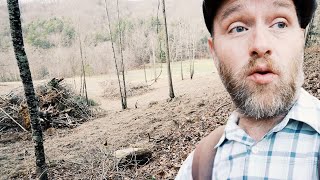
In this video, Justin explains how he expands usable pasture on his homestead without purchasing additional land by converting a steep, wooded 1.5‑acre parcel into silvopasture. He outlines the hay shortage his dairy cows and sheep face—requiring unsprayed, horse‑quality hay in large quantities—and why sourcing it from out‑of‑state is unsustainable. To become self‑sufficient, he clears the forest using hired excavator and grader equipment, paying about $7,000 for the work. The cleared wood is evaluated for firewood value, yielding an estimated 100 cords worth roughly $15,000–$30,000, effectively paying for the land improvement. He details the steps taken after clearing: raking, seeding, laying hay to prevent erosion, and repurposing brush and wood chips as deep bedding and compost. Justin also discusses labor challenges, the shift to large square bales, and the broader economic logic: the cost per acre of clearing is far lower than buying land, and the firewood revenue more than offsets the expense, enabling more pasture, on‑farm hay production, and reduced feed costs. The narrative emphasizes using analytical calculations over gut feelings to make homestead decisions.
Chapters
I've got cows and sheep on their deep bedding. They're terribly happy. It's wintertime. I love this system because we're capturing their manure and urine and deep bedding, and that will turn into compost, and we'll spread it in the weaker parts of our pasture this summer. We are running out of hay and having a hard time getting it. We have to get this— let me show you. We insist on horse quality hay since we have dairy cows. Which is a really nice hay. They have to cut it early, not like got a lot of seeds in it, and it's unsprayed. And to feed 5-ish cows, 7-ish sheep all winter long, we need to fill this entire side of this barn here with hay. That's about 600 square bales. So we have a problem. We need unsprayed, we need horse quality, we need mucho quantities. And to find those 3 things, can't do it local. We have to go across state. We actually have to get it from Kansas. That's not terribly sustainable. So what I'd ultimately like to do is harvest our own hay, rest these fields down here for hay. In the sun in the spring when hay's going nuts and have enough pasture elsewhere on these steep pastures to be able to, uh, harvest hay here, skip this part, rotate everybody everywhere else and harvest and grow in hay. The other problem is we're not able to get square bales anymore. Just talked to my guy, we have to get the big square bales which are 850 pounds. I mean, we can open them up and feed them by flakes, but it is easier just to grab a hay bale and throw it in. Labor shortages— it's hard to get folks, he says, to harvest the, the small bale hays from the field. They do it in these big bales, and you can do it with machines much more efficiently. We're gonna go to the field in just a second and show you how I'm actually buying, or how I'm actually getting paid to clear for more pasture so that it can have more grazing days, so I can have more— so I— so we can grow our own hay. Right now we don't have enough pasture to do so. Now that I have this Kubota, could I get hay-making equipment? I didn't know if it made sense on such a small scale. But when the 3 things I have in need are not available, it might just be a must. Let's go look how I am acquiring new acreage without buying land on my own farm. I have 75 acres, 10 I'm currently using. The reason I'm not using the rest of it is most of it looks like this. That's overly steep wooded mountains. So what I've done is I've gone into a portion, 1.5 acres for this demo here, and turned it into a silvopasture. I didn't do this myself. You don't have to do everything yourself to make money on the homestead, to make it worthwhile on the homestead, and this is not even counted into it. This gigantic brush pile could— we're too steep to get to it, so we're gonna burn it and turn it into ashes and spread it on the field. What's that worth? What's that worth, uh, to bring to and get some alkaline on these acidic pastures? Otherwise, if it was lower down like those. Those are going to be turned into wood chips. What are those worth as deep bedding, as sources for making compost? So guys, this area was wooded as that area. I've left some trees so the cows can have shade. These are productive trees. These are walnuts and locusts. Boy, this is soft after doing this. So then we have more piles. We have a pile here, a pile there, 2, 3, 3 piles that we can do in wood chips. So yes, we had to hire the grader. We hired professional excavator and track loader to come and do this, pull up the stumps. There's no stump grinding, there's no leaving the stumps. You can see some of the stumps in the thing. And we hired them, and this is an acre and a half, and it cost $7,000. That's about, I don't know, $4,500, something like that, to gain an acre. That's what it cost me. That might sound expensive if you're in like Missouri or Tennessee, maybe. I mean, land prices have gone nuts. But around here, you're looking at $20,000 or more an acre. So already, instead of expanding and buying neighbors, just clearing forest in my own area, I'm already saving like 5 times. It's 5 times cheaper. Once we got it— once we had them clear and piled this up, you can see we got some friends. We got some of our friends from Abundance Plus. It— I mean, strenuous labor is always more fun if you can have some friends. First, we rake this pasture smooth where the machines couldn't get it smooth. Then we seeded it. Then we came in with hay, unsprayed hay, to keep it from washing away when it rains. It's been raining lately, and I'm glad we got this hay down to keep the topsoil here. This is going to be super rich topsoil. $4,500 an acre, already a great deal if that was the end of the story, but there's value in this wood. Let's call the grader and see what that value is.
Hello?
Hey Fred, how's it going?
All right, how are you, Justin?
Good. On that acre and a half that you cleared out there—
yeah—
how much wood value do you think's there as far as firewood and lumber is concerned?
There really wasn't none of it big enough to really saw lumber out of. I mean, there's a few poplars, but—
well, that's good to know. Well, let's—
most of it was just firewood size, you know, 8, 10-inch stuff.
Guess how many dump truck loads you took out. Can you do that?
Uh, best I can recall, it was about 8 or 9 wood-wise. You probably— there's about 30,000 pounds on each load, and then about 8 or 9 loads.
Okay, I bet I can estimate how much firewood I'm gonna get out of that. All right, so worst case scenario, you don't have any timber, which Some of the land I've cleared before had a lot of timber, which has more value, but let's go worst-case scenario. He said 30,000 pounds of wood times— let's be conservative again— times 8 loads. 240,000 pounds. How much does a cord of wood weigh? Let's talk to Mr. Google Pants. Cord of wood weighs 2,000 to 3,000 pounds. Let's be on the— let's be average. So 2,500 pounds, we need to divide that into 2,400. Ah, shoot. We could say— you want to be more conservative and say 2,400 pounds for easy math. 2,400 pounds divided by 240,000. Divided by 2,400. It is 100. That's what I was thinking. Okay, so Randy Clement, don't make fun of me for not knowing that confidently. All right, 100 cords of wood. Now what does that tell us? Well, that tells us— well, how much is a cord of wood? I'm gonna look it up in my area. Can you sit down here for a second? Let's go to Craigslist. Cord of firewood going for $140 right there. Is that a cord? Here's one for $300. Is that a cord? Full cord, $300. Uh, what's this for? $140. Half cord. So yeah, okay, so a full cord of wood is going for $300 in this area. That makes 100 cords of wood worth $300. Equals— what's that value? $30,000. $30,000. Wait, you know why I'm giddy here? We paid $7,000 to get it cleared, and we gained an acre and a half and $30,000 worth of firewood. But maybe that's not fair because that's corded wood. Split, season, stacked. So okay, let's say that's not fair. Let's say to get it processed, whether you're splitting it yourself, there's some time in your— there's money is time, time is money, all that kind of thing. Or you hire somebody to split it for you and stack it. $100— let's just say a cord is $150. Let's be super conservative. Still $15,000. Still, I'm like paying myself mega to clear pastures for firewood like this. Mucho firewood we need for heating our house. We use this wood boiler to heat our house. It's super efficient, burns the smoke, burns the creosote. Oh wow, it's loaded. The kids loaded it this afternoon, but, uh, still takes 1 to 2 wheelbarrow loads of wood a day. Heats our 2 hot water heaters. So if we were to have to buy that by the cord, it would be $300. So it's super cool to be able to source our own fuel from the land while making the land better. I actually more than doubled my money. So it's not like I'm buying— I'm not buying acreage. I'm getting paid to get myself more acreage. So I'm telling you guys, this is the case where you need to go with your brains and not your guts. Like, my gut's telling me, oh my gosh, I'm being extravagant. I'm writing this check for $7,000 $100,000. But when I actually sit down and do the evaluation— hey, I couldn't buy this land. I mean, I couldn't. There's 100 acres not for sale that way, and there's 350 acres not for sale that way, and that's it. That's our choices. So we are in this great situation where we're forced to use our minds and come up with creative solutions. Clearing an acre and a half Not only is it worth it, it actually pays. Like, I'm getting paid to clear land and get myself more pasture so we can grow our own hay, so we can have more cows, so we can feed less hay, you know, run the, run the cows more throughout the winter. Lots of possibilities.