How to Get Started with Chickens: Everything you need to know
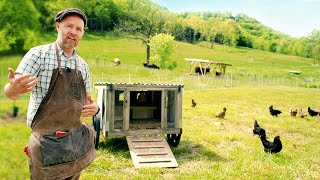
Justin and Dan show how to start a backyard chicken flock from chicks to eggs, covering brooder designs, deep bedding with pine shavings, fermented feed, and predator protection with electric netting. They emphasize low-cost DIY solutions and moving chicks outdoors after the last frost.
Chapters
In this video, I'm teaching you how to get started with chickens to grow all your own eggs. How many chickens do you need? Well, first figure out how many dozens of eggs you want to eat in a week. Let's go by dozens. You got 12 eggs. One chicken, let's say 3 to 5 eggs per week. So if you want a dozen eggs, that's 4 to 5 chickens, a dozen eggs a week. We're going to give them a tour of our chicken system. Yeah. All right, so let's show them. Do you know how many chickens you're gonna need? What kind of chickens for laying eggs? You can't go wrong with a dual-purpose like a Barred Rock, Rhode Island Red, some of my favorite, Black Australorp, Buff Orpington. Now you've got to order your chicks. I like ordering my chicks from McMurray Hatchery. Then a lot of people ask, well, do you have to get vaccinated? We have not vaccinated chicks in in 20 years and we've been just fine. I think that's more for a very conventional model, 'cause your chickens will be out in the air, they'll be on deep bedding or out in the pasture like I'll show you later, and it will be okay. We've opted out of that and we've been just fine. Inside here, I will show you guys a brooder system. It's your lucky day! We're gonna get to see the turkeys. We got turkey poults right here. We've got sea monsters here. I call 'em sea monsters. These are meat chickens. We'll show you that. And then we'll show you transitioning out of this system. So we have this bulletproof brooder system. No rat, no snake, or anything can penetrate this. We have half-inch hardware cloth. We have— we're extra, we're a little extra. We have storm doors, okay? We have 18-inch deep bedding footing. Notice how the doors are way up in the air, like we gotta step way up, except we don't. Because we've been building up deep bedding in here. So this is one thing that people don't realize when you create a brooder, and you don't have to have this massive— we just had a stall, we retrofitted it to this thing. There's 100 chicks over here for meat chickens, there's 20 turkeys over here, so we have a relatively bigger operation. Uh, actually, now would be a good time to roll the footage of me setting up a brooder for our kitchen out of a tote.
In this video, I'm going to show you guys how to set up a brooder. Look, I've got it going. I'm going to cover two things: one, all the supplies that you need, and then how to set it all up. So yeah, I've turned my heat lamp off for a second because it's so much better lighting like this and it won't kill them. It might actually be a little warm for them, but So it won't hurt to take a little break. We're in, we're inside, so we're at room temperature. They are in our dining room so that way we can keep track of them. Well, let's talk about this first thing. This is the brooder.
I like to call it the porta brooder.
This is the big box that you contain them in. I contain them in— I use a Rubbermaid. This is a 40-gallon. It's probably 2 foot by 4 feet. And remember, you can put 4 chicks per square foot up to 3 weeks. So do that math, it's, uh, 8 square feet in here, so that'll be about 32 chicks till they're about 3 weeks old till they transition outside. The reason I call this a porta brooder, and if you want you could get the similar thing, a 40-gallon thing. I drilled holes into the side so I could put the roof on. There's a little plastic roof back here that I could put it out on for transport, and then that way they can still get air Also, at night, as they get a little older, I don't do the heat lamp.
I'll actually, uh, put—
leave them in there and put that lid on at night, and maybe that gives them some warmth or some security. And then that way they can still breathe out of these holes.
To make it portable—
and the reason I would have it to be portable is ideally I would take them out during the day right here. You take them out to my yard. I have built this door so that this can open and shut. And the way I did that is I sawzalled a hole into the side of it, and then I used these scrap wood on either side as washers for the bolts to go through and as places to mount hinges. Stay in there, little buddy. And that way I can open and shut this. It hinges, it's real nice. I'll shut it, of course, while they're in here. And if I were to take them outside, I The other thing I would build is a little ramp to get them out into the grass, and then I would have an encaged area here, okay? Preferably caged roof too, so nothing from the air can get them. And that way they could get out in nature. They would be out day one with mama in the grass eating all kinds of stuff. So the second thing I'll cover is, well, the location of this thing. It's by the light. There's a natural light right there and has the indoor lighting, so it's nice. I would turn everything off at night and they would have the natural sleep cycle there. Next I'll talk about is the shavings. This is pine shavings, okay? You don't want to use like hay or straw because the manure doesn't fall all the way down and can get on them.
So use pine shavings.
Some people maybe worry about the aroma of it, but there's plenty of open here. They're getting a lot of ventilation, so I've never had any problems with that.
Next, we could cover—
I guess we could cover the heat lamp. They, they value heat more than anything else. They'll, they'll make sure they get warm before anything else. So they would actually starve and, and, and thirst to death before they would get cold. So they like it about 90 degrees at first. Because I'm in at room temperature and it's spring and we don't run our— we aren't running our air yet, It's probably— it's pretty warm in here, so they're okay, especially this few minutes. The way you can tell— I would know these guys were cold if they started cuddling up together. And in fact, because now they've spread out a little bit more since I've turned that light off, I'm thinking that light might be too much. Because if they're cuddling up together, it's too cold. And if they're going around or staying away from the heat lamp and maybe they're being a little lethargic type thing, then it could be too hot. You don't have to get crazy scientific about it or worry too much about it. You could do a temperature, you could take a temperature down here, but I think your main problem is going to be them getting cold. And see, that's not happening. So that heat lamp would come into play if you were putting them out down in a garage or something like that. This shaving is in 8 inches. I like to do at least 8 inches, that way I don't have to change it out. They'll scratch and peck and work that manure in there, and you shouldn't have to change it out throughout. Then the next most important things are this— what, the waterer and the feeder. I love to use these quart jar fittings for the waterer and the feeder. It's an attachment you can buy. I'll leave the links to all this, guys, so you can relax.
Just relax.
I'll leave the links to this in the description below. I do what you call magic water, what I like to call magic water, in this quart water for the first few rounds. And that is per half gallon, so I take a half gallon jar, fill it with 2 cloves of smashed garlic. You can see the little garlic particles floating around in there, maybe.
What?
Oh, beautiful one says pressed garlic, excuse me. 2 pressed garlic cloves, 2 tablespoons apple cider vinegar, and half a cup of honey, and that's in a half a gallon. And so then I took it from the half a gallon jar and poured it into this quart jar, and that way I'll have two cycles of it. When this one runs out, I'll fill it up. And yeah, of course you put water in it. I'm sorry, Beauty's back there keeping me straight. She's saying, yeah, after you put the mix of the apple cider vinegar, the honey, and the garlic, you, you then pour water into it. Of course, I like to do warm water. Well, you need to do warm water so you can mix that honey in. Okay, that's the water. Now this feed is special because, well, not only— it's an attachment feeder too, and this, this will accommodate these birds easy enough. And if you need to, you could get 2 or upgrade. I'm assuming you're not gonna— I'm assuming I'm talking to people who are getting 36 birds or less in this situation. I have fermented this feed, and this is what that looks like, guys. I just put the dry feed in there. You need to get a starter feed, preferably organic or non-GMO, but put your starter feed in a food-grade bucket like this and then pour water over it about 4 inches. What you want to happen is that there's no air get to that feed, and that's what allows it to ferment. And it's just, it's gonna help them boost their immune system. Same thing with this magic water, it helps boost their immune system, just gets them off to a really good start. This also lets their feed go further. I mean, it'll increase the efficiency by 15%. So what I would do—
I've already done it today—
but what I would do is get a scoop of this, and preferably you're gonna let this soak for 3 days before you need it. And if you don't have 3 days, you could put some fermented something or another in there, like pickle juice or kraut juice, something like that, just to speed up that process. And I'm just— I've got this screener, a stainless steel screener. I've let the water drain out, and then I would just pour this into the feed pan. And notice I didn't let it— this is set up to be an automatic feeder, and that works well for dry feeds, but it would not work too well for a fermented feed. Let's talk about our grit now. Grit is little tiny rocks. I like to go down to the creek and get creek sand and small rocks, especially creek sand for these little guys. See, these dinos don't have a stomach. They have what you call a gizzard. So they swallow their food and then a muscle inside of them grinds up that food with rocks. You also notice they don't have teeth. Okay? They will grind— this helps them digest it. We've just put it in this little tiny bowl. I've already seen them going into it and getting it. And now you'll notice that this is on something special. And this, this was a game changer for me. Putting it on, putting the feeder and the water on this, let's call it a dirt trap, was a game changer. Because look, they otherwise, they, they're out here on the, on the 1/2-inch wire mesh getting their water and food, and they're not tracking this shaving into the water and food. If you just put this, the water and the feeder out on this shaving, they're going to track that stuff. Into it. So when they hop up on here, when they hop up on this trap, the shavings fall down. You can see them in just one day, how many have fallen down in there, and manure. So it goes a long way to keeping this clean. If you don't have this, I'll tell you how to make it here in a second, but if you don't have it, just use a cardboard box. That helps. Now to make this, I just got a half-inch wire mesh Hardware cloth, hardware cloth, depends on who you're talking to what they call it. I'll leave a link to it and I stapled it onto this homemade frame out of wood I just got on the farm. This is like a 1 inch by 2 inch, this is like a 2 by 2. It's fine, just scrap it together and I sized it according to my pan. I think it's a 4-quart pan and I just dug that pan in there. See, if this were the area I was going for, I would have just dug it out and then I put that pan in there and then I would cover it up with this food trap and then put the feed and the water on there. That thing's just awesome. I just can't say enough about that.
I think we're almost done here, guys.
I think I'll speak about one more thing. This is in the open and that's cool if you don't have chiddlers, and that's cool until they get about 3 weeks— or not even 3 weeks old. They won't be long before you They are jumping up here, and that's fine if they want to get up here and look out and have some dinner with us.
That's nice. You like that?
You like eating dinner with us?
Sure they do.
But the problem is they end up perching like this. Yeah, holy chicken squat, on your kitchen floor.
And that's not good.
That's misdirected, and that's a pain in the butt to clean up, especially if you have chidlers. And even more so, they get really bold and they hop down and you got little dinos running all over your kitchen floor. And that's not so much of a problem except there's manure everybody, and somebody might get stepped on. The other thing about it being open, especially if you have chiddlers, is that they'll come and play with it. Gideon, he'll, he'll throw this mulch into the water. He'll grab these. If we let Gideon grab one of these, it would be like a mice and men, you know. He would have good intentions, but he would actually kill—
he'd kill this thing.
Thing. Okay, now just out of being overly friendly and overly excited, so to fix that, I created this crate to go over— a crate, I guess, and I don't know what you call this thing, but I sized it. It's just custom sized. It didn't take that long to make. It's half-inch wire mesh on a frame. Okay, there's two— there's two bars going across to hold it up, and there's two bars at the end to complete the frame, and then two bars on the side. I just measured it and cut it to size, and then that way the dinos don't jump out and the chiddlers don't grab in.
And it's the best of both worlds, and everybody's safe and everybody's happy.
Now when you go to put them in, whether you're getting them out of a box out of the U.S. Postal Service or you're bringing them in from an incubator, whatever the reason, you want to bring them in one at a time. Let's pretend we're doing that. So I would bring this little guy in.
Isn't it fun to hold these guys?
It's so fun. Give them a little dip in the waterer so they know where it is and so they get their drink. Now little chicks can go 2 or 3 days— well, 72 hours without food, but once they get food and water, they have to drink. Look, look at them pecking each other. Okay, they do peck at each other. You guys heard of it called the pecking order, and that kind of pecking is fine if they're taking somebody down. That somebody is sick, okay, and that's their natural way of strengthening their species, strengthening their flock.
Okay, the strongest survive.
And you can either separate that one out— you certainly wouldn't want to breed that one again because you want strong genetics, especially if you're breeding. And you could separate it out if you want and see if it will get better. We actually did that with one a little bit earlier. Don't be worried about losses. I'm— well, I mean, a crazy amount of losses, like over 10%, you know, under that it's going to be expected. We actually lost a guy, a guy or gal, that something was wrapped around their leg as they hatched and it cut off that circulation. And by the time we saw it and when we got them out of the incubator, we treated it.
We treated—
there was an infection, so we treated with peroxide and then put some homemade salve on it. But the little thing didn't make it. We did put it aside in a cardboard box right here, and you could do that. Otherwise they're going to take each other down and just see if it recovers. And if not, just let nature take its course. Oh, if you really want to get saucy, give them some natural feeds. That's just some food scraps from our, uh, our kitchen.
It would probably help—
it would help if I broke it up. Mama hen would be breaking it up for them. So break it up real fine and they'll really enjoy that. It could be any, any food scraps from your kitchen, eggs. Look, look how I'm picking at it.
Eggs, lettuce.
And if you don't have anything like that, or broccoli head would probably be really good, go out into the grass and just pick them some grass or clover, and they'll really appreciate it. Is it absolutely necessary? No, they've got their complete diet in that grain setup, but this is certainly a plus. It will go a long way to keeping them healthy and happy.
So that's really it. Just, just remember Probably the most important thing is just relax. Take a deep breath. Have fun with it. They are very resilient.
Sure, you may lose some, and it's to be expected, and it's okay to be sad about it, but just keep on going. They're in much better care than they would have been in some other conventional farm or something like that. So just remember that you're doing a good service for them, for the species, and for your family. So just, just sit back, relax, Do your best and enjoy.
Now let's take a deeper look at this Mega Brooder. I was talking about the deep bedding. A commenter recently said, hey, you got to change that deep bedding, you got to change it out. No, you actually want to do the opposite. You don't want to change it. You want to hang on to it as long as you can.
Why?
Because more mass you get of their manure plus this deep bedding material, which I love, the, the shredded pine shavings from Tractor Supply. And by the way, I'll leave links to my kit for all this stuff down in the description to where you guys can go get this off of Amazon or Tractor Supply or wherever. So all these things I'm referencing to, link down in the description. This fine pine shaving is amazing bedding because it sits flat. They manure on it and they don't— if you get the bigger pine shavings, the manure won't go all the way down to the ground. It'll hang up top on, on one of the shavings. And it'll get on the chicks. So we put down our deep bedding and then we just keep adding as much as we can because the more that gets in a mass, the more it's a vibrant decomposition. What do you see? You see the tractor out there? What are the things we have in here? First of all, we've got a feeder. I get my feed from New Country Organic. It's worked out great for us. Just make sure he doesn't put his hands in here and touch any manure. Otherwise, that's fine. These are not chicks, these are turkeys, but I happen to step in the turkey one because there's not as many. Chick Starter from New Country Organic. Some people say, well, do I have to switch feed to what you call— no, don't get in here. Do you have to switch to Grower? The only difference between Grower and Starter is that Starter has been ground up. So actually, for the sake of savings, we buy our feed in 1,000-pound totes and we just get Starter. Because everybody can eat it. The chicks can eat it, uh, the, the growers can eat it. The— even the adult chickens can eat starter feed. It's just higher in protein. So what? They, they don't mind that at all. You just— it just doesn't have any calcium in it, so you want to make sure you feed back eggshells in that case.
We'll get to that a little bit later more.
What do you see? So we have the feeder, we have a gallon waterer. That'll last them for a while. If you're doing 100 Cornish Cross, you're going to maybe need to switch this out for a 3-gallon waterer. As soon as they start drinking more than this in a day. But, uh, the gallon water will last them for a little while. They make these little— what you want? You want down? Okay, he's done. Here, Josiah, can you grab him from me? Thank you. They make this waterer that you screw into a quart jar. That served these turkeys for a little while at first. And if you just have a dozen chicks or so, that'll certainly work. Notice I have that on, on this feed trap. This is coming and We're gonna include this in my book, Homestead Builds, this do-it-yourself plan. It's just 2x4— what's 1x in the middle and then 2x4s on the edge, and it's a half-inch wire mesh. Well, one commenter said, what's that for? And I said, whoops, forgot to tell you. I've just been doing this so long, I forgot to tell y'all what that's for. Well, if you put your water on here and you put your feed on here, and then a chicken comes along. La la la la la la la la. And they have dirt and shavings on their feet. It mostly. That one didn't, but it mostly falls down through. You can see there's a lot of manure down in there that has fallen through. And so it keeps the feeder. I had the hardest time for so long. If I were to set this on the, on the wood shavings, the chicks especially just scratch and this would just fill up with wood shavings. But because it's here, they've got to jump and they've got to walk a bit before they get to it. It just keeps it so much cleaner. It's just a simple dirt trap, I call it. Then we have this. This is a hover brooder. I get this at Premier One. And what's really cool about this, the chicks, when they first arrive to you, they're going to want to be warm. That's their number one priority. Get all this set up. Before they come. When, when they come, the U.S. Postal Service will call you maybe early in the morning. We've had a call as early as 4:30 in the morning. Those chicks have never had any food or water, so they're sustaining on whatever was inside that, that egg from mama. And their first priority is going to be to be warm. So post office calls, you go turn on your, your hover brooder. I like the hover brooder. We do have a lamp. You want to be so careful with those lamps. We create redundancy on those lamps. They're clipped in. We run the cord across it and then we run a wire. So we have 3 redundancies that that does not fall down in here and light these wood shavings on fire and burn down my whole house. It happens, guys. It happens. So really, if you can just use the Hover Brooder, you're not going to burn the place down with it. It mimics mama hen. They get under there, they get all warm together, and then the warmth is coming from top, and it's just, it's more like nature. It's how it happened in nature. When the chicks are born, mama hen would come and get over them. So you've ordered your chicks, they're coming, you've gotten all this ready, and they're ready to go. It's going to be amazing to you. You're going to set them. We like to get them, we get them out of the box, and we like to dip their beak in the water just so they'll know where it's at. If you're feeling saucy, take a gallon of water and make some magic water, which is half a gallon of warm water, half a cup of honey, 2 tablespoons of apple cider vinegar, and a couple tablespoons of minced garlic. Put that in there, and it's just a health immunity boost for when those first chicks arrive. And you just dip them in there and just let them go through one iteration, so one, one-gallon thing, and, and they're good to go. Might last for a few days. I've went down to creek and I've gotten creek sand, and it's these little tiny rocks. This is grit. You can buy chick grit because they don't have teeth. Chickens do not have teeth. So how are they going to grind up food? Well, they swallow these rocks, it goes down in what you call a gizzard, and that gizzard, it's a muscle and it works the food in, and then they're able to digest it better. That's why I call it rooster teeth. There's no such thing as rooster teeth. This is rooster teeth. And so I get off some of these big rocks. I just go down to the creek and get some creek sand because this has even got minerals in it as opposed to just buying some quarried rocks. I mean, it won't hurt, but you got to get them this. That, that helps them break down their food. It makes it more easy for them to digest, which makes it go further. So they'll grow better, you'll spend less money on feed. They need grit the entire life cycle. I didn't cover amount of space. So 4 chickens per square foot. So a 6x4, you can raise, uh, 100 chicks up to 3 weeks in. So you do that math. If you're doing— if you're doing 12 chickens, you're not supposed to do math in public. You do that math in private. What is that, 3 square feet? I just did it. I just did math in public. So 4, 4 chicks per square foot. Yeah, that'd be 3 square feet. It's not big. It's not big. That's only like that much. Like, it could be a box, it could be a little box. The problem is you're going to need enough room for your, your, your water and feed, and you'll need— you'll need to make—
hey, my man—
you'll need to make a, a feed trap small enough to fit into your little place. But it won't hurt to have 4 chickens in a big area like this if you had to.
What are you looking for?
What you gonna do? Building a house. Okay. Oh, is it a chick house? I want to see that before this movie's over. We got a dead person. I call them person sometimes. Uh, we got a dead one. Totally normal. I wouldn't be alarmed until it's like 10% of your ratio. The dog loves this, the pig loves this, uh, the woods love this, the compost pile loves it. We went in on a friend, they're getting a bunch of these chicks, so we have too many chicks. So we put in another hover brooder, and I don't think this setup is any different than that except the heat lamp. You'll notice I do have a heat lamp on here. I have that redundancy to stay safe. I'd put the heat lamp over the food because remember how I said they want to get warm first? So you dip their beaks in the water, then you put them under the warmth, and they'll come out at their leisure. Well, they'll come out even more if you put that— a heat lamp over it, I've noticed, because then they're comfortable. If their first priority is warmth, but then you want them to eat for good health and growth, put a little heat lamp over it. You ready to show us this house? No.
Why not?
What's wrong with it? Okay, come on, I'll do— I'll help you. You cut a door in the front and you cut a door in the middle. It's a condo. There you go. That's enough. Okay, they like it. That's enough. Okay, this is going to be a perfect example of what do you do when your chicks aren't going to be in the brooder forever. You want to get them out about 3 weeks. They're going to have their feathers have grown in by that time. We should talk about this, and I forgot to mention it early— timing. So if we're putting little chicks out, what do you see? What do you see? Water? Yeah, that's water in there. You want to go see the chicks? You go see the chicks. So timing, 3 weeks. I don't like to put— they go out, so let's not put them out until after the last possible frost date. Ask Mr. Google Pants, when's my last possible frost date for your city? And ours is May 10th. We've had frost as late as May 12th, so I guess it's May 12th. I technically wouldn't want to put out chicks— best picture, text book until May 12th. So the earliest I would want to order chicks is 3 weeks before that, because if they turn 3 weeks old around May 12th-ish, put them out. I know a lot of people are jonesing to go and they get— you can do it later than that, but I know a lot of people are ready to go in the spring. But don't get them any sooner than 3 weeks before your last frost date, because you want to put them outside. They've gotten their feathers at 3 weeks. They can handle with those little feathers down to 30 degrees at night. If it's gonna be wet and cold, you might wait another week, keep them in the brooder for 4 weeks. It won't kill them. You're gonna have to add more deep bedding during the day, but it'll be all right. Where do you put them? Where do you put chicks when you put them out? Well, we have this chicken tractor. We actually had to put out these chicks early because we made the mistake and ordered too many other chicks and we ran out of space in the brooder. They were only 2 weeks old, and that's okay. We put them in this chicken tractor that I've designed that I can show you how to build in Homestead Builds, and I'll leave the link for that too, guys. All my, all my builds, all the information on that, on the book that's coming out that teaches you guys how to build these things. This has siding, look, look, on 3 sides, panel, so it kept them warm. The cold air is coming down. We had a hard frost last night. Or the night before, and we said, okay, let's put the panels on the cold side. Let's actually put a hover brooder in here. Let's run a drop cord to it. And that's because I set them out early, guys. If I didn't have to set them out early, I wouldn't need this hover brooder. But it's not a terrible situation because the chickens are now out on grass instead of the deep bedding. And in my opinion, that's a little bit better if you can move chickens as opposed to having them keep them in one spot. I think it's better. I'm a big fan at 3 weeks old putting the chickens out where they're gonna be. So if they're gonna be in a chicken tractor, put them in a chicken tractor and they'll be just fine. If they're going to be— and maybe we'll show it when we go to one— if they're going to be in a chickshaw, put them in a chickshaw. I do have this chicken tractor So I'm gonna— and they're only 2 weeks old, so I'm gonna leave them in here for a little bit, get— let them get a little bit older. The problem is they're so little they can be subject to crow attack and other predators, but they get to a certain size and then a crow is not going to get them and other things aren't going to get them. This is our trick. When I, when I spoke about predators, that what Gideon just had is a goose. We're raising that goose with these chicks. He's eating chick food and everything, and he'll— because he's alone and he's been raised with chicks, he's going to think he's a chicken. And so he's going to protect them. He's going to flap his wings. He's going to be looking up for predators. He's going to squawk, and that's just too much drama for the predator, and they're going to stay away, especially the aerial predators. The guard goose— and that's a Roman tufted— is really good about that. So, um, How do you introduce chicks to a main flock? I mean, it's great when you have a main flock because the main flock is going to show the chicks what to do. We'll go out at night, everybody's hunkered down and perched up, and they're easy to catch. They're half asleep. It's okay, he's okay. And then you take those chicks and you put them on the perch of the new place in the new coop at night, and everybody's kind of groggy and they just barely kind of notice. The next morning everybody wakes up and they walk out of the coop and they're all kind of looking at each other like, was that a dream? And they, they then they just accept that all these new people are here and everybody's just in the flock. And because you have those older hens, they're already coming home at night. They're going to teach those chicks to come home at night. The chicks might not always come home at night, especially the first few days. You might have to go out there at night and catch them. And put them in there, and that trains them to coming home. So we have a chicken tractor situation for these guys. You can see they've worn it out a little bit already, so we'll move this a length. This chicken tractor is rated for— and it's a, I don't know, 40-something by 2 feet tall by 8 feet long. It's perfect for our raised garden beds. This coop could hold 12 chickens if you let them out during the day. So I have this handy door over here and you could let them out, hopefully in a Premier Net. I'm telling you this, if you let your chickens out, you may think it's beautiful, you may want to decorate your landscape with chickens, but the first thing they're going to do is go after your mulch and they're going to start squatting on your sidewalk. You're going to have evil chicken poo misdirected. And you can turn that into holy chicken squat by just putting a net around it and getting that manure where you want it. I got it. I'll get him out. Come on, buddy, let's move them. The perch becomes the prop. You like that, Dan? That's a little improvement since you made this chicken tractor. The Dan Oman behind the camera there, guys, he built this one. He built my OG. Okay, Henry, you ready? Yeah, you go in the back if you want to hold that up. So I'm gonna go ever so slow because they're little chicks, they've never been moved. If you get chicks that are then trained to this Did I run somebody? Good. Good. Yeah. Hey, this was a really good demo. So we've moved them to fresh ground. You've got two options in management. You've— it's good. You got to move people with chickens. Uh, move it when necessary. It was just getting too scratched up, too manurey. Let's move it at least once a week with chickens if they're in a netting system. Look, he's shutting Henry in. Don't shut him in. Are you done? Or you want to put them on deep bedding where if they're going to be in one spot, say in your yard— you'll see that set up in a minute— you want to do— have them on wood chip, on some sort of carbon like wood chips. It's the same thing. Now eventually they're going to graduate out of this and we're going to need to use a bigger feed tray, and we're going to need to use a bigger waterer. I like those vacuum seal 5-gallon waterers. Again, links to all that stuff in the description. Let's show the front yard operation, guys. Put the chickens as close to the house as socially acceptable. And if you're going to have permanent garden systems like I have with these raised beds— we have our kitchen garden here in the front yard— put the chickens right next to it. Get the chickens out of the backyard. Into the front yard. This is a situation where they're gonna stay put. We might as well start talking about some of the systems you need. You need to think about that as you get your chicks and you get started into chickens. What are they going to graduate into at that 3-week time? A chicken tractor is great for 3 to 4 hens full-time in the chicken tractor, no fence required. Move them around the yard, put them in an area you want to garden, have them till for a garden. Put them on top of a raised bed to, uh, you— I'll get this in the background so you guys can imagine it. But we put our chickens over this, they tilled in the COVID crop, then we added some compost from, from— I call it the compost corner, the chicken run. And then we planted these plants. The chicken tractor, moving it around the yard, keeping 12 chickens in it as a coop, and then having a poultry net around it and moving it at least once a week or put in an area you want a bigger garden and have them there. So that's a chicken tractor option, and that's, that's moving around. You could put them in a chickshaw. We got a— we got two different chickshaws you'll see in this video. This is the pretty shaw, so it looks, it looks pretty. It's good enough for the front yard. You might as well call it a she-shaw because she's going to really like it. We could put them in a deep run system, of course, with a, a mobile Chicken coop. A pet peeve of mine is cleaning out manure. And you guys, you'll notice— and this is, this is one reason the homestead build is, is at the heartbeat and why it solves so many problems— it's because early on when I tried to find a coop, I bet you can relate, Dan, the coops are expensive, they require cleaning out the manure, and they don't move. All my coops move. You do not have to clean out manure sometimes. They'll get some hay on the floor, and sure, you have to clean out some manure. You're going to either move people or you're either going to put them still. So if you're going to put them still, we've designed this compost corner where it's this permanent run. It's this nice wood cedar with cattle panels in between and then poultry wire all the way down. And notice these cattle panels, these are pretty tall. So even a chicken, if you clip its wings, will still jump over a small, maybe a regular size railing, so we had to make these super tall. Now nobody gets out of this. This is like the chicken run no one can escape. The only time is we don't— maybe that didn't shut like I thought it shut, and that rooster buddy, he'll come climbing out. Just a regular gate shut here, and then 1x6 is on the bottom to retain the deep bedding. We put a bunch of wood chips in here once a year. We made it so that we could open up gates in the middle so a dump truck could come, so you don't have a machine you need a dump truck load, you could order you some mulch delivered, dropped in here. Even paying for the mulch, guys, you have to pay $300 for a dump truck load of mulch, probably less for us, much less for a smaller dump truck load. You only need maybe 2 yards of wood chips in this big of a compost area. And you'll see we have our wood chips down and the chickens are always here, but they're always manuring. Chickens don't pee, do y'all know that? That's a little fun fact. Chickens only, they put it all together in one, I was about to say cute, that's way too strong for describing chicken manure, manure, but they put it all in one tidy package, how about that? And it mixes with this carbon and they scratching and working all day and it turns into compost. Well, here's some, what's underneath exposed, that's compost. Like, let your kids play in that. I wish Henry were still here with me now. I wouldn't be nearly as nervous. Wouldn't be straight up evil chicken poo. You can see we throw everything in here. We throw our weed scraps. Guys, this is a bundle of poison ivy and they just devoured it. Okay, we throw our weeds in here. This is the static run method. You know, I call this the, the compost corner. And this is how a lot of people are going to need to raise their chickens. And I see a lot of people raising their chickens this way in just one area, but it's nasty. It's like a moonscape of manure and it's just, ugh, just gross. No wonder the chickens get sick, right? They're not going to get sick on deep bedding. It's not going to smell and they're going to give you compost. Still, do a mobile coop. Why are you going to do a mobile coop? Because they drop half their holy chicken squat at night and I can move this one length And watch this, and I never have to clean any manure. I just cleaned, I just cleaned the coop. Look, it's all there, it's all there. And by the end of the day, they would have mixed this all in, and it'll help. See, and it'll help this carbon and this manure mixed together makes, well, with air and water, compost. Well, what do Older chicks need— what do— oh, you're mixing everybody. It goes back to just feed everybody starter feed. You don't want the chicks to get layer feed because layer has calcium in it. Chicks don't need that calcium. But it can go the other way. The grown chickens can eat— don't mind the rooster crowing— the grown chickens can eat starter feed, not the other way around. So get everybody starter feed. Look, here's one of these. This is actually a 3-gallon waterer. You might come out here every day, stir it around like that, flip it. If you want to see how these waterers work, it's kind of neat. You fill them up. It only has one exit. When you put this lid on, there's no air coming in. This is your only air, and it just kind of dribbles out water. And once water gets over that nipple, it can't drip anymore. So it only lets out more water if the chickens drink it. I have it on this pallet. It's another feed trap. If I were to have it right here, they're going to scratch this wood chips. Chickens have no delayed gratification and they can't read, so they don't know that scratching your own manure into your own water and feed is a bad idea. Put it in there in the middle. They jump up on here and they drop some of their manure and their, their mulch before they get to the water. Feed. I have an auto feeder, just— it's easy. How much food does a chicken need? A third pound a day dry weight. If you're gonna— should we get into it, Dan? Go for it. Okay, go for it. So if you're gonna— if you want to save 15 to 25% of your food bill like today— uh-huh, I'll go for it. Let me grab this bucket real quick. Okay, so we'll grab a bucket Guys, you want to save 15 to 25% on your feed. Like I said, a chicken needs a third of a pound.
Look at this.
Look, this is what happens, Dad. Look. Hey, this ain't bulletproof if you leave the door open. Make sure it shuts or we're going to get everybody out. If people get out, how do you get them back in? Well, in that case, we'd leave the door open, we'd herd Chickens herd about like cats. Terrible. Uh, kind of scare them. They are chicken, they're easily scared. Scare them around, kind of keeping them near the fence, and, and get them back in here. Another trick is worst case scenario, you can't catch a chicken, just start— just don't take your eyes off of it. Walk after it, jog after it, do whatever it takes to not lose eye contact with that chicken. You are an endurance animal. They're not. They're sprinters. They'll out-sprint you. So don't play that game. Just slowly go after, and eventually they're going to give out and you'll be able to catch them. Let's save some money. Instead of a third pound of feed per chicken, that's just— this is not, but let's put a quarter of a pound of feed in there. We only have one chicken. Bad idea. At least get two chickens. Cover it up with water. Dan, you told me to go for it. I hope they're enjoying this. This is a quick win. This is something anybody can do. And by the way, if you have one of those nasty moonscape runs, you can fix it by just putting in wood chips, wood shavings, grass clippings, paper shredded, leaves, coconut coir, any carbon material like that that you can get a hold of. Just put it in there. Guys, I used to do deep bedding with a poultry net. You could have a poultry net around this. Sure, they're going to scrape the mulch into it, but you just go around every twice a week, once a week, and just lift up your net and reestablish it. We've got our quarter amount of feed in here. Just leave it. Just cover it up with enough water. Don't leave it in here, of course. The dinos will take it down. You see, they have no internet. They got nothing to do but to scratch and peck and explore any oddities that you leave behind and tear it up. This will soak in just for 12 hours, so just do this today. Take your feed that you're going to feed tomorrow, put in a bucket, cover it with water, and that's it. Then The next day, water and all, come out here and put it right on the ground, and they're going to pick it. It gives them something to do, okay? They got no YouTube. This is what they do. Look, they're already starting to come get it. And what that did is, just like for humans, that's a grain, and that soaking breaks down the anti-nutrients in that grain, and it becomes easier to digest. That's why The food goes further and saves you money. That's a quick hack right there. Well, why aren't you doing it, Justin? Why aren't you doing it? Well, we, we're not doing it because we have this E-I-E-I-O Old MacDonald farm and we've got such a diversity and plethora of things going, it's not going to really make sense for it. But we used to do it all the time, especially when all we had was chickens and, and milk cows. I like this auto feeder Sure, they're going to get all they can eat. You might get a fat hen or two. Why are we doing this instead of— well, we have to, you know, I got kids doing this. This is fail-proof for kids. You're gonna— you're gonna— you could show a kid how to get out your ration for the day, or you could just say, is the feeder full? Okay, this is a King Feeder from Premier One. This keeps the food dry, which is game changer. Otherwise, you have your food out in the elements, it's gonna get rained on, and the chickens aren't gonna like it as much. This is really nice. Before we go to our next system, which would be a yard or pasture system, really practical, let's talk about the impractical. Well, the beautiful, okay, the Pretty Shaw. You'll see it's got the basic concept of my Chick Shaw. You know, it came from the word rickshaw, those things in Asia that people pull each other around with. The concept though is all the weight is in the middle, and so we put the wheel in the middle. And you saw me move it earlier. This thing is pretty heavy, but I was able to move it. This is an addition that looks nice, uh, whiteboarded, black trim, windows, gable roofing style here, a little ventilation in the top. Somebody's laying an egg right now. One thing we learned with this Chickshaw, as opposed to— if you have some of my original plans for the Chickshaw, and this is the heart behind, uh, coming up with homestead builds— my original Chickshaw, we had arms that did— that came up like this, and this thing kept doing wheelies, and we had to do a kickstand, but we kept knocking the kickstand off. Well, now I fixed that problem and made this easier to build. Notice this bar. Did you ever build my Chickshaw? You did, so you have the OG, the one that Well, and you know, where are we going to put that? You know, how are we going to measure right? It was hard to instruct on that. And now it's a simpler build. It's just an 8-foot long, maybe it's 7-foot, 2x4 that is also the bottom frame, but just comes straight out. We learned that we can just come straight out. We don't have to come out at an angle. And we put the front legs on at the end of the arm instead of right here. So it puts more weight out here and therefore a lot harder to for the chickens to pop a wheelie with. I mean, we'd come out in the coops like this. You might— can't tell here, and maybe we didn't do it on this one, but these legs are shorter than the wheels, so it actually sits even on a slant a little bit, so that's even harder to tip. Now, one really cool thing about this, since I'm a permaculturalist, I wanted multifunction everything. This handle comes out, okay, and it becomes your roof prop. You can do it, you can do a little bit right here, or you could do it a lot right here. These ChickShaws are designed with 1-inch wire mesh so that their manure falls through, guys, and the floor is the perch. You'll notice the 1x's on the bottom So we make the best amount of space possible. I made it 2 feet tall. That's it. You'll see these chicken coops that are like 8 feet tall. People want to get in those chicken— I'm like, what the heck? Why are you going in there with the chickens and all the fecal dust?
No, I don't.
That's another one. I don't want to clean out manure. I don't want to go in there with the chickens. These coops, you do not have to go in. Well, how you gonna get the eggs? How you gonna get the eggs, Justin? Let me show you. No bending over, no going inside, just get your eggs. And in a pinch, these milk crate nest boxes can be your egg carrier. Forget the egg carrier, just take this with you, come back. Somebody's broody and you want to set her, just take this with you. That means somebody's wanting to lay and hatch eggs and she's not getting off of them and you want to use her to hatch some eggs. Just transport her in this. It's been working out really well. In this first book, Homestead Builds, we're going to do 12 plans, 12-ish. The problem was I wanted to prototype all these and make sure it's all right, like, you know, we worked this out. I'm glad I didn't do this 2 years ago. And the second is I'm no, like, engineer/carpenter or a graphic designer. So finally I've partnered with some others to come up with a legit book and get these plans dialed in. It's amazing how they know how to swim.
Is that amazing or what?
Huh? Just swims out. I don't think it likes it though. It just swims right back as soon as it can. The final system, not the least system, probably one of my most favorite system, is the pasture. I call this the pasture posse. This is the pasture or yard. You can see the Premier One net is set around these guys. These guys are set up to move every week. We have had it to where we move them every day behind— 3 days behind the cows, and they scratch through the cow manure and eat the fly larvae and spread the manure. But most people are just going to have a pasture posse, and so we're demoing that today. We've had some injury and we have a child out that can't help, so we've had to simplify the farm. No worries. Put them in a poultry net for a week. Move the coop once a day. Come get the eggs. You spread that manure love. Come get the eggs. It's really simple build. This is the Chickshaw Mini-Me. So we've coming out with the Chickshaw 5.0, but I'm calling it the 5.0 because our biggest Chickshaw now is only 5 feet by 5 feet. It was 6 foot by 6 foot. Well, hey, Justin, why are you cutting that down? Well, if you maxed out the 6-foot by 6-foot and put 60 birds in there, which you could fit— you want to do Surf's Up, and that's how much room you need on a perch for chickens. And you could put 60 birds in there, but it's too much weight on these Marathon Flat Free tires, and we're really not finding another solution. I did think, well, maybe we could have dually them up, so maybe somebody out there could make a dually shaw. And maybe make an 8x8 and put 100 chickens in there. But for our duties, we're like, wait, if you can't even put 60— this is why, this is why we bring an engineer in. He's like, wait a minute, it's too much weight. If you can't even put 60 in it, well then it doesn't need to be 6 foot. So if the max holding is 40 birds, what's the max size it needs to be? 5 foot by 5 foot. Okay, so that will be our Chickshaw 5.0. This is a, this is a Chickshaw Mini-Me. It's a 4 4 foot by 4 foot. That doesn't sound like much smaller, 4 foot versus 5 foot, but it's actually this much square footage. It's quite a bit, uh, when you think of it, square footage. So this is a bit smaller. This will hold up to 24 birds. It's easier for one person to move. The Chickshaw 5.0 holds 40 birds. One cool thing we've added to this— well, look, I have an O-hook on this. And we're gonna, uh, for our homestead builds, I have this idea that we will be able to hook on a little sled where we, we put our water on. Let's say we want to move this coop a distance and we don't want to go back and get our water, we just put this on a sled, we put our— I'm gonna have a mineral and I'm gonna put it down, and then we just pull that and it pulls this. So this is our new and improved design where the arms come out longer. Chris, thankfully, co-author of this book, has come. So you can see this is a dual purpose. The hitch is not on it right now. It's terrible. I should have put the hitch on there. But anyway, you, you can imagine a ball hitch on that. And let's say we're going to move— whoa— we're going to move way out to the other pasture. We're going to go up a 30-degree slope.
Boom.
Put it on the back of Sally, put it on the back of mower, and just haul it. So you can either one or two people get in here and pull this thing like a shaw, or you can hook it up to a machine. And now Chris has come up with another invention where this is removable. So the hitch system, if most of the time you don't use it, you don't even have to have it on here. Like right now it's kind of on here and it's maybe ugly, but imagine just being able to quickly put it on and being able to move people. That's some of our new design. A little bit of a lip here to cover the nest box. I've got a 5-gallon vacuum-seal waterer. For feed, I've been feeding directly on the ground. I've been putting on manure patties. I've been rationing it, 1/3 pound per bird. And let's go back to those chicks, you know. I can illustrate it more. We want to introduce these chicks to this flock. We bring out these chicks at night. Everybody's in the coop. We just put them in and they perch. We shut them up. In the morning, we let them all out and they're like, "Oh wow, that was a weird dream, or dream I was dreaming." And now we got all these new people, you know, they're tripping out, but they're okay. They accept it. Chickens are really that easy. You need to think about food, water, shelter, and protection, those 4 things in each situation. So when they're When they're chicks, they're in the brooder for 3 weeks and then they come out and they're with everybody else and they've got their food, whether it be a food tray or rationed and set out or whether it's an automatic feeder. Water situation, is it one of those little 1-gallon waters? How much water does a chicken drink? 4 chickens will drink 1 quart of water a day. Shelter, so is it going to be the chicken tractor? Is it going to be the Chickshaw? Is it going to be the pretty shawl? Is it going to be some other thing that you're going to invent or buy or build or whatever? You're welcome, of course, to get these plans at homesteadbuilt.com and make all kinds of modifications. Dan has the Millennium Falcon auto door shutter, right, Dan? Automatic door shut on my chick shelter.
This is like the Millennium Falcon.
Some other people have doors that shut with the sun. When the sun goes down, the door shuts on the chickens and puts them up automatically and then opens them up in the night. That, that's, that's, or opens them up in the morning. You have your shelter, and then the last thing is the protection. So get them a guard goose if you can. Have the electric poultry net around them to protect them from predators. Have your coop no openings more than an inch. I mean, if really you're scared, if you have the electric net and you shut your coop up at night, you've solved 99.9% of your predator problems. So that's really all there is to it. Take a deep breath. One of the best things you can do is go ahead and go to McMurray right now and order your chicks. You're not ready. You're not ready, but just do it. Order those chicks. And then you, because you've been putting it off, haven't you? And now the chicks are coming. Okay. And you have to get ready now because you have a delivery date and you're going to get hustling and you're going to make it happen.
And it's going to be okay.
"Hey, somebody's gonna die. You saw a dead chick in my brooder. Somebody's gonna die. But the alternative is, is buying eggs from the store where plenty of chickens die." Your alternative is better, even though things are gonna die. And sometimes it's gonna be your fault. And sometimes you're not gonna know whose fault it is. But there are hardships in it and there are fears and anxieties you're facing, but that doesn't mean it's wrong. My friend Christian Winger would say anxiety means go. So go order those chicks. You'll get ready. It'll come into place. You'll do fine. Let's do it. I'm going to help you with Homestead Builds, the structures of your homestead. We're kickstarting that June 1st. You want to get on that so you can get all the plans before we go to print. This is your chance. I'm going to help you build the foundational structures of your homestead, and you can go find that at homesteadbuilds.com. Get signed up for the waiting list. We'll get you first in on the Kickstarter, and then after the Kickstarter's up, it'll be homesteadbuilds.com. We'll direct you to the Kickstarter, and then after that, it'll be the book. Because I don't know when you're seeing this. You might be seeing this 2 years later and the book's already out. All right, homesteadbuilds.com.
More from Justin






If I had to start my Homestead all over again, it could only pick one animal… 




