How to Get Started with Turkeys: Everything You Need To Know
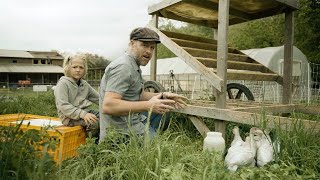
Victor Justin Rhodes shows how to raise 12-20 turkeys on a small farm, from day-old poults through harvest. He covers brooder setup (3 birds per square foot), a homemade electrolyte recipe with honey and apple cider vinegar, moving 4-week-old birds to a portable pasture enclosure, and predator protection using electric fencing and guard animals.
Chapters
In this video, we're moving our turkeys from the brooder out to pasture, and I figured why not teach you everything you need to know for raising your own turkeys while we're at it. So let's do this. First, how many turkeys do you need? So for us, you know, in the homestead, turkey doesn't have to be just for Thanksgiving. So we like to have 1 turkey a month. So that's 12 turkeys in a year. Let's buy 20. My system, my turkey shaw, is developed for 20 birds. So if we get 20, we'll definitely get 12 by the end. Some will die, you'll have accidents, but then if you have extra, you can give them away, you can sell them, whatever you need to do. Well, what kind of turkey? Well, we like to get the production white turkey. This is what you're used to eating. This is the big-breasted turkey, and they grow pretty fast. We harvest ours to be about 12-14 pounds in your freezer. At about 16 weeks. So it's not bad, 4 months, you're done. You can order your turkeys from— we like McMurray Hatchery, they've been good to us. Day 1, they come. The post office is going to call you, could be really early in the morning. I've had calls as early as 5:30. Uh, you're gonna go pick up your turkeys. Before you go, set up the brooder. You're gonna— for the brooder space, I said 4 chickens per square foot for chickens. In the brooder. For turkeys, let's say 3 turkeys per square foot, because we make a habit of growing turkeys. They're a little more sensitive when they're young, although that's what they say. I haven't had that experience the last couple of years. We didn't lose any turkeys in the brooding stage. But say they're more sensitive, keep them in there 4 to 6 weeks, and they're less aggressive than chickens. They're not turning, they're not tilling, so it's not of a burden. It's not as big of a burden for them to be in the brooder. So that's how much brooder space you need. Maybe you're buying 4 turkeys. You do the math and plan according with your brooder. You could have a tote inside your house. Oh, once we had a, uh, a Tractor Supply 100-gallon tub. Those things are good. You don't even have to— you could get the 50-gallon one. We ended up having to build something like this, a frame with half-inch wire mesh on top of it to put over the brooder because turkeys, unlike chickens, they, they, they can jump really well pretty early on. And already these guys are starting to jump up here and get into the chicken brooder. So you could do a water trough with a custom framed lid where air and light can still get into it. So then what else you need for your brooder? We, we have already gotten rid of it because they're older. I get these from Premier One. These are hover brooders. I use them for the chicks. You can use them for the turkeys. They're really cool because you can adjust the height of these things. You push this in and you can adjust the height, and you get this going. I wouldn't get turkeys until— why are you rushing it? You're going to get turkeys once. Get them in the spring, but get them to where they're going out in the pasture after your last possible frost date. So So ask Mr. Google Pants when your last possible frost date is. Ours is May 10th. So I would want to get my turkeys no sooner than 4 weeks before that, so April 10th. I wouldn't want to get them any sooner than that. I would be wanting to set them out on pasture when it's not going to frost on them. So I have this hover brooder. You could do a heat lamp, and I think I did. I have these racks here, but what I do with these heat lamps, I have redundancy. I hook them to this, I wrap the cord around this, and I take a wire and tie it to this. Why? Because if that heat lamp were to fall down into this wood shavings, you're going to burn the house down. That's why I like these Hover Brooders so much. But one good thing about this first week or so is you could heat the feed and water, and then they're going to be more likely to come and eat. Look at them scared in the corner. Uh, we had a shot of them in B-roll in our chicken video and somebody was like, why are they all huddled in the corner? Yeah, turkeys are more chicken than chicken, really. Uh, we just got us a feeder. I'll leave links to all these, all my turkey supplies in the description. Uh, we have a feeder. They, they're not nearly as ferocious as, as chickens, so this lasts pretty good bit. We're actually going to take this out to the field with us even at 4 weeks old. We have a gallon waterer. They don't eat— drink that much. 11, 12, 13, 14. Maybe we only ordered 14, maybe it was not 20, but my system will hold up to 20. We're a little burnt out on turkey, not enjoying it once every month. We're going to do it once every quarter. But you know, grow what you love, grow what's close to your heart. And maybe one year you're really hankering for some turkey and you want to have one a month. Maybe the next year you only want to have Thanksgiving and Christmas turkey, that's fine too. You could grow turkeys every other year and just keep them frozen. But anyway, 1-gallon waterer, small feeder. We have a custom-made— and I will include this in homestead builds— this, this I call it a dirt trap. It's a 2x4 frame with a half-inch wire mesh on it, and what that does is the turkeys have to jump up here to eat and the shavings and the dirt fall off, and that goes a long way for keeping this feeder dry— or not dry, but it's clean. Lastly but not leastly is turkeys too, just like chickens, don't have teeth. I like to just go down to the creek and get mineral, uh, or mineral-rich creek sand. You can even buy turkey grit because as they get bigger, turkeys will like this big stuff and they'll eat it like crazy, and that helps them break it down. So imagine if you had to only swallow food. Think about what that would do to your digestion. You know, you'd have to eat more to get full. You just wouldn't feel great, right? And so these turkeys take this in and they put in what you call a gizzard, and it's a muscle that works it and it breaks it down before it goes through the digestion process. So it helps them a lot. Keep them in that, you're going to save 25% on your food bills. Is, is my estimate, because I've, I've had years where I've totally neglected that and they were just always hungry. When the turkeys first arrive, day one, like I said, maybe I said it, the first thing they want to do is get warm. So have your hover lamp going before you— your hover brooder going before you go. Have your lamp going before you go, and that way it's getting warmed up and it'll be warm by the time you get back. You get back, they're in this little box. That's a good time to count them. That's a good time to check, make sure people are alive. And sometimes they die. Sometimes they die in shipment. So that's, that's one reason you're going to want to order more than you need. I'd say, what am I ordering? Um, if I wanted, I don't know, 25% more than you think you need, maybe even more. Like I said, you could always sell them or give them away. But you get day-old turkey and I like to dip their beak in the water, get it out of the box one, and then put it— let's say the hover brooder's right there— you put them under the hover brooder. Don't be alarmed if they're just hanging out under the hover brooder. They're not jonesing to get the, the food and water. Their priority is warmth, and once they get warm, they'll venture out and eat. And they usually do that pretty much right away. You could just sit there and watch them. Some people say, well, should I let kids in the brooder? I mean, you do see how stressed they are with me in the brooder. We do try to keep that to a minimum, and children certainly need to be supervised. We've had children kill them. I've accidentally stepped on people and killed them. So that kind of stuff does happen. You just have to be careful. But you got to give yourself some grace, because if you were going the alternative, things are going to die in much crueler, inhumane ways than if you were to grow them yourself. Now they're at 4 weeks old. That's a good time to put them out into the— you know, they're starting to jump up here and get over there. They're starting to become trouble out here. I am a— I'll be honest, I'm a little concerned. They, they're still a little small. They're almost as big as a crow, so I don't think they're going to be gotten by a crow. Certainly a hawk, certainly an owl. So I hope they'll go underneath their shelter, but we'll watch it and we'll count. And if we need to, we could bring them back in here for a couple weeks. Say it's rainy say it's colder. What's your hurry? They're not, they're not a big trouble in the brooder. People start getting killed, we'll bring them back in. You ready to get these guys out? All right, 4 weeks old, we're gonna hope for the best. Crates, we get these poultry crates from Premier One, great for moving turkeys too, really good for taking people to the harvest, taking people out to the field. I see people, I call these— but don't mind me, they're— I'm, I'm talking about the turkeys. Yes. Okay, Gideon's gonna string trim later. Safety first. Gentle, gentle. Set them in, set them in. Don't throw them in. Good, that's better. I would say we could put 4 weeks old, 12, 15, poults in a crate. Take a couple trips if you need to. Guys, if you don't have a crate, what do we used to do? Put them in a cardboard box, put them in a dog crate. We used to have this wire janky cage we put them in. You could build something custom with half-inch wire mesh or poultry mesh with just frame, but I will tell you, these are next level. These are nice. Let's say these turkeys have 3 stressful days. Of course, when they're getting shipped across the country to you, and then so that first day, first few days, and then when they're moving out to pasture. So that's 3, that's 4, 5, 6 weeks later. And then finally when they get moved to wherever you're going to process them on farm. But that's really good compared to the industry where the bird is pretty much stressed out every single day. Every day's a bad day. I'm not trying to. And I say that because in the industry they're going to be enclosed, they're going to be in tight confinements, they were going to have to have all these shots to stay alive. By the way, we don't get these vaccinated. We've never vaccinated turkeys, geese, chickens, never vaccinated any of it, and we've been just fine. And that's because the birds get fresh air, they get greens, They get— they're not cramped and they're not stressed, so they don't need it. We really just don't need that in their bodies, especially because we're going to eat them. So I have some health concerns surrounding that. And why do it if we don't even need it? Okay, can you carry the water though? We'll, we'll, we'll, we'll— let's, let's refill our water, okay? Just carry it like this. One reason I'm pushing it, I really want to— I mean, what kind of life is it to live in a brooder? Let's try to get them outside. I feel like maybe it's worth the risk. I mean, we could lose everybody. I wouldn't be totally shocked. I think that's very unlikely. I think we'll, we'll use— we'll lose one or two. So while we're still here at the brooder stage, let's, let's say 10%. I wouldn't worry too much about it until you've lost more than 10% of your flock in the brooder. And if that's the case, you know, here's some things to make sure you're doing. Make sure you're giving them deep bedding. Here, let's demo that. Notice we have them on shavings. We have them on wood shavings, pine, pine shavings from Tractor Supply. Every day— look, they've manured. Okay, just sprinkle some shavings in here. Okay, I'm getting out of the way so that— I'm coming in here so you guys can see it. I wouldn't have scared the turkeys like that. I'd probably just throw it from over there. Okay, and we just sprinkle this on. And notice how deep this is. And notice my door to this brooder. It's made to accommodate 18 inches of deep bedding. Guys, I don't— people say, well, you go switch to do bed, you go switch to do bedding, you go switch to bed. No, actually you want to add. And the more you add, the more it starts breaking down into compost. And then you have that microbial activity that is going to absorb this manure. So the more you add, the more sanitary it's going to be, the more warm it's going to be. The compost process warms it up and it's going to help keep the turkeys warm. And let's say we bring them back in here. Well, well, now it's because it's too, you know, maybe, maybe we have some predator pressure we can't handle. Well, we bring them back in here, and as they get older, you might add more, more shavings as they poop, and that's okay. So maybe this gets up here and it's annoying, then I can clean it out. And maybe in between batches, if you want to do best practice, you take a pitchfork fork and stir this and water it down, and it, it inoculates, uh, the compost process and gets it warm again. Don't put them on wet bedding. So I did say wet it down. So what you do, well, you put dry bedding over that. You wouldn't want that to be wet. That would be a recipe for disaster, for sickness with a new baby poult. Winnie, our guard dog, I'd like to think does something for keeping predators away. At least she's roaming around barking at night. Look at there, Austin, show them the guard goose. The guard goose we have on chicks, I need more really. I need to be sitting out one with these turkeys. That's one reason I'm more nervous about it. But ideally I'd have me a guard goose that would have raised a goose with this batch or with some chickens, and they go a long way to, you know, flapping their wings, looking up, squawking to keep predators away. I have went ahead and set up my net, and I'll talk to you guys about that, and I'll show you how to do that here in a second. But my first priority is to actually get these turkeys— well, they got out of the brooder, now let's get them out of the cage. So we're going to get them roaming around in there, and then we're going to fine-tune and set her— I'll show you how we set everything up. So it's not even on right now, but when I use these pig nets, that's one reason I can just step over it right there. It's super easy. You don't even have to turn the fence off. We're going to use the turkey shaw for their coop. Turkeys don't need walls, they don't need floors. They do need a roof. It doesn't have to be waterproof. Turkeys can be out in the elements. This is just the shade cloth. This is ready for— rated for 20 birds. It's inspired by Joel Salatin's Gobbly Go, which his does like 600, so I scaled it down to homestead level. Super easy to build. I'm kind of jumping myself in my hair with the the turkey jaw, but let's run with it. Uh, I don't know, 7 feet long. You saw how easy that was to move, like it's nothing. This is like a pleasure to me. It's basically a 4-foot cube square, and the idea is it's enough room for people to perch under there and up here. And I think on our design— squirrel! I think on our final design— this is what I'm talking about, I've been perfecting these designs over the years— we actually put shift the purchase this way so that for folks to get on, they don't have to jump up on this and then get up. And so if we actually flip this and they get on from this end, there's nothing blocking them from getting on there. You got your legs to hold it up. Again, we like the 16-inch flat-free Marathon Tire— I said 16-inch, I meant 26-inch. And that gives turkeys enough room to even get under. So multi-purpose everything. The flu— the floor becomes their protection from the hawk. The hawk is coming, get under, you know. And then we have this cute little 4x4 shade cloth up here. We use this in the greenhouse in the winter for our chickens as perches. The turkeys aren't on it. We don't— we, we just use this And this would not be a good chicken, uh, chicken coop because you need a place for chickens to lay eggs, etc. This is great meat chickens— it's— or turkey chickens. This is great for, uh, turkeys. Maybe even be good for guineas, but guineas are clowns. You know, the turkeys are gonna lay half their manure at night. It's gonna fall in the pasture. I do not like cleaning the manure. You don't have to with any of these systems. You just move this up a length. And yes, we are including this in my new book, Homestead Builds. That's kickstarting June 1st. You can have step-by-step plans so that you guys can build this and grow up to 20 turkeys yourself. You could grow 4 turkeys on it, you could grow 20. Yes, buddy. Gideon says I better hurry, it's starting to rain. So this first day, how are they going to know this is home? It's the most protective structure out here. It's the only protective structure out here. And now it's where their feed is, so they'll come. Okay. Oh, okay. They already associate this. They're already hanging out around it. 14, 15. Okay, that's, that's probably how many we ordered. They're still little. They're not drinking much. We're going to keep the gallon waterer, but you will end up doing a 5-gallon vacuum seal waterer, maybe even 2 depending on how many you have. You could get away with a 3-gallon waterer if, say, maybe you're— I don't know, have 10 turkeys or something. We have this— we just brought their feeder from the coop in here. You can get bigger feeders. I, uh, Premier One makes those nice long trough feeders we use with our Sea Monsters, our meat chickens. Those are great. Feed pans, we've, we've just used 3-gallon feed pans. And where's our grit? You want to get our grit? Again, as they get bigger, I've seen Joel— I've been to Polyface Farm and they have this huge rubber— it's probably— it might even be a 4 or 5-gallon tub, and it's just full of just stones for their— for these big turkey grit. You have to worry about their feed getting wet? That's a really good question. It's starting to rain, isn't it? Yep. Yeah, you do have to worry about it a little bit, but not too much. We see that, you know, the feed's going to get wet. If there's a puddle of water in it, we'll just pour it off, and then they'll actually— you might get a bit of a soaking effect if that happens, so it's not the end of the world. You do need to pour the extra water off of it, and then you can stir it around. A lot of times if it's just sprinkling, it's only wet on top, but it'll be okay. It's if you pour off the extra water. I didn't forget to tell you guys what I'm feeding. I'm feeding New Country Organic Turkey Starter, and I feed that the whole time. 15 birds, I guess it's about a bag a bird to get 'em up to 16 weeks. So 50 pounds per turkey is what is give or take. And so I just ordered it all at once. Austin just reminded me, what about the magic water? Yeah, I should have mentioned that in the brooder, sorry. Just like for chicks, when your turkeys come, get you a gallon of water, put— what is it? A gallon of water, it's a half a cup of apple cider vinegar, it's 2 tablespoons of— no, no, it's a half a cup of honey, 2 tablespoons apple cider vinegar, and then 2 minced garlics. And you put that in there, and that's like this electrolyte health boost thingy. I call it magic water. And that, just let them have it for their first gallon and then, and then you're good. So we're about— we're in the field here. Just let me demo the side of this. The turkeys are pretty calm over there for picking net up, for one. Now this is a, this is a Premier One piglet net. So why did I— why am I using the piglet net? Well, it's got a finer mesh so the turkeys aren't going to get out of it. I say that strongly as one is about to get out of it there. That might be another reason why I might need to wait until they're 6 weeks old. We'll see. At least we have this demo. You know what, I'm probably gonna— I won't be surprised if I put them back in the brooder, but this is a good demo for you guys. Pretend these turkeys are 6 weeks old. We'll see, we'll see. Maybe if it's on, they won't hit it. Okay, let's pick this up. You pick it up like this. This is the Premier 1 Piglet Net, a finer mesh, but I notice— notice, look, it's not fine at the bottom. This bottom line isn't electrified, by the way, and I'll show you how it hooks up here in a second. This is only electrified, so this can sit on the ground and it not ground it out and make the fence weaker. So you're picking up a fence, put it— if this is your writing hand, most people are right-handed, pick up your fence in your left hand. Pick it up and drop it in your hand. Walk, hold it to your side. You can do like this if it's too heavy. You can kind of prop it here and you kind of drag it. Okay? Now for putting it in, we're here at a corner, pull it tight, jam it in. If you need, get a rubber mallet and pound on that to get it in. To put it up, You just kind of retract what we just did. Now, when I came out here and put this up, this was over here, this was over here. Well, you can adjust your corners. So how did I do this? This is a 100-foot net. I put 2 posts to side. So see, one length. Here's my, here's my middle post. And then I went to the corner and that's your paddock. That's 625 square feet. So, uh, oh, I did the math for 16 weeks, but they're not out here for 16 weeks. They're out here for only 12. See, even at 16 weeks, they needed 10,000 square feet. I didn't do the math for less, but that's less than a quarter of an acre. You need less, probably between an eighth and a quarter of an acre is what I'm imagining. You, you, you can keep these turkeys here for a week, maybe when they're this young, maybe 10 days. Don't go longer than 10 days. Then they're going to be in their own manure and you're going to have parasite pressure. But they're in this net for a week. Let me, before I jump on the management of the net and moving them, let me show you. I put this net up, but the problem is, look, and you have to put it up Uh, it's on this grass. So, this is a taller pasture. Our cows were here not too long ago. They don't like it terribly tall. So, we've used our cows to mow this down and now turkeys can be in here. I kind of like it that it's tall, but not too tall, that they're, they're sort of protected. This tall grass is going to ground out our net. So, if you had a lawn, um, you're not going to have any problems. But we're in a pasture, so we're going to actually— we set the net up and then we're going to string trim around it. I'm going to show you how. This part was mowed, so I don't have to string trim there, but here I do. I've set up my net and that way I know where to string trim. If you were to go out here and guess, you're going to get it wrong. You could measure, but who wants to do that? So I'm going to go ahead and I've got it set up. Turkeys are out having fun. I'm going to move this over a foot. Turkeys are not like chickens. They're not vicious dinosaurs. They're not clamoring to get out like a chicken would. I can keep the fence down for a second. Then I'm gonna string trim right where that fence was. Gideon wanted to do this. Where's he at? Come on. Don't hit the fence, okay? You don't want to do it? Okay. Now we put our net up on this one side and then we do the other side. Keep them in here in a week, 10 days, maybe 10 days at first, then maybe move them every week. If it gets real nasty, move them twice a week. What are we doing? All right. And to move them, I was actually trying to jog my memory. What did we do? Did, did we actually get to where we open up one of these nets? Let's say we're going to move that way. So I would open it up from down there, open it up, pull the turkey shawl through. By that time, they're used to the turkey shawl and they know it's home and they follow it to the next paddock. And you have enough time to go ahead and pick up your net and put them in. Although best practice, and that would be maybe the budget way or the pro way, Best practice though would have two 100-foot nets, and that way when this is here, you set your other net up where they're gonna go, and then you open up this old net. Then you walk your turkey shawl through and food through, and then you herd your turkeys through. You could get a pig board, you could get a cardboard if you need help herding the chickens, but from my experience, they usually go. Then you pick up this old net and it becomes your next net. So that's best practice. Then at 16 weeks, you're ready to butcher. I have a butchering video on YouTube. Austin, maybe you can link to that there or whatever, so I don't need to repeat that. But look, I want to help you succeed in turkeys. This, this turkey show is going to be critical. I would encourage you guys to check that out and kickstart this June 6th. You come on our waiting list and we got all kinds of bonuses for you if you join our email waiting list. So do check that out. Down in the description or go to homesteadbuilds.com. Let's herd these guys back in and let's turn this fence on and see if that helps, because they're going to try that and they're not going to get shocked. It's going to help if we get our net tight. Look at this, we've got it twisted right here. Let's untwist that, then we can get it tight. Sometimes it gets twisted up in the spikes. Okay, now we can get this tight. Do you have to worry about clipping their wings? Turkeys, you do not have to worry about clipping their wings. They don't fly over this. That's what people— you know, this is so short, like, why in the world? Turkeys, not this, this brand, they're not gonna, they're not gonna fly over this. Put your orange clip from your Energizer directly on these metal clips. If you can't do that because you're— you need to put your Energizer further down the line Put it on the second line. This is what carries the electricity through the whole fence, not the top. Joe got on me from Premier 1. He said, you ought to know better, Justin. I didn't know better. The rest of them are all black and this one's green. That's how you can know. This is an IntelliShock 120. It's got 2 batteries in here. You just push this button to ignite it. You put one— you put the orange— the red cord to your fence. And the black cord to your grounding rod that Gideon has pounded in with a shovel. There you go. That's it. He wants to touch it. Austin, you want to touch it? I'll touch it. No, we should probably test it to see if it's— it just doesn't seem right. Look, they're not getting shocked. Let's go find the testers up there at Selma. Fence tester, let's go, let's go test it. Okay, it's hitting at zero, so something is wrong. Look, that does it. And the way I felt like that is I usually hear a ticking. The end of my line had fallen out, and there's a little hole you put it through. Put it through the hole in the bolt, and then you have this nut that pinches down on that and holds it. There's a little metal plate in there that this wire has to stick to. See, I can hear it. So you hear that? Yeah, we're hitting at 8, 6, 8.5. Look at this, look at all them turkeys out. Uh, it's not hitting that hard. Okay, see how they're— you getting this shot? How easily they're going through this. Okay, I'm calling it, we're gonna put them back in the brooder for 2 more weeks. They're too small. We need to troubleshoot this a little bit more, get this fence hitting a little harder. I won't. Yeah, turn it off. Hey, but at least you guys got to see the process. Just imagine they're 2 weeks. Older. Imagination. You might go through some of this process yourself, put them out and see everybody's getting out, just put them back in the brooder, uh, let them, let them get a little bit bigger. They're going to fend off predators better, they're going to stay in their fence better. It's not that much more trouble in the brooder. I'm looking at this positive and, and feel like I got to at least demo this while Austin's here and we got this nice footage. All right, safe and sound in the brooder. We'll try again in a couple of weeks.
More from Justin






If I had to start my Homestead all over again, it could only pick one animal… 




