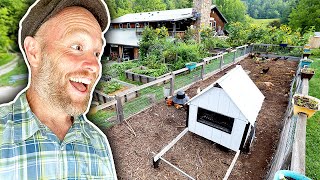
In this 20‑minute how‑to video, presenters Henry (Speaker A) and Victor (Speaker B) walk through a step‑by‑step plan for turning a typical 1,300 sq ft American front yard into a high‑yield food production system that can generate roughly 2,215 pounds of edible food per year. They begin by showing the yard layout and explain how to start immediately at the front door with a simple herb garden built on a thin compost layer topped with a weed‑blocking plastic and wood chips. They then detail the construction of raised beds (≈2 ft high, 6 beds total) using logs, purchased garden soil, and organic mulches, and provide seasonal planting schedules (spring lettuce & broccoli, summer squash, zucchini, tomatoes, peppers) with concrete yield estimates that total about 1,464 lb from the beds alone. A major pillar of the system is a permanent deep‑bedded chicken run: 30–40 chickens provide 180 lb of meat and 585 lb of eggs annually, while their manure enriches the soil. The hosts demonstrate converting part of the chicken run into a squash patch, planting 20 squash plants that could add another 250‑300 lb. Additional space‑saving tactics are covered: container gardens on rail posts (≈45 lb/year), vertical trellising for cucumbers and other climbers, and a small persimmon tree that can yield 60‑70 lb of fruit. The presenters sum the totals (produce, eggs, meat, fruit) to show the yard can feed three adults for a full year. Throughout the video they stress “grow right outside your door,” “bullet‑proof” garden design, and the importance of layering functions (soil, compost, chickens, vertical space). The video ends with a call‑to‑action for viewers to join the newly launched Abundance Plus community app for ongoing support and sharing.
Chapters
In today's video, I'm going to show you the abundance that is my front yard. It's the typical American yard, about 1,300 square feet.
Grew over—
will grow over 2,000 pounds of food in there per year.
Henry, how about we show them some tricks for growing this amount of food in a tiny— well, typical 1,300 square foot yard? That right there behind me, 1,300 square feet. That's it. The first trick is to start right outside your door. Boom. There's our door. There's our garden. We just got sunflowers in there and stuff. But if this was all we had, we can certainly be jamming out some food. Oh, you know what? You could have, I don't know, 2, 3, 4 GreenStalks. You could put like 36 plants in this. 2 square feet. A little further out, 2 kinds of gardens you could do right outside your door. Okay, you get down, you play, we'll be right here. This is an herb garden. All this is, is on your yard, you basically put down, uh, compost, 3 or 4 inches of compost in a garden bed size place, then weed barrier like a non-toxic plastic weed barrier. DeWitt, D-E-W-I-T-T, makes one. You can get it on Amazon. And then on top of that, wood chips or grass clippings or something like that. And look what happens.
Look what happens.
Just underneath the surface is all this composted material that is just rich soil. Here, you want to play with it?
Let's be super conservative with the herbs. They're light. Let's say 10 lbs we'll get out of here.
Right next to the herb garden, a second option in a front yard Raised beds. They're beautiful. They're higher up, so they're easier to get to if you have a disability or something. If you need to get them out of the weather. We're in a low spot here, so it floods. This keeps them up. Or if you're on sand, just undesirable soil, you could do a raised bed. The raised bed is just, what is it, 2 feet 18 inches, and 6 of it is logs, and then we imported soil. Don't be ashamed to buy some garden soil. It's foolproof. Grass clippings. Anybody can get grass clippings from the yard. And that helps keep weeds. Do you see many weeds in here?
I see a few weeds.
Oh, that might not have been a weed.
Whoops.
Uh, here's one. Okay, the other thing is a permanent run for chickens. Here you go, feed the chickens the weeds. We fed them a spent sunflower. They'll eat some of that, and what they don't leave, they'll shred up and turn into compost. That's what this is.
Chickens is where it gets exciting. Let's say we have 30 in there. Half of them will be harvested at the end, they're 6 pounds each. That's going to be 180 pounds of chicken in the freezer for the year. Plus, let's say 30 of them are gonna lay, uh, 3 eggs a week on average. That's going to give you 390 dozen eggs in a year. How much is that? That's 585 pounds of eggs.
We don't just have these chickens on a run. I want you to know that for sure. They're on wood chips, And eventually though, they scratch it enough, they poop in it enough, and underneath the wood chips— this has come to the surface— is this rich compost. Sure, you buy garden soil at first for your raised beds, but then— now imagine I filled this up with a wheelbarrow, 4 wheelbarrows per bed, and I just add it because these plants, they take up a lot of— they take up a lot of nutrients.
In the spring, we planted those raised beds with 64 heads of lettuce in half of it, 16 in the, uh, 16 plants of broccoli in the other half. Square foot gardening method, lettuce half a pound per head, that's going to give us 32 pounds of lettuce, plus a broccoli head a pound, so 16 pounds of broccoli. That's 48-ish pounds of food just from the spring garden. But then we planted the summer garden there, so 4 squash and zucchini plants, 20 pounds each, that's 80 pounds. That's just half of it. And then another 2 tomato plants, let's say 20 pounds each, that's 40, plus 6 pepper plants. Oh, they didn't do that great. I said 6 pepper plants at about 12 pounds, so that's like 132 pounds of food. So one garden bed, 3 seasons, is going to be 244 pounds on average. We have 6 of those beds, so that's 1,464 pounds of produce.
In a small space, you want to take advantage of all space you can get. Container gardens that fit on the rails. We just have flowers in ours, but it certainly could be vegetables. If this were all we had, guys, we would have a container pot on every spot on this rail. Teddy, really? Trying to make a show here. Come on. Goes right to his mom like they haven't been together for 6 minutes. And we do container gardens. We do one on every post, but couldn't we do one everywhere?
Container gardens— we just did flowers. You could do 3 to 6 heads of lettuce. Let's say you could do 45 pounds a year in the container gardens.
Couldn't we grow cucumbers and climbing vegetables here on the outside and use this fence as a trellis? What about vertical and horizontal space over a bed with a trellis? We would have a trellis on every single one, but look at the abundance in Garden. Look at all these tomatillos. Goodness, look at all this basil. And really, we have a generous spacing in between. I think you need that because you need to be able to get your wheelbarrow, your, your cart in here. I don't know, kind of on the outskirts. This, if this was all you had, this is a zone 2-ish in your garden. You don't go here much. Strawberries, they're somewhere in here under this morning glory. Yeah. See them? This is a strawberry.
My strawberry patch, as failing as it is, has become a morning glory patch. Still, we got 5 pounds of strawberries off of them.
How about a tree right here? That's south. You want your tree behind anything that's growing so it doesn't block any of the sun. But look how many— how many— seriously, how many persimmons are we gonna get off this? How much weight is here? There's like half a dozen right here, so there's probably My guess is 150 fruits, at least 150-250 fruits we'll get off of this. And that's just taking up, what, 6 square feet that way? And it grows vertical. You're going to want to think about growing vertical in, in tight places.
Persimmons, I estimated— what did I say? 200 pounds of persimmons at a third of a pound each. We're looking at 67 pounds of fruit off that thing this year.
In a nutshell, Grow right outside your door. Grow bulletproof gardens. Grow raised bed gardens. Grow chickens right next to your gardens in a run with deep bedding. Grow container gardens and grow in the nooks and crannies. Grow trees. Grow verticals. You can do a lot in a tiny amount of space.
Counting eggs, chickens, fruit, produce, we're looking at 2,000 215 pounds of food. Uh, what is— uh, an adult male eats 2 pounds, so that would be 1,115 days. If a male eats 2 pounds a day, there's 365 days in a year at times.
That's—
I need 730 pounds a year. How much are we going to be feeding off that? 3 adult people. So that could be me, Rebecca, and 2 of our children. That's crazy in just 1,300 square foot. And I could have maxed it out more. I've got more room for chickens. We could be more efficient with the raised beds. We could do more vertical gardens. We could do green stalks. We could do more container gardens. I think we could easily almost double that if we had to, just from our yard. I want to help you guys do it. There's a lot of folks that want to help and encourage you guys along the way. We're launching the Abundance Plus, uh, community app, and from today 3 PM till tomorrow, let's talk gardening inside of there. If you're already an Abundance Plus member, good. Get into the Abundance Plus community. And let's get in there and chat. If not, now is the time to check it out. Get in there and let's talk gardening. I want to help you. Others in there want to help you, or perhaps you want to help others. Get in there and enjoy.
Now to today's project. I've been thinking about this a lot. This is a lot of room for these chickens. Yeah, we have, I don't know, 30, 40 chickens in there, but it's still a lot of room. What if we could use this as garden space? What if I could confine the chickens over in this area, maybe from here over? And what if I could plant sprawling squash in the deep bedding? I don't see what's stopping me. Finding stuff, that's what's stopping me. If I can get that done in 30-ish minutes before milking— what if we cleared out the strawberries? You guys want to see this jungle garden transformed to neat and tidy strawberry heaven. We have two metal cages that, if it could span this, could be the answer. That's 12 feet. Those might do it. They might be 6 each. It is exactly 6 feet. That's just too nice. I got these out of a dumpster so long ago, and we've used it for so many different things. Yet another reason for a mobile coop. You could theoretically do garden beds in your chicken run. Oh wow, okay, I've seen some gaps. There it is, isn't that cool? We gotta go milk. We need to zip tie it, but that's enough to keep it for now. We'll see if it works. We'll come back after milking and see if nobody's in here. Oh, I wonder if I should put a time— I should put you guys on a time lapse. You guys could watch for me. I literally just came out here and one got in. She was on the cage I haven't zip tied it yet. She knocked it over. Well, we need to clip their wings and they won't jump up on this. This should be really rich ground and it's already mulched. We're not going to deal with weeds. All right, so we've got 1, 2, 3, 4, 5— 5 plants, and then we're gonna go 3 feet over.
We're not worrying about rows, so right here So you're gonna have—
yeah, do one right there, and then do one across everywhere. Okay, right here. Let's put that cup where the next one goes. Okay, Josiah, that's going to be 20 squash plants. They each give us 5 squash. How much do those weigh, Rebecca? So we're gonna get, uh, 250 pounds easy. 250 to 300 pounds of squash in the chicken run. We've got our squash. I waited way too long to put them out, so if it's— if they fail, it's not because of the chicken garden.
Look how yellow these are.
They're just run out of nutrients. We did it! What, what's it feel like, guys? I feel like the plants can breathe. I feel like they're Already thanking us. What do you think?
Can I be in charge of this garden?
Heck yeah!
Can this be my garden?
Just make sure if it doesn't rain to water it once a week, that's all. That is our pole barn. This was our sacrifice garden. We've planted some stuff. They didn't do well on the outskirts. This was field dirt. This was compact. It didn't work last year. We're going to try again this year because we've had another year of animals manuring, of wood chips.
Let's just open a strip right here at the joint.
I think the silage tarp has come to our advantage. Look at these, look at these worms, look at the worm castings. Holy moly, there's no way, nothing— there's no way it's not going to grow in this. All right, come on guys. It was still pretty compact underneath the surface, but here's to just planting and just finding out. At least we didn't plant the whole thing. Like I did last year. I thought, you know, we should just plant a little bit, see if it works. My motto is fail a lot but fail small.
I assure you, you can do something or all from that video, and you too can grow significant, if not all, of your own fruit, food right there in your yard. Don't forget, we've got the Abundance Plus Community app launching. It's for free when you sign up for Abundance Plus, you want to do that now. You'll get instructions after signing up on how to access the community app. Get in there, let's talk, let's talk gardens. If you have any questions from this video or anything else, or you want to show off your own garden or your own abundance, let's do that inside the app for the next 24 hours. That's at abundanceplus.com, or link for it down in the description.