In this informal, conversational exchange between two gardeners, the speakers discuss the challenges and strategies of starting tomato seedlings in early March when temperatures are freezing (28 °F). They weigh the risk of frost‑tender plants against the desire to get a head start on the season, noting that the seedlings are smaller than expected and that they have roughly 200 plants, aiming for 192 tomato plants. The dialogue covers the use of a greenhouse/low‑tunnel setup, upsizing seedling trays (blocks four times larger) to give seedlings more room, and adding a space heater to maintain warmth. They also troubleshoot a non‑functioning outlet and test a drop‑cord light before nightfall. Throughout, the speakers balance caution about the cold with enthusiasm for getting tomatoes ready for a June harvest, planning spacing (about 50 plants per row) and ensuring the seedlings are protected until the weather is suitable for planting outdoors.
Chapters
How cold is it outside?
Freezing.
It's 28 degrees. I don't know if I want to pot up when it's this cold. I want to wait for it to get a little bit warm because they are— they frost tender. I know it's not frosting, but remember that time you opened the greenhouse and watered the plants and left them— it opened and it— we came home and they were dark green frosted?
Look at all these plants my crazy plant lady wife has gotten. Oh my goodness, how many plants are here? Hundreds, hundreds of plants, and it's like March 14th. She doesn't even hear what I'm saying.
Yes, it's March.
She's so mesmerized, in love with her plants.
Stop it.
Why so many plants?
Um, Why not?
Okay, another question: why now?
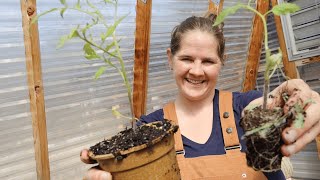
Last year when I purchased from the greenhouse, the plants were all about this big. So this is from a different greenhouse. And, uh-oh, did it get too cold in here last night? These are looking kind of sad. Gotta get them outside. Okay, they were all about this size, okay, when I bought them last May from the greenhouse. Well, so my thought process was I'll get them in March and I'll pot them up, pot them up, and then they'll be about this big when I get— when we get to planting season. Well, much to my surprise, I opened the box and the plants are not this big, they're this big. So now I have really big plants in March. So our plan is to now just work with what we have until we can get them into the greenhouse, and hopefully they'll live.
These fragile plants seem to be a-okay.
I know, well—
It was colder than—
I know, but they're not tomatoes. That's my only concern.
Do you have enough?
Oh, just under 200 of these.
How many tomato plants do you need?
Well, 192.
I saw that math. 192.
No, because we only do— well, okay, so what— how many plants did you plant last year in a row?
Hmm.
Because we can plant them closer together. I think you did 50 in a row.
So essentially, we're starting tomatoes in March, y'all, meaning we could have tomatoes in June. You can almost forget summer tomatoes. That's pretty much late spring. And this is going to be key to giving those tomatoes space to grow while still being protected under a greenhouse until We're ready, they're ready, the weather's ready. This is coming along nice. Here's your bucket.
Thanks.
Now that's dedication.
Well, just trying to keep ahead of it before it gets summer and goes crazy.
What are you guys doing? Some gravel for Mama. Ah, I'm going to ride this to the road. Okay, you know it's going to be heavier, right? That means it's going to go faster. That was kind of lame. So what if we put the tomatoes under this? These come out because they're a little— they're a lot hardier.
Yeah.
Okay, and we put what you can tomatoes under this, and then if you want, you can put your— I'll get you a space heater for right here. One tray of cucumbers, one tray of tomatoes getting potted up. That means they're going into trays, they're going into blocks that are 4 times as big and gives them more time, more room to grow while under this nursery, in this nursery. You did it! You got these ready? You're gonna put them under your— that's not all you need though, is it? For this one tray.
So that's enough.
All right.
Of that tray. You need a large piece.
Got a space heater. Let's make sure it works before the night comes, right? I can't tell. I would think there would be a light on this. Is there a way we could check our drop cord?
Yeah, that's one of those light-up ones.
Okay, but those don't always— that doesn't always work with us. I had it plugged in over there. What's wrong with that? I don't— I see it working there. Is there an outlet here? Let's take something that we know is working to test it. Bring one of those chargers and we'll see if it lights up. Still not working. And now— oh wait. Okay, now the drop cord's lit up. Okay, why isn't this working? Oh, it is, it's working. Okay, good deal.
I moved out, letting it work, right?
Was it? Yeah, it's working. Okay, good, good call on the outlet move. So let's review the trick to get tomatoes by June: uppotting them from their start trays to bigger growing medium, having them in a greenhouse, a cold frame, a low tunnel, a high tunnel, something like that. We'll double cover when it gets really cold at night. Agribon will be our first layer and then plastic our second. We just have it rigged up with, uh, little bug net poles and just secured it to our table here to keep this little drape over it in a nice little arch. Lastly but not leastly, just a little space heater, keep it warm at night.