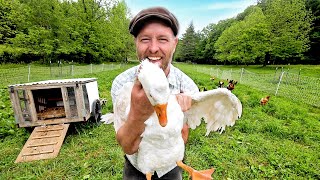
In this instructional video, Victor Justin Rhodes walks viewers through seven practical, often‑overlooked strategies for safeguarding chicks and adult chickens from predators. He begins by recommending an extra week in the brooder for young birds when weather is cold or predator pressure is high, and explains how to scale up water, feed, and bedding during this period. The second trick is using a movable chicken tractor as a protected transition zone, with tips on preventing chicks from escaping through uneven ground. The third segment introduces electric fencing, showcasing Premier 1, Speedrite 3000, and IntelliShock 120 systems, explaining joule ratings, grounding, and installation tricks. The fourth trick highlights raising geese as guard animals, emphasizing the need to acquire a pair and how they deter aerial predators. The fifth trick focuses on coop construction: using ≤1‑inch mesh (or half‑inch on sides), proper tire height for under‑coop access, and the upcoming Chickshaw and Chickshaw Mini designs that are predator‑proof. The sixth tip advises regularly moving the coop to disrupt snakes and other ground predators, and the seventh trick describes a “compost corner” enclosure with buried wire mesh to prevent digging. Throughout, Rhodes references his upcoming Homestead Builds Kickstarter (launching June 1) for the chicken tractor, Chickshaw, and related products, and offers hands‑on demonstrations, safety cautions, and personal anecdotes about catching escaped birds.
Chapters
Everybody wants to eat a chicken, but you want to do it first, not a predator. Here are 7 stunts for keeping these guys alive. Well, at the brooder stage, just keep them in there an extra week if you need to. I think they're old enough for that. They're gonna be like 3 weeks and a couple of days. Point is, if it's extra cold or wet outside when it's 3 weeks and it's time to put out your chicks, or you have extra predator pressure, particularly aerial, then just wait. There's a big difference between a 4-week-old chick and a 3-week-old chick, and it's not that much harder. It's just upgrading their water. I don't know, were they on a quart? Go up to a gallon. Go up from a gallon to a 3-gallon or even a 5-gallon. Upgraded their feeder from this little feeder to this bigger one. And add more bedding every day. Maybe you have to apply it twice a day for the last half a week. Big Whoop! The second trick you can do is transition them with a chicken tractor. These guys are ready to graduate the brooder, but since they're especially little as they're layer chicks, they're especially vulnerable to crows. We've actually had a few get out. We've lost one or two. What you got to do— look, Lily's done it today— if there's a divot because the grass is uneven, you put a shim in and they can't get out. She's done it, bless her heart. They're not gonna get out of that. It has to be pretty big. That's probably big enough. See that? And there They're getting bigger, so they're not as likely to do it, but they could crawl out something like that. This just gets moved every day to new ground. They're happy, they're on grass. Uh-oh, uh-oh, big and real spry. This is just one of many purposes for this chicken tractor, and it's going to be available directly after our Kickstarter. Kickstarter starts June 1st to backers. The chicken tractor serves as a good transition. You're outside, but you're still fully protected. And yeah, there's 29, 39 of them, something crazy. You can handle it in such a small place because they're still so small. The third trick would be to get you some of this Premier 1 Shock or Not. Shock or not, like, still works even if you don't use— it's not going to get the reward for some of the easiest to use, but it is going to get the reward for keeping chicks in. I am seeing a problem here. It doesn't sit well because we've got grass clumps right here. And they won't be paying attention and protecting the chickens. Come on, flap the wings. That's what they do. Um, what do I do about onions? We don't have any left. Grandma gave you 4 onions. What are you making? I'm gonna put the onions in the root vegetables. They not come out yet? No. Here's the other trick. See that little goose gosling? Can you get that gosling? This is the other trick to raising a goose. Look at this little goose, 3 weeks old. Look at that guy, isn't he cute? Trick is you gotta buy 2 geese. Nobody's gonna ship you just 1 goose unless you got— buy it local from breeder. You can raise them together with your chicks and then separate them. You only have one flock. We have several flocks. You could give it away or sell it. We raised that guy with chicks and they think he's a chicken, and look at him patrolling around. If you were a crow, would you dare to come down in here? I don't think I would want to. She's— he's, he's peering around. He's flapped his wings. He'll squawk. Too much drama for predators. Land predators too. Sure, a coyote could take them down, but it's just too much drama. They like it. More quiet. This is like a floodlight at night for robbers, you know. Look, they just came out and they just went back in. That's fine, that's normal. Fifth trick lies in the coop. Come with me. This is the Chickshaw Mini Mini plans coming soon. Its older brother, the Chickshaw, our most popular of all time, is coming. It will be here by the end of June, and we've designed these predator-proof. You notice Look, remember, remember how I showed you 1-inch mesh so poop can fall through? Well, it's no bigger than 1 inch because you need to have no bigger than 1-inch openings in your coop for predator protection. Half-inch wire mesh on the side is what we used. I mean, you could use 1 inch, I reckon. Bigger than an inch up here in their nest box— I mean, maybe right there. I found that the predators don't climb up this if they were to get in here. So we can go around this whole thing— bottom, sides, top— no more than 1-inch opening. I don't know what kind of coop or what kind of system you're using. But for the most part, if you shut your door, your coop door, at night and they're in there and you have no more than 1-inch opening in your coop, you've solved— and, and that's just the nighttime, which is most of your predators— you've solved 99% of your predator problems. My coops are already pre-designed for predator control. I like to brag about them a little bit. We got the 20-inch, 26-inch flat-free tire, and it's a 26-inch so that it's high enough up so the birds can get under the coop. Actually, that is a predator point. I mean, it's for shade and comfort and get out of rain, but they can also run and get away from a passing hawk, and they can get under there, and it's big enough. A lot of people try to go cheap and get the smaller tires. I don't blame you. These are like $200 nowadays for both, and the smaller ones are cheaper, but the chickens can't get under that. And you want these— you want your coops to be multi-purpose. As much as possible. Why am I not afraid for them without the goose in here? Well, they have this net, and once they are adult chickens, we don't have a problem with aerial predators. Ours is a hawk. We do have a problem with aerial predators, but not when they're that age. If we had eagles, maybe we would be still keeping the, the goose in here, but the hawks don't get them when they're that fat. They don't— they can't handle fat hens. The 6th thing is movement. I like to move it, move it. I've had snakes get chicks, I've had snakes get eggs. Trick the predators. Don't keep the predators in one spot. You see me moving it to spread the manure love? They pooped all night right there. Just move it. Not only did you spread the holy chicken squat love to different places, we're throwing off the snakes and other things like that. I don't think when I'm moving coops regularly I've ever had a snake problem. It's usually when I've gotten lethargic— lethargic, is that the right word? I wouldn't say lazy, wouldn't say lethargic— negligent perhaps, focused on other things and left the coop in one area in the chicken run on deep bedding, and, and a snake has figured it out and gotten in there. Making a practice to have a mobile coop and move it every day. There is nothing I can do for you guys getting out. I can't help you if you get out. That's just a fair warning. People get out, people get out sometimes. Actually, I'm going to start a prison system. The people that get out, I'm going to mark them and I'm going to put them in the bulletproof fence, the compost corner up in the yard. Hey, let's go look at that in a minute. Let me show you this Premier 1 net. So this is, this is a Premier 1 poultry net. It's easily put up. We put it up in about 20 minutes. This is 2— no, this is 3 100-foot nets. And we keep these chickens in here for a week. We move their coop every day inside of it. This is a little hack of mine. I don't use the solar if I don't have to. I only want to use that in a pinch because it's not, it's not as powerful. You don't get as much bang for your buck. So what I've done, I call them alligator clips. I think Premier One calls them links. You can get them there. I've hooked these up. See, these links takes my electricity from there to there, and I don't get shocked. I mean, I could have my electricity on and not get shocked. Now If it's been rainy and dewy and these are wet, I've been known to get shocked by them before. And this is connecting to a one-strand on a rebar post. It could be any kind of post. It's going back to the house. I love the grid, folks, so any chance I get to tap it, I will. Spool— this is like a welding wire spool, and I've just rigged up some bolts that go through. Then you just roll this out or roll this up Where's that go? Where's that go, Justin? Let's go see. Notice my greenhouse where we kept the chickens all winter doesn't have any more than 1-inch opening. We got poultry wire. Oh my gosh, I'm about— I'm about to put those chickens in prison right now. They're getting in our garden. Gideon, can you help me catch some chickens? This comes all the way back. This is a Speedrite 3000. I like the Speedrite. You can— you can get those from Premier One. 3000 ends up being 3 joules. 6,000 is 6 joules. Joules is what you want to measure by, not by miles of fence. That's like walkie-talkies measuring in miles. That never works. I mean, best practice would be go directly in it without a link. I just— we just looks like we have a jerry-rig here. So you hook up your electric fence to the hot side, the red side. Both these are red. I don't know why. It's probably we lost the, the other one and just replaced it. But there's also an emblem there, and these comes with instructions. We can turn this back on. Actually, maybe we'll catch chickens and then turn this back on. Before we catch chickens, and turn it back on. Hopefully this is the 120. It is. So maybe you're way out in the field, get you a, uh, you got a big flock like this. If you got a small flock, you, you might get away with one net, 100-foot net. This is IntelliShock 120. I'm a big fan. It's more expensive, but it's got 2 batteries. And same thing, this is black for your grounding, orange for your hot, and this is And you're going to need a grounding rod to stick into the ground and put this on, and then the orange part goes to your fence. It's that easy. We usually keep spare batteries charged and flip them out as needed. Look at this, they're happy! The goose especially. Goose was munching on the grass. That's the cool thing about the goose, you can feed them what you're feeding the chickens, but they eat a lot of grass. Look at these guys, they're happy. A week or two more, so maybe 6 weeks These guys are done with the nursery and we can just put them in with the girls and they won't, they won't get out of that. I say that as two girls are out and they're not even little. My best bet is to herd them against this fence and get them to jump into the fence somehow. Off camera, I caught this bird. Finally got into the bushes. Little fun fact for you. You ever have a hard time catching a chicken? Just set out after it. Don't stop. You're the endurance animal, they're not. You will catch it in usually 5 minutes or less. What I've done, taking the right leg, put a teeny tiny zip tie on there loosely, and I marked you as ornery. You will be harvested in the fall. You're going to prison. Those little chicks out there, they will replace you. Same thing here with a a run. I call this the compost corner. It will also be in Homestead Builds. Your fencing, 52 inches tall at least. It wouldn't— it wouldn't hurt to have a covering. The reason I don't have it— it would hurt to have a covering because it's not as easy to throw your weeds into it. I mean, you could have a covering, wheelbarrow your weeds in there, and then it would be truly bulletproof. You don't have to worry about nothing from the— from the top. But we have cattle panels, we've lined it poultry wire. You can see down here, 1x— I don't know, they're 1x8 retainer wall for that, uh, for the mulch. And also, best practice, look, you can see it right there, bury, I don't know, 8-12 inches of poultry wire or half-inch wire mesh so nothing can dig under and get in here to them. Heads up, the compost corner, the chickshaw, the chicken tractor, and other builds are coming Homestead builds, we're kickstarting that June 1st. These two can be the foundations of your homestead. Hey, did you catch that bird? Where is it? Oh, you put it back? I was gonna put it in prison. Uh, the front yard. Catch another one, put it in the compost corner.