How To QUIT Your JOB & Start A Farm - For $600
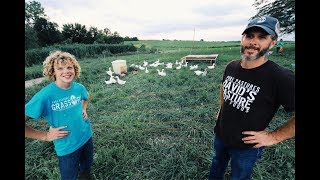
In this vlog, host Speaker A visits a Missouri farm run by David and his family, who left corporate employment to adopt a Joel Salatin‑inspired, pasture‑based operation. The conversation reveals how they launched the farm with a minimal $600‑$700 investment, using mobile chicken tractors, simple high‑tensile wire and gripple tools, and borrowed equipment. They discuss the importance of family participation—teenage sons, a supportive spouse, and community members—showing how chores become character‑building experiences for children. Marketing began with friends and family, home drop‑offs, and word‑of‑mouth before expanding to farmers markets in Kansas City. The interview outlines three practical steps for aspiring farmers: start small by growing food at home, learn from an experienced local farmer, and gradually scale the operation while transitioning out of the day job. Themes of purpose over profit, low‑cost DIY infrastructure, and the ripple effect of inspiring others are woven throughout the dialogue.
Chapters
This is a beautiful sight, folks. This man has quit his corporate job to come home to the farm and work with his family. In this video, we're going to show you the 3 steps to do this yourself, plus talk to this guy about how he gets excited as a teenager working with dad on the farm. Time for us to leave the White House on the hill. We're scheduled to go see Rome Sticks— well, a farm that makes Rome Sticks, pasture-raised pork jerky. But we're gonna go on a detour. On the way over here, we happened upon this amazing farm. It wasn't in the plan, it wasn't on the tour, but it turned out absolutely incredible. What we had found out about that farm is that they farm just like Joel Salatin, so that was the angle of my story. He was going to be the poster child of Joel Salatin. Finally, a poster child for Joel Salatin. Somebody who's going to do it exactly like he does, because why reinvent it if it works? Joel's been doing it for 40 years. Why do anything different? It's a model that works. Not long after being there, I realized there's more to this story than just systems, than just poultry, than just pastured poultry pen and chickens following cows. One, he had totally quit his job to start farming, and two, he'd gotten his entire family on board. Those boys, did you see those boys? Look, now he's starting to smile a little bit. I think we really figured it out.
He's smiling too.
He's all like, yeah, they're getting the cut, huh? Look, it's who's smiling bigger, who gets paid more. Yeah, they were totally excited about farming, and they were older boys and they were teenage boys. Aren't these supposed to be the terrible years? Yet here these boys were helping his dad. We got more of a story to uncover, that's for sure. Before we go, we gotta say goodbye to our friends White House on the Hill. Everybody say goodbye! How nice. Thank you guys, you've been great hosts. It was cool to spend the Fourth of July with you. Thank you so much for coming. You have a great year. Good luck with the YouTube channel. Thank you for being here. Thanks for your time.
We love you guys. Love you too.
We have arrived. We have thought of many more questions. Many questions unanswered. I had a feeling we just scratched the surface with David. Now we're going to get a little bit deeper and help many, many, many people who are in the same spot where maybe they want to get out of their job and maybe one day they want to come home with the family. And I would love to see nothing more than you guys do that. So let's go get some of those secrets. Y'all play with anything, won't you? Oh, looks like somebody's got their lawn nice and neat. How's it going, buddy? Good. Thanks for having us back.
No, thank you for coming. We are excited. And the family's still mad they didn't get to—
who's mad?
Family's mad they didn't get to see you.
Your family is gone. When are they coming back?
Tomorrow.
They're coming back tomorrow. We're gonna miss them.
And mom comes home tomorrow.
Yeah, David, I can tell she's coming home tomorrow.
Yes.
How are you looking? Nice to see you. He cleaned up a little bit there. Yeah, she's got it all mowed. Looks good. The inspector's coming, buddy. That's right. You didn't weed the garden.
No. Yeah, yeah, that's good. That's all right. Yeah, the girls will be back and get us caught back up.
That's right. Okay, that's a passenger van. So how many of them are you?
There are 12 of us. Okay, my wife and I, Kim, David.
I, I feel like when we were here last that we didn't know what we were getting into. Okay. And when I came here, I knew that you were modeling Salatin. So my story in my head was that you're the poster child for Joel Salatin. And finally, and I was relieved to see that. But then when we got here, I scratched the surface a little bit and found out what the story really was. And it was that, one, that you were able to quit your job and start working with your family, and two, that you weren't having to seem like forcefully work with your family, but it seemed like everybody was on board.
Yeah.
So I'm going to get deeper into that.
Okay.
Do you have like a task or a chore or something that needs to be done that maybe we could work and talk?
Yeah, we could. We've got some fencing to repair. Okay.
And does that not take— that doesn't take a lot of brain space?
No.
Okay, so you can talk and work at the same time? Yeah. Okay.
He's talked, carried it, and thrown it at the same time.
That's probably what you would rather do anyway, right?
Yeah. Okay, so my hands are Done.
Killed two birds with one stone.
Yeah.
Look at that garden though. We didn't even speak to that, but that's part of it, I'm sure, right? Like, being able to quit your job and be at the farm is being able to grow most of your own food. Yes. Yeah, just so you know, at the meetup yesterday, somebody came up to me and said, it's because of you we have land. And I'm not saying that to brag on myself or whatever. We're inspiring them, but you're gonna inspire people. Just so you know. Good. Somebody or somebody's is going to quit their job and start farming with their family because of you.
Why, I think that's great. That's great.
Okay, so I can't think of anything better than that, right? Like, it gives me chills that— I mean, it's exciting to do it ourselves, but you want to complete your joy by sharing that, right?
Absolutely.
Okay, good. Look at the smile. Look at the smile on this guy. He's gonna want to know your secret, how to get these teenagers to smile, right? Next to Pop. Come on, kids. Come on, guys, let's go. Okay, guys, let's go mend the pig fences.
We're gonna get some, uh, some wire and some gripples. We use gripples. They're fantastic for mending fence. Yeah, pulling high tensile wire.
Cool.
We don't use any barbed wire, we just use Use high tensile. Um, the gripple tool.
Oh, yep.
No, okay, we got these from Greg Judy. This idea, this, the gripples.
Yeah, okay, cool. Okay, is that it? That's all we need? A little bit of wire, some gripples, and some gripple tool. What are you doing, man?
I'm making a, making a penny hockey board for each project.
Okay, a hockey board.
So woodworking is what I do when I'm not farming.
Cool.
So farmer by day, woodworker by night.
Let's go, let's go get those pigs. He's, he's nice. No, just hanging himself. They're setting up this area for a pig paddock. The pigs are in the barn. They're gonna bring them out here, so they got to put up the fence. How many strands of wire are you gonna put up here? Just two, two strands of wire. It's gonna be electrified. They're gonna till this up for them, or should we say plow?
The pigs, yeah, pigs are gonna plow.
Chickens are tillers, pigs are plowers. They're gonna plow this up and then plant pumpkins, move the pigs on over. And looks like they got a lot of work to do over there. How did you market yourself so quickly? Well, we didn't, because people are going to want to know, where do I go, how do I sell it, right?
We started just doing a couple hundred chickens and selling to friends and family, getting feedback from them. Okay, that was so important to make sure that our product was, was good quality, as well as, you know, what's it really going to cost us. So I need to know what my costs are before I start selling some of this stuff. We didn't start markets and our farmers markets until year 4. We were really, really worried about making sure we had enough product. We didn't want to go to a farmers market and run out of product.
Yep.
There's nothing worse than that. We started with drop-offs to homes, and that went really well.
These are still your friends and family?
No, this— now we did a home drop-off to Lee's Summit, Missouri.
Okay. How did you— so at first you're calling friends and family. You're just looking in your Phone, and you're just going down the list. Yep. And then now you're gonna have this home drop-off. How did you get those customers?
You know, it's just through other people telling people about us. So friends and family started talking and telling people about the products they've been getting from us. All right, so this gripper tool, this is great. We're just gonna put this—
show us how it works.
Slide this on there, it's gonna grip that in right there. And just pull it tight, slide it back in. Wow, pull it tight.
All right, that's nice. Basic marketing here, folks. Selling the chickens and the product to friends and family. I mean, if you can't sell it to friends and family, you're gonna have a hard time selling it anywhere. Going down the black book and the phone or wherever, and then just relying on the word of mouth to get it going. And of course, there's always markets. Is there anything you wish you would have added to our time together the other day. I mean, was there anything after I left— man, I wish I would have said that. Maybe not lots of things.
No, absolutely, there's, there's all kinds of things. Just seeing the comments, like, people just have to start somewhere. Yeah, start growing it for yourselves and then for your relatives and your friends, and then it's just gonna go from there. Go slow.
Or you are in rural Missouri, but you are only an hour from Kansas City.
We're an hour from—
so you— it is worth it. It is financially worth it for you to go to the market in Kansas City. Is that fair?
Absolutely.
Would it be worth it if you were 2 hours away?
Yeah, it would still be worth it. We just would just have to drive a lot further.
All right, let's straighten it up, buddy. Tighten it up. What was your life like before farming? What was your goal?
My goal was money, toys, and what— well, it was about me and what I did with my life— hunting, fishing. It's a very selfish, very selfish life.
What happened? Was there a point where that changed? Your goals changed from money and pleasure to something different?
Yeah, there— I mean, I just made some mistakes in my life that I looked back and thought, man, I've got to, I've got to change who I am and who I serve. That's when I looked at farming, uh, something to do with my family. Found Salatin and just, uh, we went from there.
If you were gonna quit your job and go into factory farming, traditional conventional farming, you would go and have to— and you were going to do chickens, you'd have to go $100,000 and hundreds of thousands of dollars into debt. Okay, so you go the Salatin model and all of a sudden, what was your startup cost with Salatin? Estimate. Oh gosh, and you started small, so I guess it was $700. Starting a farm for $600 or $700, are you kidding me? And then that being mobile too, so literally you could have done that on borrowed land.
We unplugged our brooder lamps and we, we put our chicken tractors on a trailer and hauled them over, and that was it. And, you know, deep freezers, which we already personally had.
There's more work with the Salatin model. You're going to move the animals every day, but you're also going to increase the productivity of your land. And the other way, tractors and big buildings and infrastructure is permanent and very expensive.
Oh yeah, we don't have a tractor. We borrow a tractor if we need to do some work.
You testing it, buddy?
Yep.
Is it on working?
It's on right now.
How'd you go about the transition then? Did you save up money or did you keep working your golden chains, as Jill Salatin would call it? Yeah. Did you keep your golden chains while you did this part-time till you knew this was gonna go? Or did you save up money?
Oh, we started again, so it was so little to get started.
Yeah, I mean, $600, $700.
And then, um, as it grew, we've never, um, had to go get a loan for things. We've definitely borrowed friends', family's money, uh, because they were so excited about what we were doing.
And that's cool.
Got it. We just grew the business to the point where you can't do both, you know?
Okay.
You can't do both.
So you worked on the farm business until you're like, this is growing so much, I need to get more poultry pens, I need to get— I need to get ducks, we need to get pigs, because the demand's there.
And now the demand's there as well as I'm not going to be able to grow my business unless I'm working on my business, okay, not for somebody else.
Okay. Did you have a savings when you finally quit the golden chains?
No.
I think everybody was hoping you're gonna say yes. Okay, no. So guys, it's getting better and better for you guys. Okay, you don't have to have a savings.
We had put everything at that point, we had put so much in the farm, um, with, with walk-in freezers and chickens, crates and infrastructure and buildings. Okay, redoing barns and such that were here that were not usable. Uh, we had— oh gosh, the old brooder that we used that was already here, uh, there was at some point there was more rats than there were chickens in there.
All right, checking the line here. Yeah, you know, hey, it looks like maybe, maybe he didn't turn it off one time on you, huh? Yeah. Hey, he's losing trust in you, buddy. What happened? Did you turn it on dear old dad, huh? Have you done that before?
I have. It was funny too.
He's shocking dear old dad, and dad's been watching you. He's watching you.
I can't believe I grabbed that without testing it first.
Next up, We're gonna see the ducks move. Was your wife on board with this crazy plan all along?
Yes, she was.
Okay, that's handy. Well, what do you— what would you say to somebody if maybe their spouse wasn't, whether it's the man or the woman that's not on board?
Yeah, that's a tough question. I would, you know, the husband and wife have to be in unity on that, you know, just the change of life, uh, your, you know, how you spend your money, uh, it's important because if this does— as it grows, you've got to continue to put a lot of money back into it to grow. We've got to be on the same page and see eye to eye and see the vision for the family.
What did your parents and your friends and family think? Did they just think you were nuts? I mean, you're gonna quit Chick-fil-A, you're gonna quit the steady job to be a farmer?
Oh yeah, yeah. You know, it doesn't matter if you show them Joel Salas's video.
That's right.
Let them read the books. They still think you're crazy.
Are you still crazy in their eyes 4 years later?
No, no, no, no, no. Won their hearts. Well, they also love the food that they get too.
That's what you do. You just wait it out, okay? They think you're nuts until they get some of that food. That's right. All right. Whoa, y'all ready to move, aren't you? What are they telling you?
They're ready to— they want news.
That's what they're saying.
Yep, they want a new salad bar.
Give me some salad bar, Lily! Let's get them some salad bar. Okay, wait a minute, they're gonna get out. Yes, yes. Is that not a problem?
Nope. Normally I come out here and move them by myself, so they're used to getting out. And usually they get out while I'm moving the fence. I move the fence and then we just walk them back in. They don't go far. They'll stay, they'll stay around this area.
Okay, I'm gonna take your word for it.
What do you think, guys?
You think he's gonna get them back in a new fence? You think they're gonna run off? David, you can walk and talk if you can, or, or just stop for a moment, whatever. What are some steps people need to take if they want to do this themselves?
I would say, you know, start small in your backyard, raising your food for your family. And then go, go see a— go find another farmer in your area that'll talk to you. I have no problem sharing what we do, how we do it. Yeah, where our market is, where we sell. There's enough—
you in the way?
I think I am. There's enough demand out there, um, for all of us to share. So we're very open about what we do and how we've done it. Go talk to them. Find one that has some knowledge that you look— find one that's doing a good job.
Yeah.
And, and see what you can learn from them. Glean that information off of them and how they can help. We've helped, uh, 2 or 3 farms around here start, and they're direct competition to me. But again, I love seeing fathers, uh, that, uh, are willing— won't have a desire to to stop leaving their families during the day and starting a farm?
Step number 1 is to begin growing food because you may not even be doing that. First of all, you find out what you really like by growing different things, and then you, you kind of find something that you think you want, and then you go find another farmer. I'd say that'd be step number 2.
Absolutely.
And maybe in there you're reading books.
Absolutely.
Hopefully in that step number 1 you're reading like how to grow You know, How to Grow More Vegetables, that book, or Joel Salatin's Salad Bar Beef, you know, if you're thinking about cattle or something like that. Like some of this how-to stuff, you're starting to grow something, then you grow, then you go talk to somebody that is growing what you think you want to do.
Yes, the style you want to do it. Yeah, get, you know, go learn that information for your area. How are they growing it? What's the grasses like? Cows and chickens, where are they getting their feed from? We are strictly non-GMO. We drive 2.5 hours to get our feed every other week. And then now go to your friends and your family and start selling to them. It'll grow. It will start out slowly and all of a sudden it's doubling, and each year now it's tripling and just growing because the demand is there.
I would say that would be the third step, is pretty much you're growing this stuff on the side and you're pretty much working yourself out of that first job. You've gotten so busy with it because the demand is growing. You've learned from that other farmer how to market and things like that. We can't sum it all up right here, and it's going to be different based on your area where you are. Are you near the city? Are you away from the city? What are the different demands and wants of that place? Those are 3 really good and practical steps. Thank you so much, David. Okay, what's your name, young man?
I'm Reeves.
Okay, Reeves, how does your dad get you excited about going on the farm?
He doesn't.
He doesn't. Okay, well, why are you excited to be on the farm?
Just being out here with really God's creation and how cool it is.
And really, you can—
you just— you, when you first come out here, you have a passion for it.
So Dad has pretty much just exposed you to this? Yeah, giving you access to this, and you run with it. Now, I also take it that this is your operation, right?
Yes.
Do you make the money off of this? Yes. Okay, you paid— you paid Dad something?
For feed, yes.
He helps, he buys the food, he's put together these infrastructures. Go ahead.
No, they've, they bought the ducks, the feed, they've done all the work for it.
Yep.
Uh, they get to use our land.
He just picked that up, didn't he? I've not seen that. Have you seen that? He just done picked it up. Forget dragging it. You done picked that up.
I did.
Earth's jam right there, guys. This is the duck feature.
They usually go to the mulberry tree. There's still mulberries on it. They're just about done, but they really like the mulberries. And when you go up in the tree while they're under it, you shake the branch, they all fall and go crazy with them. They love them.
Swear to the ducks, look under the mulberry tree and you'll find the ducks. Come on, guys, go get— go help them herd the ducks. See how they're going up behind them? Come on, let's go up and get behind them.
See? Yeah.
Go right there with him. You can help him.
Can we see?
No thanks, no thanks. I want back with my buddies. I want back with my buddies. Hey, I see you found the toys. I see you found, I see you found your favorite part of the America Farture. What's going on over here? Playing with the toys. Don't be tearing them up now. Go for it, get in. Oh, slam dunk.
Good job, buddy.
Good job. Okay, David, one more last question, buddy. Yes, before we go, personally and for everybody here, I've got kids. I want them to be involved in the farm and the business now, but also when they grow up. And it seems like you've been able to do that with at least these two and probably some more of the rest. What is the big secret?
Well, the world shows us something different. We raise our children at home. Our children are around us As parents, and as well as our community that we belong to, we want them to be adults at a young age. That doesn't mean they can't have fun. They're out here playing, playing basketball, enjoying the toys, but there's a time that they're going to have responsibilities. There's a time we're going to introduce them to chores on the farm and slowly work with them. They're going to want to work with Mom and Dad. Now their attention span's a little bit smaller. We're going to gradually, gradually work on that. We're going to give them some responsibility. We're going to find something they like. And give them that responsibility, it's something they enjoy, it's going to bring— it's going to build that character. They can build the responsibility, discipline in their life. And, you know, my young man at 13 is a young man. He is, yeah, he is mature. He can go out and he can talk to people. We go from children and, and we want to be young men, responsible and dedicated to their life, have an idea of what they want to do. They have, they have gifts, and we're going to encourage in that. We're going to mold that. And the character is so important. Their education— we teach them to read, we teach them math, and we allow them to just blossom through that. So we're using every minute that we can as parents to mold them into what God wants them to be.
Thank you so much for having us again. Hopefully we've dug deep with this guy. Hopefully he's encourage you guys, if you're in that spot where you just want to get home with the family, sustainable farming is a valid opportunity.
It is. And, uh, don't make it— don't make it hard. Make it easy. Follow Salad Sons until you figure out and have success. Then you can kind of venture off. But yeah, this— it's simple.
We're talking about starting part-time, $600 investment. You can do that.
Yes, you can.
Just wrapped up my time with David. What a blessing. Good news though. Good news. His whole family had been in Florida on vacation. They were planning on coming tomorrow afternoon. So we were gonna just miss them, but they're gonna push through and drive through the night. They'll be here by the time we get to wake up in the morning. So we're gonna get to see this family, this amazing family all together. We're definitely gonna have to put that in tomorrow's vlog. One more thing, if you want the nitty-gritty on how to quit your job and start farming, I created a member video just for that. For those of you want to geek out and really go down that path, for you members, make sure you check it out. And for those of you who aren't members, check out the info down in the description.
See you there. Aah!
More from Justin






If I had to start my Homestead all over again, it could only pick one animal… 




