How to Scythe + STOP Weeding, Watering and Fertilizing
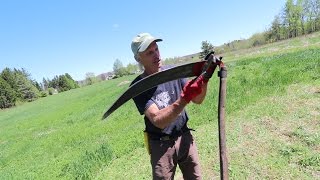
In this informal demo, Jim (the primary demonstrator) walks a visitor (Speaker B) through the use, maintenance, and broader agronomic implications of a lightweight European‑style hand scythe. He explains how the scythe’s thin, razor‑sharp edge is achieved by a unique sharpening routine that combines peening on an anvil, case‑hardening by hammering, and field stoning with two graded stones. Jim highlights the ergonomic advantages of the 3‑lb blade, its custom fit, and the availability of European‑made blades through Scythe Supply (Austria) and a U.S. partner (SySupply in Maine). He demonstrates field mowing on a 3‑acre pasture, noting productivity (≈8 hours per acre), the creation of clean windrows, and the ability to cut close to the ground without a weed‑whacker. The conversation expands to the agronomic benefits of scything: eliminating the need for irrigation, weeding, and synthetic fertiliser by maintaining a grass‑fed, mulch‑rich system; supporting rotational grazing and a “micro‑herd” of soil organisms; and providing high‑nutrient green mulch for soil health. Jim also shares teaching tips for novices, safety practices (gloves, stone handling), and the cultural heritage of scything as a low‑tech, low‑impact tool that can access wet or uneven terrain where machinery cannot. The overall message is that a well‑sharpened hand scythe is a game‑changing, sustainable alternative to powered mowers for small‑scale farmers.
Chapters
You know, this grass-fed vegetable system using the scythe and fertility grown on the farm— I don't water. I haven't watered in 7 years here, including transplant day. I don't weed if I keep the grass on the beds, you know, don't let the soil life eat it all. And, um, I don't fertilize, all because of a handheld scythe, right? Okay, you know, that's a pretty incredible difference. I mean, that's something that it could be game-changing for small farmers. Yeah, you know, and this is all, um, technology that's from, you know, like as long ago as the scythe blade that I got on my scythe is made by a company that's been— was in business 500 years ago.
Wow.
It's in Austria. This is scythe supply. So they actually buy the blades and put together these scythes. It's a European style. It's not the one your dad had in the barn.
Right.
No, um, I heard that the European one is lighter, more ergonomic. Crazy light.
Okay.
I mean, like 3 pounds. And then, believe it or not, you sharpen it with a hammer. I mean, this is such a— I thought it was such a crazy good idea. So imagine you've got a thin edge, right, that you've stoned, and so the bevel is kind of getting steeper.
Yeah.
You put it on an anvil and pound it out thin.
Okay.
Right, so now you've got a razor edge. Nice. And then high carbon steel, when you pound it, it also case-hardens. Okay. Hammer hardening effect. So now you've got this razor blade that's harder, and then in the field you're slowly stoning it, goes back, and then you bring it back and peen it again with a hammer.
Makes sense.
And if you want, I can show you that too. Okay, let's do that. Scythe blades because I know Scythe Supply. I mean, not only, you know, so a few more. These are brush blades. You can actually— they're like small axes.
Nice.
Um, but I kind of downed, uh, one blade. This is probably my favorite blade. It's called the Mr. Scott's. It's got a really— see the tip, how it really dips down?
Yes.
So imagine when you're coming up to a tree and there's grass growing here. All you do is put this against the back edge of the tree and you can't hurt the tree. See what I mean? Yeah, I see. Yeah, so I mean, you put it up against the tree and then you do that, and they're so razor-sharp that it'll cut. So this is killer more better than a weed whacker.
Okay, so this was a tree, right?
So you, you know, there's grass growing right here. You just put it up against here and then do this, and I can show you in the field how it works.
All right.
And the other thing is killer is think about that electronetting, right?
Yes.
Which, you know, you're always trying to keep it from grounding. If you put this against the back of the netting, you're always going away. So I can trim right up next to it. You follow me? Imagine this is Electronetti. You push against it, and then— so there's not— I mean, you can go right—
so you can start from just holding it against there. You don't have to have a momentum of a swing. You just hold it there and then chop, right? Okay.
And I'm actually a hired side now, so I spend a day a week down at Tide Mill Farm mowing their electric fences. Think about pig fences. They're 4 inches off the ground, right? So I can go right under it. I'm not carrying the weight of a weed whacker, right? And it runs all the time as long as I'm healthy enough. Okay, it's an incredible tool. People should know more about it.
Well, show us how to sharpen this thing and then let's go do it.
Okay, so this is an anvil. It's got a hint of a little curve, right? And so this blade also will have a little bit of a curve. So as I'm stoning in the field, right, so I'm doing this— well, I get a better stone— this. So that's how I'll touch it up in the field, right?
How often do you have to touch it up?
See, that's what everybody wants to know. They want to— what it is, is when it stops mowing good, you got to touch it up, right? Yeah. So it's all a feedback loop.
Okay.
Right after I've peened, I might go 10, 12 minutes before I stone. By the time I'm needing to peen again after mowing maybe a quarter acre, I might be stoning every minute. Okay, just so I got a good cut. But all stoning is— imagine this is on the thing, I'm done. Okay, so it ain't like it's a big thing, it's more of a break and look around. Okay, you know, but so during that, you know, may I mow a quarter acre in maybe, you know, 4 hours or 3 hours. Then that bevel that I peened out before that was really thin and sharp now is very increased. It's more of, you know, like that. And what I'm going to do with the anvil is put it right there and squeeze it out. Right, so all you do is— and I can show you, hopefully you can see this. I hope you can. So I kind of pre-did this so you'd know what's going on. So I peened this area, right? Can you follow that?
Yes.
And then look how it— the wave kind of moves in. I haven't peened right here. Can you see that?
Yeah.
Can you see that in your eyes?
Yes.
Okay, so what I'm doing is drawing out that, and so that's going to be thinner and stronger. So all I do is— Put it on here. You draw it out. You know, Europeans know well, so they pretty much all use anvil, but there's a jig that's pretty much no-brainer that they sell with the outfit that's custom fit for you. So that's kind of like a— I can show you that later, but it's just a no-brainer way to peen. And I have burnished the edge so that I can see every stroke almost. In this light I can't, usually I'm out right on the edge. But all I'm doing is holding it right in the center and then hitting it. You don't have to hit very hard. It's drawn out a little bit. But it's kind of cool. So I guess in Europe during hay season, every morning that's what you hear all over the valley is tink tink tink tink tink. There's even I think the Austrian's got a peening song. It's pretty cool. But you want to go mow?
Yeah, let's do it.
This field has never been mown, right? She's been running her chickens here for 4 years. During the middle of the summer, that'll be about 4 foot tall with goldenrod, asters, all that. You can see the remnants of that. Okay, 3, 4 years ago I started mowing here, right? Okay, and so that's the difference. But what's amazing to me is imagine 4 years of chickens. The greenness there, I was expecting to be much greener than here where I've removed every bit of grass, 3 cuts a year for 4 years.
Wow.
I would have run down the hay field again, right?
Why do you think that is?
I think it's the rotational grazing effect.
Okay.
I mean, the idea that if I do it like Salatin talks about, let it get to the teenage grass, you know, it's just past the diaper grass right now.
Okay.
But when I start down there, by the time I get down here, it'll be teenage grass because is going to take me probably 10 days.
So you're harvesting this a hair early, but you got to get going.
Right. And by the time I get here, it will be. And then the second cut will be really nice teenage grass. And then what I did in the fall is you'll see the remnants. I already moved one haystack. That's what we saw earlier there. There's the second haystack that I'm going to be moving later today after you guys leave, probably. You know, and it's not like that's worse than that, but it's a disturbance that benefits me and the crops I grow, because I mean, that's a lot of wildlife habitat.
Yeah, let's show this. I think we can see it better here. Mowed with a scythe, not mowed.
So this was cultivated probably— Bob probably cultivated this 15 years ago, and it's a wet field right now. If you walked out there, I mean, you put a tractor out there, it would sink. So I'm able with this hand scythe to get a cut way before anybody could ever get in there with a machine. Now think about how I just heard Aaron talk about he just let his cows out the first time a couple weeks ago, right?
Yeah.
I think it was only a week ago, and they just ran out of the barn because they knew that was out there. You know, that teenage, just great grass. Okay, so they love it, right? But what if I give that to the microherd instead of the mulch hay, which we always give it the last stuff? What are they going to do with that high nutrient grass full of protein, full of chlorophyll, is it going to be— it's going to be different. I don't know better or worse, but it's going to be different, and nobody's doing it. So you start doing something like that, then you get something. I gotta grab my side.
What's the microherd?
So imagine all those critters in the soil, the bacteria, the worms, the, you know, all that stuff needs to eat. So, you know, we give it the mulch hay, which is crap hay that the big livestock won't eat, right? Okay, but let's say we give it the same stuff we give our best livestock. What are they going to do with it in the soil? Their poop's going to be different. I think. Yeah, you know, this— I'm no scientist, again, this might be all a bunch of bull, you know, but I think there's some cool stuff potential going on. I'm learning just to try stuff and see what happens.
This is it.
So this is the European side. This is the European style scythe. Um, so you'll notice, um, it's a— it's not the humpy one that, you know, the American style. Yeah, which— and it's a lot lighter. Feel that.
Oh my gosh, compare that to weed whacker. It's like a performance bicycle Tour de France scythe right here. Right.
And think about the the fact that they measured my arm length. They call it the cubit, right? So, and then they measure from the bottom of your foot to your hip bone, right?
This is not cast, this is not factory, this is custom.
This is custom. That's where they decide where to drill the holes.
You send them the measurements.
Yep. Or they'll measure you if you come to Common Ground.
Where's Common Ground?
Common Ground is, uh, that big fair that I talked about in September that 70,000 people come to Unity, Maine.
So you can't get these in America? You don't have to have them shipped from Europe?
The only thing that's shipped from Europe is here. There's only one other company that makes them in America. This is Sy Supply in Perry, Maine, which is only 5 miles away. So there's this kind of cool thing that developed that I knew these people, so I bought one. I thought it was a cool tool.
Okay, so where do people get this if they want to do this? Where do they go?
SySupply.com.
SySupply.com. Okay, cool. I'll be going there.
Yeah, I mean, wait until you see how well it works.
Okay.
So while you were probably having breakfast this because I wasn't sure when you were coming.
Yeah, we had brunch.
So I come, you know, I went— I came out here probably at about 6 and I mowed until like 8:30.
Okay.
So you'll see how much I mow in that time. As a novice, you won't mow this much. It's kind of frustrating at first because it's not the same thing. But, um, and I think this field is 3 acres. Okay. And it takes me— this time of the year, I can mow an acre in about 8 hours. Nice.
Okay, do you do that in one day?
Nope, I'm learning. Okay, you know, my theory is, you know, spend 6 to 9 when, you know, and then go do the rest of my work. See, this is a time of meditation for me too. Yeah, because you won't believe how simple a stroke it is. It's not full of effort. So that's what I mowed in the time. Can you see that? Yeah. So, and the thing is, it takes all the grass and puts it in a windrow that I can pick up with a hay fork. Nice.
You can tell he's excited. He likes the site.
All right, all right. I do wear gloves just because, I mean, knock on wood, I've never cut myself with this razor when I'm sharpening it, but I think it's a potential. So I think this is just a good protection, plus it keeps my hands nice and lily soft. So when you're stoning, I actually bring two different kinds of stones. These are natural stones from— they ship these in from somewhere in Europe. So there's two of them here. This is a very fine stone and a little coarser, right? So right after I peen, when I've got that thin edge, I'll use the fine stone, right? But after about an hour, that's not going to be as effective. So then, you know, the rest of the 2 or 3 hours I'm mowing, I'll go to this one. This is called a Rosatec, and this is a Bergenza. So I've been mowing a lot, so I'll use the Bergenza. But the technique is— so this is the rib, and if you hold this on the rib and then do that, you're always going to have the same angle. You're not going to have to, you know, but if you hold it here, it's always going to be— you following me?
Yeah, let me see.
Let me see if I can do it.
Hold on the rib just like that.
Yep.
I did it right?
Yep.
I didn't screw nothing up?
Nope. You can't screw it up because that's the default. But if you were doing this, you'd be taking a lot of steel off.
I see that.
Follow it? I see that. So this is how I do it. And then I'll usually just run that burr edge because what happens is when you're drawing it this way, it'll curl a little bit of a burr and then you knock that off.
Okay.
Okay, and that's all it is for sharpening. Uh-oh, watch out. And then the technique is best to mow in the morning when it's wet, believe it or not. But even now it's so light. But my swath is about 10 foot, so you kind of reach, and it's not— and you always want to have it on the ground, believe it or not. So see, even on the backstroke, I'm riding on the ground. So even as light as this tool is, I'm not even carrying the weight. And you can see, I mean, it's not much effort. It's more like when Richard Scott, who works for Site Supply, he's kind of my mentor, He said, stand like this, right? And then do this. What happens to your hands?
They go out.
Now you put the scythe in it. That's all the effort you need to do when everything's right. But, you know, for a novice, I've watched these big burly guys come because at Common Ground we do mowing lessons kind of, and they'll come out there and, you know, and even some of the permaculture gurus, um, I won't name names, but they put it online. Oh, like this is how you mow the side. Oh, but I won't name names.
You just barely do it.
But yeah, look, it's such a great harvesting tool and it allows me to collect the fertility. And I love the sound. Can you smell the chlorophyll?
Oh wow, yeah.
I mean, that's what I'm saying. You get this to the microherd right now and they're gonna be happy. Tell you something, then other people start to value it. So like I say, now I'm a hired side. I get, you know, the seedlings I'm going to pick up this week. A friend of mine who has the greenhouse, I mow her fence line and she does the Feeling for me. The elbow will go right over the top of that little hump as long as you're holding it on the ground. Now it's getting dull. I felt the drag. It's starting— I was having effort.
Is that because you hit the ground a little bit? Because the mound could be a little uneven.
So then you go ahead and— well, now what you— I mean, I wear the gloves, so what I'll do is when it's wet, because you got to wipe the grass off.
Okay.
But traditionally it's, uh, you do this to wipe it. But I got sick. I mean, I mow so much. How many bends would that be over the day? Because it's probably every 5 minutes. So I just wipe it with my hand and I've never cut myself. Knock on wood.
Okay, my turn, Jim. Okay, first time scything, y'all.
So back left hand here, front right hand there.
You want to make them for left-handed?
They do, but like this. Yep. The thing about left-handers is because we use— they— and we'll talk about it later, but yeah, kind of on the ground. Think about that and think about your swinging like Imagine that blade's on a string.
I'm too high, okay.
And follow through. Put your left hand in your back pocket.
Ah, here.
I'm not getting friendly, but put it on the ground. Let me have it. Okay.
Did you feel that weak spot? Yeah.
Okay.
Yeah, you're kind of pointing it down. Okay.
See, I like teaching girls. And so when you start, it can be frustrating. How long does that take? Okay, that was a good one.
There we go.
That was a great one.
But then, because we're kind of on this hump here.
Yeah. Oh yeah, that was a good one. You can feel that sweet spot when everything's right, can't you?
Yeah. I'm probably bending over too much, right?
And it's probably because you're a little taller than me. So it's probably you having to bend over.
Okay.
The thing is, if it's on the ground the whole way, so that follow-through— there you go. You'd pick it up. You'd be good at it.
The instinct is to lift it up like this. I'm supposed to be pointing down. Feels like it's going to go into the ground, but it doesn't.
You know, when you've got a lot— see, this has been mowed before. If there's a lot of thatch in it, that tends to happen. But see, because this has been mowed, that's why I can mow so much faster.
Oh!
See, that doesn't hurt nothing. They're tough.
Yeah, you don't have to do it hard. No, I'm having no problem cutting it, barely swinging it. That's what—
there we go. Yeah, that's what people really need to realize, that you can move it like an inch a second and it will still cut. I just don't cut that expensive camera. Almost.
Nice, that was a good run.
Now think about— now see, the problem is, well, your arms are going to get tired. Now think of the idea that you're moving your whole body.
Okay, that you're— so I've got too much arm, too many arms.
So imagine your arms are just kind of holding it and not moving it. It's all the— yeah, and if you make your head follow the tip, it'll make you follow through and go all the way back. If you watch it And it's all about how far to step with each one. And depending on how long it is, you know, it's going to be— sometimes I'll take maybe only a 2-inch bite when it's 3 feet tall. But believe it or not, this tool with that blade, I can still cut berry brambles, I can cut small saplings, which who would have thought? And not hurt the blade because I've got the right— it's all about the stroke when you're hitting something big, you've got to have a Slicing motion, not a chopping motion.
Okay. It just gets the hang of it. You just got to do it.
Yep. And I, you know, I'm good enough now that I really believe I can mow putting greens. Wow. I mean, I do it around the farm. You know, sometimes I'm only mowing 2 inches of grass because some of it's long, some of it's not, and I want it all to look even.
There it is.
Oh, you can get it now.
You can hold on now if you want.
There, that was a good one.
Yeah, you can feel it.
You can feel it. Like, it's all about— because the closer to the ground you got, the less it's going to want to bend over anyway. And so that's all about that. The lucky thing is this has been mowed, so there's no thatch, so it makes it good that way. Because you want to cross and mow where it hasn't been mowed It would take me 3 times as long to mow that, but I could. That was a good one.
It would take you to get a hold of it.
I feel like I could probably get it in about 4 hours. I think so. And that was good enough so that you get going and then you fine-tune it. But it's kind of like bowling too. You know how sometimes after you haven't bowled for a while you can do really great, and then after you mowed or bowled for a while, then nothing's happening? And that happens with scything too. There it is. Yeah, you're getting good.
There it is.
Because most of the time, um, novices don't make much of a windrow. And look at your windrow, it's pretty good. I want to show you how, uh, you know, I'll show you later how a hay fork can pick that up. Because I can probably take— when this is dry, yeah, I can take a hay fork and pick up about probably 30 feet of that on one fork.
Cool.
Right, so you just— all you do is imagine this is a hay fork. I just do this. And then I just pick it up.
Nice.
And then I'll show you when we're moving the mulch down there into the beds how I do it with a tarp. Okay, that's an old lawn care trick. We used to move leaves around. It's— but again, nothing's new in agriculture, like Elliot Coleman said last night in that video. I mean, it's just a travois, you know, that Indians used to use. So the fact that, you know, it'll go over— it doesn't have the wheel, so it'll go over this rough ground and it's not hard.
Yeah.
And then once you dump it, it only weighs ounces when I'm coming back.
Do you harvest to put it on your gardens when it's green, or do you let it dry out like hay?
Depends on what I want to do. If I want to do a smother crop, you know, kind of like a sheet mulcher— I stopped using cardboard because you don't need it here. If you've got the volume, you don't need cardboard.
I've smothered this instead of cardboard to smother the weeds. I like that.
Critical mass though.
This is non-toxic, right?
I mean, potentially cardboard is. I've got a friend that was in publishing, and so, you know, it's a waste stream, but it's potentially a problem, and you just don't need it. No. And you got to collect it. So I've actually— so are you familiar with witchgrass? I don't think Carolina, they got it.
3-acre field, 10 10 days just coming out and getting a morning workout, and, and it looks beautiful. You're getting the green grass off of it, you're using it as mulch, it's feeding your life that is in the soil— the good stuff, not the bad stuff. Jim, let me ask you what you think about this, because I do rotationally grazing. I would run cattle along through here, moving them every day. I think I would go back with the scythe and get what they missed.
Might be worth it.
Good idea. It might be worth it going behind them with a mower.
The thing I've seen— yeah, definitely. If you're doing that with a mower, I definitely do with the scythe. So the thing about, you know, there is scythe etiquette, but even walking through this when it's a little taller, it bends it down, makes it harder to mow. So the fact that the cows have been across it, it'd be harder to mow. But then, you know, I could do it. So as you got better at it, you could do it too.
Okay. What are some other uses of the scythe?
It's the killer trim tool. Well, I'll show you how you can mow around it.
Would you recommend people get this instead of a string trimmer in mowing their grass?
I've been in lawn care for 20 years. I'd never touch a weed whacker again.
Okay.
And then look what it can also do.
Weed whacker, guys. What? This is the same thing we were cutting the fine grass with, but it's the same way. Look, he's not even putting any strength into it. He's not even breathing hard, folks.
I mean, that's incredible. And then, you know, but you wouldn't want to do that with something that's just been peened with that fine edge. Okay, so it's better to like— if I know I'm going to go and stuff like that, I'll do it after I mowed for 4 hours before I peen again.
Next thing we know, he's going to be shaving his face with this thing.
Well, you know, believe it or not I watched this video of this guy in somewhere in Europe who was clearing a ditch bank. Yeah, he was doing like the bonsai thing. Oh wow, you know, he'd be down here and then he'd be doing stuff up there, trimming the trees. Yeah, but I want to show you how good it is. I mean, that's not very thick around there, but see how fine that grass is? Yeah, you'd think that'd be hard to cut, right? But I mean, it's still cut.
Wow. That's like hair. That's like hair on your arm, such fine grass, right? But look, okay, look how he's starting on that tree.
You know, if you want— so you know how— I mean, I was good, right?
You cannot do that good with a weed whacker.
No, not— you can't, um, not without hitting that tree. I mean, so you don't have to hardly move. You do have to position yourself, but It's just the ultimate permaculture tool.
Talk about chop and drop, and you mulched right there.
You didn't sling it off somewhere else, and I didn't have to deal with the stuff hitting me in the eyes or the noise.
No fuel, no smell.
That was my original draw to it, but now it's, it's hands down a better tool. It's nothing about the aesthetics or the cost, it's about that it works better.
Nice.
Which I would never believe.
More from Justin






If I had to start my Homestead all over again, it could only pick one animal… 




