How to Set up a Profitable (backyard) Farm | Feat. Curtis Stone
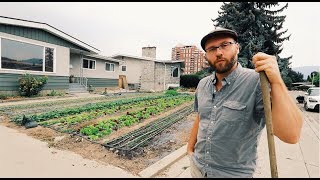
Curtis Stone walks through starting a profitable backyard farm, from picking high-value crops like microgreens and Salanova lettuce to setting up washing stations and coolers. He stresses leasing land first, planting in succession, and staying focused on a short crop list to master the work before scaling.
Chapters
My name is Chris Stone. I'm an urban farmer. I run an operation called Green City Acres in Kelowna, BC, Canada. I've taught thousands of people all around the world how to grow food in their backyards and make a living at doing it. My primary audience, or people that I teach, are are people who are kind of sick of their jobs, sick of what they're doing, and they want to do something that aligns with their values, you know, and that those values are usually growing food and living off the land in some way. So a lot of people that I've taught have been even people like lawyers and professionals, working professionals who are kind of just tired of the grind and want to do something a bit more more holistic. So the first thing that's really important if you want to start making a living with a small farm is first identify your marketplace. Figure out if there's actually people in your area that want to buy this kind of stuff. And, you know, we're talking about specific crops. That's really important. We're generally growing high-value, fast-growing high-yield-per-square-foot crops. And if there isn't a market for those crops, if nobody in your area knows about salad mixes or microgreens or baby root vegetables, then it might not work in your area. But that's number one. You can go and build a farm and plant crops till you're blue in the face, but if nobody's gonna buy it, then it's all for nothing. So these were all planted on Wednesday, and today is Sunday, so I'm uncovering them now. I put the weights on there to create a bit of resistance, and that just gives— makes them germinate more consistently right to the edge. Kind of mimics nature in a way, if you think about it, because, you know, seeds will often have not ideal conditions to germinate in, and that makes a nice, nice even germinated crop. And then we'll harvest these by Thursday, so it's an 8-day cycle from seed to harvest. That crop is sunflower, and that's one of our main microgreens. We do sunflower, pea, and Radish are our most common ones, but then I have these other odds and ends ones here. But this is an important part of how our farm is profitable. We're focusing on high-value crops. These are certainly the highest value crop. They're the shortest date to maturity, highest yield per square foot, highest price per pound, and I can grow them year-round. So those are, those are characteristics that make a profitable crop. And I outlined that in my book, but you know, our farm isn't growing pumpkins and potatoes and melons. We're growing salad greens, microgreens, cherry tomatoes, but it's mostly about the crops that we can grow year-round that really bring in the revenue of our farm. Number 1 mistake is that, well, it's not just urban, it's any farmer makes, the number 1 mistake is they take on too much. They try to do too many things. They come and they watch channels like yours and mine and they get all these ideas. Oh, I want to do this, I want to do rainwater catchment, I want to live off the grid, I want to do it all. And then they don't get anything done because they have too many goals. And it's really best to just get one thing done, dial it in, make it good, go to the next thing. And so that goes for crops too. Farmers often grow too many crops, and the problem with that is that if you grow too many crops, you don't learn all the nuances of the crops because you're not paying close enough attention. You got too much going on, so you're running around putting out fires. When you grow less, you can learn more about what you're growing. Look at this, I got some slugs growing in my, uh, in my sun chutes. So that's pea shoots, same thing, 8 days to harvest. And this is going to be harvested tomorrow, so when the guys come in tomorrow morning, that will be one of the first things they do. And so we're harvesting the whole flat. We get a little over a pound per flat, and that sells for about $15 per pound. So on each flat, we're making at least $20. So that's an 8-day crop, $20. Great thing about these too is that I can verticalize the space, so as the sun goes down lower in the sky, closer to the winter, this greenhouse actually captures more light and I can grow more stuff with less energy because I don't need— I don't need— I don't use artificial light. I do the odd time here and there, but for the most part It's all just natural light. So the second thing is finding out where you want to farm, finding some land. Now, you don't have to own land to farm. Most people think you do. That's what I thought until I found that I could farm in people's backyards. That's exactly why I do what I do, is sort of out of default. It wasn't because I wanted to be an urban farmer. I just didn't have any other alternatives. So there's many different ways you can find land. You can lease land, you can rent land, you can buy land if it's cheap, you can buy land if you want to pay for it. It's up to you, but one thing that's really important to know is there's nothing wrong with leasing or renting land for a period of time, because if you buy land and then realize after a year you don't like farming, it's not for you, well, now you're stuck with this land and now it's a liability to you. A number of people that I've consulted for have bought land, bought all the gear, put up $50,000 of capital, and then realized after 2 years that it just wasn't for them, or there was flaws in their marketplace that they should have identified earlier. They didn't like the lifestyle. There's a variety of different reasons, but I've seen it happen time and time again. That's why there's an advantage to actually not buying the land when you start, because you can just get in, grease the wheels. If you like it, build a farm somewhere else. I've turned over 20 different plots of land and I've set up multiple farms. It's not that big of a deal to have to do it a couple times. In fact, it just makes you better, because then the next time around you're going to do it a lot better than you did the first time. So there's actually an advantage to leasing and renting land. The other part of that too is that sometimes the land to buy isn't in an ideal location. This is why I ended up in Kelowna, is because Kelowna is a really good marketplace. And so just like from step number 1 was identify a marketplace, I wanted to be in that marketplace, but there's no way I could have afforded to buy land here. So I just leased land to start. Was giving people vegetables in exchange for the use of their land. So that's how I got into it. Sometimes the marketplace itself is more important than the land, because you can change your land around later on, but it's first establishing that marketplace. So keep in mind, you don't have to own land to start farming. Everything in my greenhouses, I, I use quick couplers because sometimes I want to use this really soft spray to water these crops so that it doesn't knock them over, and then sometimes I want a heavier spray for some of my other microgreens, and I'll show you both, but I can switch these up really quickly, and I love that because then, then I don't have to sit there and unscrew it. So for these ones, I like to use this soft spray. Salanova lettuce— this is our, probably our most valuable, this is certainly our most valuable field crop.
We—
it's the base of our salad mix, and we grow it around 10 months of the year. It's a very valuable crop. These are some more of the dainty type microgreens that we grow. That's red amaranth. This is radish here. This is cabbage that I'm watering right here. All these go in a mix that we grow called a rainbow mix. It's a microgreen salad mix. And then for these crops, I switch my water nozzle, and then these ones like a bit— these ones take more water, so I must have something. That's not a good flow. I'm just going to turn something off for a second here. There's probably some irrigation running. Turn that off. Yeah, that's probably what it is. Yeah, there we go. Nice big flow. This dumps down a lot more water. It's still a soft spray, but it just dumps down a lot of water, so it's faster to water. And these crops are more robust, so they can handle it. You shouldn't market farm if you don't like getting dirty and working hard. And if you don't like being in a community and you don't like talking to people, you shouldn't be a market gardener. One thing about being a market gardener or farmer is that you really have to fill a lot of different roles. You've got to be a people person, and if you're not, you can hire somebody to do that, but you've got to be out there talking to people, getting to know people in the community. And you also got to be a business manager. You got to be out pulling weeds, planting stuff, then taking it to market, delivering it to restaurants, making customers, doing the books. I wear many different hats in this business. I've learned, and it's great because it really gives you experience doing all kinds of things. If, if we're looking at 5 stages here, is to set up your post-harvest area. So this is the area where you wash and dry things and you pack things, you store things in walk-in coolers. This is one of the things that is most overlooked. So many farmers think just go out, tear up land, start planting crops, and it'll sell itself. That's far from the truth. Because what happens is if you don't have this post-harvest stuff set up, you're gonna bottleneck and you're gonna have so much stuff coming off the field and you don't have a place to wash it and pack it and store it that you're gonna let— stuff's gonna spoil. And if you've gone out and planted crops without having this in mind, then all that's for nothing and you're losing because now you've done that work and then you're not selling that crop. So the post-harvest is very important. Walk-in coolers in particular are probably one of the most critical pieces of infrastructure on any commercial farm. So the walk-in cooler allows you to store the product for longer, which allows you to market for multiple days, as opposed to just packing everything for a farmers market and then hoping to sell it the next day. But most importantly, it allows you to get the field heat off. So after you harvest vegetables out of the ground, they're warm, and if you don't cool them right away to slow down that process of decomposition, they're gonna keep breaking down and then you're gonna spoil. This is our washing table. So this is where we got a sprayer here. So this is where I wash things. All the water gets diverted into a pump and I pump it on my trees. But so these carrots were just harvested the other day, actually the last time you were here, and they were soaking in water. And so this is how I wash carrots. I put them in a tote like this. Watch out a little bit. Shake them around. Spray some water on here, and this essentially gets the dirt off. So there's— this is, you know, DIY, and we don't do that many carrots, so this works for our context. If I was doing hundreds of pounds of carrots a week, I would have a proper carrot washer, but for us, this washing table works great for this. I do radishes the same way. Beets, turnips, I'll do it the same way. So it's just shaking this around and spraying some water on here. Step number 4 in getting this all going is start preparing your land. And I put that after the post-harvest intentionally so that the post-harvest is prepared first, so that when you start doing this stuff, you can, you can kind of chip away at that stuff too. But starting to prepare your land— so there's many different contexts here. You could be really rural and have a slope with lots of rocks, or you could be in a prairie with tons of quack grass, or you could be in a backyard grinding up yard— like lawns. So there's many different ways to approach it. Basically what is involved usually is going in and grinding up the raw land. So going in with a cultivator or rototiller to Bring up the soil and start working it from there. With lawns, my favorite thing to do is tarp it for 6 months. If I, if I know that I'm looking at a new site and I want to prepare it for next season, that's the most ideal. If you can have at least 6 months to prepare it, you can let time do the work. And you can lay down silage tarps on that lawn, let it kill off the grass and all the weeds. So once you pull the tarp off, then you can start cultivating. But ideally, letting that tarp sit there for 6 months, even a year if you've got the time, it's going to make it so much easier to go in and do the prep work afterwards. Once you pull the tarp off and do that initial cultivation, then you're going to start forming out your beds. So everything we do in our market garden is a 30-inch bed. This is very standard for market gardens. Myself, Jean-Martin Fortier, Ben Hartman, we all do the 30-inch bed. That's become a standard in small farming. So now you can start forming out your beds. And there's— I could keep going on, but I think that's— that you basically get the gist of how you get started there. So this is called the Tilter, and it's essentially a rototiller, but it only— it's only tilling the top inch of soil. This is the Jang Seeder. This is my number one seeding tool. It has different densities you can plant at. It's very accurate. All of this, like, this was planted with the Jang Seeder. That's arugula. So this is how we direct seed. Most of the crops I do throughout the season are direct seeded crops, meaning that I'm just planting right in the soil and they're growing from there, opposed to being transplants. So the last thing that's going to happen on your farm is you're going to start planting. You got all your beds prepped, you got all your infrastructure in place. Now you're gonna start planting. You're gonna be planting stuff in the nursery at the beginning of the season, getting things ready to go for transplants to go out in the field. And then once the spring comes along, you start direct seeding in the field. And there's a lot of nuances to planting, there's a lot of different ways to do it. But what's really important about planting is understanding succession, is that on a farm, in order to have production consistently throughout the season, you have to keep planting. You can't just plant a bunch of stuff in May and then be harvesting all summer. It doesn't work that way. You got to continuously plant. So there's a lot of nuances to how far to spread your plantings apart and at what times of the year. The biggest challenge for us in North America, and this is the same for people in the southern hemisphere, is that our day lengths change radically from the winter solstice to the spring equinox, to the summer solstice. The days are getting exponentially longer and they get exponentially longer quicker after we pass the spring equinox. From the spring equinox to the summer solstice, the days get radically long. Where in summer here, we're at 18.5 hours of daylight at the summer solstice. But at the winter solstice, we're at 8 hours of daylight or 7.5. So it's radically different and so The challenge for a market grower is to learn the nuances of their bioregion. So I can't teach you this exactly. I can teach you what it is in Kelowna, but you're gonna have to apply that information to yourself. And one quick tip I have to do that is record everything you do in your first year with spreadsheets. Record when a crop goes in the ground and when you harvested it, because you can plant spinach at the first week of March and it might take 65 days to harvest. But if you plant it in June, it might be ready in 30 days. So it's different and it's constantly changing, and these are the nuances that we have to learn as farmers, and we can really only learn them from just doing it ourselves. So this whole greenhouse is actually— or most of it is one succession. This is all planted at once. 2 beds of radishes planted at once, 2 beds of arugula planted at once, 2 beds of spinach. Planted at once. So that's a— that was like a weekly block of planting. So on another plot, I've got the exact same thing that's a week prior and a week after. So the thing that's really neat about the seasons changing is that at the beginning of the season, in the springtime, I'm actually doing wider successions. I'm planting things in wider intervals, like 2 or 3 week intervals. But then as I get into the summer, I need to start planting things in weekly intervals. And here's the thing that's kind of weird, is that as you go into the fall, you actually start to tighten it up even more. You might actually start planting every 4 days. The reason for that is that in the fall, the days are now getting exponentially longer. So if I plant a crop on Monday and then I plant a crop on Thursday, say this is in the last week of September, they actually might end up being 2 weeks apart because that crop that was planted 4 days after is starting at a different point where it's gonna have a lot longer, shorter days and cooler nights, whereas in the springtime, you, you, things are gonna grow slower, but they're gonna catch up to one another. So in the springtime, if you say it's the first week of April, if I plant a crop of radishes one week and then a crop radishes the next week, say Monday and Monday, they both end up being ready at the same time. That's where it gets kinda nuanced, but you learn all these things just through experience. The thing I love about doing this is that each day I go to bed feeling like I feel connected. I feel connected to the land. I feel connected to my community. One of the greatest things about being an urban farmer in particular is that I'll be out in my front yard doing stuff and people walk by and they go, "This is a great idea. I love what you're doing. Why are we growing lawns?" It makes people think about stuff and I don't even have to engage them or evangelize them in any ways. This is why you should eat organic food. This is why you should grow your own food. Or any of that. People walk by and they see the production and it makes sense to them. And I love at the end of the day knowing that I'm working in the soil, growing food, good healthy food that people are eating. And it really gives me an amazing life purpose. Sure, I could do other things. Sure, I could have gone to university and been a doctor or a lawyer or whatever. But This kind of thing, it really comes back to community connection and having an intrinsic value in a community, knowing that I'm needed as a food producer. People need me, people rely on me.
Curtis is just importing some files. He shot some videos of this today. Isn't that cool? Like, he has this Steadicam gimbal, you know, the walk-along smooth shots. He did the drone footage. He's a fellow YouTuber. It is so fun. Filming fellow YouTubers, especially when they contribute two of the three cameras. So if you enjoyed that, do please check out Curtis at his YouTube channel. I'll leave the link for that there and down in the description. Also, you're gonna want to check out his website where you can get cool resources like The Urban Farmer, the book and the course, and stuff like that on his website. I'll leave the link down below.
More from Justin






If I had to start my Homestead all over again, it could only pick one animal… 




