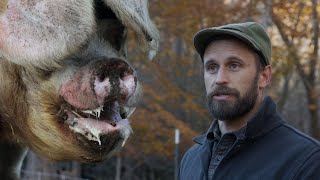
In this instructional video, the presenters walk through a step‑by‑step method for humanely and efficiently killing a pig with a single bullet. They stress the importance of a precise brain shot—aiming 2–3 inches above the eyes on the forehead—to ensure immediate death. The dialogue outlines three natural moments when a pig is still (sleeping, urinating, drinking) and how to manipulate drinking behavior to create a still target. Proper gun positioning is emphasized: the barrel must be perpendicular to the forehead, with the shooter adjusting height relative to the pig’s head orientation. If the first shot misses, the recommended response is to forgo a second shot and instead perform a "sticking" cut to bleed the animal quickly. The presenters discuss using a .22 Magnum round to minimize bone splintering and preserve the head for culinary uses, and they describe the narrow window (≈12‑13 seconds) after a successful shot to make the sticking cut before convulsions make it difficult. Safety advice includes standing back during convulsions and not attempting to restrain a powerful, rolling pig. Finally, they cover post‑mortem uses of the blood—collecting it for pasture fertilization or making blood sausage—highlighting the integration of humane slaughter with farm‑level resource utilization.
Chapters
When killing a pig, it is worth taking your time to get the accurate shot because the only thing that's harder than shooting a pig once is shooting it only twice. And your best bet to achieve a decisive kill with one bullet is just to be patient and take your time and do not shoot until you have the perfect opportunity, even if it takes 30 minutes, doesn't matter. Take your time till it's perfect. And it's only perfect if you hit brain. It is not sufficient just to shoot the pig in the head in a general sense. You need to hit brain.
How big's their brain?
And if you don't get brain, you got nothing. And their brain's about that big. It's a little thing. And the brain, the shot is going to be in the forehead. It's way up here. It is. What you do is you—
Would you go between the ears?
Almost, not quite that high.
Okay.
So what you do is you find the eyes and then go 2 to 3 inches above the level of the eyes and aim for as close to center as you can. And you have, you know, about a golf ball-sized target, so it doesn't have to be dead center, but you always aim for dead center. And, um, that is where the brain is. And the biggest challenge with shooting a pig is that they're in constant motion like this, so it's worthwhile to strategize a little bit. And there's really only 3 times in a pig's daily schedule when it's actually holding still, and that's when it's sleeping. So sleeping is actually not a bad time to shoot a pig. Usually about midday, they're all zonked out. Urinating. Pigs hold still when they pee. So sometimes when I pull up to a farm to harvest pigs, if I see one in the back and he's peeing, I'll run out and get that shot because they just, they hold still. And then the one you can actually control is drinking. So if you can deny them water from the day before or bring a wonderful treat like whey or skim milk that they love and you know they'll drink, then they'll go down into a bowl that you fill and they will hold still still while they drink. They don't laugh, they don't move their head while they drink. They hold perfectly still, so that's a good shot opportunity. You just want to be as close as possible, take your time, wait for the perfect opportunity. See, there's a still head. That's really nice. Hold it still like that. And then, um, your trajectory is, yeah, super important. So even if you hit them in the right spot— so again, 2 to 3 inches above the eyes, forehead, it's It's not between the eyes. Forehead. Even if you shoot them there, if your trajectory is off, you'll miss the brain and you'll send the bullet into the, uh, into the sinus. So like, I want my gun to be perpendicular to the forehead of the pig. So if their head is down in a bowl, then I have to be down like this to make the trajectory of my bullet perpendicular to their forehead, like that. So you are going to be moving around in relation to their forehead. You're going up and down. You know, if they're looking up at you like this, then you can do this because that's perpendicular. But when their head is down, you gotta be— you gotta be down. So if you miss, if it's a bad shot, the pig will— you— they might they usually vocalize. If you get vocalization, you know it's probably an insufficient— you missed. And then you have a choice. It's usually, like I said, it's harder to get a good second shot, so sometimes it's best to just put the gun aside and stick the pig. And usually that's the quickest way to end it rather than shooting them unsuccessfully a second time because they're moving around at that point, you know, they might be pacing back and forth. So it's, it's tricky, but the key is to— you really have to put aside your, your emotion and focus on doing the job well for the sake of the pig and be decisive in your actions. So sticking.
Are you gonna stick? You want Jonah to stick?
Yeah, I can stick. I'll show you where.
And then you'll show us after the stick how you did it.
Yeah, and we'll get a good bleed out. So hold on, let me make sure I know who it's who here. Yeah. All right, so that's the male, that's the female. So sometimes I come up and I just wait. Like, they're kind of calm right now. I might get a shot. without the way here, Here.
And I'm gonna go up the hill so that they're pulling downhill. I gotta get them to chase me a little bit. Come here.
Take, take.
Pick, pick.
That's the male on the right.
Can we turn the fence off? Turn the fence off.
Even if the convulsions are violent, you know, lean pigs that are really athletic, they'll roll around sometimes. But don't try to restrain them. You can't. They're too powerful.
You get hurt.
Just stand back. You only, you know, it's a— if the convulsions are intelligent, like if the pig is trying to get its legs under it and stand up, stand up, then you know the shot was not a good shot. But anything other than that, even if they're violent, it's, uh, it's just the autonomic nervous system.
You want to show them?
Yep.
Where you hit and where you stuck.
When you're looking at a pig, that's, that's what right between the eyes looks like. Yeah, don't shoot there. There's no brain there. You see, there's the eye. That's right between the eyes, so it's 2 to 3 inches above the eyes. That's the target. That's forehead.
Is your finger on it or is it right below your finger? Yeah, let's see. Is the X thing appropriate?
The X thing does— yeah, it's supposed to land you on the same spot. It's just, um, X's at that moment are a complex shape and it's hard to do that when you're holding the gun and aiming at a pig. So for me, the more simpler mental, uh, okay, yeah, target is just to find right between the eyes, 2 to 3 inches above.
Okay.
And that'll put you right there.
All right.
And that's where the bullet went. Gloucester Old Spots have lop ears, so as opposed to upright, they're, they're down. And they give little fat folds in their forehead right here, and it can't— it's usually right in there. Okay, right at the peak of those little fat folds. But that's, that's where the bullet went. So then the sticking cut— these are all culinary decisions. The bullet is small, it's a.22 Magnum, because there's lots of food on the head. And if we use a larger round, you shoot bone splinters and you make bloodshot meat, and you lose the culinary potential of the head. So we just use a small round, but just big enough to do the job. And after you shoot a pig, you have, you know, like you saw here, what is it, like a 13-second window, 12-second window where the pig is still right after the bullet. And that's the time to get in there and get the stick, because then the convulsions start and it's much more difficult to, uh, to get a good stick. And so sometimes you shoot them, they go down, and you got to pull them on their side so you can get that stick and stand opposite the legs when you do the stick. Yeah, because they'll kick your feet right out from under you.
We caught the blood so that we could put it on the pasture and fertilize the pasture. That's great. Well, you could have had culinary purposes for that too.
We could. You can catch it as it's flowing, you just got to stir it, and then you can, you can make blood sausage.