How We Grow Pastured Organic Chicken (just $2.50 a Pound)
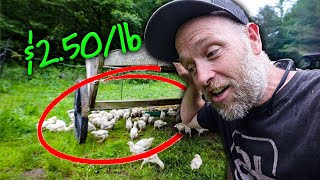
In this instructional homesteading video, Victor Justin Rhodes walks viewers through raising Cornish Cross "sea monster" meat chickens on pasture for an estimated cost of $2.50 per pound. He begins with a cost breakdown, showing that bulk organic starter feed (New Country Organic) costs about 78¢/lb, and that a typical bird consumes roughly 10 lb of feed to reach a market weight of 4 lb, yielding the $2.50/lb figure—far cheaper than retail organic chicken. The video then details the entire production system: setting up a brooder, moving chicks to a mobile “meat shawl” (a floor‑less, movable chicken tractor) on a sloped pasture, using a shock‑net (Premier 1 ShockR‑Not) to contain three‑week‑old birds, and employing electric fencing (single‑strand energizer) for predator protection. Rhodes explains the design of the meat shawl (8 × 8 ft, 26‑inch Marathon tires, removable pole, high enough for a guard goose), the importance of manure management (no floor, manure falls through to fertilize poor pasture), and the use of a guard goose to deter predators. He covers feeding protocols (starter feed, then grower, continuous 24/7 access, grit from creek sand), water delivery (Little Giant vacuum‑seal waterer), and pasture rotation (moving the coop daily to spread manure). Additional equipment recommendations include Premier One long‑trough and King feeders, garden stakes for net support, and tube‑man scarecrow. Throughout, Rhodes shares practical tips, anecdotes about family helpers, and promotes his upcoming Homestead Builds book and digital plans for the meat shawl and garden beds. The video blends cost analysis, step‑by‑step construction, and day‑to‑day management advice for small‑scale, pastured organic chicken production.
Chapters
We buy this New Country Organic by the tote, 1,000 lbs. It comes out to about 78 cents per pound with shipping and tax. Come on, is this for the sea monsters or layers? Sea monsters meat chickens. Sea for Cornish Cross, monster for the speed that they grow, guys. In 58 days from little chick shipped in the mail to harvest. Wait, I thought it was like sea M— like sea, like sea. No, not like the ocean. What? Sea like the letter. Sorry, you must put up with me and all my aneurysms. I want to say aneurysms. That's not what word I'm looking for. What do you call that? I don't know. Austin, you know what I'm talking about? A sea monster will need about 10 pounds of food to get it to 8 weeks. To get it to about 4 pounds in your freezer, sometimes you win and you get more than that. We've had some as much as 6 pounds. Other times, you know, maybe 3.5 pounds. So let's just be conservative and say average of 4. Sorry for the, uh, house build noise, but I'm not stopping that progress. Can we go? You want to drive and I'll talk? All right. I've done the math in private. You're not supposed to do that in public. It came to about $2.50 a pound. That's an incredible price considering like Whole Foods is $6 a pound, and that's not even pastured. I've seen pastured organic as much as $8 a pound. Now that we got the numbers out of the way, if you want to actually see see how we set it up. We're going to show you the chicks in the brooder and how we set that up. We're gonna right now set them up to go on a pasture. We have clouds, it's raining a little bit, we may wait. You want to do this when it's warm. You want to do this in the afternoon when it's dry. Let's go ahead and turn him off before Gideon ruins him. We mowed this a little bit ago. Hey, you want to go parallel on your bank here. I'm going to move the shaw parallel with the slope, not up and down. We are also putting Putting the sea monsters— we're putting them in a poor part of our farm. This part of the pasture needs some more nutrients. Those sea monsters will improve this pasture like nothing else. Guys, grab the Premier 1 shocker knot net. This shocker knot net is clutch for getting them out at 3 weeks old. I showed this in a previous video. Can you turn that off? Come on, no, undo that. Yeah, I think it counts on, you know, it makes his hands wave. Balloon man. That's, that's his— that's the real name, like on Amazon. We lost zero chicks last year when we started implementing Balloon Man. Anyway, one 100-foot net, uh, it's hard to get at ShockR-Not. It's likely going to be out of stock. You can try, you can get on the waitlist, you can use a regular poultry net. The problem you are going to have is the first few days they're going to be likely to go through it. Just every evening go put them back in. And you only really have to do that for a few days and then they'll be too big or they'll be trained to stay in. Jonah's working on getting the fence up. We got the meat shawl. Introducing the meat shawl. If y'all haven't seen this before, this is a chicken coop. No floor, we don't even have any walls, and it works fantastic. The cool thing about this over, say, a a poultry pen is, well, one person can easily move it without any extra tools. You can go on wild terrain. See, I'm, I'm nook and cranny farming. Like, we're at the base of our pond here and needing to be on sort of a slope. This is probably a 15-degree slope. Hey, those aren't drivable posts, so let's use the— there you go, there it is. As you can see, this terrain is awful. Need some manure. None of my coops have a solid floor because why would you want to clean out chicken doo-doo? Stop doing that. Stop doing that. No floor or minimal floor, guys. Inch gaps if you must have a floor so that the manure can fall through. Mobile coops, always mobile coops, even in permanent situations, move the coop around inside the deep bedded run. Okay, and you spread that manure love. No more cleaning out chicken doo-doo. Instead of cleaning it, we're fertilizing a poor pasture. The chickens will collect under this, get out of the rain, get out of the sun and the heat, and have that shade and just manure. We'll leave them there for one day and then we'll— here, move this forward. I guess I'll show you that in real time. There's three moves. Inside of this net, and then we move the net. Give yourself a gift, the most wonderful gift, and never manage manure. Put it where it can be helpful and beneficial, and don't handle that. That's evil chicken poo. But when you put it in place without having to check, check it, that's holy chicken squat. Not drivable posts. You did it all the way around. Good job. Oh, let's do these if we can. And if it hits a rock, let's just move it over slightly. There's a big gap, big gap, get big gap right there. Look at this big gap in the bottom. We got these handy dandy garden stakes. We're going through the bottom, it's not electrified so it can totally ground out. And already that has helped a lot, right? Get them in by foot or by— did you try the drive post? So we stretched that back out. Let's just move it over a couple inches and hope we aren't on a big rock. We weren't, so moved it over a couple inches and it went in fine. Good soil, you don't have to do this. We won't have to do this in a couple of years. Maybe we can get away with hitting the top because it's a rubber mallet. All right, I'll take it back. You can drive it if it's a rubber mallet. Just as getting us more stakes in these high spots like that. And once the chicks get bigger, say in a week or so, we don't even worry about that. They don't crawl under. But when they're wee little things, they do get under something like that. Let me give you a tour of the meat shawl. While we wait on Josiah. It's on 26-inch flat-free Marathon tires for easy moves. I'm moving this with one hand, y'all. I'm moving this. It's an 8-foot by 8-foot— it's a— it'll accommodate 100 chicks. That's what I rated that. We start out with 125 in case we lose some. Like last year, we didn't lose any and it was just fine. This was an early thing where I actually had a tray in here for storing feed and stuff, and I think that's good. If you aren't doing 100 chicks. If you're doing 100 chicks, especially towards the end, you're feeding so much feed it's not even worth handling it twice to have a different storage area out here. We just haul feed with buckets every day. Feed them all they can eat all the time, 24/7. It keeps their metabolism lower or higher, whichever one it is. They actually gain better if not eating as much. We rationed at one point and it just kind of backfired on us. What's up? You couldn't find any garden stakes? Okay, super simple, easy to build, very inexpensive. Cross boards to support it. By the way, we actually raised this early on. I had this down very low. The axle board was part of the roof, and Joel Salatin came in a consult and he's like, you got to raise that, they're going to get hot. Yeah, okay. I ended up raising it. I was afraid that predators would get to them. They don't, especially to help with the tube man and a guard goose. And now we actually made it as high as a sheep shawl. So we have a hack there for you. If you just do a one run of chickens, it's only been used 5 weeks, so you could have other purposes for this. It could be a pig shawl, it could be a sheep shawl. And now it's high enough that the guard goose can get in there. So if you built one of the old ones, my apologies, we were working things out. You could just add risers and just raise it up a foot or even a little bit more like this, and you've got a sheep shawl. This pole is actually removable, so when you go to harvest day, you could actually prop up the meat shawl and get under there and catch these chickens for the harvest. I'm running a single strand electric to a plug-in energizer from Premier 1. Just more bang for your buck. We're gonna get a lot more power. You could run a solar energizer. I would suggest their highest one. The 120, and that gives you like 2 joules. You want to look for joules when you're getting an Energizer. My rule of thumb there is get as many joules as you can afford. I think we've got 8 joules coming through this line here, and that gives you way more forgiveness. And if it grounds out in different grassy spots or whatnot, and with kids managing the farm, that's clutch. Easiest to do one big batch of chickens as opposed to multiple small ones. Like, get all your chores done, chicken chores done, in 8 weeks. It's incredible. I like this long trough feeder from Premier One. We put that right in the middle right there. I like their King Feeder. I don't like putting a lid on for the sea monsters. It makes it a little harder for them to get at it. You've got to put the feed under the shelter so it doesn't get wet. Plus, that keeps them from getting too much exercise. You want them to get some exercise but not too much, hence one net. We used to do two nets and could have like 6 moves without having to move the net. But the chickens got too much exercise and they weren't putting on the weight. So they get plenty enough exercise just being outside like this. That's enough. We start them out on New Country Organic starter feed, and as soon as they're 3 weeks old or older, you can transition to a grower. It's a little easier for you to manage, and the only difference is the starter is ground up. It's more powdery. So we actually get 1,000 pounds of starter, and everybody has it— laying egg chickens and everything. Won't hurt them. You just need to make sure your egg layers get some calcium source. Um, they enjoy the extra protein that starter feed gives. And then we just switch everybody over to grower, and that's all we ever do until all we have is egg layers, and then we do layer feed. Now the grit— this is just creek sand from the creek. You can buy what you call chick grit. I like to call it rooster teeth. They grind up their food by putting it in their gizzard. It's a muscle that moves their food around, and it's got these little rocks in it, and that's their teeth. And they are able to digest their food better. Gosh, that can be a 25% difference in weight. Get them some dentures, all right? They'll be able to chew it better, therefore digest it better. All right, let's get these chicks. These are, uh, jumbo Cornish cross. They're from McMurray Hatchery. We get them unvaccinated. We plan on eating these. We do You don't want to eat vaccinated chicks. You get a guard goose, it's going to train up, guard these fellas. One of those guys will go to the egg layer. If we put two geese together in the field, they ain't gonna pay no attention to the chicks. One guard goose per posse. You probably only have one posse, you have to order at least two geese. So give the second goose away, raise it up, and harvest it. Whoa, I think I'm getting pooped on. Oh. Yes, but I think I missed my body. Give one away, harvested it up. I don't know, I forget when the window is for goose. I want to say 12 or 14 weeks. See if he's ready for these guys. He's not guarding them yet. He's a little guy. I keep saying he, but it's actually a she. The she's are annoying because in the spring they pull out the, the nesting material and make nests and lay— now they do lay eggs, not many in a year, like 8. The eggs are nice. After the spring's over, they do quit pulling the nesting material out. The males though have a more catastrophic problem. Eventually, between 2 to 4 years old, they get sexually frustrated and they start thinking these chickens are geese— goose— and they're rough, and they end up— they end up killing them trying to mate them. Let's get him back in. Her. I think she's more imprinted on us because Lily spent so much time with her. Come on, come on. Oh, you like this grass? Okay, have some grass. You see her? She follows me around. Oh, I got a little treat for you. The beautiful one will never know. Here you go. Come on, eat your— eat your greens. You, you just— just spend some time with him, I guess. Her. Hey, spend some time with her, but don't let her over in that. That's been like tire waste. Oh, look, super tender. You probably don't want to eat while I'm holding you. Did you get them all in there? Yeah. Okay, Premier One poultry crates, Little Giant vacuum seal waterer. 5 gallons. 9-year-old boy whose name means warrior. A 125 dirt bike. Kawasaki Mule. Have you got your wire down? Homeboy dug a trench to get the single strand of electric out there. He's going to bury an insulated wire. That didn't take you long. All right, come on, let's get them. We snaked the water hose out here. These drams, guys, I've had nozzles— it helps if we turn the water on— I've had nozzles They're just too complicated, they just wear out too much. Just a simple Dram shut-off keeps it shut, open it up when you need it, put it halfway if you need a sprayer. You're just dragging them and putting them out, huh? Look how fast they found their feed. They moseyed on the clover a little bit, munched on the clover. The goats though could just live on that. Happy day. Oh, we got to get their other feeder. I like 2 King feeders, tray feeder. You want enough feeders that at least 30% of your flock could be around them. He can swim, he'd rather not. I like two waters. We need to order another one. For now, they're little, one water will do. I like to keep the food spread out but close to the coop. Under the net with those instead of over so you don't sag your fence. These guys getting the grit, some out getting some grass. Jay's getting feed. At 3 weeks old, these guys have their feathers. It could be down to 30 30 degrees. I wouldn't want to put them out if it's going to be 30 degrees and wet. I wouldn't do that combo. Probably 40 and wet and higher is fine. We're in like 49 right now, 50 at night. Could be wet, that's fine. We normally wait till they're— we set them out at 3 weeks old. At least let that be your last possible frost date. So for us, May 12th, they're ready to go out. Let Tube Man go! Come on, it's a modern day scarecrow right here. Scarecrow will only scare crows away for about 3 or 4 days. Let them go, bro. Free tube man. Starting to rain, no big deal. They've got their feathers, I'm not worried about it. It's actually a pretty good thing because I'll stay under the shed and they won't pressure the fence. The Smeet Shaw Do-It-Yourself Build at homesteadbuilds.com, that's a book we're coming out with. We're giving away the chicken tractor and the garden beds build right now at homesteadbuilds.com. Pre-order this right now until July 4th, 1st. And get 10+ plans delivered digitally. And then that— if you order by July 1st, you'll get the print book by Christmas. So if you want to guarantee Christmas delivery, you want to check out Homestead Builds right, right now. And it includes the meat shawl. I don't know if I've ever sat around with the sea monsters. It's a little weird. It's a little smelly. Busy, aren't they? Got a little limp. These guys act like chickens. What a happy life. Just total free range right here, protected by the net. Little guard goose, fresh grass. I don't think they know how good they have it. It's handy having big kids. Just drove right over that line. I'm noticing even with him working with me earlier, we're just kind of butting heads. You just kind of need your own job, don't you? You want to help, but you want autonomy. Do you know what autonomy means? He agreed to it. It means you want to eat tofu and tempeh at dinner. No, I don't You agreed, you said yes. Oh, it's hitting. Oh, I would not run it to that ground rod. I don't know if that would mess it up. Oh, that's off. Can you hook it up? This it? No. Oh no, this isn't hooked up. Hook it up. All right, it's been a few days. Our, our meat shaw has gone all the way through the net. I'm going to show you some tips and tricks for moving this entire system. The chickens will be free range for a minute. So it can be— it could be tricky if you don't know what you're doing. So here's what we do. First of all, your electricity— I've turned it off at the source. We're going to make sure you run your reel out to the fence and not the opposite way. That's because when you want to adjust this, whether you want to go that way, that way, that way, or back In this case, I'm going back. I just roll my reel up. Actually going to look at the lay of the land, go on contour. We're going to go right through there. I'm actually probably going to be all right just going to the next step. In this case, I'm moving the net from here to here. They are total free range now. They associate the meat shawl at home, so that's going to be our first priority, is to move the meat shawl over. Let's go ahead and move the food. They're always hungry. It's their first move outside the net. Don't panic, they just don't know what we want yet. Good, it's not going terribly smooth for y'all learning this. They didn't catch the Nemo at all. They got into this clover. Look at that goose guarding them. Isn't that something? I'm just going in behind them. I've got that net down there. Notice we haven't taken down the whole net before we start moving people over. We're using it now as a corral. If all else fails, you could get a pick board just to be safe. Be a lot easier to herd them with. Chickens don't herd that great. They herd like cats, but we got them over. We're going to try to close in the back end. They're going to tend to want to go back. As expected, everybody's ordering around the meat shaw, the snack machines, the water cooler. We're wide open down here and doesn't matter. I'm cool as a cucumber. I know nobody's gonna get out. Just relax, enjoying the cool morning. Like to hear them chirping. There's nothing like animals on new grass, guys. That never gets old. Something so right, so good about that. This meat shaw is available at homesteadbuilds.com. It's in our book, uh, If you order by July, you'll get physical book by Christmas. You can get these digital plans right away when you preorder. So you might want to hop on that and join me in growing our own year's supply of chickens. And really, just— it only takes 8 weeks, just 2 months, and it came out to like $2.50 a pound organic pastured chicken.
More from Justin






If I had to start my Homestead all over again, it could only pick one animal… 




