How We Prepare For Food Shortages
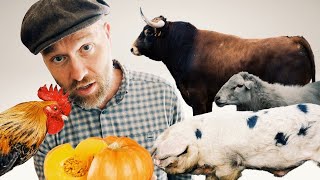
This content was created by Victor Justin Rhodes. This content was uploaded by Victor Justin Rhodes. This is a YouTube homesteading vlog titled "How We Prepare For Food Shortages" (created 2021-10-18). The excerpt is a first-person narration by a homesteader (with children present and occasional mentions of neighbors Arun and Amy) describing day-to-day farm life and preparations: a failing walk-in cooler, managing cold-hardy winter crops, harvesting and processing pumpkins (including saving seeds), collecting eggs from chickens, milking a cow (Flossie) and discussing pasture/breeding management, food preservation strategies (freezing, canning), and cooking/meal prep. The tone is practical and instructional with family interactions and on-site farm activity.
Chapters
Our AC for our CoolBot, for our walk-in cooler— that's a custom walk-in cooler right there in our unfinished room— is— has been breaking down, but it turns out lifetime expectancy is only about 2 to 3 years. It's been freezing up and I've been having to turn it on fan. It warms up in there, so we've put a bunch of our more sensitive stuff like milk, the yogurt, in the spare fridge. Pumpkins— you'll see we're gonna do that in a second. Those are cooked pumpkins. Well, not in a second, maybe a minute. G-Dog, let's go! As somebody in the homestead space, I often get asked, well, am I a prepper? Got prep, like for a doomsday event, high oil, food shortages, anything like that. Y'all hungry? The answer to that question is yes and no. Like, I don't have a bombshell bunker. We're not doing canned goods storage. We don't have a million and a half seeds in some vault. So in that sense, no. But on the other hand, it's yes, simply because this lifestyle lends itself to that. Like this, for a second, it's cold and chilly. Now I'm not as cold as chilly as the other kids might make you think. They like to break out the coats as soon as it gets cold. We're going today— this is lettuce. This is a hardy, cold, cold-hardy crop. We're gonna hopefully convert this, taking the panels off of this, put some Agribond on it, some material to protect this from frost that I think might happen tonight. Gideon, can you bring me the hose? The kid's not over enthusiastic. It makes me think, you know, it's kind of chilly out here, windy. It's Sunday. Normal people are like sleeping in, looking forward to the ball game, smelling some roast cooking. I don't know. I don't know, what do normal people do? But we're out here. I don't want to be out here. This is a morning I don't want to be out here. Henry didn't sleep good last night. I'm letting mom sleep in. She had— if I had a bad night, she had a worse night. When this is a lifestyle, you got to do it sometimes even when you don't want to, and you make progress, you move forward. Picked up this pumpkin on the way Over here, you know, it was rotten, uh, breaking apart. We're gonna just give it to the chickens. Papa, there's 6 eggs. In exchange for that rotten pumpkin, we're gonna get 6 eggs. That's huevos mucho. All right, take these in the house and bring this back, please. Come on, you can do it. Come on, you're 7 now. You're a big strong helper. Come on, you can do it. See how fast you can do it. See how fast. Hey, come on, we'll time you. It's not always a romance. The kids don't always want to take the eggs in. Actually, most of the time they do not want to take the eggs in. Let's be real, they want to eat the eggs. We all want to eat the eggs. Oh boy, I said oh boy there because I just saw the cat digging in there, probably covering it. Get in! That's not inside. I set it there so I don't have to carry it. No, no, I want you to carry it in. Okay, it's overflowing. All right, put it on quick, it's running. See how it's running? It's got to— we got to get the vacuum seal. All right, let's get the eggs. Maybe it's still worth the battle. Nice glove there, buddy. You can do it. You have to bring it back out. All right, there you go. Good. Yesterday we processed a lot of our pumpkins. We're making pumpkin pie. He's gonna get the eggs in there. Our neighbor friend, Arun's wife Amy, had tried to get pumpkins like a pumpkin, um, what do you call it after you've mixed up the flesh? What do you call that? I don't know, puree? I don't know. Uh, It was short at the grocery store. So with the embargo and things, maybe that's why. Maybe it's a sign of more shortages to come. Just last summer there were no chickens. Remember that? And we had chickens. And actually with our pumpkins, we can't be in there eating pumpkin pie and our neighbor not even be able to get pumpkins, so we took her some. We're back in the chickens. He's— Gideon's putting, putting the thing back. But let me show you something. Hey, what are you gonna do, have 100 cans of pumpkin? No, actually, we saved— we saved a lot of those. That's— you saw those pumpkins in the fridge? We're gonna go ahead and freeze up— we're gonna make— I guess it's puree. I don't know, don't kill me if that's wrong. I don't know. You want to put his hood on? I mean, what are we gonna do, have 100 cans pure? And if you have 100 cans because you're prepping, they're gonna run out. He's gonna try to put his hood on. What I want to show you guys is what's inside this pumpkin. Pumpkin seeds. Come on, get— come on, get it done. Get in. Do it. Boom! Those pumpkin seeds means we could technically keep on having pumpkins forever. Okay, so do you see what's happening here? We've got the winter harvest garden coming on. We've got pumpkin and pumpkin seeds. Just being homesteaders makes us preppers, I guess. And I would like to think more of the sustainable kind. That means seeds. That means boars, rams, roosters. And bulls too. See if we have scissors over there. Are there any? Nope. Get it. There's another one out. Waters need to always go away from the fence. Why are we putting extra pressure on these fences? We need to get waters away, and then the animals are away from the fences. You see, with breeding stock, I mean, yeah, sure, we could can meat, have hundreds of cans of meat, but it's gonna run out. But not if you have the breeding stock. You can keep on going with it. It's great to learn how to can, but you got to replenish that year after year. We went and got our milking supplies, and I remember, remember, I was taking out the trash earlier I guess what I'm saying here is growing food inevitably, inevitably ends up being preparation. It's a sustainable one. If we did a SWOT analysis, we just went over, uh, strength, weakness— that's SW. I don't know what O and T stand for, I forgot. But the point is, those are our strengths. We have our own animals. Our breeding animals. We know how to grow food year-round. We don't need to store that kind of thing. So hopefully this is an encouragement to you guys to grow something, anything. You don't have to have the Old MacDonald farm like we've got. We all started somewhere. That cool room, these freezers, although they're a strength, they're filled with our own homegrown food. In a sense, that is a weakness. So I sense it. Analyzing yourself every year, trying to get better. I think we need to build some redundancy there, and we will eventually— well, probably sooner than later— learn how to can meat. Not that we'd can all our own meat and get rid of the freezer, but it sure would be nice to be able to do that, to have the supplies, to have the know-how, to have the redundancy, wouldn't it? Is it really that cold? No. Well, I should ask you, is it really that cold, Jonah? A little bit. My feet are cold. I think Henry's had enough. Flossie's in heat. This is how we keep on having calves, how we keep on having milk. Now it is a pain. We're separating them. That's the easy part. It's not letting Flossie over, but getting Stud over. You know what I'm gonna have to do? I think what I remember we have to do is get them both over, right? Because Stud ain't going without her. And then get her back. See, we'll get her ahead. And then we'll, we'll shut the gate. We'll get them back in here. We're stripping her out. This is where it's at, man. We're probably gonna get harvest, uh, 24 pounds, 25 pounds of food. From the grass. From sunshine and grass. We actually had this little bucket in the truck. Let's see, it's a little uncomfortable on my knees. Oh, this might be it. Aha, I'm milking again. We tied the calf up here so she wouldn't press on the fence. She is feisty. She is just like her mom. The calf was in the other fence with the sheep and we let her over so she wouldn't bust through the fence. Let's not do that again. Seeing her mom. Hey! I think it's okay, she's just got to get used to— you're fine. She's flossy. You are a little flossy, aren't you? Personally, I think folks are missing something when— if we pay attention to what I just said, we're gonna get like 25 pounds of milk. Wait a minute, if I could survive on 2, Rebecca 1.5, 3.5, the kids all together, I don't know, another 5 or 6. Guys, that's more than enough food. Like, we could survive on milk. We can survive on just meat. Actually, we could thrive. On just milk and meat. It's fresh harvested here every single day. It doesn't matter if it's 40 degrees outside right now, doesn't matter if it's 9. If we couldn't get hay, we could probably only have one milk cow. We probably couldn't do two. Stockpile of grass. But this is the most beautiful, and I think the biggest potential here, because we're just taking something that's unedible to us, grass, and turning it into nutrient-rich food. Milk and meat. Now the key is you— we're moving them every day so that this grass can actually recover and just doesn't turn into a bunch of weeds. You leave them in here, they'll just eat the good stuff again and again. Do you want a milk? Sure. They just eat the good stuff again and again and it gets destroyed and the weeds thrive. Yeah, so you know, on 8 acres We might not be able to do 2 cows without hay, you know, and all their offspring. Look, I mean, we're raising their offspring for new calves, for meat. We may be able to not do that many without hay yet, but moving, giving this land rest— and that's it too, we're talking about it's good for the land, letting this land rest and not continually grazing it, letting it fully recover and express itself again makes it stronger, makes it better, and we'll, we'll double, quadruple our production on the same amount of land. The wind knocked you guys over. It's quite the windy day. You see the back of your head. Let's just say the poop saved you. 1, 2, 3 gallons of milk. He's getting around. How do he and Teddy get along since they're on the same level? Picture of the two of them. Yeah, they're gonna have a special relationship. Ay, mucho papas. On today's episode of Burn It Up Cooking Show, we have a loaded fridge. Yes, we have dark meat chicken. See what I'm gonna do is, Rebecca, I was gonna, um, sear it. Is it called searing? Yeah, yeah, I'm gonna sear it, brown the outside, and I'm just gonna cook it at 400. Okay, processing our potatoes. I think this is enough. This many more? Yeah, I think that was great. Whoa, you've got the chunky salt on there. That's fried real good. I, I wrapped the legs in bacon. I'm going for a 400 speed, trying to get more crispy Oh my, 30 minutes later. I like the wings because they got the most fat on them. I got a little bit of leftover, uh, what was that? It's not— I keep wanting to say sauerkraut. Bratwurst. Rebecca is gonna have to nurse and eat. She's got a very meat and potatoes kind of lunch. With some sauerkraut. Literally. A little bit of sauerkraut.
More from Justin






If I had to start my Homestead all over again, it could only pick one animal… 




