How We Store A Years Worth of Food (in our Yard) No Electricity
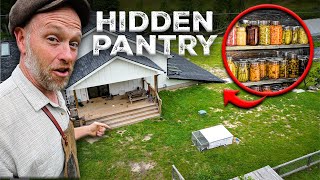
A homesteader shows off a root cellar built under the front yard that stores a year's worth of canned goods, jams, and preserved foods at a steady 55 degrees. The video also covers spring planting: potatoes, onions, and corn, with help from family members using a drill-mounted auger to dig trenches.
Chapters
In my front yard, I am literally standing on a hidden root cellar where my family stores a year's worth of food. The bearish ground around here kind of gives it away. Here, let me show you our current preserves. I'll give you a tour of this root cellar. We also spent some time, final touches, fixing it, waterproofing this thing. Our root cellar had been flooding no matter what we do. When our vent was down below in the ground, water would seep around it. We're just moving our vent up above the ground. Ta-da! Oh wow, this is stuck. Anyway, we didn't form tight along the wall there. Inside the plug plugged it pretty good. I do kind of wonder if we have a leak over there in that corner.
Let's call it.
We can't. Let's let it dry out a little bit. And we've got some planting to do in the spring so that this root cellar will be plump by fall. How about a quick tour of our root cellar? Probably one of the coolest things is— look, it's hidden. Yeah, it is literally hidden under our— that's our front yard up there. And so we didn't have to create a special space. Probably the second coolest thing is this is an entrance right here. This gets us into our house, come out the winter It's cold. It's snowing. It's raining. It doesn't matter. We have a roof. And then we step in. It's like one of those YouTube videos of these hidden rooms. We have a hidden room. I just built a secret room in my parents' house. So they don't bother me anymore. Behind this storm door is a little storage area. On the shelves in here, things that don't have to keep. That's cool. This room won't be as cool. The reason we can do this without electricity It's because we're under the ground, and the ground keeps at what, 55 degrees? So it's insulated by the earth, kept cool by the earth during the summer, and kept warm during the winter. This area that's not as cool because it's not as deep in, we just have— it's a good place to store canning jars that will be filled come fall with persimmon preserves, raspberries, blueberry preserves, some quart jars back there, pasture seed. We've been reseeding our hurricane-washed-away pasture. That's also good for when we create— when we turn forest into pasture. We've got cover crop for the hurricane field. We got, uh, winter rye, uh, vetch, and— or that's buckwheat— and then vetch. Shall we go in room number 2? Room number 2. We're a little bit scant because it's spring. You're at the end of pillaging your root cellar. More seeds. These organize in a huge binder with like collecting card plastic Pages. We've had potatoes in here. We keep our garlic in here. We keep our onions in here. Somebody sent us some bulbs for our cemetery we're making on farm. We have tomato juice. I don't think we need to make that again because we— I don't think we've eaten it once. We got fat old lady chicken broth can. Haha, the last of our tomato sauce. I know this is juice. We must have ate all our tomato sauce. How sad. But we did plant more tomatoes this year because it wasn't quite enough to get us through a year. More jars and canning lids. These ones from Suburb. Applesauce. Well, we could be eating this better. Henry, you gotta start eating that applesauce, bro. We go to the local apple farm in the fall. Our apples are not of age yet. Make the applesauce, then we don't have to buy it. And that's a sweet— it's a natural sweetener. Oh wait, wait, crushed tomatoes! Yippee-ki-yay, we do have some! Okay, we have a lot. Oh, let's get it— let's get in here and shut the door. Just more cans, some onion. These, these little nifty bags for storing onions are awesome. They store them individually. Strawberry jam. We hit a buttload of strawberries from local farms. This is amazing. This is amazing in yogurt. This is amazing just this and some peanut butter, a nice little treat. I'm glad I came down here. I forgot about those crushed tomatoes. We can do that, we can do that, we can put those on the menu. As you can see, the jars could get out of here. We will fill this by the fall, and it'll get us through to this time next year. Been key to have nice electricity. You see a lot of root cellars just dingy and dungey. It just doesn't have to be. Invest in yourself, make it pleasurable to come in here. Let's keep this door shut, let's get it cooling. Also pretty key was that we put an outlet in here because the root cellar flooded and we needed to plug in a Shop-Vac, we needed to plug in a dehumidifier. As you can tell, we love the grid. Big diesel Cummings generator if our power goes out. The way I figure, the reason we're doing this is for our health, and we're growing food. So because this is the healthy food that we can't even buy in the store, so I try to make other things easy on ourselves, like a lit up root cellar. No need to struggle and, you know, strife, uh, in your preservation. Forgot to show you one thing. There's a vent up here. No, no, yeah, there's a vent up. Yeah, you can kind of see it back there. There's a vent, so air circulates in, air circulates out. It was lower. Hopefully it'll still work. And now air circulates out. How does it get through this wall? Well, we had a little cut through right there. We've had a problem with this flooding since we got it, but hopefully, you know, keeping water off of it's going to help. That's like the core of the problem. We're kind of addressing the symptom here, but if we keep water off of this, we won't have a lot of water pressure going, you know, on this. So grading this a little differently, a little more away. I'm happy with this root cellar. It's critical for this family growing our food for health, quitting the grocery store, getting food as local and as seasonal as possible. And that means in our backyard. I'm hoping this weather holds out. We've got a lot of potatoes to be planted to keep that root cellar full. We've got some onions to be weeded. But as always in the spring, we got a lot of chores to do before we do that project. Let's go! You want to help us with the chores?
Oh, chores. Yeah.
Or do you want to start planting? Oh no, that's tough. Or do you want to do the chores, not plant? What are we planning? We could divide and conquer chores. We're planting potatoes. You could start cutting them up for their eyes. You want to do that? Grab a knife and cut them up.
How many rows are we planting?
4 rows. 4? We're pulling up— the garden will be full. That's a lot. This side's gonna mow.
What do you have left on the chores?
Now he's gonna mow. What does he mean mow? What's he gonna mow? We need the string trimmer.
Gonna mow the cow pastures.
Oh, okay. Why don't you get the string trimmer and do that while I do the chores? And then we'll plant together. Come on, I'll take your string trimmer. I'm excited to get packing.
The first day— yeah, the first day, you know how many thousand— we have to climb 4,000 feet the first day.
No, no.
Yes.
Oh, that's true because there's two climbs. We're prepping today for tomorrow. We set on a 100-day— no, no, not 100-day, 100-mile.
I did 3,000 in 3 hours.
That first climb is brutal. Anyway, we gotta, uh, get our chores done so we can practice setting up the hammocks, practice the cook stove, set up the phone holder on the bike, final packing. This is neat. Mama not only hatched these chicks, she's raising them. She's up and about scratching. Gotta move the tractor more often. But it's a perfect setup for this. You guys can build the chicken tractor from my book Homestead Builds. Good for raising little chicks and mama. It's good for separating a sick chicken over here. It's good for raising 4 chickens full-time in this, 12 chickens if it's just their nighttime coop. Rain has held off. Come on, boys, let's go plant potatoes. First thing we've done is pulled the tarp up. Love these Farmer's Friends silage tarps. Pull those up and it's ready to plant. I'm gonna let them plant potatoes. We marked out a long tape. We're gonna plant in a bed one every foot, about 6 inches deep. We've cut these into 1-inch cubes, leaving one eye, and you just— hey Henry, you want to come cover these up? Drop them in. And are you filling those holes? You got a system down. Jonah's drilling, got a nice auger attachment to the drill driver. Gideon's dropping them in the holes. And now Henry's covering them up. I just communed with my late grandfather. Never even met him, but we named Henry after my late grandfather Henry, who bought this farm back in 1932. He worked this very land. This was a potato patch where our house was, so it's not far-fetched that potatoes were right here. He walked and worked this land. Now we're walking and working this land. Their kids had cute moments like wearing too big of a Shoe. That's where my dad got his name— nickname Boots. That's what everybody called him because one time, or maybe many times, he wore his dad's boots when he was like a little toddler. Not only did we just get all the potatoes planted, we got 400 feet of potatoes planted, corn, onions, Oh, we could put something here. Brassicas, strawberries, and peas. Our crop garden is nearly fully planted. We have some tomatoes in the high tunnel. This feels really good. Let me show you the root cellar crops. Garlic and onions. 200 feet. I mean, each of these is 100 foot and there's 2 rows right here. We've got tomatoes, 2 rows. I'm thinking that's got to be more than we planted last year. I hope so, so we can have salsa year-round. We almost made it, so we just need a little bit more. But tomatoes are— they're jamming. No, we lack— it's about 2.5 rows to be filled, and this whole crop garden, 8,400 square feet, is full. You planting the extra corn? What are you gonna do with those extra potatoes? Okay. In a little container. Onions were out of the ground. Let's make lunch. 3 hours later, it's evening. We've spent all day packing our bikes, all the afternoon. We're ready to survive 100 hours in the wilderness. 100 hours? 100 miles, starting tomorrow. See you then. Happy day.
More from Justin






If I had to start my Homestead all over again, it could only pick one animal… 




