Hunting Buffalo @ the Allan Savory Institute
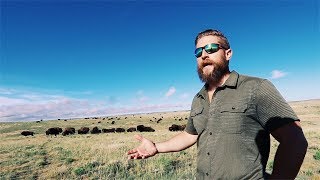
In this on‑site video, host “Speaker A” joins Bobby Gill, Director of Corporate Development at the Savory Institute, for a field tour of the 7,600‑acre West Bijou Ranch in Colorado. They drive around the ranch searching for a herd of roughly 300 bison, reviewing a grazing‑plan map that outlines paddocks and seasonal rotations. Gill shares herd demographics (220 cows, 195 calves, 30 yearling heifers, 10 two‑year‑old heifers, 17 bulls) and typical weight ranges (cows ~1,000 lb, bulls ~1,800 lb, calves ~200 lb). The conversation expands to explain the Savory Institute’s mission to restore grasslands through holistic planned grazing, the ecological importance of bison as wild megafauna, and how predator‑prey dynamics shape grazing patterns. Gill describes the Institute’s broader work: a global network of learning hubs, efforts to develop a land‑health scoring system (bare‑ground %, water infiltration, soil organic carbon, biodiversity) to certify regenerative livestock products, and ways for the public to access training or donate via savory.global. The video blends informal adventure narration with educational content about regenerative agriculture and the role of bison in ecosystem health.
Chapters
So did you figure out where they are? Did you get an idea?
Um, no, I just pulled this out, so it'll, it'll be an adventure for us.
Okay, let's go on the adventure.
Cool.
Check it out, guys. Got up early this morning, drove about an hour, got my little psychic. Just say you're gonna help me this morning.
Yeah.
Okay, we're gonna find some— I've been calling them buffalo. But I learned this morning from my contact the true name for these animals in North America is bison. But look, check out this view. Some of the most beautiful terrain we've seen. We're at some ranch land owned by Savory Institute. Alan Savory himself, that institute.
We're with Bobby Gill.
Bobby Gill. Bobby, how are we going to find these bison, my friend?
Well, uh, we've got 7,600 acres here. Oh boy, at the West Bijou Ranch. So, um, maybe we need to go on a little drive. I am not the bison manager, I just work for the Savory Institute, but I busted out our grazing plans and our map because I was trying to get a peek at what's going on here to see if I can get some insight as to where they might be today. But we'll go on a little voyage and see if we can find them.
Okay, show us these plans. Can you understand them?
Um, So I am not a holistic management practitioner, so I can't go into detail here. Uh, there are others who are much better at it than I can. But essentially along this side you have the different paddocks. You know, you break down your land and here's a map that shows all the different paddocks of what we've got going on here on our land. And then you look at that over the time. So you got April, May, June, July, August, September, October. So this is our growing season plan. And then when the non-growing season happens, we'll have another plan. We go through this all the time. And then basically you track your movements and you plan on where to go, and you list out where you can go, where you can't go. Basically you just kind of track your movements, look at what's going on, keep track of the weights of the animals and like how much they're growing. There's all these things down here. Basically it takes all these complexities of managing grazing, uh, livestock and puts it into a nice chart format that is easy to understand for the ranch managers and those who are out here moving the animals and kind of keep track of all the different things that are happening.
So how big are they right now?
Let's see, how many do we have? So we've got 220 cows, we've got 195 calves, 30 yearling heifers, 10 2-year-old heifers, and 17 bulls.
Average weight of each of those kind of changes, so anywhere from 1,000 to 1,800 pounds. Yeah, a cow, 1,000 pounds.
Bull, 1,800. Yeah, and then the calves, you know, they're about, you know, maybe 200 pounds right now. So you got little baby guys running around too.
So did you figure out where they are? Did you get an idea?
Um, no, I just pulled this out, so we'll— it'll, it'll be an adventure for us.
Okay, let's go on the adventure.
Cool.
Okay, are you up for that, buddy? You like that? It's starting to get more exciting now.
If I were to look, we're on the end of July. So let's see, this is the last known area that they were in. This was Paddock 10, which then on the map is over here. So they were over here. That could be where I saw them coming in this morning.
You think you saw them this morning?
I saw them out in the distance. I saw some black spots.
Okay.
Yeah.
Okay.
So yeah, we'll go find them.
What do you want to do? We're going to take your car. Are we walking?
Oh, I mean, it's 7,600 acres. I don't think we could walk.
Okay, grab a four-wheeler.
We could grab some four-wheelers. Uh, yeah, you want to— let's go into the barn, see if the four-wheelers are running, and then if we can get those moving, that might be the funnest one. Okay, that would be—
what is Savory Institute?
Savory Institute is a nonprofit based in Boulder, Colorado. It was founded by Allan Savory. He was the Zimbabwean rangeland ecologist who created holistic management back in in the '60s, um, and he's been refining that process ever since. And so we founded the Savory Institute in 2009, basically to teach ranchers and farmers and pastoralist communities around the world how to better manage their livestock herds in a way that isn't just going to get you better outcomes on the land, but is taking a holistic approach. So you're getting, um, benefits to the ecological, the economical, and the social outcomes of everything that you're doing.
Let's see.
Actually, I wonder, truck might be easier. Oh, that looks rough.
Is it going to start just that? Hopefully it runs better than its seat looks.
That doesn't sound promising. Nope. God, I don't even think I've ever ridden these.
Oh boy, started right up. There we go. It's meant to be, Bobby. You didn't know you was gonna get to ride four-wheelers, did you? Huh? Was it worth it now? That long drive, was it worth it? Getting up early?
We had to wake up at 5:30 this morning. Actually, I, I already just woke up. You did?
You just woke up naturally? Good. Are we on? Yeah, we're on, buddy. Okay. Let's do this. Let's do this.
So I'm, I'm looking around as we're driving trying to see if I can find them, because normally it's like this little speck of black dots that you see somewhere out in the distance. Like, it's like trying to find a needle in a haystack. It's like 300 bison somewhere on 8,000 acres. We'll find them.
They're big, but they're not that big, huh? Yeah, in the grand scheme of things. You see them?
I think I see something over on that hill. You see past the trees over on that other hill?
Sort of see that. Are they on the other other side of the stream today.
Where is the stream crossing? Oh yeah, actually hold up. So you see them out on the hill and then down past that.
Oh yeah.
You can see some. You see them to the side?
Yeah.
There's two stream crossings. Where they are is a different question. I'm gonna go up ahead a little more in case I see another road, but I'm pretty sure that there's like a little road that crosses down so we can get to it. So we'll, we'll try our best. This brought us to the water. I don't think this is gonna get us to the stream crossing, so I'm gonna turn around. I saw a fence down there, and here's where I tell the people people that I'm not the ranch manager, so I'm not the one who is supposed to know how to get from point A to point B.
That's right.
I just work for the nonprofit. We forgive you.
What is your role?
Uh, Director of Corporate Development. So I just deal with partnerships and fundraising and stuff like that.
So, okay, cool.
So I'm not on the ranch as much as I would like to be, so this is fun. It gives me an excuse to be out here and play around.
That's right.
So let's go see if that gate down there was anything. This looks like maybe something. I think we found our stream crossing.
Perfect.
So just to show you something, this is a stream that used to run year-round, but as you As the quality of the land degrades and you get more desertification happening, you know, your grasses start to grow further and further apart from themselves, their root structure doesn't go as deep and it doesn't hold as much water into the soil. And when you don't hold as much water into the soil, streams start to run dry. And that's essentially what's happening here. So, you know, now that the Savory Institute is going to be managing this land, this is a marker that we're going to use of, hey, we know that this is dry most of the year right now, but I bet you in a couple years we start seeing this run a little more often, and then, you know, probably a decade, two decades down the road, we might even start to see it running annually. But we're gonna get close to them soon.
You see them up there? You see them way up there?
Little black dots at this point.
Here they are. This is beautiful to see. A little taste of what it would have been like. Yeah.
Whoa, there's a big guy just, uh, you see that big guy? Big old bull. Bison are much stronger and much bigger than cows. Cows have been domesticated for quite a long time, whereas bison are much more wild in their genetics, so you need to keep a safer distance. You can't go up and pet them.
Grunting at us.
They're wondering what we're doing here today. An aspect of holistic management is trying to replicate the predator-prey relationship, so basically keeping your ruminants bunched up so that they act as if they are herded by their prey. You know, with bison, that would have been gray wolves, or there were grizzlies that used to roam the plains. And so that kept them tightly bunched and regularly moving.
Native Americans too?
Native Americans, I think, to an extent. They more coexisted with them. They weren't as much of their predators. Okay. But when they're tightly bunched together, they're going to be less choosing of what types of grasses they're going to eat. So you get a more even graze when they're in a tightly bunched herd. When you do more continuous grazing, where you take your herd and you just put them out to pasture and leave them there for a long period of time, time, they get kind of picky. And so they go back to their favorite grasses and they ignore their least favorite grasses. So certain grasses get overgrazed, certain grasses get undergrazed, and you kind of throw off that equilibrium of how things are growing. So that's one of the benefits to keeping them tightly bunched and regularly moving. You get that, that herd effect on how they graze.
They're curious.
They see us.
What do you think that means?
What are they saying? They're saying, who are you? Why are you out here? Imagine the entire US being grasslands and just bison everywhere. That's essentially —what it used to be. Oh, it went from Mexico all the way up into Canada, coast to coast. They existed everywhere.
Wow, I didn't know that.
Somewhere between 40 and 70 million bison. After, um, you know, we colonized the US, we basically wiped out the bison population. We exterminated them because they were the source for the Native Americans for all of their, you know, their food, their leather. Just everything that they did was based off of bison. So that was kind of the the white man's approach to kind of taking control over this land was exterminating the bison. So at one point, the bison population in the US got down to less than 100. So they went from somewhere between 50 and 70 million down to less than 100. I think the most recent estimate is that we've brought it back up, we're at about 400,000. And so the National Bison Association just launched a campaign that they're— it's called Bison 1 Million. So trying to get to— get back to having a million bison. Why is that important? They were the original stewards of this land. They keep these ecosystems intact. This is what used to— this is what health of this planet used to look like. It was large herds of wild herbivores grazing the lands, tightly bunched, moving because of that predator-prey relationship. And when you did that, you had healthy animals, healthy grasses. With healthy grasses, you have healthy soils. With healthy soils, you have more water-holding capacity, so healthy streams and all the habitats that exist from there. That's what health and equilibrium used to look like on this planet. And then we kind of came along and industrialized things, and we got rid of these beautiful grazers that used to keep things in balance, and we threw everything off kilter. You know, our goal at the Savory Institute is to heal the grasslands of the planet, because without grazing animals on grasslands, they're not going to be healthy. They're going to desertify, they're going to degrade, and, you know, all sorts of downstream effects from there. So this is what we would like to see more of. And you can replicate this with cattle, which is what most people do because that's domesticated and it's easier to, to manage. But this was the original, you know, large characteristic megafauna that used to keep our planet in equilibrium, at least here in North America. The Savory Institute owns this land, the West Bijou Ranch, 7,600 acres. The herd of about 300 bison is owned by 3 different individuals. So, you know, they aren't our bison to determine where they go, but we're managing them in a way that's going to bring back the ecological health of the land. We do though have a global network of hubs. We've got 30 hubs all around the world, and they're all these local learning facilities where people can come and learn holistic management and holistic planned grazing in their local context, you know, so based off of the climate and geography and the social structure and whatnot. So we got hubs all around the country. We've got Mexico, Canada, Argentina, Chile, all over the world. And we're trying to influence some market forces so that more regenerative livestock products can be found and accessed in the marketplace. Because right now you can go and buy a grass-fed steak or, you know, some grass-fed yogurt at the store, but that's really the extent of what you can find. You don't know how those animals were managed. You know, they could have been continuously grazed, which is grass-fed, but it can degrade the land because they can overgraze certain grasses, undergraze others. So, you know, there's the management of those animals and what are the ecological implications and outcomes that happen from that. We're starting to put some wheels in motion on a plan where we're going to be measuring land health, looking at things like percentage of bare ground, water infiltration rate, soil organic carbon, biodiversity, and using that to create a score which you can then use to verify if something was regenerative. You know, because if that land health goes from here to here, that's something that a consumer should know because that product should be worth more. That's a product that's sequestering carbon back into the soil. That's a product that's bringing back ecosystems. And so if in your everyday purchases you can be choosing meats and dairy or leather or wool or pet food or cosmetics— I mean, it can go on and on— there's all these products that are derived from livestock where you can have this positive ecological outcome and you can be regenerating the planet. And, you know, we're putting some wheels in motion so that you will be able to find those things in the store. So kind of look for some things, probably in 2018 you'll start seeing some products that are going to have some, some seals that indicate that the ecological outcomes have been verified. That's kind of like the big thing that we're doing these days. We train farmers, we train ranchers, you know, we help them be better stewards of the land, but then at the same time we're also trying to help consumers know the difference that, you know, the way your livestock is managed can make a really big difference difference. And you can, you know, in these day-to-day purchases, you can be helping, you know, solve climate change and, you know, bringing back wildlife habitat and all these other big global issues. Good work you guys are doing.
Thank you so much for showing us around here. Thank you for coming out.
This has been a really fun day riding around on the four-wheel. Yeah, good.
It's a good day of work, right?
This is— I mean, yeah, tough day on the job.
Darn, we got lost, didn't we? You knew all along. You knew all along the creek crossing. I just want to ride more. If people— if people want want more of you and, and they want to get trained, where do they go?
So the Savory Institute, we have hubs all around the world. If you go to our website, it's savory.global, there's a map of all the different hubs. Get in touch with the hub, they have trainings. We also have online courses and ebooks. And then of course we are a 501(c)(3) nonprofit, so we couldn't do this work without the support of donors. So if you do support regenerative agriculture and the Savory Institute, you can go to savory.global/donate and every little bit helps. We would appreciate that.
Yes, thanks. Let's go!
More from Justin






If I had to start my Homestead all over again, it could only pick one animal… 




