I Spent 60+ hrs with RuthAnn Zimmerman + Learned 10 Critical Things
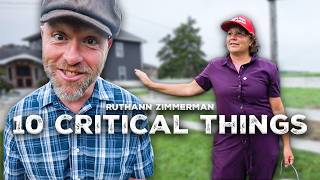
The YouTube documentary‑style vlog follows creator Victor Justin Rhodes as he spends several days on the homestead of Ruth Ann Zimmerman, an ex‑Mennonite farmer in Iowa. The film is framed around “10 critical things” the host learned from Ruth Ann, each illustrated through candid conversation, on‑site demonstrations, and family interactions. Key takeaways include: (1) Ruth Ann’s consistently cheerful demeanor; (2) her relentless work ethic, moving from dawn to dusk in the garden; (3) practical tips for content creators working off‑grid (e.g., delayed uploads, using Instagram camera); (4) the family’s approach to chores as character‑building for children; (5) the balance between growing vegetables and preserving – Ruth Ann prefers growing over harvesting and preserving; (6) detailed dairy practices, from milking a single Jersey cow to making butter, yogurt, and cream cheese, with temperature windows and hand‑folding techniques; (7) livestock management, including cow‑kicking bars, heifer rearing, and using whey as pig feed; (8) garden design choices such as planting raspberries at the edge to hide weeds and managing prairie encroachment; (9) cooking methods using farm‑fresh ingredients (sweet corn, green beans fried in bacon grease, coleslaw, cottage cheese) and the seasonal differences in butter texture; (10) Ruth Ann’s cultural heritage influencing food (scrapple, German roots) and her book on homesteading. Throughout, the vlog interweaves family banter, moments of prayer, and reflections on how homesteading builds work ethic and community. The video ends with a promotion of Ruth Ann’s upcoming book.
Chapters
I am traveling to the breadbasket of America to spend several days filming a documentary of Ruth Ann Zimmerman, ex-Mennonite, inspirational story of her leap of faith and her homestead journey. These are just 10 things I learned myself that it's changing my life for the better, and hopefully will yours too. The number one thing I learned was Ruth Ann is always cheery.
Make myself a smoothie. I can't have coffee on an empty stomach, so this is simply so I can have my coffee.
A smoothie to start the day?
Oh, it's Clabberin and Chipton Peach.
Ah, just so that you can have coffee.
So I can have my coffee.
Fancy vlog setup you got there.
I know, right? It's gotta fit. I don't have big hands like that. See, it's basically the same thing.
Number 2, Ruth Ann works as hard as a chicken. Works from dawn till dusk. You see how fast she's moving around this garden? It's every day for her.
Now, Ruth Ann, you told me you were going to come out on your patio and have your smoothies.
Yeah, this is how I have my smoothies.
I was imagining you sitting down, but that was a mistake. Do you ever sit down?
Um, when I eat, and even then I have to be intentional about it. I have to tell myself, sit down.
She's a praying woman, so last night I asked her— I'm imagining she might have a morning devotion or something. I said, do you pray in the morning? You pray in the morning, Ruth Ann?
When I'm in the garden, yeah.
When you go to sleep at night, how long does it take you to go to sleep?
Oh, well, I try to watch a show. Oh, so I'll turn the TV on and find my show and fall asleep. I don't actually watch the show, I just turn it on and then fall asleep.
What's the show?
Oh, I don't even really care.
Okay, you just need it to go to sleep.
Why?
I think it's, it's habit.
I see.
This is for the dogs.
Okay.
Whoa, they won't be out today. They're not friendly.
One of them's not friendly.
Normally I don't handle such a big cup going to the garden because I'll just spill it when I walk to the garden. The first one I poured is over there for you.
You need a Yeti with a lid.
Yeah. No, I need to smell it.
Yeah. What's up with all the flowers?
I only had the capacity to grow vegetables because I was so busy with babies. Right?
Yeah.
So now, you know, with, with two having already left the nest and, you know, there's only five kids at home, I already feel a little bit less pressure. Or maybe I'm just more— yeah, it just doesn't feel as intense, the gardening doesn't. So I have more time to kind of relax and enjoy it, and the flowers do that for me. Plus When I garden, I don't like to harvest and preserve things. I just like to grow things. So the flowers stay, and you know, even though I have to pull the peas out and pull the beans out when they're done, the flowers get to stay.
Nice. You actually don't like the process of harvesting, preserving?
No, I just like to grow things and nurture things.
Even though that's kind of what I know you as—
what, the gardener?
Just this— yeah, this great preserver.
Well, it's not my favorite.
Yeah. I have to be in—
yeah, I have to be inside. That's it. And that's why the whole outdoor kitchen is so I can do my preserving and stay outside.
Yeah.
And that's part of the reason I don't like to turn my AC on, because then everybody stays inside, and it triggers me from our long, long winters when everybody sits in the house and does their thing, because we get like 8 months of that.
Number 3. Well, sort of a practical thing in homesteading. When we are homestead content creators, we often don't have cell phone reception or Wi-Fi outside. That's a real problem for me because you can't upload in the moment. And how do you remember? Well, I didn't realize you could just hit upload and it would start doing that when you got back into the house. The Wi-Fi— look out in front for more Instagram stories from me.
Post it right then and there.
Yep.
You get good reception out here?
No, it'll post when I go back to the house. I've been trying to be a little more present each moment, so I'm using my phone camera more often.
Yeah.
And then waiting till I get back to the house and just then just posting whatever I took. But, um, I forget then, so it's still easier for me to be present on social media if I just use the Instagram camera and film as I go.
So you just did that and you posted it to Instagram and it didn't go up because you're on the Wi-Fi right now? Yeah, or cell phone.
It probably—
and it'll automatically do it when you get home?
When I get back up to the house, it'll post. Yeah, it'll— like, if I don't try to do too many stories out here, one, one photo will post.
But if I try to do videos out here, they won't post because I don't have service.
I don't like to harvest and preserve.
Okay, yeah, I need proof right here.
I kept thinking, oh, the cabbage is okay, it'll be fine, it'll keep growing, and then, then it split open. Now it's pig food. Okay, but we'll make this one today.
All right, we're gonna make sauerkraut out of that one.
Okay. Uh-oh, what are you doing with kale?
Well, I'm not eating it. Okay, good.
I don't eat—
you scare me there for a second. Um, I was trying to kill you.
This is gonna go to the cows.
Kale, no. What's the story with the baseball bat?
Well, okay, so the boys— we have 3 sons, they are 9, 10, and 12, so they play ball down here. And if they play, you're gonna love it because, you know, there's not enough for teams, so they have ghost players. So you'll hear them say, "Ghosty on third!" And they'll run and they'll hit. And then when Ghosty comes home, it's a run. Yeah, so they have ghost players. Last summer, suddenly testosterone took over and they're hitting, and I hear this like crack, and I see the sunflowers just— and I'm like, I walked out here and I'm like, all right, new rule: the ball goes in the garden, it's an instant out. I don't even like It's just out. If the ball goes in the garden, you're out.
Because they were running into the garden to get the balls.
Yeah, fielding the ball, and they take everything down with them as they went. So now, so I helped them set their base where they kind of hit up towards the house. But we're about to make the rule where wiffle ball is the only thing that gets played in the backyard.
Yeah, because they're thinking 12— at 12 years old, wiffles are easily hit.
Yeah. And so I'm trying to get them to hit towards the the maple tree, and it's really a good skill for them to learn how to turn their body, you know, so, so to direct the ball.
But yeah, that's some of your most famous content, isn't it?
Yeah.
You had a moment to pray yet?
Yeah, I'm praying when I'm scolding my my, um, look, here's a weed.
You're hard-pressed to find a weed.
Yeah, they, they pop up here and there.
This grass clipping is nice on the bare feet.
Yeah, isn't it?
Yeah, I mentioned that about the grass clipping. She's a grass clipping mulcher, which continues to inspire me. We've done it. We do it.
We—
well, that's what we do in our raised beds, and it's wonderful. But could we do it on a bigger scale? Maybe. One thing I noticed barefoot in the garden feels really nice on grass clippings.
Is there a reason you put the raspberries on the edge of the garden?
Yes, there was a reason. So people that drive the road can't look down my garden and see all the weeds between the rows. Okay, but they—
the vanity measure. I love it.
What?
A vanity measure.
Yeah, it's a vanity measure. They really shouldn't be here because they want— I have to pull them out because they want to take over the entire garden.
I thought maybe you're going to block road dust, or—
look at all of those berries.
Things want to grow in Iowa.
They do. Our biggest battle is to keep the prairie from taking over.
Yeah.
Okay, we don't have to coax things to grow.
Okay. Nope.
And that was my problem with wood chips. Wherever I put wood chips down, trees would start growing because they're so— like, it gets real windy So there's tree seeds coming from everywhere, and in one year I'd have trees this big. I'll show you. That's a tree growing in my raspberries. Wow.
Almost looks like a blueberry bush. Is that where the ball players fell through?
No.
That was actually a windstorm, but, but yeah, that's what it looked like when the ball players played ball in the garden.
We can just throw that in as the B-roll. There it is, reenacted.
Yep. This is what my worship is. Okay, see how pretty that is? Yeah, look at that. Just tie, tie themselves down and get ready for storms.
These are your pickling cucumbers today?
The little ones are. The big ones for the chickens.
Okay.
Well, you know, most days I get up and make breakfast and then I go to work and she's here all day by herself.
So, um, yeah, I usually, um, yeah, I usually hear the coffee maker going and smell the bacon and then I know you're cooking. Then I'll come in to say goodbye.
Where do y'all get your bacon?
Our pigs.
Oh, where are they?
Down back. Oh, okay, you'll see them.
Okay, good. How many pigs do you have to raise in a year to have that much bacon?
No, this is how it works, Justin. It's not how many pigs you have to raise to have enough bacon for the family. It is bacon is for special occasions because there's only so much bacon on each pig.
I know.
What do you eat for breakfast then when you're out of bacon, when you— when there's no bacon?
Sausage or scrapple.
There's a lot more sausage on it.
Yeah, big, or a lot of just eggs.
What's scrapple?
Scrapple is— it's made from—
I heard that maybe on the—
it's—
yeah, it's the menu for us.
It's a cultural food from our heritage. Um, it's a German food that when you butcher, um, all the meat from the bone that's left on the bones is cooked in a pot.
Oh, fun.
And then you pull all that meat off and then you grind it up and you add flour and cornmeal.
Oh, meal.
And then you let it set, it'll kind of like set up, and then you slice it and fry in a pan.
Yeah, she's smiling.
She may or may not, you know.
You don't know scrap, you're from a different order, completely different background. They're not from Germany.
Harrison, you hear their feet? 1, 2, 3. Good morning, Harrison.
Good morning, Harrison. You normally get up that fast?
Uh, I usually sleep with my clothes on.
Ready to go, buddy. Ready to go. Now tell me the truth, did it help that Gideon's here get you up out of bed?
Um, yeah.
And it doesn't have a cord, it's rechargeable.
You know you're at a homesteader's when their whole fridge is jars.
And barbecue sauce.
Oh yeah, yeah, you gotta supplement with the barbecue sauce.
Oven's over from last weekend.
So if I sleep in, the cows literally just holler in my bedroom window right there.
Would the jumper be allowed in the Minnehaha culture you're from? Yeah, it would.
Well, we all— we did to do chores growing up.
Nice.
See, this is how I share my space with Elvin. All of this space, and somehow this ends up on my cream separator.
So Lizzie's a heifer.
This is her first time, her first baby, and he's about 2 months old.
Tell us how she's working out for you.
She's doing really good so far. You can tell how calm she is. She's always the cleanest, so I wash her first.
What breed are they?
Um, Brenda's a full Jersey. Lizzie is half Jersey, half milking shorthorn.
I like how you're doing your work and in between movements you're looking up at the kids supervising.
Yeah, always.
Hey, what are you gonna do when your kids are grown up and independent? You got nobody to look at during the chores.
Have you, um, I'll probably just have my worship time during chores.
That's probably why you like gardening so much early before they wake up.
So Lizzy is a first-time mom. She's an heifer, so we put this on her because we don't have a stanchion to put her in, and this keeps her from developing.
Cow can't kick. Is that the cow can't kick bar?
Okay, keep milking.
What does that mean? What? He told you she kicked?
I'm not sure.
You want you to come over there? Yeah, he wants the cow can't kick bar.
No, she doesn't. We don't ever use that for her.
When you use the can't kick bar, do you ever find that you can take it off of them and eventually they won't kick?
Yeah, that's the— that's the goal.
Pretend she has that 5th teat that's a dud. I've heard that that's a good sign of a good milker. Is that true?
I don't know, I've never heard anything about that. But you know, in commercial dairies— I know, just keep milking.
Do you ever have to put the cap on to get the milk down?
I don't want to start that. Yeah, but they're probably just a little, um, Nervous because there's strangers around, but that's okay.
This is all you feed the cats?
No, they get cat food, just a little bit.
So how many boys does it take to milk a cow? This is quite the queen. Hey, Ruth Ann, this must be the queen. She's the queen of the homestead. Yeah, she's getting the flies brushed off.
I don't like to use fly spray unless I absolutely have to, right? So I use fly spray on her because I don't have anybody to brush the flies off her. We really only need one milk cow, but then I would be the one milking her because I love milking my cows, and then the boys won't have chores.
No, but we want to milk her.
I know you guys, we gotta have something for them to do, right? Yep, you gotta have a— they have to have a purpose for getting out of bed in the morning.
A lot of people homestead for health, to save money, for food security, and they forget. And RuthAnn Homesteads for building character in the children and herself. How are you going to do that? Then give the children a job. Great reason to homestead.
Where and when did you learn that that's what built character?
When Alvin and I started reflecting on the difference between the modern American culture and the way children are raised. When we first left the Mennonites and we started seeing what— how modern America was raising their kids, and then questioning how we can raise our kids to have work ethic and character like we saw in the Mennonite culture. And so then we got the animals because they needed chores.
Does the Sharpie on the jar wash off? Yep, that's a good trick.
Well enough.
What'd you say?
Gardening me never understood cooking me well enough to plant enough onions, so this year when I planted onions, I thought of cooking me.
I'm gonna geek out here with 3 things I learned about making butter. I'm relatively new to the butter-making journey, a couple of years, but I've never had any formal in-person instructionals. So this is about to be great.
What's the plan now, Ruthann?
I'm going to get this butter churning.
I learned that I shouldn't let the butter get too warm.
Have you noticed that the warmer you let that cream get, the quicker it turns into butter?
But there's also something like letting it get too warm because then your butter's too soft and you can't work it.
Yeah, so there's a window, isn't there?
There's a window.
Where do you find that is?
I don't know. I kind of feel the outside of the jar, but I've heard people say it's around between 50 and 60 degrees.
So you were making yogurt.
This was yogurt from yesterday, and then we like our yogurt really thick, so I strained it. Well, this is extra thick because I left it overnight.
You strained all the whey off of it?
Yes. So leaving it out, this is then what you could use as cream cheese.
Whoa, that cream cheese, you can—
I would have left it for the rest of the day. I use it as cream cheese.
Yeah, this will be cream cheese.
This will be cream cheese, um, that I'll use. Like, you can use this to make cheesecake or anything.
So cream cheese is just all the whey Well, traditional cream cheese is—
you would kind of do this method with just cream.
Oh, okay.
But this is milk.
Okay.
But it works the same in, in recipes, like if you're gonna bake something or—
okay.
So I'll use— I'll make yogurt and I'll use it for to replace sour cream, cream cheese, and store-bought yogurt.
How long did you leave it here to strain?
I put it last night.
How did you make the you make the yogurt in the first place, or no?
Yeah, in the Instant Pot. I made the yogurt in the Instant Pot. Yeah, because it has a setting and it's hands-off. But I want yogurt for my grandson and for us.
And, um, what did you use?
I strained it too long, so now I'm just gonna add some whey back into it.
Quite a bit. What are you gonna do with that whey?
It'll go to the pigs. There's a lot of things you could do it, and people are like, oh no, don't throw the whey. I can get whey every day if I need it.
She's getting schooled here.
I see I have to be taller so that I don't make a mess.
I've learned that you've got to work the butter as soon as it breaks. Sometimes we forget and leave it on the counter and yeah, causes problems.
Do you find that if you let it sit there now for too long it gets weird?
Yeah, it'll get soft because of the humidity of the day, and yeah, it kind of starts reabsorbing the The buttermilk?
Yeah. Okay, do you ever— do you get it out enough that you can leave your butter on the counter, or do you always leave it in the fridge?
In the summertime, I always leave it in the fridge.
Wash your hands with cold water before you handle it.
Here's the one tip: always wash your hands with cold, cold water. Okay, anything that's not wet, the butter will stick to.
Okay, so how's the consistency of the butter? It's good?
It's nice.
Yeah, it's gonna not be too sticky.
It's not too sticky.
You'd rather err on the side of making butter that's too cold than too warm.
It takes a little longer when it's cold, but in the summertime especially, it's so much easier to work with because the components of summertime butter are, are really soft to start with because cows are on fresh grass. Wintertime butter is very waxy. And here's the other thing, in the olden days, like our grandparents, they would mark their winter and summer butter in the freezer when they stored it. Did you see how close I was to eating that? Because their winter butter is more waxy and better suited for making pastries.
Ah.
And their summer butter is softer and better suited for spreads and cookies and things like that. And it's all because of the cow's diet.
What does grain do to the butter? And probably makes it more pale.
I don't know what grain would do to the butter.
Vanessa, you ever wash a butter churn?
Um, I washed this.
Oh, you got to be very careful.
Yeah.
And I learned that you don't have to squeeze the butter to get the milk out, but just caress.
This is how you rinse it, huh? Yep. Put a little water in there and just pancake it.
That's what my mom taught me.
You never press down too hard on it, huh?
No, I just kind of fold it because the, the, um, milk is actually in between the curves of butter. So if you just fold it— see how I'll show you. See, when you just stretch it like that, you're opening up all those little pockets.
Okay.
It's not so much about pressing as it is about opening up those little pockets.
I'm always trying to squeeze it out.
No, you don't have to squeeze it. It's about opening up those little pockets. So see all the buttermilk that's coming out of there?
Yeah.
And when my mom taught me, see, if you get your, your milk, your butter too soft, if you make it too soft and then you don't— you can't open that, or they're too tiny then.
So how do you relate to your viewers who are like me and they didn't grow up doing this and they're watching you because they're trying to learn from scratch?
So normally when I, when I have multiple questions saying the same thing. Um, it causes— asking the same thing, like, I can't get all the buttermilk out, or, um, you know, why, why do you fold and not squeeze?
You've already been asked this.
Yeah, then I'll be like, okay, I need to do a video on butter making, and then I'll address all of that.
That's neat. Yeah, that's why everybody likes you. You just have to serve.
I really do like— and also, questions sometimes cause me to stop and think the why behind I do what I do. Because, you know, when you've grown up doing something, you just do it and you don't often question the why.
So, so are you still open to learning something?
Absolutely. And I'll still ask my mom something. I don't remember, we were in the garden and I asked her about something.
Um, what was the last thing you learned?
The last thing I asked my mom?
Oh, or your mom, or anybody. Surely your mom's not I'm not the only person.
No. Um, so I learned when we were at your house—
what'd you learn?
Um, I learned about separating the calves, you know, because we've never half-shared before. So that was— that gave me the boost of confidence of, oh, there's no— there's no just one way. You just— this is the way you do it. And I really liked your way. Yeah, I'm like, oh, it doesn't have to be complicated.
Wait, you said you're gonna put that in the freezer?
Yeah, because we can't, um eat all of this.
Oh, okay.
Last winter, going into winter, I had 30 pounds of butter in my freezer.
This could be every other day job for you.
Butter is like twice a week because I kind of let it stockpile.
But you're always doing something every day on—
every day I'm kind of— I'm like, what am I doing with the milk today?
What now, Roxanne?
I'm, I'm making some cottage cheese for tomorrow's, um, for tomorrow's lasagna, and I wanted to see Robin in her new book. I wanted to see her method.
What's your go-to meat?
Beef.
Is there a reason?
Um, Elvin doesn't really like chicken and pork. I try to keep pork to like once or twice a week just because I know pork's harder to digest. Beef's my go-to. Plus, we for the last 2 or 3 years have plenty of beef, so I'm always trying to work through my beef. But my, my— that's my, um, that's my milk that I've added clabber to it for tomorrow's cottage cheese, so it's just fermenting there.
Looks like they're out there learning how to cook though. Lunch was good.
Now we Ruth Ann is showing us, giving us a real horse and buggy experience.
One day Mitchell was giving me a hard time because I didn't know how to change my wiper blades on the car, and I said, listen, I can harness a horse, drive it to town, bring it back, take the harness off before you ever figure out how to put the harness on.
All right, what are we doing here, Ruth Ann?
We are in my brother's sweet corn patch because mine in the garden's not ready yet, and we are picking sweet corn for supper. And it's going to blow your mind, there's nothing like Iowa sweet corn. Oh, you know how they say Georgia peaches?
This— they say Iowa corn.
Iowa sweet corn.
Grandma's pulling you. It's just where you got the blueberries we're eating today.
No. Oh, okay, yours. The ones we were eating today actually got from a neighbor to here because she had earlier ones that were shipped in.
And how does he keep this soil acidified? Acidified?
So you put sulfur chips on it, it's little sulfur pellets, and then the bark mulch helps too.
Ruthanne, you've done 2 days of work in a day. You tired yet?
No. Well, yeah, I can tell.
When do you When do you start getting tired?
When the sun starts sliding down towards the horizon.
What time are you gonna go to sleep tonight?
Well, it depends. What time are you going home, Justin?
After supper.
After supper. I'll probably fall into my bed before 9 PM.
Okay, I'm a fan.
I'm a fan.
We're gonna be here right at the— as soon as the sun comes up for your interview. Sit-down interview.
I'm at my best right first thing in the morning.
Okay, well maybe that'll work. No, how about— how about after breakfast?
Yeah, I'll have mine.
I know you want to get out, get your coffee.
Yeah, after breakfast.
We thought you'd be upset if we got— it got you there in that hour. It's just teasing you.
Oh no.
Tell me what we're making.
These are green beans that I picked while you were doing an interview with Elvin, and then I cleaned them, and now I'm just frying them up in bacon grease. Roast in the oven, and we're gonna have sweet potatoes.
Beans.
I mean, no, sweet corn.
Sweet corn. And sweet corn.
Yeah. And I've got coleslaw made too from the cabbage.
Would this be a typical meal, or are you going a little extra because we're here?
This would be typical. Meat, meat and veggies.
Yeah. Okay.
Yeah, whatever's ready.
Yeah, good.
Iowa sweet corn, it's gonna be the best corn you've ever tasted in your life.
Those are the 10 things. But to reiterate and go back to number 1, the most important one, just how cheery she was. When we got home, I sent Ruth Ann a picture of us with our bounty of blueberries. And the work ahead of us for preserving. And her response, I'll never forget it, was, looks like a wonderful way to spend a day. And admittedly, when I go into that, I feel a sense of overwhelm, duty, is this worth it, not an overall great, greatest attitude. And I think whether I'm feeling it or not When I go into a duty like that, like today when we're going to end up doing our tomatoes or green beans or sauerkraut, I'm going to say this is a wonderful way to spend the day. And even if the feeling isn't there, perhaps it will come around, and we'll explore how to truly get the feeling there. Hope you enjoyed Ruth Ann as much as I did. Look at this.
Hey, you gotta sign this book you gave me. What is your favorite chapter?
Probably the milk cow chapter. Those are also my favorite photos.
I saw that cursive there for a minute.
I thought you were writing in Pennsylvania Dutch or something.
What is this? What is this strange lighting?
Writing?
What?
It's not a written— it's not? Okay. All right.
Ruth Ann gave me her one and only copy of her book. That is a pre-copy. This book is amazing. I've read through most of it already. The pictures are fantastic. She goes into character. She goes into practical How-tos. It's a go-to on my shelf. It will be a go-to on your shelf. It is available right now for pre-order. Let's help her hit the number one selling charts. Check out that book, link down in the description.
Say goodbye to your buddy. This is goodbye.
Bye-bye.
Y'all were a lot chattier on the way to the airport than on the way home, huh? Bye-bye.
Bye. It was so nice to have you. Tell Rebecca I said hi.
Yeah, I'm gonna tell her.
La la la la la, let me be free.
More from Justin






If I had to start my Homestead all over again, it could only pick one animal… 




