If I Can Homestead, So Can You
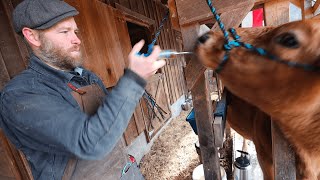
In this informal, on‑farm video, Justin, Rebecca, and Brianna walk viewers through a typical Sunday milking routine while sharing the three biggest barriers they faced when starting their homestead: lack of knowledge, insufficient money, and health challenges. They illustrate each obstacle with personal anecdotes – the early loss of chickens due to inadequate wing‑clipping, the high cost of organic feed and how they reduced feed by rationing, compost‑feeding chickens, and a community volunteer who helped turn compost piles. Health hurdles include mastitis in their cow Phyllis and Justin’s chronic Lyme disease, which forced them to scale back market‑farming operations. The trio explains the practical solutions they discovered (wing‑clipping, daily poultry net moves, feed‑rationing, using Animal Synergy’s Celix Gold, and leveraging compost), and how those constraints sparked creativity and a shift from selling farm products to creating educational content. They promote upcoming talks at the Mother Earth News Fair in Belton, Texas, offering discounts on their Great American Farm Tour DVD and encouraging viewers to connect and share their own stories.
Chapters
Good morning to you too. All right, Beck, time to do the cows. Yeah, you know, fitting day to be talking about this. If I can homestead, so can you. It's, it's cold. It's Sunday. A lot of America is hunking their shoes right now, sleeping in. As my dad would say, Sometimes when we'd be hauling wood in on Saturdays.
Yeah, you want me to do that and you bring the cows in?
Sure.
All right, because I can't bring the cows in. Okay, but I can get that stuff.
Hopefully the tumbler and stuff's up there and everything. We'd be hauling wood on Saturday, seeing people out shopping. Are we the only ones working today?
Beautiful.
But cold Sunday morning. You know, a lot of people are sleeping in right now. Not us, right, gals? Brianna and Rebecca milking Flossie while I tell you guys this story. Rebecca and I grew up some of the most unlikely to become homesteaders, actually. Sure, I grew up on this farm. Uh, it wasn't really a farm at the time though. It was— I mean, sure, we had cows, but they stayed in one field, we threw hay, we threw grain. I think my dad did it to write it off on his taxes. I can remember once asking my dad, because he ended up leaving the sustenance farming lifestyle. When he grew up, if you didn't grow it, you didn't eat. So I said, Pop, why don't you do it anymore? You know, grow a garden, do more. And he said, because it's cheaper to get it at the store. Dollar for dollar, not considering quality, he was so right because he could go out and do business and make more in an hour than what he would save growing his own food an hour. You know what I'm saying? Bitmoose, are you gonna please stop nudging the tripod? Thank you very much.
Just need you to not move. Just wait.
We need this stall. Hopefully the little one doesn't come out.
Come on, wait, wait, wait, wait right there.
Hey, Rebecca, tell them where you grew up. Rebecca, Florida. Suburbia Florida. But I grew up on the farm, but half of my life easy was in town. Went to school in town, went to town on the weekends, both days. So it was a mix. And none of my siblings, if it's saying anything, are living this lifestyle. All right, you're feeling frisky. Yep, let me try to get Flossie in a stall. We normally do her first, but we need to treat Philis for mastitis. All right, come on, get up in there. So given our background, it's kind of unlikely that we're going to come into this. And so, like many of you, we're coming into this with all the obstacles, all the obstacles you can imagine. I'm going to talk about 3. That's lack of knowledge, lack of money, and lack of health. Arthur, you can give them 4 scoops of that alfalfa. 4 big old scoops. Half a tablespoon of RC Gold. And shoot, will you show him? He can break open the new apple cider vinegar, and the big ladle should be over there.
Yeah, it is.
So one quick story of our lack of knowledge coming into this. I can remember us getting our 4 chickens our first 4 chickens. We put them in a stall just like this on the other side, and we came, you know, came out excited to show everybody our new chickens, show mom our new chickens. And we open the top and we look in, and 2 of those chickens fly up on this perch and fly out. I knew so little. I mean, you know me now, as this, you know, some call me the apron-wearing permaculture chicken ninja.
Master.
Actually, nobody calls me that. I just like to call me that sometimes. It's just fun. Well, the chickens— it wasn't always that, and I didn't know the chickens could fly that well. And they got it, and then they're out. I don't know how to catch a chicken. And looking back now, those chickens are disoriented. They don't know this is their home. They're not going to come back here. How am I gonna catch those chickens? You want to pet them? You can say hi.
Okay, so Justin's milking one T in the stainless steel bucket. The other two that Brianna are milking into the plastic bucket for the pigs is because on Thursday when we didn't milk Phyllis because I wasn't feeling well and Justin was actually sick in bed. She got mastitis because she just— if we don't milk her, she just gets it. So we can't, we can't skip it even in sickness. So we've been treating her and she's doing really well actually, and I think we caught it really early, um, and so It's really not that big of a deal, but lesson learned. No more skipping even when you feel like puking.
Another very common obstacle for people doing this is health. Sure, you might actually be getting into this for health, but it might be your health, your well-being, that is also an obstacle. For us, we were living this lifestyle going for it, and suddenly I began to suffer physical pain. Like pain when I was walking, and then pain in my feet, and then pain in my back, and then depression and brain fog. And ended up being chronic Lyme disease. And we ended up having to slow down this farm dramatically. We were market farming, we were doing well, grass-fed beef, market gardens. We had to cut it off. We barely hung on to the chickens, the gardens, and I think we had one family cow at the time. Round one with Phyllis. Y'all want to put the calf to bring down some more? We got this much out of just one teat, this much out of two, and we'll probably get nearly that much more round two. All right, as far as I can tell, mastitis is— milk is fine to drink, we just don't.
It's salty.
I don't know, maybe it's best practice not to, so we give it to the pigs, certainly. And, uh, this is the third day, and we even tested her yesterday, and it seemed like it's pretty much cleared up, so it wasn't vicious or anything. Tomorrow we'll Harvest as usual. The third obstacle I want to talk about is money. A lot of people get into this to save money, and I think you can do that, but you also need some money to get into it. Like this fence right here. Quick story: Rebecca and I, you know, we're on— we're in this for a health journey, uh, we're, we're trying to be frugal. We decided to buy some local grown feed for our chickens. We decided to get it in bulk, and we decided to drive there to get it. Save as much money as we can. We go down there to this farm and these big gnarly men, they're picking up 50-pound bags, one in each hand, and they're loading our van. Our van, you know, we got this cheap van, it's old, it's, it's— the springs are getting maxed out. And we load our 1,000 pounds or whatever it is, and they say, you want a tour? And we say, sure. And we go on this tour, you know, it's kind of looking— it's kind of not looking like Joel Salatin's farm, you know what I'm saying? It's kind of looking a little different, you know. We had found out about Joel and we had learned from him. He had this beautiful farm, and it's just kind of like looking like a just any old regular farm. And Rebecca said, hey, do you guys use GMOs? And at the time I didn't even know what a GMO was, but the farmer said yeah. And I didn't think anything of it. We finished our tour, we got in the car, we got— we started driving down the road, and Rebecca starts crying. Rebecca, you can correct me if I butcher this at all. She cries. I pull up I said, "What's the matter?" She said, "There's GMOs in this. It's not good for us." I said, "Okay, let's take it back." "Oh, they won't—" "Yeah, let's take it back." We pull over. I call them. I say, "Let's see if they even will." And I call them up. Wonderful farm. I mean, wonderful people. Kindest people in the world. You know, loaded our car. We're honest that it was GMOs. And usually when people are asking if there's GMOs, They know that you want to hear no, but they told us the truth and they took it back. The big man grabbed the bags, one end, one bag in each hand, unloaded the car. We went home. The problem was we still needed chicken feed, and organic feed at home was going to be 3 times as expensive. Don't let me forget, guys, to treat her, because that's why we're milking her first. We can treat her and it can settle in. Before we give her back to Cash. All right, let's go. All right, he's got it, he's got it. Usually if he gets one going good, they all get going. Hey, what are y'all doing? Getting cat food. Big deal. Right through the window. Shut that window. Look at you two.
Yeah, we went out and saw the sheep and the bull.
Do you like the sheep or the bull? You know, little boots.
Is he not just adorable?
Little tiny boot. So those are just 3 common obstacles. There are more, uh, but what happened? Like, how did we overcome those obstacles to get to where we are now? So what was the first one I mentioned? Um, knowledge. Those chickens, remember those chickens jumped out? Well, now I know and learned that you can clip a chicken's wings and they'll stay in. We're staying in pretty good over here. Now, are we perfect? No. Every once in a while you get a rogue one gets out. And I also learned, interesting fact, you guys know that— Brianna, do you know this? You'll have to hear the story. If you, if you get a chicken that's out and you just set out just slightly jogging, walking, just keeping chasing the chicken, just keeping the chicken in sight, that eventually that chicken is gonna crouch down and you'll be able to pick up that chicken. No, I did not. You didn't know that? I'm gonna have kids and they're experts. Yeah, if you have kids. Yes, well, I didn't have kids at the time, but yes, we've also learned that kids are, kids are expert chicken catchers. But if you, you know why this is? Do you know that If you and a chicken were in a sprint together, the chicken would slaughter you. Yes. But, but if you and your chicken went on a marathon, you would slaughter it. You are, uh, you are an endurance machine. The chicken is not. All right, you milked her for all she's worth, Brianna. Every last drop. Okay, um, we're gonna let you jam that needle up in there. Yeah, I'm not doing it.
Really? Does she kick? No, I'm gonna let y'all wait a minute. Okay, you know her, you know her body language. You know if she's about to whack you one. Have you been kicked yet?
No, she don't kick. She's too old.
Justin got kicked in the butt by Flossie.
Flossie will kick your butt. So you want me to wash it, Rebecca, before? Oh boy, oh boy.
Stain coming off. Nice bucket of pee out there, Justin. Thanks.
Oh, it makes me want to pee. So the money issue. We're driving home from buying all this feed— well, we didn't buy the feed, we had no feed— and we're gonna have to spend 3 times as much on organic feed. What did we do? Well, we had been reading the books. We had read Harvey Ussery's book, Small-Scale Poultry Flock, and he talked in it about how you can begin to ration chickens' feed and ration it down, down, down every week until it affects egg production. So I said, you know, Rebecca, what can we do? We're gonna have to feed this organic feed. What can we do to increase feed off the land, cheaper feed? Well, let's move the chickens every day instead of every week. And we had one poultry net, remember? We at one time, guys, we had only one poultry net, and we still only have— we still are using that one poultry net. We would, uh, go out in the morning, move the net to a new place, move the chickens in a similar type chickshaw type of thing. And we got to where we could move that net in 9 minutes. But the ultimate story here is we found out our chickens were eating way too much, and we ended up cutting our feed down to like— we were feeding 10% of what we were used to feeding. And Even buying organic, it was cheaper than it was going to be buying the GMO. So we just shifted our mindset a little bit and just put in a little more effort and did a really good thing. So I'm going to tighten up her stanchion because I don't want her falling down. Uh, somebody wants to hold her tail up. This is very tricky. Well, this is the third day of doing this, but we take this Animal— what is it called? Synergy Animal Products. Yeah, what's that particular, um, one? This one is Celix Gold. Celix Gold. And we do 30.
I just realized that I don't—
do you do 20 mil? You do 30.
I need to, um, shake it better.
So we do 30 mil in the teat, man. Hold on, wait, well, let me see this while you're shaking that. That goes up in there. So you can imagine she's probably pretty uncomfortable.
She doesn't kick or anything?
She's very stoic.
Yeah, she'll kick a little bit probably. But not always.
Yeah, when they told me that this is what you do with it, I was like, what?
Somebody's gonna lift the tail.
It's like, no, surely you're not saying like in the teeth. And he's like, yes, I am.
I was like, okay, Rebecca, you hold up the tail. Sometimes that helps prevent them kicking. Not always. So we've watched it. You just go— you just— oh, you know what helps? The tail's up, the bar's tight. There it is. I'm pumping slowly in now. She's stoic right now.
Good job, girl. She's such a good cow.
If they kick it, you just change out the needle and go at it some more. And the reason we milked her first is now we can put her back in the stall, keep her away from Moose, let this soak in for half an hour while we milk Flossy. For the health thing, how did we get through almost losing our farm, just dwindling it down to just the bare minimum. One guy, one friend of mine, reached out to me and said, you know what, I've got this youth group, I want to, I want to do some positive work with these guys, can I come out to your farm once a week? And at that time, you know, we talk about cutting down our feed costs with chickens, we had developed it to where we had a system where we had 4 compost piles going and we would go into town to the health food store and get their food scraps and feed that to the chickens. And the compost chickens would eat the biota in the compost. We were feeding nothing, nothing, like feed bill zero. But those compost piles need to be turned, and I was physically unable. And a friend said, you know what, I'll do it. And every week there was a great job for them, and we hung on to the farm that way. And eventually we, we shifted our business from selling farm goods to creating content, and that's been a more sustainable, wonderful blessing. Heat number 2. She's making me look good right now. Can you continue? Sometimes it's hard to get it in the tail.
Oh yeah, the tail. Sorry. And does she need more? She's like, I'm milking this for everything it's worth. I want more alfalfa.
It's like having donuts after you've done a class.
Difference that made, hopefully. Yeah, look at that. She just— give her some alfalfa, she'll, she'll take the hit.
It's like a little bit of donuts.
Why can't I get in this?
There it is. Oh, check it out.
My left hand is like numb.
Why is it numb? I don't know, it hurts really bad. Okay, there we go. Those are just 3 tiny examples of some of the obstacles, very common obstacles 3 obstacles to overcome. There are more. Those are 3 simple solutions in those cases. There are more. I'm going to talk to you about the general principle that was applied here to help us overcome all those here in just one second. But first, I'm going to talk about this and more at the Mother Earth News Fair, guys. We just contracted them. We're actually going to speak at all 4 of their events. I'm putting this up here because Texas is coming up, guys. We're going to Belton, Texas. You ready to go to Texas again, Rebecca? Your birth state. When is that, Rebecca? February 5th, 15th and 16th. Oh hey, hey, February 15th and 16th, Belton, Texas. We're speaking on this. We're also speaking on the 10 things we learned from the Great American Farm Tour. So I got 2 talks. We want to meet you guys. We want you guys to be there. Come and we're going to give you time after each talk. We'll bring some DVDs, we'll be signing DVDs, selling those. Mother Earth News is giving you guys a discount if you buy from our link down in the description. And I'm gonna hook you up with a Great American Farm Tour digital version, so the basic edition, if you guys forward me your receipt. That's it, that's all you got to do. So again, you get a discount going through the link below and forward me your receipt. I'll give you instructions on that and we'll get you the Great American Farm Tour. Did you come over to add something or did you just come over to just be pretty and add to the value of the video here? Okay, any questions for me? So really, I want to conclude with this and what got us through that, Rebecca, okay, is that ultimately one day we decided this is what we wanted. Yeah. We don't need to get into the how. And here's what we wanted, and it's over here, and we're here. Of course there's going to be obstacles, right? But sometimes, too many times, there's what people want and it's over here, and there's a gap between that where they are, and in between here and there is what you're willing to do. Yeah, sometimes that gap is way too big that between what people want and what they are willing to do. But ultimately, we were willing to do whatever it took. And as Joel Salatin would say, if you want it, you gotta want it. And that means overcoming health, pushing through. That means finding the money. That means finding the alternative to money. Permaculture teaches you that the obstacles end up spawning wonderful creativity. It really does. It did. It does. Yeah, we ended up having a compost system that fed our chickens. Yeah, we did, for $0 and gave us, uh, a wonderful compost— 1, 3 cubic feet of compost, uh, a week. Yeah, $80 worth of compost a week.
So yeah, like, the fact that we didn't have the money then produced a wealth. Yeah.
And the ironic thing about health, if you can't do something that's fine. I'm not saying you have to be Superman. I'm saying there is something you can do. Yeah, and it may be you're going slower and maybe you're not going as fast as other people, but the act of actually moving is a wonderful health— it's probably one of the best things you can do for your health. So come see us, come see us. I want to hear your story. We'll be at all of them, but this in a month we'll be at Belton, Texas. Links to all those down in the description. This is an XL 7000 Animal Synergy products. 30 cc of that, right, Rebecca? Or do we do 60 because there's 2 infected quarters?
All right, I'm gonna let her poop. She's pooping.
Yeah, this is the poop one. All right, we did it.
That's the last treatment. Yay! And I, I think all the signs seem to be gone anyway.
Yeah, she— and she's not even like sensitive when you're like—
when he was— we'll be milking like normal tomorrow.
Got to let her head out.
Yeah.
Big girl.
They get crazy. Yes.
More from Justin






If I had to start my Homestead all over again, it could only pick one animal… 




