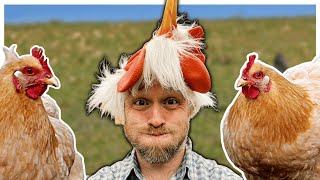
In this farm‑vlog, the creator walks viewers through the process of moving a flock of unusually heavy hens from a greenhouse into a pasture that lies behind the farm’s cows and sheep. The video explains the rationale behind the rotational grazing system—cows get first access to fresh pasture, followed by sheep, and then chickens a few days later to consume fly larvae in cow manure and spread the manure, improving grass for the cows. The host describes the challenges of keeping large chickens confined in a small‑scale operation and details the solutions: wing‑clipping, training the birds in a heavy‑wire poultry net, and experimenting with sheep‑netting that the fattest hens can’t easily slip through. Breed information is shared, listing Sussex, Red Star, Black Star, Australorp, and Partridge Rock hens ranging from 6 to 7.5 lb. The vlog also captures incidental observations such as egg finds, chick hatching, and the overall health of the livestock, highlighting the success of the integrated system.
Chapters
Today is the day the chickens are getting out of the greenhouse and into the pasture. Okay, we got a bunch of fat hens in there, but not everybody's in there, so I've come out here at night to get people in their coop. Hopefully if I grab One or two of those, they all don't leave the roost.
I think I got 3 of 5.
I caught 2 chickens, one in each hand at night. I think that makes me the apron-wearing permaculture chicken ninja master. They're up.
Let's get them out in the morning.
I got myself the fattest chickens on the internet. Basically, my cows are the centerpiece of my farm, so they get first priority of the pasture. They move every day to new ground, and then we follow them with the sheep. And behind the sheep, I want to follow chickens. If you follow the cows 2 to 3 days behind with chicken, they go to their manure because a fly larva has been laid. The chickens naturally spread that manure, which fertilizes, making the grass better for the cows. And they eat that fly larva that's inside that manure.
Oh my gosh.
So the chickens have improved the pasture for the cows, and the chickens have gotten free food. How you guys doing in there? You got plenty of room, you fat birds? The only problem on a small homestead, it's hard to keep the chickens in place behind the cows. There is 300-400 pounds of chicken in there. The secret is all the weight is on these back wheels right in the middle. It worked good, Beck. I didn't know how it would go for sure. Part of our taming program— I'll talk about that in a minute— we're gonna have to clip wings. Let's get one at a time. You're free! Happiest day of your year. I want to go to be with my friends. We had this spent hay and they're already spreading it. Look at that, look at that! I love these fat birds. The problem with being on a small stead and just free-ranging them behind the cows is they won't stay there. You know where they'll go? They'll go right over to that tree every time. I don't care if they're supposed to be way out there. They're going to come to that tree every time. All the fertilizer goes under that tree. I don't need it under that tree. And if they're under that tree, they're not out in the pasture scratching manure and eating fly larvae. We've used poultry nets like this in the past, but these have a lot of woven wire and they're heavy and clunky and hard to set up over the entire area the cows were. The good thing about this wire is chickens have a hard time getting through it, and so we're training these fat birds in it now for a few days. At first we had a cow fence for the cows, we had sheep for the sheep, and then we had our chicken fence. They like to eat that grass, don't they? What are you expecting, some babies back? I am. We got the mama pigs in the pole barn the other day. She's expecting anytime. And it's going to be much cooler than that greenhouse. So eventually I came to the thought of what if we put everybody in a sheep net? The cows will definitely stay in it, the sheep will. Will the chickens? The thing about sheep netting is a normal chicken can fit right through it because it's big webbing. But what if I got the fattest hens possible and they had a harder time getting through? That might just work. Well, we've clipped their wings, we're— we've got them a tight net to train them on. We're doing all the right things to hopefully get them on this pasture behind the cows in a sheep net. How much longer, Pound Cake? Ah, look at that underline. Been swollen.
Eggs! 2 eggs! I found 2 eggs in there, Papa. Nice.
We got the cows and sheep on alfalfa. Got Winnie in there on some of her feed. Lamb bones! Goose egg and kibble. Look at how well these guys have cleared in here. Good timing, cuz tomorrow they go out. It's dirty.
My God.
And they're on him. I'm thinking I'm pretty lucky right now. They pushed all this soil onto this net and haven't busted through it. What's going on? I hear chirping. You remember Gideon set his first eggs and he's got chicks. How many you got?
2.
Look at that, proud mama, proud papa.
Good job.
Rebecca gave me the numbers for the fat hens. We have a weight range from the Sussex to the Red Stars Black Stars at 6 pounds, to the medium weight at Australorp at 6.8 pounds, and the giant Partridge Rock at 7.5 pounds.