In this informal, family‑focused vlog filmed on Father’s Day, the narrator (the father) celebrates with his children Kayla, Beck, and Jonah before heading to a neighboring farm to visit the original Jersey cow, Apple, that the family once owned, and her offspring Bellflower. The family receives homemade cards and a playful "dollar‑bill" song, then tours the farm’s endangered‑livestock herd, meeting a Bulgarian Karakachan guard dog, an Irish Kerry cow, and a herd of American Milking Devon cows. The narrator explains each breed’s historical background, conservation status, and practical uses—such as milk yield, butterfat content, and suitability for grass‑only feeding. He also recounts a brief history of breed standards introduced by Robert Bakewell. After locating Apple, Bellflower, and Bellflower’s new calf, the family reflects on the success of their visit and previews the next day’s trip to Spiral Ridge Permaculture in Tennessee. The vlog blends affectionate family interaction, educational commentary on heritage breeds, and a celebration of sustainable farming practices.
Chapters
I don't think I'll be able to see Apple in all that. Good morning! Today is Father's Day. We have a special surprise today. Was not planned on the tour, but where we are staying at Whistlepick Hollow, pretty much next door is a lady who bought one of our original cows. Originally we bought 2 milking cows. That became, we didn't need 2 milking cows so we ended up selling one. Her name was Apple. And Apple had a baby called Bellflower. And she lives just right up the street and we're gonna get to go see her. But before we do that, they've got some gifts for me for Father's Day. You got me a card?
Yeah.
Thank you very much. I see you already opened it a little bit.
From Oliver.
Wow. I sprouted from seeds. Ooh. And grew something perfect.
I sprouted from your seed.
Hey. I sprouted from your seed and grew something perfect. Aww. Yay gardening! Am I a gardener? Did I garden you guys? Did I plant y'all seed? Decorations. Money, money, money.
$10.
Thank you. Happy Father's Day. R. What's the R stand for?
Road.
Oh, big money, big money, big money. $20 bills. Dollar bills, y'all. Dollar bills.
Dollar bills.
We need the dollar bill dance. Dollar bills. How's the dollar bill dance go, Mom? Come on, how's the dollar bill song go?
Dollar.
Dollar bill.
Dollar, dollar, dollar.
Dollar bill.
Dear Father's Day, thank you for— Dear Father's Day. Thank you for taking me on this great bus trip. You're the best dad ever.
I'm glad I made your day.
Thank you for making money. You're welcome. Thank you for making this bus—
Dollar bill.
Hey, hey, hey. Thank you for making this bus and finding out who could do it. You are welcome, Josiah.
Dollar bill.
You're welcome. I'm gonna give a— He's still stuck on the dollar bills. We're gonna give a big group hug after this is over, okay?
Oh, big hug!
Alright, Jonah. Happy Father's Day. Oh my gosh. $9. I'm rolling in the dough. Hope you're having a good Father's Day. I thank you for taking me on this bus trip. I love you. You are the best pop in the whole wide world. Aww.
Here's Mama's.
Here's the Mama. Here's the Mama. Ooh. Ooh. How'd you do that? I put lipstick on. You don't even wear lipstick.
But she put it on.
To make a special card. Not only have you proven that you can make an actual human, but it turns out you're also really good at helping one grow and learn stuff and become even better human every day. Aw, that's sweet. I love you, Papa. You are the best in the whole world. I would not be so awesome without you.
This, Papa, is from everyone.
You guys remember this? I've already been using it. Chop up the coconut coir for our compost toilet. I'm gonna chop firewood to make kindling. This is a man's gift right here.
Happy Father's Day!
All right, everybody, group hug, group hug! Oh, oh, thanks! Oh yes, I love you guys! Put around here. Look at this. Okay, y'all stay right there. Check it out, we are at the place! Y'all remember Willow, right? Work is before you. Go ahead and trim it down for the chickens so they could come in and till. And get us a garden ready. Thank you very much, Willow. Our family cow—
when, when—
well, when we bought her, we also bought a cow named Apple. Well, it turned out we didn't need two milkers, and now we're at the new owner's place and we're gonna get to see her and her baby. You still got Bellflower? Still got Bellflower. Has there been any more offspring? Apple has had two more. Oh my gosh, and they're all here. Okay, let's go see them. Everybody sit down. You guys are going to be excited to ride this big old ATV. This is our host, everyone. Kayla. Hi.
So, so you can grow black tea leaves here.
Crugs in your feet.
It's good for their joints.
This is a Bulgarian Karakachan. Did I get that right, Kayla?
Yes, that's right.
This is a special guard dog all the way from— you can guess it— Bulgaria. All of her animals here are on the endangered, critically endangered livestock list, except for our Jersey cow. You're here for that cream. Hey buddy. Kayla says these dogs don't bark as much as the white Pyrenees, and they're more people-friendly, and they're smarter. What do you think, guys? Would you like a Bulgarian? Yeah, a Bulgarian Karakachan. This is an Irish Kerry black cow. Tell them the story, Beck.
Well, they're supposed to have horns, but this one had been dehorned by her previous owner. But these are the cows that started Kerrygold butter.
So they're not Kerrygolds anymore, but no, they don't, they don't milk Kerrygolds anymore.
But that's how that's right.
Kerrys and the Devons are alike. In that they'll give you a lot of milk on grass alone. No, no grain. So Kerry, they'll give you a little bit less than a Devon. The Milking Devons are the only American triple-purpose breed.
Thing about the American Milking Devon is they're trap purpose, they work, they're good for milk, they're good for meat. The Kerry, she's saying, more naturally separate the cream from the—
the cream separates out of the milk easily and faster, so they're better for cream and butter and cheese, and higher butterfat content than the Devon.
Yep. The American Milking Devon are more— is more homogenized, so it's a better drinking milk or yogurt milk. Yeah, right. Yeah, we used to make a yogurt with a lot of ours.
We would get like a half of a gallon.
Yeah, we didn't get much cream, that much cream from our—
from—
oh, you get more from— they have, yeah, higher butterfat content, and they produce their milk on grass only.
And it doesn't have to be that great of a grass either. Yeah, yeah, they can do well on more forages and poor grasses. And help him up, help him up! Let's go, let's go on and see Apple. Bellflower, what's so special about these sheep?
So these sheep, uh, are— were the original animal, the original livestock breed to ever have a breed standard. An Englishman named Robert Bakewell, uh, originally got the brilliant idea that instead of eating their fattest animal in the winter and saving their skinniest one that took the least feed, they would save the one that was really nice and big and breed that one and eat the one that was measly. And so that idea essentially led to a breed standard.
My goodness, look at these big horses! Holy moly! That guy's over 6 feet tall at the shoulder.
She's a girl.
It's a she. They look kind of magical.
They do.
That one looks kind of magical. I'm looking for the horn. I'm looking for the unicorn horn. Where's your horn? Behind that shed is a fella named Bonham. That's one of Willa's offspring. No apples.
Oh, is Bonham on the left?
No, no, Bonham is the smaller. He's a little bit younger though, so don't hold it against stem.
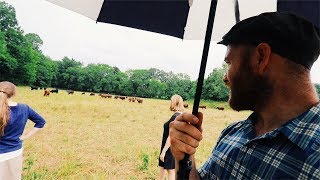
No, no, you American Milk and Devons, you're something special. We've seen these cows on the front end, still waiting to see Apple and her and Bellflower. They're apparently in the very back, backing it up. We were almost to see Apple and Baby. We saw this storm brewing and we said, oh, we left the van windows down, so we gotta go roll them up and then hopefully we can see Apple. All right, got the windows up. Let's go, guys, before this rain hits. It's starting to sprinkle, guys. Let me get the umbrella. Always be prepared. Filming this ride, but I think it's gonna get too wet for this camera, so I'll get in under my body here. We're there! Oh my gosh, look at that herd of American Milking Devons! Do you see the size of that herd? What are you doing with all these?
Our main purpose is to breed breeding stock for other farms, and then our secondary purpose is to breed them for meat. So the ones that are not breed standard, we will sell for meat. The Carys is strictly Basically more for like a conservation because there's like less than 50 or so in the whole country.
Have you found Apple yet?
She'll have a name tag with her name in her ear. There's Apple right there.
Oh my gosh, she's right in front of us, guys. Don't scare her off. Hey there, Apple. Do you remember us? She's not so sure. You're in good hands here. She's got a number 1 tag. That's because she's the best.
Number 1. She was our first, uh, first cow, so she's number 1.
Apple's got a new calf behind her. Fiji. Good name, good name. Now all we got to do is find Bellflower. Kayla found Bellflower. She's out here straggling. How you doing, honey? Oh look, and Bellflower has a calf. Good job, Bellflower. Good job, Apple. Good job, Willow. That's Willow's great-granddaughter. We've accomplished our goal. We found Apple, Bellflower, and we got a surprise. Bellflower had a calf. Thank you, Kayla, for showing all this. I like what you're doing. It's beautiful to see such a Beautiful breed. So many all together on grass too, guys. Closing out today's vlog. Tomorrow, Spiral Ridge Permaculture in Tennessee, a whole institute. Tennessee is jammed full of all kinds of farm goodness. Tomorrow we're going to tap into yet another piece of it.