Infertile Family Cow :( Our Plan
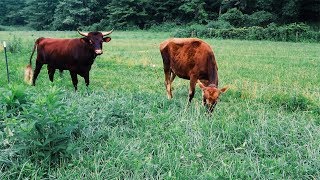
This content was created by Victor Justin Rhodes. This content was uploaded by Victor Justin Rhodes. This is a YouTube video titled "Infertile Family Cow :( Our Plan" (created 2018-07-17) containing an informal, multi-speaker farm/family discussion. Multiple speakers (labeled SPEAKER A / B / C, plus Johnna and others) converse about homestead topics: tending poultry (feeding logistics, a movable "Chickshaw" coop, feed storage and bulk-buy tradeoffs), and the health and fertility plan for a cow named Violet (breeding options with a bull called "Stud Muffin", deworming and home-remedy ideas such as Basic H soap, diatomaceous earth, beet pulp, copra meal, mineral supplementation, and budget/management considerations). The tone is conversational and diarized, focused on practical herd and poultry management on a small farm.
Chapters
out there? Yes.
Okay, Papa, you have to fill up the corn as crock water.
Okay, I will.
You have to. They're bone dry when you don't.
Okay, watch the intensity.
You've been doing it and it's not been filled up.
Okay, well, I thought you were gonna come fill it, I guess.
No, if you're doing them, you're gonna have to fill it. I'm gonna do the asses and the chickens and the Guinea pigs.
Okay, well, I better watch it so the boss man don't get me.
We'll clean them out.
Clean them out.
Sometimes people want to know where I get my feed. We get our feed from a company called New Country Organics. If you order a bunch, you get a discount because, you know, or Compared to conventional or even non-GMO, organics can— are more pricey, but you do get what you pay for. And one way to knock down the price a little bit is buy in bulk. If you buy 40 bags, you get a discount. Even with the heavy shipping price, I think I'm able to knock off— I think it was like $8 or $9, something like that. Good morning, how are y'all? We're gonna get you out of here soon. We're gonna get you free. We gotta build a Chickshaw mini-me. The Chickshaw 2.0 is 6 foot by 6 foot for a lot of chickens. It's for moving around in the yard. I'm gonna build a mini-me, 4 foot by like 4 foot wide, that I can just move anywhere on this property behind the cows. We're going wild and woolly train.
Here's the thing though, you got to keep in mind when ordering in bulk.
If you're getting ground feeds, pre-mixed feeds like starter or grower or even layer that's already been combined for you, not whole grains, don't buy more than 3 months worth because it starts losing its nutrients after 3 months. If you buy whole grains, you can store that forever-ish.
Yesterday I showed you how this was—
this metal pan was rusting. That's unfortunate. What's going to happen is they're going to get iron. They probably don't need that much iron, and if they're going to get the iron we're gonna get it and we don't need it that much. So I tried putting it on the ground and I wanted to see if they were gonna tear it up. Okay, I can't even see where I did it. I mean, they scratched a little heavy right there, but that's not where I put the feed. So I'm very happy and they cleaned it up. I can't— I cannot find any leftover grain. Can you guys? No leftover grain. So That's good news. That makes the system even more simple.
So you're gonna follow me.
You gotta be careful not to step on somebody. Let me move your shade. So good clean ground for their feed. Is that your buddy? Hey, that's a she. We gotta, um, maybe we'll move their poultry pen up. Hey, we gotta name that girl. Poor thing hasn't even got a name yet. What'd you say?
Waddler.
Waddler?
Because when I let her go, she waddled like crazy.
Uh, maybe Waddle. I can already see a couple problems with this, maybe 3 problems. Because I don't have a trough— look, if I had a trough, I could have it over here and be filling it up and then move it. I'm having to take one scoop at a time and putting it over here. That's the other thing, that's another problem I'm seeing. Because I had to scoop it out one at a time The big guys are gonna get it and they're rushing it and they're not giving others much of a chance. If I had it in troughs, I could put it all down at once. I see a crow. I heard a crow. Can you guys see it? Can you guys see that crow? Hear it? I know you heard it right there somewhere. Yeah, the scarecrow only goes so far. I've seen crows come in here and eat this feed, and I think When we had the crow problem the first time, they didn't realize there was grain here. And now I've seen them come sit on the shawl, sit outside the shawl during the heat of the day while the chickens are underneath there and eat the grain. I think they like the grain more than they like the chickens. So that'd be another problem. I can't put— well, I guess I could. I could put the feed down and then roll this over it, but then they'd be wallowing in it. Not looking for it. So a feed trough would get it off the ground underneath, but I don't know how much of a problem that is because they can eat the feed even if it's wet. Probably makes it even more efficient because it captures the dust, the feed dust, and makes it more solid and edible. Holy smokes, they've just about ate every bit of that. They hit a point, uh, right around 4 or 5 weeks, they start eating like monsters. That's gonna be another problem. You could fit a lot more food in a smaller space with a trough. I just dished out 50 pounds of food and they'll probably be done with it by the end of the day. Violet, we got a plan for you, honey. We're coming up with a plan for you. You too, stud muffin. Hey, did you guys stay here? Did you catch any rats while we were gone? Huh? Did you catch rats while we were gone? I like cats more than I thought I would. Hmm.
Hey, get off the table, you dork. Come on. About Violet, right? You ready to talk about Violet?
Yeah.
Our plan. We want a plan.
Yes.
When you have a plan, you have a goal. When you have a goal and then you have a plan to meet that goal, it makes things easier. Yes. So after lots and lots of thinking, I think we can think better from the angle of Stud Muffin.
Here comes—
Stud Muffin was here to breed her back if she she were to come in heat, she would get bred back, and then we're going to harvest him. Well, if she doesn't come in heat, we've got to harvest him by a certain point, right? I would say by the time the grass stops growing, towards the end of September, early October, wouldn't you say?
Yes.
Like cars, the car you have is your—
is the cheapest car, right?
The best car, right? Violet's calm. She's A2A2. We don't need a harvester. We don't need the meat. We're gonna have plenty of meat with Stud Muffin. So if our goal on this farm is to have a cow for milk that is relatively low maintenance, I think we're low maintenance cow people. There are people who enjoy this and try to work through that process and go for it, but I don't think we're those people.
Well, I just think that maybe a Jersey is more high maintenance than We're looking for— oh boy, so Mr. Brown's joined us.
You wake up from your nap, buddy?
Oh, I think that we— well, we had American Milking Devons before. They're very hardy. They're heritage. We don't get as much milk. So I think that our goal now is maybe to have more heritage breed cows. They will be overall less maintenance. Obviously, they still have— you will still have things that we do with them. Oh yeah, but like, you know, just this with the understanding that we'll have—
they don't give us much. I mean, yeah, she's doing— we're getting a gallon a day. That's a lot of milk. Yeah, so we're gonna— with the understanding we're gonna have to get more cows, and it might be a blessing if we end up going with a smaller breed and Dexter's, and it's something like the kids can handle, right? If Stud Muffin goes away and has to go away by early October, she's going to be bred or she's not, right? And if Jerseys are not going to be in our long-term plan, right, we're going to need to sell her.
Correct.
I think it would be great and a better victory if we were able to mend her, you know, get her bred back.
Wouldn't that be amazing? That would be great.
Now, if she doesn't, we still sell her as she is. Yeah, no holding back.
She's not a bad cow.
Uh, So to try to mender, we've had some great comments from some— from— for some ideas. Somebody reminded me of Basic H, and Joel Salatin loves it. He puts in 1 cup of Basic H per 100 gallons for a dewormer. He had a wormy cow that he could not heal no matter what they did— veterinary recommendations, everything. They put it on Shaklee Basic H, which is soy-based soap that's completely edible, cured that cow within a week. And from what I see, that can happen within a week. So we'll know. Basic H soap, 100 gallons of water.
I'm stirring it in to make sure it goes not too concentrated.
Yeah, we can do— we can do the soap. We keep on doing alfalfa. We'll put a little DE on that, which is also a dewormer. So we're thinking let's try deworming. That's what this is, the soap. Yeah. And, uh, the, the DE.
This is the dewormer that you and I are comfortable with. There's other dewormers out there that we've looked into. There's Molly's Herbal Dewormers, um, which is another option that we can look at if we feel like—
here's the thing about Molly's, I'm sure Molly's is great, but how much money are we going to spend on this cow, right? And we've spent a lot of money already. We have DE, we have Basic H Soap. The other thing we might do because we have it or need it is like, we don't have a juicer, right? But we could use a juicer for our health. Yeah, is a beet pulp— poultes?
Beet pulp.
Beet pulp, which is somebody from the community homesteady recommended that they'd done it with one of their sickly cows in the past and it worked. Okay, so I might try like, let's just give her a beet. Let's give her a beet from the garden to see if we think she would even eat that.
Yeah, we're gonna, I guess Most beet pulp is GMO because they, they get the sugar out of the beets and then they have the pulp left over, and then that's what they're feeding to the animals. So because obviously we're not going to feed GMOs to our cow, we're not going to go the traditional beet pulp route, and we will look at feeding her— growing— we, if we're going to do this, we would grow our own beets for her to eat, then we wouldn't buy beet pulp. So we're looking into that whole process of what that looks like and how one would grow their own beets and then either shred the beets and then feed that, or if we would juice the beets and use the pulp. I don't know, we haven't really figured that out yet. That's something that's kind of like on our radar. There's also the copra meal, which is coconuts. Someone suggested coconut. Someone suggested that and you can buy it. It's just out of stock right now.
But even then, that's like $80 a bag.
Yeah, it's a lot of money. Um, yeah.
And to not be sure that one, she—
will she eat it?
Right.
And will it help?
And to get it, you have to get like a 66-pound bag. Like, they don't give you like 5-pound samplers.
Right.
Yeah, we bought the fescue balancer stuff, that mineral. If we knew it was gonna help her, we would spend the money.
If there was a $1,500 guaranteed solution, of course, because that's cheaper than going out and getting another cat.
Yeah, and finding a new cat. The problem is, is when you just start spending money left and right.
Yeah.
On maybe— maybes, and then that's like, and then you have all these bags left over. You know, downstairs. Like, there was a copper— like, there, um, yeah, it's just, you just get to a point where you're like, the madness has to end. And Violet's not dying. Like, she's not suffering. She's not in bad— like, she's fine.
She's not even sick.
We want her to be in better condition, and that's what we're working towards.
She's not getting heat.
Yeah, like, she's, she's not coming back into heat. So that's, you know, But I'm wondering though if this is all just Jersey mentality, like—
It's an attitude.
Well, just Jerseys because like, Willow, 3 weeks she was back in the heat. Like, maybe this is just like the—
and I did read it can take like 90 to 120 days.
So has it even been 120 days?
Oh wow.
For a first time effort.
She had her, what, March 8th?
March 8th.
So let's say it's July, just let's say July, or you know, April, May, June, July, so it has been 120 days.
Okay.
A little more.
So yeah, I mean— Hello, no.
Yeah. But I feel like her milk's increasing, so maybe she's like— Yeah.
And maybe it's—
Maybe she's coming around. It took her a while.
Well, or maybe it's the fescue toxicity and now that the seed heads, now that the grass is not, because first when this when the grass came up and they were all seed heads.
Yeah.
And that's where the toxic fungi, bacteria, whatever it is, that's in the seed head. But now that we've mowed all that down and they're just eating the blades for the grass, maybe that's starting to restore her health. I have no idea.
Remember the other day when she— we noticed the iodine, that's getting eaten.
Yeah.
And we looked up in the Homeopathy for the Herd, that book.
Homeopathy for the Herd, yes.
Iodine, and the symptoms of them needing iodine are rough coats and not coming in heat. So she is healing herself with the minerals by eating the iodine. It's just gonna take time.
Yeah, and she didn't get this way overnight. Yeah, that's all that— I feel like that's all this is. Oh, is Laurel joining us?
Yeah, she can join us. She's bothering me down there. Join. Don't you lick me. I've seen where you've licked. I've seen you lick a cow patty. You really went to town on that cow patty. Give Mama a kiss.
Don't lick me.
Give Mama a kiss with that cow patty tongue.
I'll just pet you. I don't want the cow patty tongue.
She's taking this though.
You got no complaints, huh?
Is this what you wanted? Is this what you wanted?
There's some rice in the fridge.
Can I have it?
Some what?
Rice. Ow!
Rice? Hey, don't bite.
Yeah, it's rice.
All right, we gotta make mom's supper.
Yes, Johnna, hold that.
Thank you.
More from Justin






If I had to start my Homestead all over again, it could only pick one animal… 




