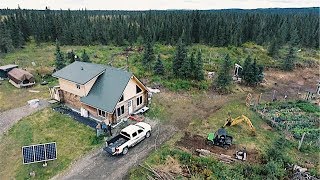
The video follows a group of vloggers as they travel by commuter plane to Homer, Alaska, to tour an off‑grid homestead and the nearby Anchor Point Greenhouses. The hosts meet local residents Al Poindexter and the Rudolph family, who explain how they live without connection to the public power grid, relying on three 250‑watt solar panels and a dual‑fuel wood boiler for electricity, heating, and water circulation. The homestead includes a chicken coop, a fenced garden, and a root cellar. The tour then moves to the Anchor Point Greenhouses, where the family produces a variety of vegetables (tomatoes, cucumbers, squash, peas, beans, corn, potatoes, berries) and specialty crops such as rhodiola rosea and peonies. They describe their potting‑soil business, which blends fish and seaweed compost with native peat to create two branded products—Alaska Earth and Fishy Peat—that are shipped statewide from Nome to Kodiak. The hosts discuss community dynamics, noting that about 15 families live scattered in the area and that neighbors rely on each other for snow removal and emergencies. The video concludes with reflections on the challenges of off‑grid living, plans for future greenhouse expansions, and a brief travel narrative back to the westernmost drivable point in the United States.
Chapters
Here we are at the off-grid homestead in Alaska.
Here's our host for today. Bye everyone! Bye-bye! See you later!
Bye, see you later!
Bye-bye!
Oh, another hug, another hug! Oh, and a kiss, and a kiss! Oh, double hug, double hug!
Here we go, here we go!
Let me get down here and hug you guys. Oh, he's safe.
Yep.
Have fun.
Yes.
Today Big Daddy and I gonna catch a commuter plane going to Homer to an off-grid homestead. Grandma's giving us a ride to the airport.
Come on back.
Thank you.
All right, on our way to the airport.
What's it say the temperature is?
48.
Oh, good thing I did bring my jacket.
Yeah, I think that most of the people that live in Alaska live in the 4 big cities.
Yeah, what I heard. Bye-bye.
Bye.
For the trip to the airport.
We will.
Oh yeah, we will. Now to find our airline. See you guys. There it is, Bruce, right there.
Hello?
It's all the way at the end.
Yeah, we're there. We're going through the line. Hey, thanks. We're heading to Homer.
Did you find our gate?
Yeah, 14.
Okay, is that our plane?
Probably a little early.
At this time, I'd like to begin general boarding for even Alaska Flight 874. For service to Homer, out of gate A16, please Please have your photo IDs and boarding passes out and available for me, and we thank you for flying with Raven today.
Ladies and gentlemen, again, good morning. Welcome aboard Raven Flight 874 with service to Homer. Flight time this morning will be approximately 35 minutes, give or take. My name is Kim and I'll be your flight attendant.
Ladies and gentlemen, I love you there first.
Watch me too.
Beautiful Homer.
Hi, Justin. Hey, nice to meet you guys.
An unmaintained gravel road. The only ones that maintain it are the people that live here.
So how many people live here?
There's got to be— I think we just got 2 more families moved in this year. There's got to be close to 15 families back here. All scattered throughout.
You all get along with each other? Yeah.
Yeah.
Is there a camaraderie in Alaska?
Yes. Because your life may depend on your neighbor. At some point.
Now Doug, I don't see any power lines.
You'll see power lines over there.
Oh, okay. Those are the closest ones?
That's it.
So all these neighbors, they're off-grid too?
Or not? Most of them are.
Why aren't you hooked up to the grid?
Because we didn't want the grid. We wanted that opportunity when we wanted to live. We wanted to live in the wilderness. As bad as wilderness as, you know, we're willing to get. But you know, at our age, because you know, if I was your age, I'd be back further off-grid. We don't lose power when there's storms, and during the summer we'll hardly ever have to run the generator.
Okay.
You know, we have sun like 20 hours a day or something.
Hey Doug, does everybody have a snowplow?
Everybody. If you want to get out And, uh, okay, snow machine, some type of four-wheeler. We have a side-by-side, but yeah, I've even used that tractor right there one winter to move snow.
Here we are at the off-grid homestead in Alaska.
Here's our host for today. Tell everybody what's your names.
I'm Doug Rudolph.
I'm Catherine Rudolph.
Okay, let's see this place. I think there's no better place to start than these solar panels right behind you. So let's start there and just give us a quick tour of the place.
These are 3 250-watt solar panels. They run the entire house. We do have an electric refrigerator. We have a small freezer. It does our computers. We have a television. This central wood boiler is, as far as I know, it's the only one that's dual fuel. So on the other side This is the control panel. In here is our pump. This is both temperature of top and water and bottom of the water. This unit is big enough to run two of those. So we were thinking maybe if we got greenhouses, we may heat the greenhouse with it, or if I build a shop. This is where we give the meat chickens their baths and help them change their feathers. Throne room of Alaska.
Is this a good enough fence to keep the moose out?
So far we haven't had— people say they can jump it.
Oh wow. Do you hunt the moose?
I haven't hunted.
Okay. Beautiful garden, beautiful garden. Where's your 81-pound cabbage?
Uh, it's at the greenhouse.
Oh, okay.
He's got them up there.
We have a broody pen in there.
Oh really?
Yeah, she just started laying.
How do you break her?
How do you break her?
Okay, well, after, after everybody's laid there, you have her in a bear cage. That should do it for 3 days. 3 days, no nesting material, right? Just food and water. That should do it. Okay, come on now.
Why are you going broody this late in the year?
Yeah, that'll work.
That's perfect. And then the way you tell she's not broody anymore is you go up to her and see if she puffs up. Yeah, pecks or puffs. Becks or puffs? Hey, Big Daddy, as a building, uh, as a professional builder, what do you think of that off-grid house? What's your impression?
I think it's, uh, very adequate. It's, uh, it looks good to me, and, uh, I think it'll be there for a long time.
So you're telling me it passes the Big Daddy test, huh? Passes the Big Daddy test?
Yeah.
Okay. Hey, they've been living in it for 7 years. Okay, the proof's in the pudding. And she's not complaining.
No.
Timeout right there. I was editing the vlog. I could only give you a tip of the iceberg of that off-grid homestead. I'm gonna do a special movie. You want to come in and see this? Okay, come on in with me, buddy. I'm gonna do a special movie just about that, the off-grid homestead in Alaska. It's gonna be free to everyone. It's gonna be on the YouTube channel. Give me about 2 days. And we'll put that up. That'll be our video for the day in a couple of days. It's really good, guys. We get into more of the power systems and the chickens and the gardens and more of the story of why they're here and what do they struggle with and what would they do different, all that kind of stuff. So stay tuned for that. Just give me a couple of days, it'll be up. All right, back to the show. Stop number 2.
This is where Kathy works and Anchor Point Greenhouses.
This is Anchor Point, Alaska, and we're at the Anchor Point Greenhouse, and this is where Al Poindexter has his garden where we plant—
this is a 3/4-acre garden here. We lay down IRT, put the plants in it, and then cover it with Green A. That gives a higher temperature protected environment. In the middle of July, we take the ream off and then they grow up like that. We moved here in 1962 from Seward off of a 17,000-chicken chicken farm. We tried growing, raising cattle, and that didn't work. And then 1976, my brothers and I built my dad a greenhouse because his health was failing and he needed something to do. Then he passed away and then left it with my mom, and I quit teaching to help her, and we've been growing this place ever since. This is rhodiola starts. We, uh, start an herb called Rhodiola rosea We— they sit here for 18 months, and then after 18 months, we take them out of these trays and put them in the field. So let's go from there. Originally, my dad tried growing tomatoes, couldn't sell them. Tried growing plants, selling plants, that didn't work. So he decided to just start selling his potting soil. It took off and people started buying it. So originally, we were just making potting soil. This is one of them. Tomatoes and cucumbers. We're producing about 300 pounds of tomatoes and about 300 pounds of cucumbers every week. I came out to help my mom with the potting soil business, and then we decided that we should grow a few plants to make sure we were doing a good job with the potting soil, and people wanted to start buying plants, so we started growing plants. This was beans and peas. We just finished cleaning this out. Squash over there. I got a few peacocks just to keep, uh, customers entertained. This is an experimental house. This year we're trying different varieties of tomatoes and cucumbers to see what does the best.
We're moving, aren't we? Yeah.
So this is another tomato and cucumber house. Next year we're actually going to be growing only tomatoes in the house and only cucumbers in the house. It'll be easier to control nutrients that way. Down over the hill is a peony patch. We do grow and try to sell peony flowers. Cut flowers. So this is one of the patches. This is a root cellar. We just built this last year, and this is where we will stage all of our produce before it goes to market. Stays at about 40 degrees in here. Those white totes are full of rhodiola that we just harvested. This is what a rhodiola crown looks like. We wash this up and then we run it through a slicer, and then and then we dehydrate it. That's the slicer. You wanted to pass through it, right?
Yeah, that's good.
This is the washer for rhodiola, and that would be available to wash other products too if we decided to do that.
Who are your main customers?
We have local people that come in here to buy produce. We have lots of people that come in all the way from Anchorage to Homer buys all of our plant starts and all of our amendments and our potting soil. Potting soil is wholesaled all the way along the road system, all the way from Fairbanks and Nome down to Homer, to actually down to Kodiak. So that our potting soil goes statewide. We had a crop of lettuce and arugula and a bunch of other stuff, basil, in here. And then all of that left, and then we replanted with squash. And so we're finishing up the season with squash. We got a little bit of corn, that's just a novel thing. We grew a bunch of turnips in here.
Can you grow anything during the winter?
No. And this is, uh, this is almost finished up too. This is a garden spot. Next spot over is rhodiola. I peonies. So this is a big patch of peonies. Actually, I've got one bloom out there, a couple blooms.
What is peonies?
Peonies is a big robust flower that's used primarily in weddings, but it's pretty big demand worldwide. And we— our flowers bloom after all the other peonies in the world bloom, so We fill in a market when there's no other peony blooms from Alaska. So that's what we're doing there. Next patch is all potatoes. Inside the fence is all berries. There you go.
That concludes our tour.
The 1.5-hour tour condensed down to 7.5 minutes.
This guy's a whirlwind. His nickname's Tornado.
If I'd have known we were going to be filmed, I would have cleaned up. But this is our head shed. This is where we do all of our transplanting before it goes to the retail section. All of our labels are there. We store dry peat so that I have dry material to work with starting in January. This is fish and seaweed compost. Seaweed we pick up off the beach, fish that we use, and we compost right there on that raised floor. And then that's blended with— that's blended with native peat. This is shredded native peat, and that makes our potting soil.
How good is that potting soil, Kathy?
Wonderful. It grows the veggies like crazy.
It goes through that blender, it all gets blended there into the conveyor. This is a bagger, it's timed, fills the bag, then goes on the conveyor belt and gets sealed and onto a pallet. So this is a palletized Alaska Earth, one type of potting soil we make, and a pallet of Fishy Peat, different type that we make.
Where do you ship this to?
Well, it's all along the road system. Of all the way from actually Nome, Fairbanks, and south to Kodiak.
Okay, thank you.
Anything else?
Thank you, it's beautiful.
You want to see anything?
Good job.
Any questions?
Should I see anything else?
Covered everything that was about—
Okay, we'll see you. Thank you, thank you, thank you. All right, let's head back, going back to the airport. We had to do this, guys.
Did you know this is the westernmost point you can drive in the US?
Here we are, as far west as we can drive. Ain't no more roads. Absolutely beautiful. Incredible. Time to go.