Joel Salatin Solves My RAT Problem
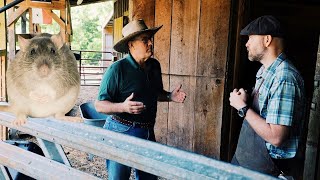
Joel Salatin helps solve a rat problem that killed 2-day-old chicks. He recommends rat-proof brooders with quarter-inch hardware cloth and concrete floors, elevated structures, a mowed DMZ to expose rats to cats, and sealed feed containers like IBC totes. Disrupting rat habitats works better than poisoning.
Chapters
You hear that water running? Yeah, this is my Everflow waterer. Oh, that water is coming from the pond that's creek-fed. Okay, so this is about the 10th of the flow of the water that's going through that pond. Uh-huh, uh-huh. But in the winter, I was wondering, well, how do you keep— how does nature keep water?
Just keep it running, keep it running.
So we built that for the winter. Uh-huh. But it also works great in the summer because it's always cool and it's always clean.
Yeah, uh-huh. I love it.
You ever seen anything like that?
I love it. That's great.
This is your Polyface Design water. Yeah, yeah. Uh-huh, uh-huh. But it just comes in right there.
Yep, yep.
We adjust that. Yeah, you just, just flow it down according to the siphon we can get, right? But it's been working. We have no water chores.
Wow, that's fantastic.
There's a little filter in there. It's just a little shower filter. This is all stuff you can get at Lowe's.
Sure, sure.
There's a filter in there, so if they were to get— but it's, it's on this so that the wood chips don't get right on there, right?
Right. That whole thing is to get it up out of the— you know, chickens, chickens love to reach for water. Yeah, they really do. They like to reach for water. So, you know, so that works out. Yeah, that works out beautifully.
It was good for, uh, ducks too because they're so messy with water.
Good.
I feel good this morning. I did crash hard yesterday. Rebecca's interview. Okay, so hopefully I'm gonna get an ibuprofen in before that happens. We had 2-day-old— 100 2-day-old sea monsters, uh, Cornish cross. And we came out— my son Josiah came out here, opened the door, all 100 are dead, and there's a rat nibbling on them.
So, and he didn't get the rat? No, I mean, the rat was there, right? But the rat got away.
You know, we didn't catch— we didn't catch the rat. Now some say, well, that wasn't the rat that killed them, it was a weasel, and the rat took advantage. Or it could have been a rat. He said it was a big rat. We've shown him pictures of weasel. It wasn't a weasel, but we realized it could have came after. But I just wanted to get your insight on that as far as—
it was a rat.
Okay, a rat will kill 100 chicks.
Been there, done that. More than once.
Okay, more than once. How did you stop it? I bet you didn't kill a rat. You did environmental manipulation.
The worst that we ever had, I couldn't get the— I couldn't catch him. Okay. And I brought a cot out. That doesn't work. I brought a cot out and slept with the chicks with a baseball bat.
Okay.
For a week until they went out in the field.
And you never caught him even in that?
Never caught him even in that.
He just knew you were there.
He knew I was there and he knew I was gunning for him. Okay. So, so the thing about rats is that they can, they can go through places that you can't imagine and they can get through places you can't imagine. It does take them time to find stuff, so if you can exterminate— and I don't mean exterminate like with poison— I mean, if you can disrupt their situation. The worst attacks we ever had were in our— were in a skid structure. I built it on 4 poles, and it was 12 by 20. It was pretty good size because we were doing several hundred chicks, and it was built so we could move it was on 4-pole skids, but I didn't move. And so that gave, that gave this space underneath, yeah, for the rats to go and dig and build holes. So when that happened that year, and this was, you know, a couple years after we were using it, when that happened that year, then we began every single spring before we got our first chicks we'd get onto that thing with the tractor and just pull it aside and had a rat killing. And I mean, those, you know, with scoop shovels. Yeah, people don't realize in the daytime running like through— rats are really ungainly. I mean, you can chase them down, and of course you can imagine Daniel, and I mean, this is great fun in the daytime. You can actually catch them. Yeah, yeah, they're really ungainly. You know, at night, you know, when they're running up the door jamb or whatever, I mean, they're frightening. They scare the— yeah, it's like, oh, you know, first you say it, then you do it. And I mean, they scare the pookie out of you. But, but in the daytime, they're really— they're pretty easy to catch. And so anyway, so the point was that we then every spring before the chicks came, we'd pull that thing aside, make sure everything was clean, pull it right back over where it was. Never had any more trouble. And so the point is to disrupt, disrupt them.
So in this situation, a brooder somewhere else?
Yeah.
But your brooder is in one place at Polyface.
Okay, yeah. So when we built our— when we finally, you know, got enough money together to build our real brooder. That's why we built it concrete floor, concrete lip up this high, so it is impregnable. If a rat goes through 6 inches of concrete, I'm probably gonna move out. So it's essentially a pie pan, and in fact, in fact, we didn't even make it for front-end loader access. Obviously you can't run a front-end, you know, you can't run a tractor over a you know, 24-inch piece of concrete. And people say, well, you know, man, you mean you got to shovel this out? Yes, because if you make it front-end loader accessible, there's going to be a door, there's going to be a place that a rat can get in. And so now there's another solution. This is the other solution we came up with. We took a hay wagon and put a brooder up on a hay wagon. See, rats, they know where they're vulnerable. And so if you place a brooder up here like on a hay wagon, they don't— and you keep it mowed and trimmed neat, neat around it. Think about where can they get there. See, here you've got all sorts of hiding, all sorts of places he can go to get there. But if you set this same thing out on a a platform out here. I mean, it doesn't have to be very far, just here where the greenhouse is, right there where that, you know, Kawasaki's parked. All right, but just get it up off the ground where that rat has to go across some gravels and some grass and then, and then go up an exposed, uh, chassis, you know, to try to get there. Then the cats pick him off. They, they, yeah, they—
and the cats are good.
Yeah, cats are good. Cats are good. We We have cats. I mean, cats are our vermin control. But the point is, you've got to get a rat out in the open, out where he's vulnerable, so that the cat can get him. Yeah, you can't let that rat just be able to live.
I like that.
In this—
are you here, Rebecca?
Yeah, I'm here.
Sounds like I need to build a brooder shawl.
Yeah, a brooder shawl.
Yeah, the homestead level.
Yeah, let's pick up the Yeah, so we ended up making our— what are they, 8? Yeah, 8 by 10s, something like that. 8 by 10s, we could put 2 of them on a 20-foot hay wagon, and they're big enough to brood 300 chicks apiece. That's 600 times 8 batches in a season, 4,800 chicks that we can brood on on top of a hay wagon. And we did that for many, many, many years until we finally went to the, um, to the mobile home chassis, the more sophisticated, uh, ones. But, but the chassis, getting it— you can either concrete, you know, and make it impregnable.
Yeah.
Or you can elevate it. Those are the two takeaways here. You either elevate it Or you can go concrete.
Okay. You know, if you build a mobile structure like that, you could take your bedding to where you ended up.
Oh, absolutely. Absolutely.
You're not shoveling it out and putting it in something.
No.
It's already in the something and you just roll it out.
That's right. You just roll it. Exactly. You pull it right to where your garden is, your compost pile or whatever, and just shovel it right out.
So, okay, so we got ducks coming in just a few weeks, little ducklings. We've put a brake on replacing the chicks till we get this under control. So what about a guard goose? I mean, you laid out with them one night. What about putting a guard goose in there with everybody?
Interesting concept. I don't know. I don't know what a guard goose would do. My sense is the guard goose would not, would not attack a rat. My sense is the guard goose would just sit and watch. Okay, but I don't know. I don't know. So we need to— that would be an interesting experiment to see if a gargoose, you know, it's a— I wouldn't put all your chicks in one spot if you tried it. You know, try 10 or so. But I can tell you, this rat here, he's going to be really hard to catch because there's— well, because there's—
he could go anywhere.
There's too much.
He can get Could we fortify this with just like poultry wire going down along? Hardware cloth? Hardware cloth?
Yeah, quarter-inch hardware cloth. Yes.
And you would say it needed to go all the way across the bottom too?
Yeah, because they—
yeah, because, because I think she's going fortress and I'm going, uh, Ritter Shaw.
Yeah, well, we'll see. Yeah, you'll work that out. But I mean, yeah, if you rebuild this What you would do is literally, you have to put your quarter-inch hardware cloth on the edges, the floor, the sides. But you still have, I mean, I'm looking at this door here. You see this gnaw right here?
I am sure— I think that's from a rat.
I don't know if it's from a rat, but see, I could, but look, I can stick my thumb clear through there. See that?
I want to see it.
If I can put my thumb through it, a rat can get in there.
Okay.
I mean, you, you just—
where's their nostrils?
We'll show you. So you see that?
No, right there.
So this was a horse barn, so it could have been—
well, it could have been a horse, but the point is I can stick my thumb— when you close the door, I can— well, let me tell you, a rat, a rat can go— if you can put your thumb through it, a rat can go through it.
Okay. Well, there's rat holes too. We found a rat hole.
Does this have a concrete floor?
It does not.
Does not? Yeah, I mean, look at that. Yeah, I mean, there's—
well, I'm not opposed to concrete.
This is, this is a—
it has been nice to have it in one place, you know. You got all your electricity here, your water could be this—
well, that was my question. What do you do with brooding them in the brooder that's up high when it's a little bit chilly, you know? Or is that—
we have, we have, we have a, we have a, um a hover in there.
Okay.
I mean, yeah, we got—
we don't use heat lamps, you use the hovers.
We use the propane. Okay.
Uh, we would just run electricity.
Yeah, you just run a cord out. Yeah, I mean, that's what we used to— so we used to do in the yards, I would think. Yeah, yeah. I mean, uh, for years, for years, we ran our little 8x10 brooders, uh, in the yard, actually right outside the back door.
Yeah.
But, but over it in 2 years, rats would find it and move in. So the key was to really to have it out, to have a— you need a DMZ, demilitarized zone, you know, some like 12 to 15 feet zone that's nice yard, you know, short grass, no hiding place, to give the cats time you know, to be able to see them and get them and, and to make them feel vulnerable. Here, goodness, they— this is, this is a rat— this is a rat habit here.
This is really great for them.
Yeah, we've been doing good, dude.
I know, I can't, I can't believe you haven't had a problem.
I, I can't believe you haven't as well.
We did this in 2018. 300 chickens through here every year.
And one of the problems with hardware cloth is that it's real hard to fork, to clean up, because you're snagging the hardware.
We have to concrete the floor.
Well, no, no, here's another, here's another option. Another option is to just take some roofing, some metal roofing, yeah, and put it on the floor and bend it up here, you know, yay far, and then go with your hardware cloth. Okay, that'd be a lot cheaper and a lot easier.
It would be a lot cheaper than concrete.
Yeah, a lot cheaper than concrete and real easy to put in. Yeah, you just, you can just lay it in and just bend, you know, bend it with the corrugations here on your, you know, you can bend it real.
Yeah, you're handy.
You can have it. You just rip this out, lay it on the floor, bend it, you know, so it's real nice and tight, and come up on the wall yay far, and then go with hardware cloth. That'd be a—
yeah, because that would be a big tussle with the hardware cloth.
Yeah. When I do my predation talk about poultry, I start with, over the years, the number one predator has been rats and chicks. My worst one was one morning One morning I went out and I could— the chicks were real, real quiet. I mean, I had like, you know, 500, right? And man, they're really, really quiet. It just— and then I got to look, I'm not sure they're all here. And I got to looking around and I could hear this real silent, you know, down. And I got to scratching away the bedding and And here I reached my arm down and there was a rat hole and he had stuffed 50 chicks. I pulled them out, but most of them were dead. Yeah, some of them were still alive. And I pulled out 50 chicks where he'd stuffed them, or she, probably it was a she.
Yeah, I know, why do we always blame he?
It's all his fault. Yeah, yeah. And she stuffed them down this, down this hole. And I literally, and by the time I got to the bottom, I was Oh, what's down there? Um, but, but that, that was my worst one, and it really, uh, yeah.
We store our feed in the garage just right there by the tote. We haven't seen any alteration of the tote bags. So is that something that we're going to be facing just like this one day? The rats are going to find the feed?
Yeah, they probably will.
And do you have any ideas for that.
I mean, we could build a fortress in like a room in there with hardware cloth, and because we have concrete on the floor already, a rat-proof fortress for feed storage.
Well, ideally, I mean, I mean, people that— you're, you're now getting to a scale that's— a lot of people real small just use like garbage cans or barrels, or barrels, yeah, but you're way beyond that now, so you're probably going to want to think about some bigger, you know, bigger container, you know, an IBC tote with a— Yes, I think somebody was talking about that or something.
IBC tote.
Yeah, you know, with just a nice tight board lid that you just, you know, leave on top. I mean, there's numerous ways, but I can tell you if you've got a crack the size of your thumb, a rat can get in there. Mice are not a problem. Mice, I've never seen a mouse. Yeah, we didn't want to catch a mouse. Mice are not a big deal, but boy, a couple of rats are just devastating. They're just devastating.
Oh, that was a good session this morning. I'm feeling strong. I need to force myself to rest and get some water. Why am I walking backwards?
Stop talking to the camera walking backwards. You can't do that. You're not— you're crippled.
Oh, I'm gonna put my feet up a little bit.
You're crippled walking backwards.
You want to race? I don't have a lot of swelling. Oh, it's so A little bit. This is the thing. This is the thing that we're concerned about. Last couple of days, a 3 or 4 o'clock crash and just throbbing pain in my hands. So what are we gonna do? 3 PM and we have a shoot tonight surrounding supper. She's going to suck it to me. I can count on one hand how many abacruskins I've taken in my life.
What do you think?
Yeah, is that the—
that's the tree of heaven. That's the atlantis.
They ain't going to have it, are they?
No, they don't like it. I mean, yeah. Now, would they eat it if they're hungry? Possibly. They're not hungry, but if they liked it, they would eat it just because.
So we put sliding doors on it.
Wow.
And, uh, wow.
Isn't this something?
And every month we show our show in here. We have a party every month. Uh-huh. We've already had a wedding here.
You had a wedding?
Somebody came and did their wedding celebration.
Yeah, you beefed it up with some other poles.
I just took an afternoon bath. They interviewed Joel. We're about to go on a drive interview just to mix things up. I feel so good now. I did take a a baby girlfriend this afternoon. But we're trying to stage this off so that I can function throughout the afternoon and evening. So far so good. They're queuing up the car for us. We're about to go on a drive and have a life talk.
So secrets, uh, well, uh, for one thing, we didn't live together. Before we got married.
Okay, why do you think that?
Well, because it's special. Okay, it indicates a respect and a specialness, uh, should I say a reverence? Yeah, a reverence for this, for the station.
This is like an interrogation. Yeah, yeah, because a lot of homesteaders are coming into this new, like this is new to people. People are just starting out and And one of the biggest concerns we all have are— so we've seen you, you're into keep the children involved, but then stay involved. But how do we, as homesteaders, get our children involved in this oftentimes new lifestyle for parents and children?
Yeah, so there are a lot of things that you can do to make it— to incentivize it. So first let's talk about just making, making the lifestyle enjoyable.
Good, Ben? Yeah, that's good.
Oh, are we done with the interrogation?
We're done.
Interrogation's over.
These are our friends Ben and Meg.
Hi, I'm Joel.
Nice to meet you.
They moved here from California.
Is that not cool? That is so cool.
11-acre lake.
Wow, look at this! Look at that, right? Oh, is that not cool? It's Indian food. It's called creamy chicken, white creamy chicken, and one is like a just a dry chicken.
Chicken, dal, lentil soup, and rice, and raita. This Rooted episode is about the importance of intergenerational relationships, mentor-mentee stuff. And so we're trying to mimic a little bit of what Joel attracts with where if you go to Polyface and you go eat dinner with them, it's— he's surrounded by young people. And that's something I think that is inspiring. And I think tonight what we'll do for the content for Rooted is I've been asking him questions all day, and we'll ask him more tomorrow. So how about you— I'm going to put it in front of you guys to ask questions. And I'm thinking more along the lines of lifestyle. I mean, he He's been married 40— how many years?
40, almost 41.
He's been married 41 years. He has sons, uh, which both of his children are involved in the business in some way or the other.
How do you deal with the haters?
How do you deal with the haters?
That was a big day. Lots of good content captured. We got some immediate stuff for Abundance Plus coming up. The farm consult— you saw Joel consulting us. On the rats. We also got golden information on the pig port and the pasture. That's going into Abundance Plus like now-ish, like soon-ish, like days-ish. So that's cool, we're very happy about that. And we look forward to the, uh, we wrap the show Rooted tomorrow, which will go in Abundance Plus, and then we film the master class, and it's going to be Inspiration. Mega. Inspirational times 10.
More from Justin






If I had to start my Homestead all over again, it could only pick one animal… 




