Joel Salatin Teaches Pasture Pigs (for Profit)
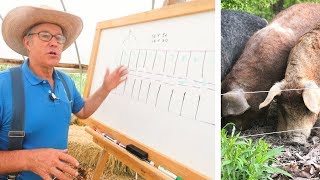
In this instructional field walk, Joel Salatin of Polyface Farm, contract farmer Matt Grundish, and host Speaker A demonstrate a low‑cost, scalable system for raising pigs on pasture using rotational paddocks, electric fencing, and simple wooden gates. They explain how to train pigs to respect low‑height electric fences, the construction of 12.5‑gauge aluminum high‑tensile wire fences on locust posts, and the use of spring‑loaded training wires to avoid breakage. The layout features a central alley with a series of half‑acre paddocks (typically 35‑50 pigs per paddock) that are moved weekly, with 6–10 paddocks providing a 5–12‑day rest period. Wooden gates act as mental barriers, allowing pigs to move without electric shock. Water is supplied via Brower float‑type waterers placed at paddock edges, with valves controlling each paddock and custom‑built rebar “pigtail” supports to keep hoses out of reach. Shelter is provided by silvopasture trees or portable shade cloth trailers. They discuss feed rates (~2 tons per half‑acre), vegetation monitoring, and the importance of maintaining visible, tight electric wires. Common mistakes include leaving pigs too long in one paddock and neglecting fence maintenance. Health care is minimal, with charcoal used as a tonic for sick pigs. The system is presented as a low‑capital, labor‑intensive alternative to conventional confinement, adaptable to leased land and various climates.
Chapters
Here's a free sample from my course Permaculture Pigs Premium Edition. If you guys are interested in more of this kind of content, check out the link I'll leave it in the description.
I'm Joel Salatin at Polyface Farm.
Matt Grundish, I'm a contract farmer for Polyface.
Okay, nice, nice to meet you. Nice to meet you.
We produce about 800-900 hogs a year on pasture, so, um, you know, this isn't backyardish, but it's very scalable to a back— uh, scalable to a backyard.
He's all alone. You're gonna move these 50 pigs by yourself?
Yep.
There are 50 in here?
Um, yeah, I mean, the groups are generally around 50, and this is smaller, some are 36.
And this is about a half acre paddock?
Yeah, half acre. Yeah, that's about right.
Whoa.
Do an acre. So when I move them, the first— usually the first couple moves you need a few few people, um, because they're just not used to it. So you just get like 2 or 3 people, walk down to the end, and then push them up. Okay, these guys are used to moving.
There he goes, he's just walking them. He's getting some stragglers there, but they know the drill. Dialed in systems. Look, are you serious? It's like we're herding cows right now. Are you serious? I'm serious. This is amazing. One guy moving 50 pigs.
So the first thing is training. Pigs really respect electric fence even more than cows, really, because they've got that tender nose and they want to sniff everything. But the difference between pigs and cows is that their tolerance is way less. In other words, if here's the ground and here's the fence, a cow, you've got some pretty decent tolerances on how high the fence can be. A pig, you don't because it's a lot closer tolerance. And remember that a pig's nose is pretty low so you want the wire to be at pig height. So normally the difference between the ground and the wire is going to be somewhere, on a little pig we use 2 wires, on a bigger pig a higher wire, but it's never going to be higher than about 14 inches. About 14 inches is about as high as it's ever going to be even on a big pig. That's not very high. Remember, if given a choice, a pig would rather go under than over. A cow would rather go over than under. So if you're going to err on a cow, make the wire high. If you're going to err on a pig, make the wire low. Those are just different nuances of animals.
First, is that like aluminum 10-gauge wire just from Tractor Supply, or do you have a specific?
We prefer aluminum, aluminum high tensile wire. For our permanents, we use 12.5 gauge. Well, for our pig pastures, all we use 12.5 gauge. That's big enough because, you know, we're in very remote areas. And so, you know, we've got to be able to have a deer trip over it, a bear, you know, it's not high, so everything can go over it. But it's just, do they catch a foot? Do they, you know, that sort of thing.
And it's just rebar metal posts with plastic insulators too, I noticed.
Yes, yes, it is, it is, except for corners where we use wooden posts.
Okay.
All right. So, so, so when we're— so the first thing is to train them to out. And so we have a physical, you know, pin in the, you know, somewhere physical, a physical fence. All right, and what we do is we just put, we just cut a corner off with electric fence, and there's a spring in the middle of this training wire. And of course, you know, here's your energizer over here, and it's very short. And the pigs are here, and of course as they hit this, they get shocked. We're training. You want a really hot spark. I mean, like, you know, 10,000 volts is good. When you're training pigs, you want their first experience to be memorable. Okay. The reason for the spring in this training wire is so they can go through it and they won't break the wire. Without the spring, they're going to keep breaking this wire. and then you're going to go out there, you know, 10 times a day is going to be pop, pop, pop. This wire is going to be sitting on the ground and you're not training the pigs. So the wire lets them, you know, lets them go through and be trained, and, and, um, and, and they're, you know, they won't break it. Okay, so now we're going to go out. Now we're going to go out to a field, and our preference— so, so we've got, you know, we've got a field out here.
What did this look like before you guys got started out here?
Uh, is pretty much a giant briar patch that was above your head.
Okay, that's crazy tall because, you know, I would think if you're going to a landowner, they're not doing much with their land, they might be scared of pigs coming in, right? But if they could come and see that this is the work, this is what's gonna happen. Yeah, it's nice and peaceful and quiet. Yep, doesn't it stink?
If the landowner was to say, okay, you guys have to go, this stuff isn't that hard to tear up. Yeah, no, just the way the posts are the most permanent thing that you have out here.
That's right. You haven't invested a lot or any in permanent. Yeah, I mean, you might come and pull up your post. Would you?
Right, I mean, you could, or I mean, if you didn't care, you could just leave them. It's, it's not treated wood or anything, it's just a locust post.
It'll last a long time because it's locust, but you would pull up your wire. You could probably pull out of here in a day or two and pull up the water line, get ready.
We have a cistern up there that feeds this whole thing, sort of like a pressure tank. Yeah.
And if you're leasing land, say you're leasing land in Virginia and for some reason, oh, your family, rest of your family is in Michigan and you want to move out there, right? Okay, let's go find some leased land in Michigan.
Yeah, I mean, the post didn't cost Joel anything but labor. He cut them off his own farm. It's, it's a pretty simple system.
Beautiful model.
Yeah.
Okay, does it matter how many acres?
Doesn't matter how many acres. What we like to do is put a central alley. So this is the way it goes. It comes out here to a gate. Alright? So these are all gates. And then the other side of the alley is gonna have opposing gates. Are you with me?
Yep.
Okay.
It could be a forest too. It doesn't have to—
it can be a forest, a pasture. Uh, I mean, it works great in like old cropland, old crop fields.
Yeah.
Are those physical gates, like wooden? I saw up in your— no, no, you had wooden. No.
Okay, so then, so then you have, um, each of these has—
okay.
Like this. Alright. These paddock sizes will vary depending on your scale. So if you're only running, you know, 10 pigs, these paddock sizes would probably be, well, we're running 35 to 50 in a group, half-acre paddocks. So if you're running 10 pigs, you probably want, what's a fifth of half? Whatever it is, you know, a fifth of half. We're having trouble figuring. If a half an acre is 2,500 square yards, a fifth of an acre would be 500 square yards. Which, 500 square yards, you know, you can configure it however you want to. I mean, you know, 500 square yards could be 10 by 50, it could be 25 by 20. All right, so you know, the, the, it can be configured any number of ways. All right, but, but the point is you're going to, um, you're going to lay out these, these paddocks.
Lines so far are actually electrical lines.
These are, these are electrical lines. And I'm gonna, I'm gonna fill in something here in just a minute.
Okay, theoretically you wouldn't have to have all these necessarily set up. If you only had the infrastructure, you could actually move these, right?
You could.
Or do you like to set them all up?
Well, the reason that we have set these up, the reason that we don't move the pig fences on these pig pastures is because the pigs actually do a fair amount of landscaping. So over time, they actually root up, you know, here's the wire going, okay, and the stakes. And the insulator, and they actually mound up. They make mounds because they're rooting here, rooting here. They actually create berms under the wire, so over time you have to raise your insulators a little bit as they berm it up. But once that berm is up, it vegetates, it grasses over, and it becomes very, very stable. So that is a real great protection for erosion and things like that. You're almost creating a bit of a rice paddy idea. That's why people have actually terraced with pigs. Use pigs to terrace a hillside. Make real narrow strips, make real narrow strips, and the pigs will move the soil enough that it kind of flattens, and you can make an 8-foot-wide terrace. I wouldn't make it less than 8, because the pigs would be No animal likes to be forced to be real close to an electric fence. So although they will walk up to it close, they never like to be forever confined where they can't get more than a couple feet away from it. So I wouldn't try to make a 6-foot-wide terrace, but 8 to 12-foot-wide terrace on a hillside, absolutely pigs will do that. Someday I want to do that just to show it. There are few things in my view as pretty as as terraces. Agriculturally, they really make a beautiful landscape. All right, now you'll notice that I haven't connected these, so each one of these gaps here, each one of these gaps here, so remember this, all of these are electric fence, and so all of the corners have a wooden post. All right, I won't put them all in, but, but all of these have wooden posts. These are electric fence gates. I'll put dots in. So these are your access, you know, with the, like the tractor, the feed buggy, the, you know, the pigs, if you need to get the pigs into an alley, whatever. But these are equipment access. We have portable pig shelters, for example, so you got to be able to get, you know, your shelters. So by having the So these are big, wide electric fence gates, you know, 30 feet, nice and wide. You can get your turn-in and stuff like that. Okay, maybe you're in a wood situation and you want to be able to turn in here with the tractor to maybe take out some dead wood or clean up. You need equipment access into these paddocks. Now this one here we'll use a different color. These— this little gap here is going to be a wooden gate, okay? And the reason for the wooden— so, so what we do is, um, is we come here to the, to the wooden post, wooden post here, and we put in a little— and this wooden gate can be 6 feet, doesn't have to be very wide, 6 feet. But the point is, that way when the pigs are over here and we wanna move the pigs over to here, they don't have to cross an electric fence. The one thing about pigs is because they're so intelligent, their time to trust us as humans for their wellbeing, they never trust us like a cow. And so when we say, hey pigs, come through here and this is electric, They come up to it, they look at it. I'm not sure. I'm not sure I want to. That was electric yesterday. It's been electric for a week and I can't see it, but I know it's there. They're trying to pull a fast one on me, right? And so by making these little wooden, wooden gates, it makes a physical barrier. So the pigs are, you know, they're used to up there scratching and all this on this wooden gate. We take that aside and there's no reticence. There's no reluctance for the pigs to flow through.
They're cramming to get through.
What's really important about this setup, and I'm sure Joel or Daniel probably told you guys, is the wooden gates.
Yeah.
So pigs— you saw how I had that fence down and they wouldn't cross it. It's even— even if I completely chopped that away and that, that wire wasn't there, they wouldn't cross. It's like a mental barrier. It's like, it's like the elephant that gets chained to a little post when he's young, and then when he's older, he still doesn't— he doesn't understand he could just rip it right out of the ground. So the reason we have those wooden gates is because if they can physically touch it and then see that it's not there, then they'll go through it.
If you try to make the pigs move over electric fence all the time, you'll lose your religion and have a heart attack, you know, in the process. So by putting the physical gate in here— now fortunately, so the pigs are in this paddock and all we do is we take this gate. So let's say now we've moved the pigs and they're in this paddock and now we're ready to move them into this one. All we do here is we take this gate and we walk up here and we reinstall it here. And after the pigs are in, we go back and we take the old gate where they were. So this gate has been removed. Okay, and it moved up to this side, then we go back and we get this gate and we carry it over and put it up here. So you only need 2 gates. You don't have to make a wooden gate for all these. All you need is 2 gates because when the pigs come in, they will never beat you to this opening. They're going to immediately quit, start eating grass and clover and stuff. They're going to start eating, so they stop. They come in here and just kind of plug up here. You can take the gate, and just walk on up here and set it up right there. And then you can go back and get this one because they're not going to go back through because they got new salad, right? And so the wooden gates enabled us to move them from paddock to paddock to paddock, but it doesn't have to be very wide because our machinery access for feeder, tractor, you know, firewood, different things, all that access is going to come out of the alley. Now the beauty of this is that at any point in here, so the pigs aren't moving, you know, this is paddock 1, 2, 3, 4, 5, 6, 7, 8, 9, 10. We generally try to like to run somewhere between 6 and 10 paddocks because that gives us enough rest period that by the time they get out here to the end, all right, so they get out here to 10, then we put them in the alley and run them down the alley and they can start back in paddock 1. Okay. And 10 paddocks has given us enough time at somewhere between, we never leave them in a paddock more than 12 days. And generally they're in there more than 5. So what happens is as they grow, because we're giving them the self-feeder, so they're eating out of the self-feeder, that becomes a constant a constant measure. Generally in wet areas, you know, you want to move them faster than in dry areas because the wetter it is, the more the pigs will dig and tear up. So what we've found for us, that 2 tons per half acre, 2 tons of feed per half acre gives us about the right amount of disturbance. If you over-disturb, it turns to weeds. If you under-disturb, it tends to go toward brambles and, you know, blackberry vines and things like that.
Do you have a measure for what's under-disturbance and over-disturbance, or do people just need to eye it?
I think that's where each ecosystem is going to be a little different, and you're going to have to customize this. But, you know, you'll be able to see very quickly within, you know, 2 years, you'll be able to see, are we maintaining good vegetative cover? And if it's going differently than you expect or than you planned, then adjust your time. You can either make your paddock smaller, make your group of pigs bigger. I mean, there are any number of ways that you can make adjustments here so that you move your vegetation in the direction you want it to move.
I want to show you guys the succession. The half-acre paddock Okay, grass, plenty of it. This is where they just got moved there. This is where they were. So some moonscape, not a whole lot. Some more where their feeder was. There are some briars and weeds about to go to seed, but he said they're going to go in with a bush hog and mow those down. That is what this is going to look like. So they were in there for a week. This is a week ago. This is just a week old, guys. This is a week old. There's, there's still manure on the ground. There's still visible manure, hasn't even been absorbed yet. Butterflies. Now look, 2 weeks. You guys ready to see 2 weeks? Boom! Oh my gosh, look at the line I just crossed. 2 weeks. What? Matt, did you guys mow in here?
No, not— none of this has been mowed yet.
So they didn't mow this, so that's why the, the briars are still here. You won't mow this, or will you? It's too late to mow this?
No, I think it's, it's still mowable. See, most of these haven't seeded out yet. Those have a little bit of—
okay, but I mean, at some point you don't, you don't want to cut the grass, right? Or do you?
Um, so like most animals, they don't really like the super stemmy long stuff. Okay, they like that fresh, you know, maybe 3-week-old grass, nice and green. So if we came through here and you, you can raise and lower a bush hog, so we could chop all these off maybe 6 inches up.
Okay. And then it would give the grass a really good head start to get above it. And ideally maybe 3 weeks before they come back in here, right? Okay.
Yeah, so they started up here.
Okay, so then this is what— this is— so we're a week old there. This is 2 weeks since they've been in here.
A week old with the thistles, 2 weeks old, 3 weeks old.
Oh, okay, this is 3 weeks old.
And then the 5th one down there is—
you guys got to see 4 weeks old right here. 4 weeks old, it looks like if you came here, you wouldn't even know. If you were a landowner, you wouldn't even know pigs were been in here. It doesn't sting. Does it stink? Correct?
Nope.
Doesn't smell here. This is 5 weeks old.
Yep, that's the first paddock, and that wasn't That grass that's growing there wasn't there when they started in here.
It only came in after they left because they, they brought it up from the seed bank, right?
Yep.
Is this—
and that's good stuff.
Wait, show me this good stuff. This is Timothy, you said?
I believe so. Okay, broader leaf grass. I think that might be—
okay, so will you mow this before they come in here?
This one is not that bad. The thistles in here are pretty much So you're saying—
okay, all right. Well, thank you for showing me. This is 5 weeks?
5 weeks.
Oh my gosh, 5 weeks and we got grass. We got grass up your shoulder.
Yeah, and that's, that's beautiful stuff.
Is it fair to say this is richer than when you found it?
Definitely.
Okay, the pigs, the pigs are, are bringing up the value of this land, not taking it away, right?
Adding value.
How does That's your electricity source, I imagine, is right here.
Yeah, let's just say jump to the black wire.
Oh, the wooden gate.
Okay, so here's the energizer. Okay, so what we do there is, um, let's do a, let's do a, let's do a side view here. So we've got, we've got a wooden post here, a wooden post here, there's a wooden, a wooden gate here between them. Okay, you know, we'll say we've got braces here and, and, um So this gate is just, you know, between these two wooden posts. So we'll draw the electric fence in red. So here comes the electric fence up to here, and here comes the electric fence up to here. And remember, this gate doesn't have to be very tall— 3 feet, 3 feet's plenty, you know. So it doesn't have to be heavy, doesn't have to be tall, you know. It can be a pretty light gate. So what we do then is we just take an electric fence, um, a gate handle, you know, with a hook, and we just hook it to a piece of extension cord. It's kind of an extension cord, and we just hook this over here with a gate handle and run the— and just let the extension cord sit on the ground, run over here to another— I'm sorry, another, you know, gate handle, and we hook it up on this side. And we just let this be a jumper on the non-pig side.
Yeah, let me see this. Let me see this jumper. He talked about it, but I couldn't quite imagine it. So this is actually an electric—
yeah, it's just—
it's just cord extension cable.
Yeah, it's insulated. The way that this system works is it's a big U. It goes from back there all the way down across the driveway that we came up, and then all the way up that side. And then we can select which paddocks we actually make hot because we have jumpers on the end of each line. We just hook the jumpers in the paddock that they're on, remove the one that they were in, and now we can—
So you're not electrifying it. So now this one has no heat. It's not hot.
No, this one is hot. So the hot one's right there.
Oh, the power's down there.
And then we jumper it from this one to the gate.
Okay.
Okay.
You don't want this to be on the pig side. You want this to be on the not— wherever, whichever side the pigs are not. And that just becomes a real long jumper cable. And we just hook it on one side to the other and extension cord. Remember, when you're doing extension cord, you know, because usually you use a, like a, you know, an older junky piece of extension cord, uh, just remember, if it's a multi, you know, if it's a multi-wire extension cord, make sure that you hook your white on, you know, your same color wire on both ends.
So basically you're cutting it and accessing the wire inside this extension cord. I guess you could do an insulated wire as well.
You can do an insulated wire. We just like extension cords because they're made— they're real malleable, you know, you can roll them up real quick. The under— the underground wires that you buy from, you know, from electric fence supply stuff, they're pretty stiff. They're made with a single wire and they're pretty stiff to go.
Okay, I get it. So you're not actually burying this?
No, no, it's just—
it's on the ground with your gates. Yeah, because you only need to have—
you only need to have it too hot. That's right, that's right. So, so here That, so that extension cord, that extension cord is going to be when the pigs, you know, if the pigs are in number 3 here, okay, we'll say the pigs are now in number 3. All we need is we need to go over here and over here and we're good to go. Yeah, yeah. Now, you know, this, this perimeter might or might not be electric depending on your situation. You know, if it's a good woven wire boundary fence or something like that, it might or might not be. So we can't always count on the power to go down here, over here, and up. This, the purple, may or may not be electric, but all the internal is. So, so the other thing is that by, that by having these not necessarily continuous here but with jumper cable, with, with jumpers here, it helps allows you to isolate each of these legs to find shorts, you know, if you've got a short.
He's found that these insulators tied to a post like that work better than, say, a plastic energizer that screws in.
We'll see. These are, these are actually movable, so if I need to make a new one, I say this one breaks, I can just make a new one with wire, or I can take these and just scoot them up the post. With the plastic ones, they're stapled in, so you have to pull the staples possibly get a new insulator, get more staples, and hammer it back in taller. And these are just locust wooden posts that Joel cut off the farm. Yeah, so they're not— you may need to replace the post, or it just— it's a little bit more efficient.
Yeah, it makes it a little—
you could tighten it here. I guess this is where you pull tight on this thing, isn't it? Yeah.
So if I need— I, I pretty much tighten the lines off the fence on every— yeah, right. If I need to work on a certain paddock, I just go disconnect the jumper fix the fence and then hook the jumper back up.
And you just hand tighten these, right? Yep. Because he keeps talking about making sure these fence are tight.
Squeeze it.
Okay. Twist it up.
We like to run at least 4,000 volts on this for pigs as a normal thing. If they're really well trained, 2,000 will hold them, you know, if they're really well trained. But as a general rule, you want over 4,000.
And really not that much labor, right?
The big labor with pigs is specifically here is the, uh, the paddock prep. And that's— the paddock prep is key to keeping pigs.
And you mean the paddock prep initially setting all this up? No, just maintaining it daily, like, so the—
well, weekly, I guess you would say. So I move these pigs about once a week.
Okay.
Um, what I do is I come in— well, you saw, they weed whack it. Tighten all the fences and then electrify it and then let them in.
Like, this needs weed whack.
That needs weed whack. So that will drain your battery like crazy. Okay, so when you're gonna weed whack that, um, they won't be back on this end for a while, and so none of this is hot. I always weed whack the charged lines which run on the outside of the paddock.
Okay, so the re— the how you didn't get— how you wouldn't make this hot is there's a jumper line right there. Yeah, so somewhere down there you've disconnected the jumper, right?
Right. Okay, see, this actually—
this is—
this can be— this is fine here. It's the hot line. So the lines that we actually make are the ones that run this way, and they actually run to the one that's always hot, which runs the length of this entire field. Okay, so these, once— once you use them, you disconnect them and you don't have to mess with them anymore until you come back for the next round.
Okay. And you take your piglet, you get your piglets into the holding area like you showed before, train them. How long does the training take?
As long— when they don't go, when they don't go over that training wire for 4 days, you're good to go.
And then you— how do you get them then up to this area? Do you trailer them?
We, we, we normally trailer them to, to that area and And then when we bring them home, it depends. We have some of these are on, some of these pig pastures are on rental ground, you know, that's 5 miles away from the farm. So it's hard to walk them that far down the road. But here at home, even if they're a mile away from the house up in the woods, when they're done, we just let them walk home. We drive them home.
Yeah, and you drive them. And that brings me to this question. So they're done here. This is electric fence on either side, right?
Right.
Um, so it's pretty easy to drive.
Yes.
With your pig boards.
Yes.
What are those called?
Yeah, yeah, sort boards. Pig sort boards.
Why did you draw this side? Oh, if we're— if we're going back here.
Oh, well, because over this side there's another set of pigs.
Okay, okay. All right, you're hustling. You're getting— you get— yeah, why do just one row when you can get two, right?
Well, well, uh, I mean it And again, this is an ideal setup, but not every one of our pig pastures are like this. I mean, we have one, for example—
And you're only talking about maybe going through, really only hitting this twice in a season.
At the most 3 times, often twice, but at the most 3 times. So yeah, we have one pasture. For example, we have a— it has a— it's a valley in the center like this, and this is all woods in here, okay? And so the pig paddocks come out, and then the outside is like this, that's the field, okay?
Okay.
And then the pig paddocks, yeah, are like this, okay? And then of course, you know, again, the You know, the wooden— in these cases, because our access road, this then becomes our access lane right through here. So these gates here, again, they're portable gates, but they're 16 feet or 12 feet, maybe they're 12 feet rather than 6 feet. Because we've got to get not only pigs but tractors through here too, and they're wood gates and they're heavier. Actually, I think what we have there are two 6-foot gates that we can set up with a little bit of dog leg, and that dog leg helps it to stand up. It's a little easier if you just kind of set up a 12-foot gate. It's easy for it to be a little bit flimsy. But if you put a dog leg, you know, here's your gate post, and these gate posts are small, you know, they're little, they're little short, you know, wooden posts. When you put a dog leg in it, it gives it rigidity so the pigs could come up and scratch on and stuff. If you have a long gate here and it's straight, the pigs will come up here, they'll scratch on it, and it's gonna bend a lot. You're gonna put a lot more pressure. But a dog leg gives it some rigidity.
And all I saw was water, or not water, chain. Yeah, one chain.
That's right, the bottom, not the top, right?
Uh, because that's where we're going to put the pressure, and that was it.
Yeah, that's right.
And actually, this was attached with a chain.
That's right, that's attached with a chain.
Like you had used to hinge them, but maybe that didn't work.
No, no. Well, what we used to do, uh, yeah, well, the, the key here is when I, when I'm, I'm saying wooden gate on purpose because we've tried other kinds, you metal gates, things like that, and they always It's too fragile here. There's too much, whatever, the pigs moving on it and stuff. You can short out if you use metal. So we say wooden gates because that way— when we first started, we used plastic chain to put around here so there wouldn't ever be a short, but the pigs ate the plastic chain. And so we had to go to metal. Which meant we had to go to wooden posts or wooden gates. So everything is insulated.
And there was nothing fancy about those gates. They must have been pine boards.
Yeah, scavenged, scavenged lumber. Yeah.
And I like that you drew this because this is more, you know, the square is nice because we can get the concept, but this is reality.
Yeah, that's so—
because nobody has a square. It's like the permaculture principles, the zones.
Yeah, yeah, yeah.
Perfect, right?
Yard.
So this, to measure it out, are you just walking and do it? Because that's, that's not even a square. So it— how do you do the math on that to figure out?
Oh, you just kind of by guessing, by golly.
Okay.
Yeah, yeah, I mean, yeah, you walk it and you got a little bit of a, you know, a little of a parallelogram.
And people might be surprised how accurate they could actually estimate.
Oh yeah, you, you can come here within 5%. Within 5% is, is plenty close for this, for this kind of thing.
You didn't talk about, and I didn't I don't see shelter for these pigs, so are you relying on the woods?
Yeah, okay, so—
Or do they always have trees?
Yeah, generally all of our pig pastures are silvopastures, so they've got trees in them. We have a couple that aren't, they're on like old corn ground, and there we do have portable shade for the pigs. So it's a trailer, it looks just like the turkey gobble-de-go except it doesn't have perch boards in it. So it's the same thing, it's a trailer with just nursery shade cloth on top. Pigs love to get wet. Pigs love water, okay? So you don't have to keep them dry like you would a chicken, okay? And so the shelter we want for chickens, we want an opaque roof, an impermeable roof. But for the pigs, pigs and turkeys, cows, they're perfectly happy to get wet on a you know, on a hot summer day. Yeah, yeah, yeah. It's just to get them out of the sun.
We should maybe— I'm thinking— talk water. Uh, how do you get water to your system?
Okay, so, so here, for example, there's a water line that lies right along the edge of this fence all the way around. Okay. And at every other So, so here there's a valve. So that serves this paddock and this paddock. And then let's see. And then here there's a valve. Okay. And that serves. So you got 1, 2, that serves paddock 3 and 4. And then here there's another valve and that serves paddock 5 and 6. Okay. So every other paddock is a valve. And the thing about water, of course, pigs love to play with water. And so what we'll do is we'll put, you know, we use the Brower water.
So I always move their water last, specifically with this type of water. When you pull this plug, it's going to drain and it's going to dump all that water. And if those pigs are still in here, they're not going to leave. So I mean, it's going to create like a giant water slide here and they're just going to lay in it, and then you're going to have real trouble getting them to go into where you want, especially right here at the door, right where you want everybody to go. Crazy muddy. I mean, it's heaven for them.
Yeah, so you just reach down. Yeah, you got to reach down and unplug it.
Yep.
Do they make smaller ones of these?
Um, I'm sure that they probably do.
Uh, this one works best for us just because of the size of the group, but I guess that you don't waste water because it's automatic water feeder, right? And it's a float system, and you need, you need a lot of water in there because one big pig could knock this over if it wasn't heavy, right?
Yeah, it's got a whale.
So even if you're just feeding one or two pigs, you still need the bulk.
Yeah, and it's, it's super important that they can't actually get access to water on the ground like this.
So why is that?
If, if the water is dripping just a little bit, if there's any flaw in your system, they're going to expose it. So if I have water dripping in the mud right there, they'll dig until this entire thing tips over.
Oh yeah, I noticed that this is— this was pretty dry around it. There's no like even splashing, right?
Yeah. So, and, and I keep it to where the water doesn't come all the way up to here. It's made— this is maybe only a quarter full, so they can come up and drink. It's unlimited water, but it's not all the way up here where they can splash it out. And then once they make mud, they're just going to start digging. And they'll tip the entire thing over and it'll flood the entire paddock. Okay, so you always make sure there's no drips.
Do you ever have to clean this out? Like, I mean, we're seeing some algae or something in there. That's not gonna harm them? No, it's better than drinking out of a pond, I imagine, right?
Yeah, right. It's not stagnant water, it's com— it's always flowing and it comes from a cistern. It's fresh water, it flows in there. Once in a while I'll get in there, I'll scrape those out where they're actually putting their nose. They'll get feed and stuff in there. But generally when I pull this plug every time I move them, that all fills up with water and then once I start rolling it, it'll all fall out anyway.
It's the only one we've found where the pigs can't waste water. Because if you give them a nipple, a nose thing, any kind of other waterer, I'm confident that the pigs actually draw straws or make a schedule and somebody's in charge to say, okay, back. You take the 10 to 12 shift, Jane, you take the 12 to 2 shift, and the pigs sit there and they rest their noses on whatever the water outlet is and it just drains. And then they get a big wallow and then the pigs are really happy. And then you've got a big hole and they gouge it out and whatever your water system is, it all collapses and falls over into the new hole. And you've got a mess. And so pigs will play with water. So what we do is we have— so normally we can, you know, we can kind of hang it up in a tree. So this, you know, this water pan, okay, has— let me just— you know, it has two access ports on it. It actually is indented here with access ports so that the pigs can drink there. And so we have a float valve here in the top. Here's the water level. Float valve here in the top. And as long as it stays full, it's heavy enough the pigs can't push it around. And so our water line comes in from the top and we just, you know, if there's a tree over here, you know, we just hang this water line in a treetop, you know, and here's the main line and we just run it up. So the point is to bring it, to have it near the edge of the paddock, the fence, the electric fence, have it near the paddock, hang your water line so it comes down from the top so the pigs can't come up here and play with the water hose. If we don't have a tree nearby, what we've built, what we've made are a couple of tall rebar pigtails, okay, that we can— tall, I mean they're 6 feet tall— and we can push these in the ground right next to the side electric fence, run our hose through this pigtail, you know, over into the, over into the tank. And that again, that keeps the, that keeps the water line from being down close enough where the pigs can play in it. Because if they, if they can play with that water hose, they will eventually gnaw a hole in it.
Yeah, and you just move that with them?
And we just, we just, yeah, one, we just move that with them. Our pig system, yeah, we just need that one, one per, one per group, one per group of pigs.
And I notice you don't create wallows for them, do you?
No, we don't, but they, they make wallows. I mean, if they're, if they're in a If they're in a paddock when it rains, they will make a wallow. So if there's no tree here next to the border in your field that you can hang the hose up in a branch or something to drop it down in the water, we make a, we make a rebar, like 6-foot-tall pigtail step-in post thing holder that we can run the hose through And run it in. Of course, this would sit right outside the pig pen and the waterer would be, you know, 3 feet in. And so the hose is kept out of the pigs' reach. Because the pigs, if they absolutely can play with a water hose, they will eventually gnaw a hole in it. Every time they will do that.
Custom welded pigtail. It's how they get the water line over this fence. But I imagine you could use a— I don't know, some sort of T-post rig.
Yeah, just basically it's just to hold the water line up off the wire.
Even a small— maybe even a small one.
So this has a float system in it, and you want— I'm not going to this thing right here to be uphill.
Okay, okay.
It'll leak if these aren't perfectly even. You have to make sure that the float is, is downhill so the water reaches it first.
You got your first customer, buddy.
I, I'm not gonna be able to get that. You probably need to put it up further.
This ground is You guys have got this system dialed. Yeah, you guys really do. Cheap system too.
Yeah, that's probably the whole thing. I mean, I'm sure if Polyface really wanted to get high-tech, yeah, they could. Yeah, they have the means. Um, but they're still in the area of showing people that they can just do it on a—
like, the big expense here is land, but you could also lease land for $50 an acre. So your interns are— you train an intern, they're going to leave here. What do you think is the biggest mistake they're most likely to make? What's the biggest mistake?
With the pigs? Yeah, with managing pigs. The biggest mistake most people make is not moving them frequently enough. And so you're moonscaping the the outdoors. So we don't want to— so you leave them too long. So we have a hard and fast rule: they never stay in one place more than 12 days. Here's what happens. You say, well, you know, why is that? Well, because in 12 days they will create a very heavily impacted campsite of some sort, either a walla, a campsite, something. And so even if they haven't disturbed everything, they will have disturbed a portion and then they start making brick. You know, what is beautiful and nice and loose soil, you know, then becomes hardpan brick. And other— so if they haven't disturbed the paddock as much as you want in 12 days, then reduce your paddocks. Or increase the number of pigs in the group.
You don't just keep them there longer than 12 days?
No, no, no, no, 12 days they're gone off because in 12 days— the thing is, when a pig has a paddock, when a pig has a paddock, anybody's got pigs knows this, when pigs have a paddock, they do not spend equal time on every square yard. They will pick an area and they will pick 50% of their time in this spot and 50% all out here. Well, what happens then in 12 days, they have too heavily impacted this relative to everything else. So if you're not disturbing, if you're not getting, if you're not harvesting the grass, blah, blah, blah, what you want in 12 days, then either reduce your paddock size or increase the number of pigs.
So here you and I are both used to 30 to 40 inches of rain a year. Does this 12-day rule and all this still apply in 12 inches of rain mid-California?
I don't think so. I think as you go drier that the stay can be longer, but the rest period also has to be longer. So I absolutely, I've seen plenty of dry areas And I think because they're so dry, they can, you know, they're more forgiving on the length of stay, but they're less forgiving on the length of rest.
Would it be a good rule of thumb to say we get 30 inches in this system of rain, somebody gets 10 inches, would it be safe they need 3 times as much rest?
Yeah, well, certainly double, just as a general rule, double.
So instead of 80 days rest, 160. So maybe just go through this once, one season.
Yeah.
Okay. All right. I've noticed there's trees in every paddock and the pigs are enjoying them. There's not a— there's not a wallow in this paddock. They don't create wallows. If they happen because of rain or whatnot, then it happens, but they don't go sitting about creating them. Anything else you think we should add?
Oh, well, you were asking about, uh, what's the number one mistake? Yes, that, that people make. So the number one mistake is leaving them too long. That kind of got us onto this, this 12-inch. Um, the, uh, the other biggest mistake they make is failure to maintain the electric fence. A hot spark, and it's got to be visible. So, you know, I would like, I would like to tell people that these electric fences you set up You set them up today and they're good forever. But vegetation grows up, weeds grow up, stuff grows up. And so once a year or twice, we have to weed eat. Okay. And the pig, you, you can't hold the pig responsible for something he can't see. And so, so there is some maintenance here. Now, electric fence is cheap. You can set up a lot real quick, but it does require maintenance. That's the offset. You know, that's the offset. So you have low capitalization, low input cost, but you have annual maintenance costs to keep it visible. The second thing— so visible, keep the vegetation off, keep it clean, keep a hot spark. And the final thing is to keep the wires at the right height and tight. The looser the wire is, the more pigs can play with it without getting shocked. If a pig can come up to wire and they can and you can kind of shoulder up to it, you know, and the wire hits his hair first because pigs are hairy, right? Hair is insulator. Hair is insulator. It's not like the nose, right? So they come up to it, and if they can rub on a little bit, play with a little bit of hair, and they start pushing on it before they actually make enough skin contact to get spark, you're going to have trouble because those pigs, you don't want them to play with it. Tight, taut, nice tight, not piano wire tight, but enough that, you know, if you touch it, it's not going to want to move away where you get good skin contact. Anything else? No, I would just tell people one of the beauties of this system is that you are substituting the drugs, the concrete, the fans, the stench, the toxicity of manure and all that. You are substituting that with a very beautiful— yes, it does take a little more labor per pig, you know, person hours per pig, but you're substituting all that negative with something that actually nests into the ecosystem and makes a pretty landscape. Skip, because you're not sure— makes a better pig. You're not vaccinating? No.
You don't need any antibiotics? No. What if somebody gets sick?
If somebody gets sick, the best tonic for pigs that get sick is charcoal.
Okay.
And if you read any swine handbook prior to, say, 1940, and it starts into the, you know, the, the disease and the sickness, you know, the wellness part, the first part of it will say charcoal. And we've I've had pigs that, you know, you think they're gonna die tomorrow, uh, and, and, uh, you know, and you feed them some charcoal and they will just blossom.
Do you ever have to force-feed them that charcoal?
Oh no, no. Pigs, look, they don't have to file any insurance claims, they don't have to pay taxes, they don't have to deal with any, uh, licenses. And so, uh, they've got 24/7 to, to curiously You find things, right? And so yeah, they find it. And they don't watch TV, so they know what they need. They're not going for it because of what somebody else told them they needed. They're going for it, they know, they're in touch with their internal needs and they find it.
Well, thank you, John.
That was great.
Absolutely. Good to see you, Tom.
Pow!
Wasn't that amazing? And it can totally be applied to any operation. Now, I've learned lately it's not so much about what you know as it is about who you know when you want to learn to do something. In this case, learning to grow your own pork. I've assembled folks like Joel, myself, Cliff Davis, Jordan Green, and others to teach you everything you need to know for raising your own pork from piglet to the plate. That's available now down in the description under my course Permaculture Pigs. Check it out, and there's special incentive for checking it right now because until Friday— what day is that— November 1st up to midnight there's an early bird special. So we're going to be dripping out content through November. So if you get in now, you get most of the content, and you wait patiently through November getting the rest, but we give you 40% off. So grab this by Friday midnight. I mean, technically that's going to be Saturday midnight, but just get in there while you can. Link is down in the description.
More from Justin






If I had to start my Homestead all over again, it could only pick one animal… 




