Justin Rhodes’ Chickens Systems 2019
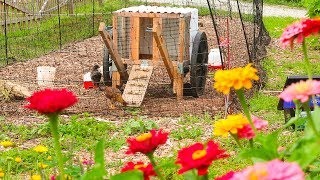
In this 2019 farm walkthrough, Justin Rhodes demonstrates four distinct chicken‑centric production systems that simultaneously generate eggs, meat, compost, and improved pasture. He begins with a “compost corner on steroids” where layers are fed organic pre‑mix directly onto a hay‑based compost pile, using an Everflow water system that circulates cool pond water. Mobile coops (the Chickshaw 2.0 and an A‑frame with wheels) are moved daily to till, fertilize, and spread manure across a future garden area. The second system is a kitchen‑garden setup with deep wood‑chip mulch; chickens eat garden waste, turn the mulch into rich compost, and their manure is harvested in trays. He explains predator control using a guard goose, electric netting, and fine‑mesh cages. The third system focuses on meat birds (Cornish Cross) run on a shallow pasture, rotating them weekly to fertilize weak spots, achieving a 58‑day growth cycle that yields ~4 lb of meat per bird. Finally, he details a brooder‑to‑layer transition, using starter feed, automatic feeders, and a heated hover‑brooder, before moving the chicks into the rotational systems. Throughout, he highlights practical tools (electric netting, vacuum‑sealed waterers, portable water lines) and the broader philosophy of nutrient cycling: chickens stir compost, spread manure, reduce flies, and regenerate pasture, turning daily chores into regenerative outcomes.
Chapters
Today I'm showing you 4 different chicken systems that not only give you delicious eggs and meat, they give you compost, they improve the parts of your pasture, they till, they fertilize, they rid your house of waste, or rid your garden of waste. Let's do this. This is my breakfast posse. They're on what I'm calling the compost corner on steroids. You guys are a little loud, so maybe I should get you your feed. I just threw down some commercial organic pre-mix feed right on top of the compost to encourage them to stir it. For feed, I use an organic pre-mix, 1/3 pound a day per chicken. Plus, they have access to this compost pile. Not only are they stirring that and creating compost for us, adding nitrogen to it, stirring it, they are eating from it. For water, we have what I call the Everflow watering system. It's bringing down water from the pond, bringing it through this system. It's always moving, it's always cool because it's coming from the pond, then it goes back out to the creek. Makes chores super easy in here. Don't have to ever worry about cleaning the water. Don't have to, uh, worry about keeping it cool or even replenishing it. You do— now one thing you do have to worry about now, since we're composting with hay, some of this litter does tend to get up in here and block the filter pretty easily. So we do have to clean it out every day. See, there's been some leakage. I'm thinking I probably need to put that up on a pallet, and then they'll— some of this hay will fall off before they get to that. For shelter, these guys are in the Chickshaw 2.0. That thing easily moves from one place to the other. Move it throughout because this is a future garden area. They're building this up for a future garden. Not only have they They certainly fertilize. And look, look at the concentration around where the chickens were, around where the coop is. The coop has a 1-inch wire mesh. Poop easily falls through and fertilizes the ground below. Also in here is the A-frame, great for running chicks. It's got an attachment for wheels so we can move it. Also, they were here fertilizing these guys. I feed, I feed these ladies first because they get the layer feed. It's got calcium and I don't really want my little chicks to eat it. They'll be cooped up in here for another hour or so, then we'll let them out. And while they're in here though, they have water and they have all-you-can-eat starter feed. When I feed little starter chicks all they can eat until they're eating a third pound a day each. You could say that chickens are tilling, fertilizing in here, but look, look at this composting system. We turn this once a week. They help us turn it. They help us spread it. Look at this reach on this compost system. They have spread it off the top. Look, come all the way out and around, even as far as this. They've come out 15 feet in some places to help us cover this. Nature is modest. She doesn't need to be naked. She likes to cover herself. So the chickens are helping us cover her in a little sort of a rougher compost that will eventually break down into compost. It'll serve as a mulch right now to keep the ground covered. And they're doing a beautiful job helping us break down this hay bedding from the cows. This is bedding of mix of manure and spent hay from the cows. And that's pile number 1. We have pile number 2. We had it protected. We had a gate, or we had moved our Premier One chakra knot net in so that we could actually have pallets around a Compost pile, we turned it yesterday. Now it's time to open— I just didn't have time. It's time to open this up and let them help us with this pile. Look at the steam coming off that. When we turn this thing, I don't think it was getting hot enough. It wasn't— it was barely getting over 120. So we added some nitrogen, we turned it, we added a lot of water, and oh yeah, look. Oh yeah. There was a smell out here. I still smell it. You shouldn't really have a smell at the compost pile. Still a hair of a smell. We're working on that. 140, probably would make it to 145 if I set up here long enough. Okay, yeah, you guys are ready for this, aren't you? You ready for this? This is a super bare area, so we really need some composting action going on here. Let's get it to them. I'm using these shocker knot nets because They have this thin wire mesh here. Yeah, I have this thin wire mesh, and that's good for keeping little chicks in, which those chicks you saw over there are much— were much younger, and they needed a much tighter net. So this helped keep them in. And also the stakes— we put these plastic stakes in around the bottom. It doesn't conduct electricity, and it keeps the chicks— they're feisty ones— from going underneath. All right, I got all the stakes pulled up. Let's open this up to them. Simple procedure. There, we've given chickens access to this pile. They will begin manuring. Needs a little more fertilizer. They will begin stirring it, breaking down these bits of hay. Hay can take a bit to break down. You're just the right person for the job, aren't you? Let's talk system number 2, the chicken kitchen garden. Possibly guard goose in training. Young chicks inside of Premier One Chakra 9 gallon waters. They need help, they need help. We need to change those out. Throwing in garden wastes. To give the greens to the chickens. The chickens in here are on deep mulch. We used wood chips because they're going to be in here like forever-ish. So when chickens are in an area, or any animal, a long time, they need a deep bedding. They need a carbonaceous diaper, as Joe Salatin would say. This is right next to the kitchen garden, so waste from the garden can easily come to the chickens, they eat it, and the chickens in return turn this deep mulch into compost. Look, move some mulch aside and you're gonna have rich, rich compost at the bottom there that you could easily harvest. You could also capture their manure if you want underneath this. We've got this MicroShaw here, just a little 2x2. Move that forward. You've got a concentration of manure that you could— you could put a tarp or a tray under there and harvest that and use it for something, or just move this around. And that helps break down these wood chips, this deep bedding, to create compost. For feed, we got these handy bigger Premier One trays, commercial Reedy Fork organic feed, and then 2-gallon waterers. We could probably get a 5-gallon waterer for these guys at some point. But for now, let's just go clean these up and get them some water. Maybe we have some weeds out here, we could easily pull those up. Not only are we cleaning the area, we're feeding the chickens and giving them something to do. Looks like our— see, like our collards here, or no, it's a cauliflower. Wow. But these leaves are going to be of no use. They've been shredded and attacked by something. So let's say we're cleaning this up. We're not going to eat it. Guess who will? The chickens. And maybe they won't eat this stem per se. So look, the goose is just tearing into that. She loves it. If everything that they don't eat will degrade and eventually become compost, you get some fresh water. Enjoy. Right, right next door. Some lettuce that's bolting. Let's be done with it. Oh, look, browning, rotting lettuce. Perfect, perfect for chickens and a goose. They love it. For shelter, I just have this micro shawl. Jonah built this at 11 years old. He built this again, 1-inch wire mesh in the bottom, uh, door mobile. He's got hooks on it. You goes. The door is long enough it swings down. You can't have a handle here. Move this around to fertilize. Huge wheels so that the birds can get under now and serve— it can serve as a shade. So not only this is a coop, it's a shade, it's a mobile fertilizer from one beautiful garden system close to the house. That's beautiful. I just love that. Beauty did a good job on that. That's just beautiful. Sorry, I'm a little distracted. Hey, good job, Beauty! Should I just share the results of you— of an— what I call the animal garden miracle? Having animals on a garden before, this is what it looks like after when you plant the garden. Absolutely ridiculous abundance. Great view right here. Another animal garden miracle where the chickens were. That's where the chickens currently are. So one day where the chickens currently are will be a jammin' garden just like that. Gardens take, they pull and pull from the earth. You take the produce out, you take, take, take. Nature needs an animal, hence the animal garden miracle. To restore that, to bring nitrogen back into the system, to disturb it a little bit, to consume the wastes. Oh look, these guys have gotten out the back. Shoot, this is trouble. Their nesting box has come undone. This is trouble. I mean, it's not the end of the world, but look what happened. I think— yep, the nesting box got jostled. And they were able to get out. This is a problem because to move them, they need to be in the coop. This is a Chickshaw Mini Me, a 4x4. It's for moving these chickens all over this farm. It can hold up to, I'd say, at least 20 birds. It's their shelter. Again, they can get under there and have a shade. It's a centralized fertilization. Put this in an area— well, I did, I put this in an area that was poor pasture and they build it up. But what's most beautiful about this system— I'm not going to be able to move it for you today because they got out. Well, let's let everybody else out. Good morning, y'all. You guys are the ones that behaved. You didn't escape. You didn't escape, did you? The ramp is also the door. Ah, Waddle. Waddle, our goose, is here to protect them. These guys go way out over the farm. Actually, we like to have a goose with every posse. On the farm. So flapping the wings, squawking does help keep predators away. Now what I want to show you here is the cows have pooped. The cows were here 3 days ago and they pooped. Flies get in those poop and lay larvae, and then the chickens do that to it. Are you serious? There are dozens of less flies on this farm because of these chickens going through and eating those maggots. Now they also spread this, and in them spreading this— this is great nitrogen. If this was not spread, it'd be one pile of dookie right here, and then that one little patch would just be green forever. But now they've spread that, and the green is not bad, the green is good, but they've spread the love. See that love? That's gonna be a much bigger patch of green. Look, here's where you can tell where a manure has been. See how that's greener there? And let me tell you again, look, just, just see a manure patty. This was so old they didn't scratch it, but you can see, look how green it comes back around this. And this wasn't spread, so this is a concentration of green. But if this were spread, it would be like this. I don't know, we must have missed bringing the chickens in sometimes. Look, look how much greener in some patches. You guys did a good job. It's worth it. It's worth the 20 to 30 minutes a day moving this system. We take this— it's again a Premier One electric net. It's easy to move. The poles are further apart. The poles are further apart, so it's a little cumbersome, but it's a super, super temporary system. So it's easy to see it sags a little bit, but that doesn't matter because we move it every day. Well, except for today when the chickens, uh, escape. Huge, huge area. I've used 3 nets to encompass there. It doesn't quite encompass the cow's paddock, so some manure patties are, are missed, but I try to hit most of them. So water— these 5-gallon vacuum-sealed waters are amazing, super mobile. Just go to your nearest water source, fill it up, you know, clean it out, fill it up. There's your water, guys. Enjoy. We would have picked up this net, rolled it up, put the 3 nets on top of our roof, strapped it down with our ratchet strap, and hauled it basically way over there in front of our house. I'll show you that. I'll show you that in just a minute. It's actually the field the sea monsters are in right now. Good morning, pretty lady. You've got your gardens looking so beautiful. Thanks. I've just been admiring them this morning. Do we have anything that we can— like those bamboo posts I bought? She's all business. Can we, um, I don't know, my pepper plant's falling over now. Okay. Okay, right? Or is it okay if it falls over? No, it'd probably be best if it didn't. So right there is where the ICs would have went this morning. They'll go there tomorrow morning. It's really not that big of a deal. It can be 3 or 4 days behind the cows. We've mowed behind the cows, so that's what they like. They like it nice, the grass nice and short to eat. They'll eat 20% of their diet from the grass for feed. Let me show you what Feed us. I forgot to take feed out there. As for feeding these guys, we strategically place the grain on manure to encourage scratching right there, to encourage them to stir it up. You can also pour it on weaker parts of the pasture to encourage their presence there, more manure there, more scratching and disturbance there. To— once they leave, it gets rest, it comes back even better. This is an organic layer feed. But 20% of their feed, because we're moving them so often, every day-ish, they're getting at least 20% of their food from the land— bugs, grass, and various whatnots. A little trick for getting over a net while it's on: plastic bucket on top of the electric net, step over. Electricity doesn't go through plastic, so that's one way to get over. Okay, now I think the The layer hens have had enough time to eat their food. Let's go let out the little chicks. You guys liking your new pile? They've already put a huge dent in it right there. Good job, guys. Way to help us out. This is always insane. You ready for this? You ready? Chaos! Boom! 120 chicks. What are we doing with 120 chicks with 30 layers? Well, these 30 layers, they're well over 2 years old, past their prime. Cycling them out, raising up new chicks to replace them. But this is— they're mixed. We don't know if they're female or male. So if you want 50, you got to get 100 and hope for at least a 50-50 ratio. Pretty soon they'll be old enough and we'll know, and we'll be able to tell and we'll harvest the roosters, use them for meat stock, slow cook type chicken meals. And the hens and the little baby chicks will replace these old lady hens. They give us eggs, but production can get cut 50%. Oh, look, they're loving on this water. They're loving on this. There's one more chicken system. Very exciting, very efficient. A little side note here, micro system. I guess it's a— I guess it's a system. We have a chicken tractor. Look, we've concentrated areas. They were there, then there, and now there on fresh grass. It's one of those hens that went broody. We put fertilized guinea, and she is raising guinea keets. Just a waterer, and they've been putting feed directly on the ground like they would find it in nature. You guarantee this is going to come back green. It's mowed. I mean, you probably don't want a mowed lawn look like this, but it's mowed, it's definitely fertilized, and will come back greener than you could have ever imagined. Little bonus system there for you. Didn't even plan on talking about that one. All right, let's go on to one of the most efficient systems on our farm. That's terrible lighting. I'm gonna say that again out in the light. Exciting stuff. This is a 4x6 area in one of our stalls downstairs, so sort of a barn-ish area, protected, uh, what, 4 complete walls that would protect it from predators. We're just giving them for feed. This is a Reedy Fork organic starter feed. Just when they're young like this, we can use trays. When they get a little older in the brooder, we use a King Feeder Premier One automatic feeder. In here we use fine wood shavings to serve as a deep bedding for them, their diaper, 1-gallon waterers, a couple of them or just one. It's surprising how little water 100 little chicks will drink. When they get a little older and are eating a little bit more, we keep them in here until they're 3 weeks old. This is a 4x6 area, 4 chickens per square foot up to 3 weeks maybe 4 weeks old in a pinch if it's wet outside. These hover brooders are amazing. They're no light, they— it's a heat plate. Light is not natural, especially at night, and this kind of mimics mama hen. And much safer too, much less of a fire hazard. Let's get them some water. These chicks stay in here till they're about 3 weeks old, and then they're gonna go out there. Okay, as I was saying in that terribly lit hallway, is this is one of the most efficient systems on the farm. 58 days is all it takes to raise a chick to harvest. At harvest, say you have 100 birds, you get 4 pounds of meat in your freezer per bird. That's 400 pounds. So you have a 25— high 25% failure rate or trading rate. You give some people some chicken, for helping you harvest. A normal loss rate is maybe 10% or less. So let's say you lost 25, whether you gave them away or lost— and lost some. 300 pounds of chicken in your freezer in 58 days. And you don't have to do 100, you could do 50, you could do 20. Say you eat 1 chicken a week Do 50. You've raised a year worth of chicken in 58 days. Absolutely crazy. We have— I call these sea monsters. They are Cornish Cross. They are bred just for meat. You're not going to want to keep them. They're not going to lay eggs. They're not going to breed. We, we have them in this grass run. So again, 20% of their diet can just come from this grass. We have them on the weakest part of our pasture. This is our most shallow pasture. They were here, they've just laden it with fertilizer. A week ago they were here, a week before that they were here, and a week before that they were here. It comes back beautifully, more beautiful than it was. This is where they were last year, guys. This is so ridiculously thick and lush, it's just crazy. Look, you can see a patch of it right there. Just crazy. Some clover coming up, really green fescue. Amazing system with these chicks. And it's not like it'll just be green this year. No, these patches will be green forever-ish because of these meat birds. Now to move you guys without Jonah— we're letting Jonah rest. We've been having some crazy— we've been having some busy days lately. Stayed up late last night. Jonah usually moves this all by himself. What we'll do here, let's take up this side of the net, move them over there. We'll keep that net up for a while. Where they were, where they're going. Two Premier One chokranuts. Keeps them— you know, we keep it narrow. We found that keeping it narrow keeps them closer to their meat shaw at night. That keeps them away from the owls. We can run them in here for probably about a week, maybe a little bit more, maybe 10 days. Move their shelter every day inside of here, and you've gone from one end all the way to the other, and you need new ground. So a week inside these two nets, moved every day. We're just making sure— okay, so this corner post is already off. We're gonna get this corner post off. Put in these diagonal rebars just to support the corners. See how that collapsed when I did that? So now all I got to do is get this, get this end up. And I'm doing that with one hand. This stuff is bulky. It does take some time to get used to, but it can be done. Probably couldn't— oh, they probably might like it a little bit better. You don't have to. Certainly wouldn't want it to be any longer than this, but they're going to love this. The, the lamb's quarter, fescue, uh, there's some clover in here. A patch of lamb's quarter right here. Got my one side up. I just realized I probably just want to open this wall, move the meat shaw over. By the way, look at this meat shaw. Look at their covering, tall enough for them to get under it. All it is, is it's no walls. They don't need to perch. They're meat chickens. Their days are 58 days. And here, I'll show you how it moves right now. Come on, guys. Like me talking to them is going to help. They don't speak no English. Bring this over here, turn it around. They are spreading everywhere. Okay, it probably would have helped if I would have restricted feed last night. I should have put the feed up. Okay, look, crushing this lamb's quarter. Good job. You're telling me that's not going to be an amazing meat? Oh look, okay, water's empty. We got a water hose all the way from the house and it's over here somewhere. Let's get it and fill this thing up. Oh, here it is. That was easy. 7-gallon vacuum seal waterer. By the way, I'll leave the links to all this stuff— the meat shaw, the waterers, all that stuff— in the description. 7 gallons will last them a day, generally, 100 chickens. Even on a hot day like yesterday, 90 degrees and very humid, it was just barely— had a barely had a little bit left. Okay, they've spread out quite a bit, I think. Let's open this up one more notch. Next, we'll put up our net. Our— what was the outside net will now be the outside over here, and then we'll worry about getting all these chickens back in. All right, I got the fence up. We got many birds in here. I'm kind of liking that I left this much because they're really attacking that lamb's quarter. So, but how to get everybody else in there? All right, you ever heard the phrase herding cats? Well, herding chickens is like herding cats. So just go wide on either side. It helps that they're chicken, you know. Bring up the rear here. It's working good so far. They would eventually— hey, I could leave it. They would eventually just— at night at least, they would go back in there. So it's not an emergency emergency if you didn't have crazy predator pressure, mainly domestic dogs. I'll use this netting here. That's a bit of a funnel. It's got a few stragglers. Come on, let's go, let's go down our, our funnel. Look, look, just don't panic. I was tempted to panic with about 90 chickens out. There you go, that's it. Jonah's gonna be so happy. Jonah, what? I did the chores, bro. Slept too late. Thanks. I even did the sea monster trick. The only thing I didn't do is the forest of pigs, so I need you to do that. Oh, you know what? I forgot to shut— remember how I said I don't want— got to keep their feed separate. The layers eat theirs early in the morning. You guys, because you're growing, have food all you can eat. Look, see, the layers got in there. They'll eat too much. Now I shut this door, but only 3.5 inches, so the chicks can get in and out and the big ladies can't. Now, making compost, building up soil, all that is great stuff, but still, let's face it, It's not as exciting as this. This is what I'm talking about, Rebecca. The turning compost, building up the pastures is all exciting, but this is the good— this is where it's at. Farm count, Mr. Brown, how much of the farm is on your plate? The greens, the yogurt, or is that milk? Milk. Uh, there's strawberries. No eggs. I'd say 50 strawberries. Not yet, that's gonna be next year. I've got plans for strawberries next year. I can't wait to see your plans. I'm excited. Look at Laurel, y'all. Passed out upside down. No worries. Where's all the rest of your shoes, Mr. Brown? You've got one of everything. I promise I could not make this up. One snow boot there, one water boot there, one Keen here. Oh, you do have two Keens. One tennis shoe there.
More from Justin






If I had to start my Homestead all over again, it could only pick one animal… 




