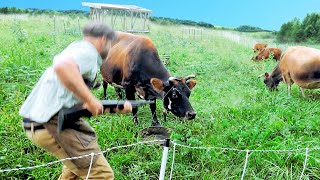
This content was created by Victor Justin Rhodes. This content was uploaded by Victor Justin Rhodes. This is a YouTube video titled "Killing Our Family Cow : Real Talk about Flossie" (created 2023-10-17T20:00:54Z). It is a first-person vlog/monologue by a homesteader recounting the decision to cull and butcher a family cow named Flossie. The speaker describes the emotional and practical aspects of homesteading and harvesting livestock (including memories of other animals), details about the butchering process and meat aging/quality (fat ratio, hanging for 3 weeks, grinding vs. roasts), and notes the involvement of family members (Rebecca, children) and a hired shooter. The video also includes a promotional mention of Abundance Plus and a free trial to view uncensored footage. The tone is reflective, instructional, and personal rather than a multi-person conversation.
Chapters
Stand back behind those trees. Come up here with your knife. Her brain is right here. Okay. Oh boy, let's go. Come on, I need to take my time. I don't want to rush you. Yeah, we harvested dear old Flossie. Unfortunately, we cannot— we are not allowed to show that on YouTube. It's against the community guidelines. Can't show the blood, so we can't show a lot of the processing even. I'm gonna show you what I think I can without causing any trouble. That's what this video is, but to give you a little bit of content— well, if you want to see the whole thing, if you want to see the whole thing shot, blood and all, you're gonna have to go watch it on Abundance Plus. Right now we have a free trial, so you could technically get in there, watch the butchering, consume the new couple new shows of Elevated and whatever else you want for the 7 days and just cancel before it picks up. Most people actually don't. 75% of the people get the free trial, actually enjoy it so much they stay on. So abundanceplus.com. Anyway, for Flossie, you know, homesteading hurts. Sometimes. We don't talk about that a lot. I talked about this at Homesteaders of America at one of my talks. We talk about the glory, we talk about the good, but with every single thing there is a good side and a bad side, a blessing and a curse. Even with a tree, something as holy as a tree, you know, beautiful shade, uh, spiders for fly catchers, birds for fly catchers, rubs for animals, firewood, siding, framing for houses. It's so good, a tree. It can fall on you, you could get burned in a fire. A tree, even a tree can— it can fall in your house. Even a tree can become a curse. So one of the curses, downsides of homesteading is The harvest, I mean, that's a perfect example of everything is a blessing and a curse. It's a blessing, you're feeding yourself, your family, but it's a curse in that something has to die. And cows, particularly, especially family cows that you've milked, I've had my head, you know, I'll purposely, you know, want to get that microbiome exchange, I'll purposely lean my head on these animals and milk them. And I'm milking them by hand. In their nether regions. How much more intimate can you get than that? Except for this. I'm laying my head on the— on this cow, I'm milking, and then I see this bump. I see this movement. It's the calf moving. I can put my hand up there and feel the calf. These are intimate moments with these cows. There was a particularly difficult incident with our first family cow after coming back from the Great American Farm Tour. Her name was Violet. Well, she failed to thrive. She would, uh, she would eat this fescue, which is in plenty. It's a kind of grass that grows here in western North Carolina and in many places in the east. She couldn't handle it. Her particular build could not handle fescue. So it's what you call fescue toxicity. And as a result, she wouldn't come back into heat. So she had had a calf, we're milking, but she needs to cycle. She's not having her cycle so that she can be bred back, have another calf, and we can keep getting calves and we can keep getting fresh milk. You know, once they have a calf, their milk production goes up, but then it gradually starts going down, and you need to give them a break, let them breed, have another baby, and you're back in milk. And she just wasn't doing that. We had to make the hard decision, and we probably waited too long— 6, 6 months. And you know It's what you call— farmers call being open, and that is one of the O's for being cold. Open, ornery, which was Flossie, and old, which was also Flossie. She was certainly not open. She was, uh, very quick to get bred back, and we appreciated her for that. But anyway, Violet, we had to make that hard decision, and she was our only family cow at that time. And perhaps that's one reason we've gone to two, in case mainly so we have milk all year round, 365 days a year, but two, in case something happens to one of them. So it happened that we had to cull her, and I wasn't confident enough in my shooting skills for it. And you want to get that right. There's only like this big of a window to shoot them, and if you miss, which I've missed before, uh, you know, they start bleeding out the mouth, they start running around crazy. Uh, it's just stress on them, and you don't want those adrenals to go and taint that meat. So, um, we hired a guy and he came out, and I was bold enough and to, to watch. Uh, Rebecca wanted to watch. I remember we had our Great American Farm Tour bus Maple there, and this cow was so calm. That was a good thing. We could just halter pull her up to a tree and get basically point-blank. And Rebecca came around the bus to watch, and he pulled up that gun and she turned right back around. It was just that difficult. These family cows, they're extra special for us and for people who get them. You spend so much time with them, they're such a height of provision, and it's hard. It's like losing a dog. And We lost a dog that day, and she shed blood, we shed tears, and it's okay. Now we go into Flossie, and I've got more animals under my belt. I've shed tears over Buddy the sheep. Flossie now, because, you know, we were calling her because she was old and ornery. The ornery part, you know, you get, uh, uh, kicked enough times, you're ready, you know. Headbutted. I've been headbutted a number of times. I've got a few scars from Flossie. Yeah, you know, it got to be where the kids couldn't even handle her. You know, I wouldn't want them to handle her. So that was— I mean, it just wasn't so sad. I mean, it just wasn't. Uh, and I don't know if that comes with time or, you know, they say if you've been farming long enough, a farmer has two happy days. Once when the livestock come— I should make sure this is recording. It is. And once when the cat— did the whole speech and it wasn't even recording. And then once when the livestock leaves. So two happy days for the farmer. So it was a happy day for us. We had a harvest. Yes, we, we loved and appreciated her. Love in the sense of the word of laying down our life for her. We gave her the best life we could, moved her every day, treated her if we shot— if we thought she got ill, got her in clean water, gave her time between the end of pregnancy, letting her rest before she had another baby. And we harvested her. And I'm learning that she lived, but now she still lives in a different way. And now, you know, it's, um, it's been 3 weeks and we've gotten the meat back. You know, they like to hang the meat for 3 weeks just to tenderize it before they cut it up. And they cut it— the butcher cut it up and they brought it back. Or we went and got it back. And I've noticed we're calling it Flossie. You know, we're not just having ground beef tonight. We're not having beef. We're having Flossie. And you know, for some that just may be too fresh. You know, that's just too fresh. That meat has a name. But for us it's special. And we've named our steers and we like to name them exotic names like Bear or Moose. And we'll tease guests. We'll say, we're having Bear tonight. Oh yeah, yeah. Well, now we're having Aunt Flossie. We're having Aunt Flossie for dinner tonight. It's Taco Tuesday. So do you see what's happening? Flossie has been reincarnated and is now living in us, like through us, in a very literal sense. We're eating her flesh and then living. And so she lives on, certainly in our memories for a while. The meat, how was it? The meat was, uh, you know, I lost the audio when we actually took it and I had my review, but, uh, here it is. We'll play it and, um, It's very red. An older cow is tough, so I had most of it ground into hamburger. I did save the chuck roast. That's very rich, as you know. It's very, very rich in beef flavor. It's not my favorite. It's not as good as this young beef Angus steer, you know what I mean? I gave them suet, which is beef fat, to put in the burger because I knew it would be lean. And now it's probably— even with that, it only brought it up to maybe a 50, what we're used to. Like a 15% fat ratio. I'm used to a 25% fat ratio. I was hoping to get it up to there. It's not quite there. It didn't burn in the pan. It had enough fat to just throw it in the pan and cook it. But, um, I do hope to get some more suet and try putting more fat in there and just bringing it up to my liking. I will say this: we haven't had to feed it to the dog. We've had experiments where we put liver and heart in the thing, and then it's just terrible, and we have to feed it to the dog. We've had experiments where we didn't do anything to it, it was just too lean and went to the dog. So third, third chance here. At least we're eating it. I'm gonna add a little bit more fat, but it's delicious and special that we know our meat and can call our meat by name. And in respect to her, really, and she lives on in our memories and in our flesh. All right, if you guys want to see the nitty-gritty of what I did capture, Abundance Plus free trial I'll leave the link for that down in the description.