Learning How to Make Cheese feat. Beth Dougherty
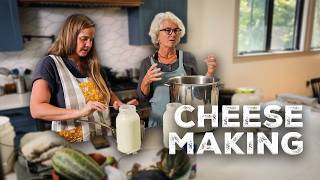
In this informal homestead vlog/podcast, host Victor (Speaker A) and guests—including cheesemaking expert Beth Dougherty, Luke, Tara, and Troy—demonstrate and discuss the full workflow of making cheese on a farm while simultaneously tackling other homestead tasks. The conversation begins with the need to warm fresh milk to body temperature, explaining how lactobacilli and rennet work best at that range. Beth outlines her plan to produce Gouda and cultured mozzarella, noting how yeast contamination and seasonal pollen can affect curd texture. They walk through the culturing stage (using warm milk, starter cultures, optional yogurt/kefir, and precise temperature control with a kettle), then the curd formation, checking for a clean break, and cutting the curd to increase surface area for whey expulsion. The group debates aging and storage options—wine fridges set to 55 °F, vacuum‑sealed bags, paper‑based wraps, and concerns about plastic leaching at higher temperatures—leading to a brainstorm about beeswax‑coated butcher paper as a non‑toxic alternative. Parallel homestead topics surface: pig butchering, rendering lard, various meat‑wrapping methods (cling wrap, vacuum, paper), and the logistics of harvesting meat throughout the year. The participants also touch on sustainability, community learning, Beth’s published field guides and books, and a personal fasting update from the host. Throughout, the tone remains conversational, instructional, and enthusiastic, blending practical demos with reflections on homestead life, health, and family.
Chapters
Did it stay pretty cool? Yeah, it stayed very cool in your cooler. That's right.
Okay, last night I freed this up while the carcass was still warm. I pulled this free from here, comes out easily this morning along with this. This is the, the nicest lard in the whole pig. This would be like your baking lard.
Happy day, guys. Happy day. We, uh, need the milk warm. Beth Doherty needs it for her cheese making. We're gonna learn how to make cheese today. You look thrilled. You don't like cheese? It's okay, but Lily let the sheep out. Oh no. Does she know this? I hope so. Making cheese today, are you excited? Yeah, you excited? Parting a pig. You guys can go learn how to do that if you want. After you. We need that milk warm. Let's go, she's waiting on it. Yeah, yeah, we'll have to become neighbors if the apocalypse comes because you look like a good idea. You just get with it. You're folding our towels. Oh well, geez, first time guest. I'm very impressed.
3 different kinds. You have the ones that are good enough to be in the bathroom, the ones that are good enough to be in the kitchen, the ones that are rags.
Yeah, I was literally shocked this morning when I was Cooking breakfast with Lily. Every single one of you came in here and said— you just started working.
That's what we do, huh?
You started working and then said, what can I do? That's somebody who really wants to help.
It's also somebody who's used to working. It's like, you don't— you sit down, you think, uh, it's not really appropriate for me to be sitting still. There's stuff to be done.
You know how much there is to be done living the homestead life.
Well, and also how much— I mean, like, folding laundry is a pleasure if you can sit and talk to somebody.
That's true. Sure.
I'd sooner fold laundry than sit and talk with my hands in my lap.
Right.
Preach. I got your morning milk.
Great.
Do you need more warm milk for what you're doing?
So you use warm milk when you're using— you know, ideally you're taking the milk out of the cow and putting it right in the cheese bucket. Most of the time I'm not, but for whatever reason there's a delay or I'm using cold milk. But the reason it's important, or it's valuable, to use body temperature milk from cows. That's exactly the temperature at which both the lactobacteria you're using for starter and the rennet are going to do their job the best. That's because the lactobacilli— the cultures in here— I'll use whatever you got. That's because the cultures in this milk are there naturally. They're there in her teat, not in her udder, but in her teat canal.
Isn't that something?
To protect the milk. And so that when the baby cow, when the calf nurses, its stomach gets probiotics put in it every time automatically. Milk is so nutritious that if it wasn't protected by lactobacilli, it would grow pathogens, you know, grow every germ that wanted to hop in and have a family. And a lot of that is stuff that you don't want in there. So not only do the lactobacilli put probiotics in your gut, but they also create a hostile environment for pathogens. They lower the pH, and they're perfectly happy at a low pH, but your stomach pathogens aren't.
Do you want this whole thing? This is 2.5 gallons. Um, so let me look at the recipe.
You get it right about here is perfect, because that gives me about 2 gallons to work with in here, and then I know what I'm doing.
What cheese are you making first?
So what I'm going to do is set up curds for a Gouda, and I'm hoping they're going to work perfectly. If they were to get funny on me, like if there was a little— if there's enough yeast, and in the fall when there's a lot of pollen in the air, sometimes you get yeast in your milk, um, that it made the curds, uh, bloat, they'd get bubbles in them, we could make mozz with that, but we couldn't make a Gouda with that.
Yeah, we know how to make mozz. Hopefully we can make Gouda.
Well, this is cultured mozz, so this is, this is, um, this is a different mozz, right? This is not citric acid mozzarella. This is a cultured mozzarella. So this is just milk.
You have to import Cinque Cassa.
Yes, right, and I don't use it.
It'd be nice to not have to do that.
So this is just milk that we brought from home. We were traveling and we had it along.
Oh, cool.
And I said to Sean, don't, if you're not, if you don't drink it, let it get warm, I'll use it for a culture.
Oh, good.
And so, like your nose would tell you, this is already a beautiful, mostly miso-feathered.
So it's more sour.
It smells like sour cream.
Yeah, okay.
Or cream cheese. And, um, that tells you that the culture is cooler temperature loving, like 70 to 90.
Yeah.
And, um, it's just perfect to go ahead and add some to this as a starter.
So if we were doing this, we'd have set out some milk last night.
Yeah. Or you could just use— you could actually use yogurt, buttermilk, or kefir to do the same thing. And you notice I didn't measure because it's not terribly important. The milk is already inoculated.
Okay.
But it would culture slowly if I didn't add some extra.
If you didn't have warm milk, could you just warm that.
Yeah, absolutely. If you're taking cold milk and you have to— and the cream has risen, what you do is— so we're going to stick this on the stove for just a minute. It's right about 88, and I like to see it around 93.
So we are going to heat it up.
So we're just going to put it and warm it up a little bit. It's got that thick clad bottom, so it's going to absorb heat fast into that.
Yeah.
And so I have to pull it off as soon as it starts.
I like your warm bag here. Oh, you sew? You actually sew?
Oh, there's an old bath towel. They're both old bath towels. A drawstring into it. Yeah, right. It just makes it a little bit easier. And this is actually two of them. This is one too, but I just spread it over the top.
All right, good, fantastic. That's just going to keep it warm for warming up. You're going to try to hope that cultures by—
it'll, it'll do all the culturing it needs to do by 9:20 in 7 hours. Then we'll add rennet.
Yeah.
And then, yeah, yeah. And then, then, I mean, there's a process.
You're hoping that does it in 4.5 hours.
It'll do it.
Okay.
I can't be certain it's going to be as firm as I want it to be, but if it isn't, we are going to fake it.
It'll— should we put it somewhere warmer?
That's fine.
Okay, good.
This isn't the stage at which it needs more heat.
Now, the only problem—
I'll be adding heat.
The only problem with taking that with us, it's gonna be cold over in that barn. Does that matter? It's gonna be as cold as it is outside.
Okay, we'll see what stage we're at.
Okay.
Um, because I don't actually cook it on a stove, I add hot water from a kettle to warm it. So I could even have a kettle over here, carry it over there, and do it over there if you like, right? You can do this anywhere.
That's neat. We can do it there. Literally stepped away. I literally say 30. He started at like 7:40 and you're almost done with half the pig. Yeah, it goes fast.
Wow, he's really good.
Really?
If there's any—
was teaching it.
If there's something that I'd like to teach people, it's that this doesn't have to be a long all-day process. Yeah, this can be something you do.
You don't even have to get pork chops out of this. This can be a roast. Exactly.
Yep, we've done a lot of times at home, we'll take this loin out boneless off of the bone. Yeah, and that, that I'd be done already. We'd be done and we'd be wrapping.
You coming to the film shoot? It's Everyday Bill bringing your kid to work day on the farm. In the film shoot.
What Brandon does is he cling wraps. So he'll cling wrap a piece very thoroughly and then wrap it and uncoat it. That's how he can wrap and uncoat it.
Okay. I wonder what Tara's using. She gets it— it's like uncoated, unwaxed, everything.
But it's like really thick.
He said what we have—
Yeah.
Maybe what she's using— why don't you show them that?
Yeah.
It says it's gonna freeze or burn.
Oh.
But we may eat this soon enough.
Right, or we could just put it in the— we could just vacuum seal it because that's what we know. Yeah, I don't care.
We're going for the most non-toxic paper as possible because we've raised— we've raised this thing— we've raised this thing on organic feed, no dewormer, no vaccines, nothing.
Rotated on like this for a long time, uh, so we hate to throw any of it away at the end. Very difficult trying to decide. I don't know, some— I got two different ones and both people said that they wrapped their meat in this, like there was reviews.
Why don't we try it for freezing?
How about we do— how about we just some of each?
Yeah, yeah, yeah.
And then in our experience, when we have accidentally bought un-faced paper, we've regretted it. But really, let's just do some of each.
I like that idea. And then you're going to be able to tell people which one. Yeah, that'd be a good learning experience for all of us. But this— does this— is this going to leach as bad as plastic?
I mean, it does have plastic coating.
I don't know if it hurts.
Okay, but everything's cold, right? So it's not going to leach nearly as bad.
So what I read is at 77 degrees, plastic does leach into our food at 77 degrees.
Well, the good news is this is not 77.
At a much slower rate, it's 77. At like 120, it's like rapidly leaching into—
yes, you don't want to shrink wrap a chicken, right? Because it's 180 degrees.
Yeah.
That we've eaten a lot of plastic. Yeah, with our shrink wrap chicken. So I feel, I feel better about this because it's frozen, right? Like, that's why we use vacuum seal bags, because like, what are you gonna do? Like, I would love to know, because people are like, how do you not use plastic? I'm like, I wish someone would tell me.
Look at all the plastic, because I have, I've looked and I've tried, right?
And like, in terms of putting it in the freezer You have to. You need something that's a paper barrier.
Well, where are you not going to get plastic?
Really?
Yeah, I don't know. What we need to do is all join a tribe, make a tribe, and then just eat the meat fresh.
I mean, that's what we used to do.
I know, that's what we did.
Yeah, see, now that would be very interesting.
I have looked for a beeswax butcher paper. I have not found one yet, but I have not stopped.
There's not a line of butcher paper.
I know, this is This is the product.
Maybe that's our product.
This is our product, is butcher paper that has beeswax on it.
All right, yeah, because this is straight up—
because I was like really hoping someone else had done that.
If it was me and I was, and I was demoing these three, if I was checking these three out, I would— I wouldn't do a lot of meat in these two because I do think you're gonna probably end up with some freezer burn. But I can do packs in each of these.
Yeah, just do a little bit. Just do a little bit in this and then let's do that and then let's just see where we go from it.
Right.
Now he said 3. Is this another one? Is this another experiment? So yes, and we all know how plastic turns out. Turns out great. Uh, vacuum sealed plastic turns out great.
Vacuum sealed, you can see what's in it. You've got long— you've got a long time. This, you've got 6 to 8 months.
Okay.
Which will you eat? Will you eat the hog? Oh yeah.
I know this is definitely gone in 6 This is gone. And we're eating this tonight, right?
So that doesn't need to be wrapped.
So that's—
how long will we eat this?
Well, it's double that because that's just half of it.
So your family just went through—
we easily 5, 6 pounds a week. Or yeah, 5, 6 pounds a week.
Honestly, that's the argument for the trailer is I can keep harvesting hogs throughout the year. I'm not trying to harvest everything in the winter. And have every— like, yeah, be stockpiled for the whole year.
Or I don't have to worry about, you know, if I have to get my butchering date, I'm stuck, right? I have to go with the butchering date.
Yeah, but if we can do it, we frequently slaughter a beef, split it 3 ways.
That's right.
Go through it and start another beef.
Do it until 2 days beforehand and you say, we really want to get rid of this cow. That's right.
Yeah, right. And we can drop everything and slaughter a Well, I'm not.
That's a good way to look at it. That's how we're gonna— we need to do our lambs that way. Don't kill them all at once. Just let him breed them when he breeds them and just harvest our lambs when we need them. Perfect for that. Lambs are so underrated. That's another reason.
30 minutes and 30 minutes.
It's just the perk of the job, learning some homestead stuff, seeing all these greats come through, learn the homestead stuff and get paid. Yep. Podcast time. Cannot wait to sit with these guys, mentors of mine in farming and life and faith and everything, parenting. We're really going to go deep with them. Sean, you ever been on an in-person podcast? Lots. Oh good. Yeah, the one with Brandon Sheard, was that live and in person? Yep. Okay.
Oh, we do a lot of them.
Oh good. Yeah, in person.
Yeah.
Okay, good. Well, hopefully we'll take you places you've never been before today. That's our goal. This will be a first.
So we're gonna wrap this up to keep it warm while we're working.
We're gonna be making cheese while we do a podcast, right?
And at this point, I can't even afford to joggle it too much. I'm just gonna lay these over the top.
She's a professional homesteader. Yes, she is. How many books you written by now?
Uh, the 8 field guides and then the 2 books.
All right, I'm getting a sneak peek of this one. Oh, I love these ones. Uncorrected proof, not for sale, not for quotation.
That's right, that's—
it's being printed even as we speak.
Heck yeah!
Look at this, the Dardis and then the, uh, Kocheris. They were, they were all cuddly. We're like sitting apart. They did ask us too. They did.
It was hard to get them all— get everything in the frame.
Look! He's got his arm around her.
Yeah.
How long y'all been married? It looks better when everyone's tight.
Yeah.
How long you been married?
Uh, going on 40 years. We're gonna be— that's how we're ending our Camino.
Okay.
On your 40th anniversary.
Oh man, now I got my first question.
Okay.
All right, it's gonna be about professional— how are they married 40 years and still sell textiles?
Oh, still so effective. There's a camera, bub.
Oh, look, a kiss. Do it again, do it again. Zoomed in.
So see how, see how this is holding still while I turn the pot?
Yeah.
It's because this is a curd and it's floating a little bit away. It is one big chunk. So a curd— milk is proteins, fats, sugars, and a bunch of vitamins and minerals. Suspended in water, or yeah, suspended in water. And what you're trying to do when you make a cheese is get those solids, the food value, out and get most, get most of the water out, keep the food value, salt it, and then it'll keep a long time.
Okay.
And so the way you do that is the way a cow's stomach would do it, which is you induce the proteins, which are long, complex, sort of origami-style molecules, you induce them to form a matrix. So they'll join up in a 3D network, and inside that network, all the fat and minerals are going to get caught. The proteins form the matrix, and then the other stuff gets caught inside of it. And because they're sort of— they, they like— they're like origami, they like to fold up in complicated shapes. Once they join hands, they begin to shrink as they're folding up. So you can tell that the matrix is there because we have this curd. Here's the other way we're going to check.
Did this happen?
Yeah. So I stick my finger in at an angle and I bring it up sideways. See that clean break, that clean crack?
That's like your finger with a sharp knife.
That's right. So that tells us—
we'll be doing next.
So that tells us that this curd is ready to be cut. And when we cut it, we just get it. We make a lot of little curds, so we make a lot more surface area so that more whey can come out faster. And the curds will shrink.
Thank you.
And we'll do this the rest of this process.
So we're gonna cut these, and I'm going about, I'm 3/4 of an inch apart.
So this is the same thing you would do for mozzarella, right?
Yes, it kind of starts the same.
The beginning concepts are identical, right?
Is Gouda the ultimate homestead cheese?
Yeah.
Or mozzarella?
No, Gouda, because it has more— because it stores. You can— you can—
you can You can age it for a long time and not at freezer temp.
You can just age it on the counter.
You can actually—
it's fascinating. I mean, the, the understood temperature for a cheesecake is 55 degrees, but over the years we've discovered by doing that you can do it in your refrigerator and you can do it on the counter. It's just going to slow it down or speed it up and change the results a bit.
How is Gouda consumed? How do you like eating it?
Is it like a cheddar cheese?
I think it's like cheddar. So we go down To the cheesecake, when we pull out a cheese, you know, like we've run out of the last one, so we get another one out and we bring it out and we cut a wedge. And we all, you know, whoever's in the kitchen always wants to taste it. And we go, mm. And then we wait a few hours because it's gonna— as it, as it breathes, the flavor changes.
Do you make a grilled cheese with it? Do you put it, shred it and put it on Mexican?
Whatever is appropriate.
Fabulous stuff with taking her homemade bread and then putting cheese on top of it.
Okay. Cheese sandwich on top of it, and it is just fabulous.
Okay, I love grating it. I grate it on everything.
So I put it on my salad, put it on, huh, potatoes, salad, everything, right?
Right. Like you put dinner and then grate cheese all over the top.
Put it on a fried zucchini and squash.
But we also just walk through and we slice off some and start eating it, right?
Right. It's just on the counter. It's usually not going to get refrigerated. It's just going to sit there and we're gonna eat it.
It's like cheddar, it's the most versatile.
Very versatile. But here's the other thing to remember. So imagine that it's spring and you've just calved out a cow and you've got extra milk and Rebecca makes 10 cheeses. And she puts them— we're gonna pretend for a minute that you have a place that stays about 55, so you put them there. And but you're not gonna eat them as fast as she made them. So that each successive one you eat is going— even if you eat them in the order she made them in, it's going to be older. So they're going to be different as you go along, right?
So how are we going to get a 55-degree area?
I found like a wine fridge.
Yep, those work really well.
You can set to 55, and it has the humidity also setting. Like, there's—
and so, yeah, let's do it.
I mean, I'm hoping it's still available. I did this research a long time ago, so that's my plan is to put in the garden kitchen, um, in the counter or somewhere down in the garden kitchen, this little wine fridge. And you can get shelves for it too. That's the other thing.
Now your answer, instead of buying that—
yes, I would—
is to dig into the earth.
Yes, that's right.
And get far enough in to where it sits.
Well, they have a cheesecake. They actually—
yeah, you would actually— for people who can get their hands on a wine cooler, let's just get started.
I would say do it, and here's why.
Let's get started.
To know that it's working, you need a certain amount of success that you can identify as success.
Yeah.
And it's really helpful if, if there's not too wide a possibility of variation. You can in fact age cheese in your refrigerator, and you can age it on your counter. But it's going to be really different, and you won't necessarily know whether— you won't necessarily feel successful about it. Whereas if you do it all in the, in the wine cooler, we know it won't be the temperature issue, right? You'll just watch it and you'll, you'll get to a little bit more. That's right, that's right, that's right. But for those who have to start with the rough and ready way, the important thing to remember is that when you take most of the water out of milk and then salt the results, the curds, they're not going to go bad. They're going to age in a lot of different ways, all depending on, okay, one, whether did I use the number one difference is going to be, did I use rennet or did I just let the lactic, the acidity of the milk, make my curds? That's going to make a difference in your results. And then everything else is kind of like, well, did I wrap it in a grape leaf and stick it in a box and then bury it in the garden, or— which is one of the ways you might age certain kinds of soft cheese— or did I, you know, leave it out on the counter and just flip it a bunch of times? Did I put a cake bell over it to keep the moisture in, so it was warm, it was moist, but not, not cooled on my counter. Um, you could do this just about any way, and the proof of that is that if you traveled the world and looked at all the different ways, and cheese is made everywhere there are kept ruminants, are kept, and ruminants are kept almost everywhere, right? Um, that the methods vary hugely.
Fantastic podcast. Faith, family, Land Homesteading, their new book. We talked all about these things, uh, that's coming this week. That'll come this weekend as we— when we don't have a vlog scheduled. A little fasting update: when I got up from sitting 3 hours with Tara and Troy, I almost cramped so bad I thought I might fall down. There, I wish I could say there was no stiffness. It was kind of like Walk slow, make some movements. It's a little discouraging being 6 and a half days in, 7 days, especially since it seemed like I had kicked it earlier on in this fast. But I am much less— I'm much less stuff. I tend to look at the negative. Still itching down there, the psoriasis. Look at you, Lily! Leftover turkey, leftover Tater tots, a roast, zucchini, a bit of rice. Boy, you really hodgepodge it together beautifully. Oh, I'm so proud of you, and I had to give you very little guidance. I thought hunger went away after a few days, certain days, but that still looks pretty freaking good. I'm very impressed. This is the lard from just one pig. Just in time because we're out. But what I'm impressed about is Luke did that while we're at the podcast. You made our— you rendered our lard.
Yeah, and that's not all of it. You got more down there.
Thank you so much. Oh, we have more lard down there?
Yes, there's some wrapped, so you could pop it out and put it in the crock pot.
But yeah, okay.
Yeah, so good.
So there's more to be made. There is.
Sweet.
Thank you. You like the lunch? I'm happy you went back for for seconds. That means you liked it.
I did.
I do. You going back for seconds? Oh yes, I'm so glad. That's the test. That's the test. All you want. I bet I don't want to be a part of the family, so putting away the food. Monster ham. It's 15 lbs. Might be the biggest piece of meat we've ever had in this pan. Scoring the fat. Rub: thyme, salt, pepper, olive oil, just to get it on there. Don't forget the lid. She did. Every time they leave, I like to hug them because you never know, you never know. Could be the last. It could be the last.
Come here.
And I don't tell them to be careful. I tell them to be dangerous. Because often doing the right thing is dangerous. And ultimately I want them to do the right thing. I have 20,000 thoughts, but I never am worried Rebecca and Beth are live right now on Abundance Plus. Replay will be available. They are live making cheese. Rebecca's learning how to make goat. I think that's going to be the ultimate homestead cheese.
Esoteric, expensive thing, doing this very easy homestead farmwife kind of thing that you can do.
We're seeing the Dohertys off. They're coming here directly. It's been a wonderful visit. I thought hunger went away. But I'm ready to kill some of that ham. Did you, uh, I know, did you, uh, tell me how that ham is? It was alive yesterday.
Yeah, because I haven't eaten it yet.
Can you take a bite? That might be the freshest ham we've ever had. Yes. Oh, it was alive at this time yesterday. Is it not insane? 7 days fast. It's a record for for me. It's rough. I don't think anybody talks about how hard this is. It's hard, but we're doing it and making progress a little bit by time. Going strong. Tomorrow's another day. Happy day.
More from Justin






If I had to start my Homestead all over again, it could only pick one animal… 




