Magical Permaculture Food Forest Sure to Impress | Our 3rd Visit | 2022 GreenDreams Update
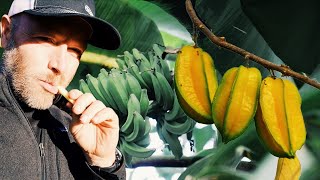
In this on‑site video, host Justin Rhodes visits Pete’s subtropical permaculture food forest in Florida for a follow‑up five years after their first tour. Pete explains how the system thrives on low‑input, neglect‑tolerant practices: massive mulch piles from tree‑service wood chips feed bananas and build soil; mycelial networks decompose organic matter, retain moisture, and facilitate plant communication. The discussion covers a wide array of perennial edibles—multiple banana varieties, jackfruit, starfruit, loquat, turmeric, ginger, chaya, moringa, Tithonia (Mexican sunflower), and more—detailing propagation methods (pups, grafting, tissue culture), the role of nitrogen‑fixing plants, and the microclimate created by a dense canopy of water oaks. Pete contrasts this approach with conventional monoculture banana farms, highlighting chemical inputs, pest vulnerability, and the loss of flavor in commercial fruit. He also critiques typical lawn care, advocating for replacing grass with edible, nitrogen‑fixing groundcovers. Throughout, the tone is conversational and enthusiastic, emphasizing the joy of harvesting fresh, diverse produce and the sustainability of perennial food forests.
Chapters
One of the most amazing farms. We discovered this— where are you going?
I didn't want to be—
come on, you got to be in the big shot. Come on. Uh, on, on the Great America Farm Tour in 2017, Pete, we now come to call Uncle Pete. Man, this is ridiculous. This is your backyard.
I know.
People talk about food forests, but you're living food forests.
And you guys get to see it, you know. I mean, 5 years ago and then today. Yeah, that's kind of the whole idea with the food forest, you know. You, you plant it, and if you do walk away and don't manage it, what does it become? It becomes a forest full of food, you know.
So that's what's happened since 5 years ago. This has not just come become a weedy mess, this is just still productive.
5 years?
What have you been doing? 5 years. So we'll link the old video down in the description and your channel and all that good stuff. Give us a tour, show us.
It's been too long.
What's the same? What's, what's, what's different? What are you gonna do with this big mulch pile? This is gigantic.
So we get a lot of mulch delivered on the regular from tree services. You know, I found some local hookups and they're constantly dumping in the front yard. And that's how we feed our bananas. That's how we feed our entire farm. So we're growing, you know, hundreds of different types of fruit trees, multiple different types of bananas. But obviously the main thing we're growing out here is soil. We're building soil. And just like Jim You know, my main source of nutrition is the mulch. So this is just kind of in a close range of the bananas. In spring, I'll go around with my little Kubota and put piles next to all my banana clumps, you know, and that'll start to feed them. There's no irrigation, we don't use fertilizer, you know, that's the whole idea here. Things are just kind of thriving on neglect.
Yeah. Is this a banana tree right here with some mulch around it?
Um, so that's a banana tree right behind it. This is a ginger. These are native ferns.
No, this is a banana tree right here.
This is the This one, that's that turmeric.
So what do you do? Like, so growing underneath the ground obviously is the root.
Yes.
So if we wanted some ginger or turmeric—
so this is a type of ginger called a shell ginger. This one's a little bit soapy, maybe some medicinal type uses. But we grow, we grow like shampoo ginger, we grow regular edible ginger, we grow yellow turmeric, black turmeric, you know, green tuber.
So like, we pull that up there would be the tumor.
Yeah, we could actually pull that up.
Do you want to?
Oh look, he's getting down and dirty. Look, he's taking the— don't be fooled, he's wearing a Carhartt jacket and it's, it's a big 59 degrees.
It is cold.
Oh look, he's going digging.
Okay, so this one had a lot of mulch dumped on it. See what kind of rhizomes we have formed. But you know, everybody knows that, uh, You know, organic turmeric. Oh, it's all breaking off down in here. I can— you don't want to do that.
You—
oh, you are?
You're going to harvest the whole thing?
Yeah, why not? We can replant it. This is—
how do you replant it?
So the best way to replant this— and you can see that's a big piece of the rhizome. This is a white color.
Nice. You would just—
turmeric.
Yeah.
And I would just break this up and, you know, just like plant each one of these little fingers would become a plant.
Oh, okay.
So there's actually a bigger, bigger chunk back down there.
You go put it in your nursery first.
Well, you know, maybe.
Or do you just throw it over here in the—
well, a lot of these— so turmeric wants to be in the ground for about 2 years for maximum production. So every 2 years we dig them up, we split them up, we divide them. So a certain portion goes back into the nursery, a certain portion goes back in the ground to grow back out. And we just keep expanding our varieties and more diversity. So these go to sleep in the wintertime. This is getting ready to go dormant. I'm actually surprised to see it this green. I mean, the whole farm right now is sleeping. Bananas stop growing when we get into the 50s. So you've never been here in the middle of the summer?
Yeah, this is a banana tree right here, right?
That's a banana tree right there.
You fed it heavily. Are they heavy eaters?
They are. So if you know, if you have a banana tree and a banana is not fruiting, it's because you're not giving it enough nitrogen, you're not giving it enough organic matter. They like a little bit of water. With that being said, I use no irrigation, but because we have them in this dappled light understory, I might not be getting the production you would get in full sun. But bananas evolved as an understory species in a rainforest. You know, these didn't pop up in the middle of a field as a pioneer species, you know, fixing nitrogen. So, you know, we don't get the production you would get out in the full sun, but everybody, you know, needs to realize that Florida gets frost, Florida gets freeze, you know.
I mean, yeah, you could have it freeze.
Coconuts— I can't grow coconuts, I can't grow mangoes, you know, but bananas will recover from a cold winter.
Pete, if that's your coat at 60, What's your coat look like at 30?
Oh, you can just see my eyes, you know. I'm completely covered up.
I mean, what you do too is you just have more bananas, more banana trees to make up for the lack of production because you don't have full sun.
Just filling space, you know. Everybody told me when I bought this farm, oh, it's too covered in trees, you're never going to produce anything, you don't have enough sunlight. Well, I found plenty of things that are thriving in this dappled because you got this Florida oak.
These beautiful Florida oaks, right?
Covered in water oaks all over the whole property.
And you didn't look at them as a problem, you looked at them as a solution.
Well, you know, we're not only taking advantage of this high canopy for a microclimate. People don't realize that when we get a frost out here, I can be 32 degrees out in the field and 38 degrees underneath here because of that, you know, greenhouse type of effect we're getting. So it's allowing me to really push that edge, allowing me to plug a lot of things into the understory of what would have been non-useful space. It's quite usable. I mean, you know, everywhere you look there's a rack of bananas. This is a jackfruit tree. Um, this is a spiraling ginger. This makes a really nice edible flower. You know what I've realized from planting in the understory? Some things obviously are going to thrive more in the understory, some aren't going to do as well, you know. So we're planting more of what does good.
What does not do well?
Well, you know, mangoes are not very productive underneath here. That's a really interesting variety of bananas. I was just looking at that, I was like, this is That one's called praying hands, and it's like this, like two hands. So when a banana makes a rack, they call it a rack. We can go back here real quick. This is the flower stem. There was actually just some bees on this, and that's the rack. This is a fairly small rack, but coming down that rack on that, that stem, they create individual hands. So when we harvest that rack, we actually take it inside. As soon as one starts turning yellow, hang them upside down, and as they ripen, we'll eat them. I think I have a ripe rack ready to harvest.
So commercial farmers for bananas Do they feed their bananas like this?
No, but they do manage them really well. So I was in Costa Rica a couple times, and you know, it's actually a sad sight to see. Every rack of bananas has a plastic bag around it. Um, they almost have like railroad tracks going through banana groves. So these, you know, these guys are out here harvesting, they stick them on a railroad, but the bananas are just flying down these rows and sprayed with planes. You know, bananas commercially, you know, produced are highly chemicalized. There's lots of disease problems. I mean, you guys probably have seen these articles, you know, bananas are on the edge of extinction. You know, it's because just like with everything else, like we have a citrus problem in Florida. Anything we're going to grow one species as a monoculture, nature's going to find a way. We're going to have a super pest. So I had one time I was a collector of bananas. I had 50 varieties. I probably lost 10 to 12 of those, and I'm in the mid-30s right now. There's hundreds of varieties. And yeah, that's, that's the message we've been trying to get out is this, all these, this wide world of fruits, all these different things that we can grow. I mean, there's 40,000 edible species of plants. And inside of that we have varieties. You all know how many varieties of apples there are. I mean, what, 20,000 varieties? So we're not scratching the surface. We're not seeing anything in the grocery store. You know, this stuff that we can grow on a home scale, it just, it doesn't even compare.
I, I hear, because I don't eat bananas, that homegrown bananas taste a lot better than the grocery store bananas.
I can't eat a grocery store banana. I'm kind of like a banana snob now. I've been ruined by homegrown bananas, and it's a good thing.
We're gonna eat a banana.
We're gonna find a small rack of bananas. This is not the time of year for banana production.
This is, uh, January.
Yeah, so this is probably one of the more exciting trees I have on the farm, and one that if you were to tell people that know anything about plants, especially subtropical plants, you can't grow that. That's what I've been told for years. You can't, you can't grow that. This is a jackfruit tree. Oh, I have one in the driveway by the house that has flowers all over it, you know, that has a really nice trunk on it now that can support fruit. Jackfruits are the largest tree-borne fruit in the world. Huge. I mean, it's like they, they compare it to like cleaning an animal because it's kind of a mess to clean this fruit, but they're just absolutely delicious. They derive the flavor for Juicy Fruit gum from these fruits.
Really?
Um, you know, that's a— it's a compact fruit, almost kind of like a pomegranate where there's arils inside of there. I really needed to overlay a picture of a jackfruit, but yeah, they come off the trunk of the tree just like the japodacabas do. We call that clifforous production. That's how it's able to hold that weight of the fruit. I mean, they can get up to 180 pounds More commonly, you know, 30 to 40 pounds, but that's like that world record jackfruit.
We should talk about this, Pete. This is your property line. This is what a typical forest would look like in Florida. This is what a food forest looks like.
Yeah, yeah. So Justin, as that mulch starts to break down, you'll see, I mean, you know, the mycelium starts to take over. We start to see all these little white webs in there and You know, that's like the, the internet of the forest. You know, it's, it's 2022. You know, if we don't have internet, you know, what do we have? This is how the plants communicate. This stuff breaks down to be black gold. You know, the, the mycelium can also take humidity out of the air and transpire it as water into the soil. Really, it's how we're able to not have any type of irrigation in here. So it's, it's just amazing, you know. I mean, there's lots of studies, you know, Paul Stamets, things like that, where, you know, one plant starts to get a pest, the other one gets the pest, and they'll both die if they're in the pot. But when they're in a, in the soil like this and they're inside that mycelial web and they're able to communicate communicate with each other. The other one puts off the sensors to keep the pest away. You know, we just— there's so much we don't know out here.
Do you only get the mycelium in the wood chips, or is it also in soil?
I only— in wood chips.
Only wood chips.
Only wood chips. It needs that fungal layer, you know, that—
if I'm not using wood chips like in my raised beds, then I'm not getting that in my raised beds.
And that's something I do suggest to all my clients. You know, as you can see how well Jim does with it. Not only is your raised beds and your vegetables are going to stay cleaner. You know, when it rains, you're not going to get as much dirt. You know, if you don't know what I do for a living is I get to rip out people's grass and put in these edible ecosystems. That's what we do for a living, you know, design and install. I hardly have any time for my whole— my own place. You know, Justin asked me when he got here, you must do a lot of work and maintenance. I hardly do any. A couple times a year we come in and reset and prune. The girls that work for me weed the driveway, things like that. The whole idea here is, I mean, like, yes, this could be pruned, you know, yes, it could get a little bit more love, but it's thriving on neglect, you know. I don't have the time for that.
Yeah, so you pull out people's grass and you plant these things.
Yeah, so I could have dived deeper into that grass hole. So my grass hole, it's like, you know, grass is one of the most— in on the urban scale, one of the most wasteful things in the world. You know, we're using irrigation, we're using chemicals, we're using insecticides, we're using fertilizers, especially here in Florida where this stuff is running off into our waterways, our estuaries. You know, it's feeding our red-tied mollusks, you know, and we're not all kings. We don't have to have these pretty yards with no weeds in them. I have nothing against grass that has some weeds that thrives on neglect, but by a grasshole, I mean, yeah, don't be somebody that's out there overwatering their yard, overchemicalizing your yard to just have this green pretty yard. I mean, you know, look what's going on around the world today. You know, there's better things we need to be focusing on. And, you know, so I get to come in and rip out this entire yard and throw it away and plant a system like this. Pretty, pretty awesome job. I feel pretty lucky. Okay, so can we have bananas where we are? You know, not really.
We're in North Carolina. I wouldn't.
Casey, uh, Casey has one, but I believe it's more of like an ornamental variety.
You're just gonna have to stick with apples and peaches and cherries.
But I just would love to have like, I don't know, that's the hard part.
You're inspiring her to grow bananas.
I know, I'm inspiring her to grow bananas.
I think he should be inspiring you to grow what works in your place.
Yes, he is.
You guys need to get some pawpaws. Pawpaws.
We have a pawpaw.
These are pawpaws.
No, no, no, you guys need to get some pawpaws.
Oh yeah, pawpaws.
I was going to say, this is probably one of the most—
Is this the Moringa?
No, I have those in the full sun. This is probably one of the most productive trees we have. This is a carambola or starfruit. I grow about 10 different varieties, and this is probably the only one that doesn't have fruit on it right now. These trees make about 2,000 pounds of fruit a year. And if you guys have ever tasted starfruit from the grocery store and you're watching this and you're like, oh yuck, Just forget that memory. Those are gassed, you know, they're picked green, they have no flavor, they're not sweet. You know, this is very hydrating, very sweet, they're delicious. We'll eat one here.
So are we gonna eat one? He knew, he knew what I was gonna say. Are we gonna eat a star fruit?
We're gonna eat a star fruit.
More bananas.
Yeah, so this is a pretty decent sized rack. This one's a little better up in here. This is an Orinoco variety.
Yeah, Rebecca's asking what's this vine going up this tree. It is just such an exotic feel in here. This is not doing it justice, this camera. Oh, that's nice. You know, the camera's not quite doing it justice.
I, I think you guys mentioned it last night, and I mentioned to Justin, it's been 5 years since you guys have been here, you know, and, uh, that really resonates with me too. And Justin said, you know, it's hard to leave the house. It is, you know, when you, when you build out your homestead and you plant out these trees and you're growing food, you know, it's hard to find something that's better, you know, on Jim's small scale, on my 12-acre scale, at your scale, you know, it's like You're not escaping something where most people, the everyday person, you know, they're escaping. They're living in that box life. They're living in that tight neighborhood apartment, whatever it may be, trying to get back to nature. When you live in this, you don't want to go.
Yeah, I know. We have lives that we don't want to escape from.
So Rebecca's asking about the firebush. This is a native plant that we grow here that's more for like the hummingbirds and the butterflies and the beneficial insects. Very medicinal, very healing. You can actually crush the leaves up on this one and use it for stings, burns, poison ivy, anything like that. It'll kind of calm it down. So, you know, that's another thing to mention.
Not everything here is edible. Some of it's medicinal.
It is all edible, right? But not just us. You got to remember, we're feeding the beneficiary, you know, the predatory insects. You know, it's about creating this diverse ecosystem, you know, where if I don't get to it all, nature's going to eat some of it.
Yeah.
What do you got, hibiscus flower?
Yeah, so not many people know this, but all hibiscuses have edible flowers. Some are really, really delicious. We grow about 10 different varieties.
Is this a lame one or a delicious one?
This is what I would consider to be a delicious one. This is what we call a Turk's Cap Hibiscus. And right when you see that little end piece start to come out, that's when you know they're prime. And you kind of just pop it out of the cap like that, eat that end right there. The whole flower is edible.
So you'd put that on a salad, so you put that on the salad and you have a fancy deal going on.
Wow.
The tail end has a really nice sugar sweet to it.
It does, right?
They're quite amazing. We have pink ones, white ones, red ones, you know, so And this is like a garnish on a plate. We plant these in the food forest for the client. You know, it's attracting beneficial predatory insects. It's a garnish to eat. So this is a multi-function plant.
Wow.
Justin, come on, let me get you, let me get you.
Come on, come on.
All right.
Yeah, I don't think I've ever eaten a flower before.
What do you think? Was that breakfast?
Yeah.
Wow, we gotta get that started.
A tease.
All right, so everything that I grow here is obviously perennial-based and fruit trees. We kind of moved out of the annual garden thing a few years ago and Yeah, this tree right here behind me, you know, I put this up there with like moringa and a lot of these other trees that are super tough and easy to grow. I can literally break a branch off this thing, leave it on the ground for 2 weeks, and come out here and stick it in the ground. It'll grow. This is called chaya. It also makes flowers that are great for beneficial and predatory insects. I always see butterflies on it. It's twice as nutritious than spinach.
Oh, you eat this?
Grows like a weed. We don't eat it that much because we have so many better greens, but it's a pretty plant in the landscape. I look at it as—
if we had to survive, this is a survival food.
Like, I could take this plant and make 10,000 plants, you know, same thing that I could do like cassava, same thing we could do with moringa. So, you know, things ever did get worse, my neighbors start asking about this, I'm giving them chaya, I'm giving them moringa, I'm giving them cassava. These easy-to-grow plants where this one does have to be cooked, um, it has like a cyanide that off-gasses, you could say.
What's your case against annual gardens versus this perennial system?
I think annuals are delicious. I buy Jim's vegetables. I just, you know, because I'm so busy with my day job, I don't have time for it, you know.
So in other words, this is easier?
This is easier, yeah. I mean, there's always greens out here if I want to harvest. That's it.
Who doesn't want that? Like an annual garden?
You go support Jim.
That's it.
I'll support Jim and his effort. You know, we put in gardens for clients and stuff, but you'll stick with the easy one.
I don't have the time. No, you know, and Jim's growing me enough of my share every week that I don't need to grow it, you know, plenty to eat.
So you're talking about Jim Kovaleski, the Nomadic Gardener, by the way, the guy who's farming Florida in the—
what is this?
Winter and Maine in the summer.
So Rebecca asked about this one, and I think this is a really important one to talk about. This is known as Tithonia diversifolia. This is like our—
remember that, Rebecca? What, wait, what, what'd he say?
Cthonia diversifolia. I'll try it.
Cthonia diversifolia.
The reason you say the botanical names of some of these plants, because this has 15 different common names. They'll call it Mexican sunflower, Bolivian sunflower, you know, all these different countries want to claim this plant because it's so amazing. So this is a perennial sunflower, but what's so important about this plant is we grow this as our fertilizer. This plant is pound for pound equal to chicken manure. So we chop and drop it. It grows 6 foot a month. You know, this is a biomass plant. This is a mulch plant. This is a fertilizer plant. This makes flowers. You know, this is another one.
Can it grow anywhere, or is that just tropical?
So just so y'all know, like I said, you guys aren't here in the prime time of year. It's not summer. Things get way more lush this time of year. There's been years where this place looked like, you know, a bomb went off, like a fire came through. Everything is just black. So we get frost, like I said, we get freeze, we get into the teens, 20s here in Florida. These plants, like I said, thrive on neglect. Everything comes back. The bananas come back, the chaya comes back, the Mexican sunflower.
But no, this is subtropical. You can't grow this everywhere, right?
But this plant is, you know, this is one that I've sent samples off to colleges. They're making liquid fertilizers with. They're sending them into, you know, third world countries where they have no access to fertilizer. So super powerful plant. Look, I mean, this is how we lay it down on the ground. You know, and after it grows— and I really like to grow them in relationship with like clumping grasses. This is super high nitrogen, the grasses are super high in carbon. When we lay them on top of each other, because this breaks down so quickly in the sun, you're kind of getting that carbon-nitrogen ratio with that breakdown when we're laying it on there. So the, the grasses are almost shielding this, you know. If I lay this out in full sun and a 90-degree day here in Florida, it's just going to disintegrate, it melts really quick. We want to have more of a slow-release fertilizer, so that's why we kind of When you look in our food forest areas, we have the grasses and we have these very close to the fruit trees. And the idea is you come through, you chop drop, you lay this on the bottom, you put the grasses on the top.
I mean, but isn't this like the solution to all the, the fertilizer issues that Florida has?
100%. Like, between—
you know what I mean? It's like when you're saying like, this is this, and I'm like, why do we even have— why, why are they having chemical fertilizer issues? In the state of Florida if we have this? Do you know what I mean? Like, it's kind of frustrating.
Tell us all-knowing Pete.
It kills me, you know. And, uh, it's, it's a highly money-driven industry, unfortunately, you know. Yeah, you know, between this and nitrogen-fixing plants, you know, if a certain amount of our plants are nitrogen fixers— so I think it's, um, 30% of your overstory or 70% of your ground cover are nitrogen-fixing plants you never need fertilizer, you know. So just by growing these trees and plants in our systems, you know, we're not going to need any kind of fertilizer.
So like, for the people who are not in Florida who want to not use fertilizer, they just need to grow nitrogen-fixing plants that are for their region.
They just need to cut their grass and mulch their stuff with grass.
Yeah, yeah. Like up by you, I think you have like a mimosa tree. I believe I've seen it all the way up through Georgia and up into North Carolina. Some people would call it invasive. Yes, those are the type of plants, you know, those super tough, those are the hard workers, you know, those are the ones that come in and fix soil, those are the ones that pioneer empty lots, those are the ones that when we plant them in our syntropic agroforestry food forest systems and come in and prune them, you know, they're feeding all those other plants around it. So certain plants have a, you know, a symbiotic relationship with soil-borne bacteria, and they can take the air we breathe and literally turn it as fertilizer into the soil.
It looks like it's gonna be banana time. Oh, not bananas, star fruit. I see it, I see it. Is this normal for a star fruit tree to be so tall?
So yeah, it's important, you know, we have very, very dense spacing all over the whole property. This tree is ready to be coppiced after it gets done fruiting heavy this time. I'm going to whack it down to 8 to 10 foot. Um, it's going to really stimulate the roots and get a lower height.
Look at this branch, you'll probably find one right there.
Cow.
Oh, that's a smaller one.
Henry was eating the star fruit last night.
He loves it.
Did he? Yeah, he did. He liked it.
So this one already got—
chickens are checking you out.
Bite from nature, you know.
This little compost, you know how it is. Little compost corner there.
That's it. Wow, nice.
Okay, you gotta slice them open. Let's have— yes, have a taste.
I wish I had a knife.
I got it.
That's why it is called Star fruit because they look like little stars.
Yes, that's just what you do, eat the skin and all, huh?
Skin and seeds, everything. I can smell it. That was a good one.
Good. Tastes nothing like this. You have to, you have to have the whole bite right there. This is not really a fruit person, but we'll see how it goes. I'm here.
The texture's a little—
I mean, not in a bad way, but for me, I'm not somebody to ask. Yeah, this is like a—
you don't want to ask a little bit of an orange feel to it.
It's got—
are you eating star fruit too, Chris?
Seeing stars? Are you serious?
He's got thick ones here.
Yeah, I mean, this can go on a drink, you know, on the edge. They can also be dehydrated, they can be juiced, they can be eaten fresh out of hand. There's so many different ways, but I think it's getting that flavor, you know, fresh off the tree compared to these green gassed ones. Yeah, yeah, no comparison.
Henry likes it. His taste buds haven't been tainted yet. Go ahead, Lily, try one. She's been swimming.
You don't like it?
She'll tell you the truth. Well, we're out about to eat bananas. You like a banana?
Not much.
Really? She's your daughter. What do you think?
Good.
It's delicious.
They're fans and they will tell you the truth. The chickens like it. What's this?
So this is a Louisiana sweet variety of sugarcane. We've selected this from about 40 varieties and this variety is just extra good for juicing. Um, this is the time of year the sugarcane needs to be harvested. And basically, like, you could restart it from the cuttings here with the roots on them. Yeah, pick them back in. But typically they're planted in spring, harvested in fall. You can make cane syrup. Cane juice, but this is nature's sugar.
So if you ran it through a juicer—
I have one—
you would get cane juice, and then you could dehydrate that to have cane sugar.
Yeah, so I think they actually boil it. Okay, they cook it into like a syrup.
Okay. Yeah, he's broke this, and now you're gonna peel it off. You're gonna show us the syrup?
No, we're gonna have to— we would have to juice it and cook it to actually get the syrup. I'm just giving the kids something sweet.
How do you think they figured that out originally?
Yeah, that's, that's been going on for 100+ years, you know, all the way up into Georgia. They used to use donkeys to actually, you know, turn the, the crank that would actually make the, the liquid. And then, you know, they'd have these big pots.
I'd like to have been the guy who would have discovered it, huh? He'd been the head of the town. Cool.
We've come so far away from sugar today though. Yeah, all this processed sugar where it's GMO. Yeah, it's terrible, you know. And then, you know, unfortunately, the way they grow sugarcane here in Florida You know, it's destructive to the ecosystem too. They're using too much fertilizer. I mean, I've been growing this stuff for years. I've never put any fertilizer on it. You know, I mean, it doesn't need any kind of love and the juice tastes amazing. So it doesn't need the chemical fertilizers.
Look at y'all steaming or swimming. Was the pool water warmer than the air?
Yeah, it was.
Steaming.
It was?
Are you gonna chew on that?
You gotta like really chew on it.
Yeah, sweet.
That's pretty neat.
So somebody just fiddled around one day and chewed on this plant, and they're like, hmm, I can see the old Seminole Indians sitting around, you know.
Um, you know, they used to grow pumpkins up the trees.
Yeah. Do you think they figured it out? You think they just chewed on it, or do you think they figured out how to extract it?
Started with the chewing on it, you know, and then sitting by the fire cooking it down, you know, just some kid fooling around. We've moved pretty far away from this originally, probably started, you know.
Wow, it's very sweet. Boy, they were like— when they found that, man, they'd probably give it to little kids like this to give them a chew toy.
So these are loquats. Um, if you're from Florida or from the South, you might have seen these or eaten these growing up. We grow probably 15-20 different grafted varieties. Loquat's commonly confused with a kumquat. Um, you know, kumquat's citrus. This is actually in the rose family. Um, yeah, we've got orange ones, yellow ones. This one's actually called Yohuda, and it has a little bit of fuzz on the outside. So what I like to do is just kind of rub it on my pants and it'll polish it up. And we're going to let one of the kids or Mama or somebody eat this one.
Do you want it? Here, do you remember it?
Wipe them off, wipe it on the towel. You just want to take a little bit of that.
These are not commercial. These were— these are not commercially available.
These are so good.
They are, right? Like a creamsicle. We have yellow ones, we have orange ones, we have ones of sweet, we have ones with more sub-acids. Wow. These are all grafted trees. You could grow this tree from a seed, but just like your kid, every kid is different from a seed. This is why with commercial production—
wow—
and we graft so we get that clone.
Rebecca said this— yeah, this tastes like a creamsicle. It is so good. We want some more of those.
All right, all right. Yeah, that's delicious. Oh, that was okay.
Got the kid stamp. Oh, this one's a little yellow. Let's go down to that other one.
So what do you do with them yourself?
So I mostly have these trees to have the plants, to have the varieties for propagation, rootstock for grafting, to create more trees. So I don't get it, I don't have enough species for people. Yeah, we don't have enough of one species for commercial production, but there's enough for— there's always different varieties coming in, there's always something to eat. That's kind of the idea. We walk around here and we laugh, we eat fruit. Yeah, enjoying life.
He's deciding if he likes it or not.
Oh, he's going for it. Oh, boom!
That's a pretty big Yohuda. Um, most of my varieties, like Christmas, started around Christmas time, and they'll come in all the way through April, so it's non-stop.
Who wants this big one?
Who's due?
Oh, Mom takes it.
We're sharing it, it's so big. It's like a peach.
Even the sour ones are good. That last one I had was kind of sour, but it's okay.
Not quite all the way ripe yet, but delicious. You know what time it is?
Banana time.
Banana 30. Worked. Let's go cut one down. All right, I see a couple that actually already came off the stalk, so I think the animals beat me to this one, unfortunately.
Oh really?
You noticed this when I was going out of town.
Oh, you're gonna cut down the whole thing?
So when a banana tree fruits, it actually dies. There's always a pup coming up and taking its place. In a perfect situation, you have 3 bananas: one fruiting, one midsize, and one pup. If you notice, some of my clumps— and they call it a banana clump— had 5, 6, 7. That's kind of wasting energy where we want to focus all the energy into the one that's free.
Yeah, I see some bananas there.
Oh, they're there, but I think we lost a couple since last night. I think the animals might have been here.
We'll see what animals. Um, typically you got no monkeys, huh?
Raccoons.
Raccoons, they climb the tree?
They can.
Look at this. What do you do with this stock?
So I will just chop and drop the stock. And we'll lay this down for basically mulch.
I'll put it inside by one of the bananas. All right, are we ready? Yeah, go for it. These are little miniature bananas.
Whoa, get it!
Have you been harvesting this?
Um, a bunch fell off, so the nature has beat me to it.
Here. And this is not actually the seed. No, there's no seeds in this. That's not how bananas grow.
Little tiny seeds.
Tell people how bananas grow because I just learned that and I didn't know that. So those little black bits inside of that are not seeds.
They've been bred away from those seeds, even some of these more wild varieties.
Yeah. So how do you plant a banana then?
You start from a pup, but commercially they're taking them.
You got to tell people what pup is because I don't even know what a pup is.
A pup is a baby. So you would dig up a baby, or they do them commercially Yeah, there's little pups coming up there next to it.
Oh, okay.
That little guy that's coming up, so they stem off of it. Yeah. And you know, they— in commercial production, they use a method called tissue culture.
All right.
It's done in a lab to kind of spread them.
Okay, have a bite.
What do you think? Was it any good? Kids are eating it.
Yeah, better than the store.
All right, hold on. Oh, and so when I go inside and actually hang the bananas, I'll hang them up inside like this.
Well, these yellow.
Oh yeah. So as they ripen, so as soon as the first one starts to yellow is when you want to take them down. And you can see they're just going to start yellowing out more than this. Who didn't get one yet?
Me.
You?
I got you, little man.
I'll take more. I know I'm gonna like this.
You guys can have them all.
Just let Henry have a little bite. Just a little bite. Open up.
See, I got mama's milk. I'm good. I had fresh bananas in Hawaii and couldn't stop. I had it for breakfast one morning, the only thing. Lots of bananas. There's something about that. There's a different flavor about such a fresh banana. It's firm. Thank you so much, Pete, for the tour. It was about right here. Well, This is about where we started years ago, 5 years ago. Oh no, it's way over there. I got you started on YouTube.
Where's my phone?
I know, I was like, what's stopping you?
You just said the whole idea was no edit, quick videos, wouldn't get anything crazy going.
You go extreme, buddy. You, you go over the top.
Well, it's probably one of the best things that ever happened to me. Thank you for getting me started.
Yeah, good. Yeah, I started him out. He just said— he said— I tell people the story all the time. He just set his phone I said, look, just set it up on the tree there and just go to town on— what was it, the moringa or something?
The Mexican sunflower.
The Mexican sunflower. It was just one, no cuts, no edit. And now you just go over the top with these really nice polished beautiful videos.
Thank you.
At Green Dreams TV.
Oh, you got the same hat.
All right, go check out Pete. I'll leave link in the description, or you can just go to Green Dreams TV. Thanks, guys.
More from Justin






If I had to start my Homestead all over again, it could only pick one animal… 




