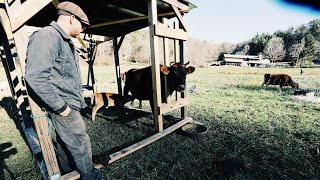
In this 20‑minute vlog, Victor (Speaker A) walks viewers through a typical day on his small mixed‑species farm, blending practical DIY projects, animal husbandry challenges, and reflections on regenerative‑ag practices. The video opens with a quick check of the weather, boots, and a visual of a frost‑covered crop, then shifts to a hands‑on build of modular fire‑wood racks using 2×4s and a board system designed to keep wood off the ground and easy to access. Victor explains the design rationale, measurements, and adjustments made on‑the‑fly, illustrating a trial‑and‑error approach to farm infrastructure. The core narrative follows the fourth day of trying to get a cow named Flossie to adopt a newborn calf. Victor documents the calf’s hunger, Flossie’s reluctance, attempts with alfalfa, positioning, and gentle coaxing, interspersed with moments of progress and frustration. He shares his emotional state—hopeful yet questioning the effort—while Becky offers encouragement. The vlog then transitions to a brief tutorial on assessing grass readiness for grazing, showing how Victor counts dead stems to decide paddock size and timing, and he references his learning sources: Greg Judy, Richard Perkins, and Joel Salatin, highlighting their influence on his regenerative‑ag philosophy. The episode closes with family moments (heat‑pump issues, meals, birthday wishes) and a call‑to‑action for viewers to explore the recommended channels. Throughout, the tone is conversational, instructional, and candid, providing both concrete farm techniques and personal reflections on the challenges of small‑scale regenerative farming.
Chapters
Look what I found. Will those fit you? The other one's up there. You want to go warm those boots up and come out at milking time? Yeah. Okay. Heavy frost last night. See how the COVID crop held up. Doesn't that look nice? Doesn't that look much better than the plastic? I like it, I like it.
Papa, we did all the chores besides milk and move the sheep.
And look, it's only— I think I know your motivation, but what's your motivation? It's only 7:30, guys, and you're done with chores. Sometimes I can't even get you out here by this time. So what's going on? We want to go build yourself Lego. That smile. Okay, for a little bit. And, uh, Arun and I are going to— well, we need to make stands, racks, firewood racks. I got these handy dandy rack stands. 2x4s go in them. And my idea is, well, if you have multiple stands here and you run out of this wood, you don't want to be able to— you don't want to have to step over a rack. So you can pull out your— you can pull out your 2x4 and get it out of the way. And we can go vertical from there to the roof. And we're going to put it on this board because my buddy Ben Holler said, you know, he didn't— the only thing he didn't like about these things is the wood gets rotted and warped. Well, because if you did it just on the bottom, yeah, it would. That makes sense. So I'm gonna help elevate it on another board. I like it there, but I think we'd have to dig that out to put it on this side. So maybe we'll put it back on the other side. And besides the weight of the wood, that'll help because it'll also be The board will be leaning against the truss there. Well, we should have done— we should have done that one first. So close, so close. Shoot, I wish it was a little further out, uh, just to get a little further away from that wood. Trying to think of the easiest way to do that. Well, how did that— how'd that go? Yeah, but most of them aren't that short. I reckon we can just do it. It's right there. Yeah, that's pretty good. All right, way to measure, way to test. We got it stacked about this high, probably go maybe 2 or 3 more feet. It's amazing how when you stack something, it's so much more efficient, takes up so much less space than if you just throw it. We've got— we're gonna— I've got the measurement now. We pretty much have to go 8 inches off of that. On either side, so 16 in between. I wish I would have maybe thought about that. Well, I didn't know until I started stacking. I wish I would have made that 2x6 a little longer, but we'll just have to add an extension. All right, milking time. My hope is that we go out there and Aunt Flossie— this will be day 4 trying to get Aunt Flossie to adopt this calf. My hope is that calf won't be hungry and Flossie will be empty, meaning they would have nursed without me. I don't hear any bellowing. Flossie's up, the calf's up. It's hard to tell till we get out there. Hey, Lego maniacs, what are you doing on the table? Come on, let's go. I got Mr. Brown dressed and off the counter. You ready to do this? Yeah. All right, I got the work crew around. Oh, what do you say, Flossie? Have you let her nurse? Looks like she's hungry because she's coming for you. It looks like you haven't let her have anything. Nope. That's discouraging, as this is day 4. That calf is very hungry. It's not what I wanted to see— hungry calf, uncompliant mother. We'll try again to give— we'll give alfalfa in there today and see if she does any better than yesterday. Go ahead, go ahead, baby cat, go ahead. There we go. Well, maybe, maybe she's— maybe she's cooperating a little better than yesterday. Come on, calf. Try, keep trying, honey. Keep trying, keep trying. Why isn't she nursing? She just hasn't figured it out yet. Come on, calf. Come on, try it while Mom's mom's alfalfa. She's not gonna do it. Okay, well, we're digressing from yesterday. I'd hope that we would make progress. There you go. Come on, come on. The calf gonna get it on this side? Come on, honey, come on, come on, persevere, persevere, come on, keep trying, keep trying, okay, keep trying, keep trying, keep trying, keep trying. You almost got it, almost got it. She's got it. Keep pushing through. Hey. Hey, you have a sock right here. Right there, honey, you got it. Flossie, you're being— oh. Come here, come here, come here. Hey, come here. She wants her cat to come, but she don't want to treat her nest, let her nurse. She's not coming to the alfalfa. She's on to me, I guess. Let's try the alfalfa bucket. Come on, you know you want it. Come on, come on. All right, put this here. Look at this, look at this stuff. Look at that, Kev. I think Cath almost nursed while she was grazing. Okay, so if we can't lead her, we'll drive her. There you go. Come on, come on, come on. Right here, right here. Shoot, how are we gonna get her in here? Can't drive her into the stanchion. Cass almost gonna get something while she grazes. Come on, come on, here, come on, Miss Thing, come on. She knows. Let's try one more time. It's frisky. Everybody's feeling frisky this weather. Here, come on, check out. Come on, come on. One more time. Come on, you can do it. Come on, come on. There you go. Come on, come on. What? Okay, I guess we're nursing, Miss Dang. Go at it, it's all yours. I think we might have progress here. She hasn't kicked in a really long time. She's out of alfalfa— or she's not out of alfalfa, she hasn't eaten it, she's done with it. And she's standing there, she's got her legs spread out, calf's bumping her. She almost has a look in her eyes. Consent. Did you consent? Do you lose some spunk out of those eyes? She was able to nurse the other side. Go, go to the other side. Go. There you go. Why do you only let her nurse on this side? Oh yeah, she milked those. She milked that one. I don't know if she milked this one. She didn't. Come on. Hey, calf's done. I'm gonna have a little harvest. Aren't you ornery? Aren't you ornery? Aren't you ornery? Oh wow, really? The ram is going against Swazi. Hey, you won't win that one, buddy. All right, made a mistake by putting them over here. Who knew they would do that? Let's get him out of there. Come on. All right, let's get— let's get Flossy over. Hopefully she doesn't chase that ram down. All right, note to self, don't let the sheep over. There we go. She could care less. Let's move the shade. She's on new grass eating. You know, I wonder if that means Should move her to a little paddock tomorrow, fresh grass, and see what happens then. Maybe not do the alfalfa. We had a— we had— I feel like day 4 today, I feel like we had— might have been worse than yesterday with, with Flossie not coming into the stanchion. And I don't feel like she nursed the good in the paddock. But yeah, I don't know if it's the sunshine, but I'm feeling hopeful today. Yesterday, not so much. Kind of discouraging that it's not going even better. I mean, it is just day 3. We'll see how it is tomorrow. Kind of wish I would have just— I mean, in this moment, I wish I would have just let it be. If I see this one, this guy— this whole thing's got me wondering Was it worth it? I feel hopeful today. I feel like, you know, maybe we had some progress. I want progress every day. I feel like maybe we had some there. It looked like Flossie really kind of submitted there for a moment, unlike she has before, so I want to say we're still making progress. Tell me it's worth it, Becky.
It's worth it. It was a rough day today, huh?
Yeah, I feel a little more hopeful. I don't know if it's the sunshine, but yeah, we might even had a little better day yesterday.
Oh no.
Although she did come into a submitting stance.
The flossy did?
Yeah, like she seemed a little bit more submissive to the calf towards the end.
Yeah, she was like spread out, like making sure that the calf could get in where she needed to.
Yeah, and The calf got all she wanted and we have milk, so that cheers me up because I was thinking, why, why, why did we do this?
Yeah, because we just are missing out on milk in the beginning, but we wouldn't be getting a whole lot anyways, would we? Because have we even hit—
oh, maybe a half a gallon, three-quarters of a gallon.
Yeah, I'll say this, I feel like that sometimes with this pregnancy.
Oh, you feel the same way? Yeah.
Tell me it's worth it. I know it's worth it. I know it's worth it. A little bitty baby is worth it.
But you have— but you have days.
Yeah, where you just feel like, like yesterday after all this. You're tired of having to sit on the couch. Hey, off! You cannot get up here. I know you miss being next to me.
Parts of me thought she would nurse by yesterday, which would have been the third day. That seems what everybody's telling us. Yeah. But you did read somewhere it can take up to 10 days. So that makes me feel better. That takes some pressure off.
Usually 3 days, but it can take—
so you had some expectations.
Yeah. Teddy, is he not paying any attention?
I'm not paying you no attention. I'm not paying you no attention. I shouldn't reward him from barking, huh? No, no. Off, off, off. All right. Hey, you got matching socks today. I do. That's nice.
I do. It's cold in here though.
Yeah, I know. Our heat pump's not working. It's been too warm to run our wood boiler, so we're in that weird interim. Leftovers. Chicken broccoli plus a little bit of Alfredo. We got some chicken, guys, too. Mom's got some. I'll get you guys some. Josiah. We had a good birthday with you yesterday. Glad you were born and going strong. All right, I want to teach you guys one thing before we close up this vlog. A lot of people ask me, how do you know how much to give the cows? I'm going to show you one method. I mean, I could do an hour-long video on that. It's such an art. I personally wish it was more of a science science, but it's an art. I'll give you two things. Basically, we give them a paddock. Next time we move them, did we give them enough? Yes, we gave them enough. Let's do a similar size paddock. Did we give them too much? All right, let's give them a smaller paddock next time. Did we give them too little? Let's give them a bigger paddock next time. But how do you know when the grass is ready? I'll teach catch you down in just one second. We'll go check on it, Flossie, while we're at it. People will also ask me every once in a while, what other YouTube channels do you watch? Honestly, I'm putting out so much content, I don't have much time for YouTube channels. I'll catch up with my friends. You guys all know my friends, Art and Bree, The Hollers, uh, Jason, So the Land, Casey and Tori, Honey Tree Farm. But If I want to go watch a YouTube— you guys, a lot of you guys are watching me to learn. Here, let's look. One thing you want to do when you go into an area— so they're here and they're going to go here tomorrow. Well, you want to make sure your grass is ready. One thing I learned from somebody I'll watch every once in a while to learn— you guys watch me to learn, right? Well, so who do I watch to learn to There's two people that put out regular amazing content that I watch, uh, if I want to learn something. And that's Greg Judy, an amazing grazer. So the people that are continuously grazing and not moving their animals, that's why they're— that's why they got a worm. The animals just loaded down with parasites. We saw him on the Great American Farm Tour doing amazing stuff. And Richard Perkins, author of Regenerative Agriculture, permaculture and co-owner of Ridgedale Farm here in Sweden. Entirely different culture over in Sweden, entirely different climate, but a lot of the, uh, principles apply. He's a big regenerative ag guy, permaculture guy. Good stuff. Oh, you got to be kidding me, guys. Okay, apparently you're still rolling, but I broke the LCD with this wind knocking over my tripod. Oh, and I just got this camera back. All right, anyway, you want to make sure you don't hit this before it's ready. So one thing is it's bladed, so it's fully recovered. It's bladed. But you guys know how grass has leaves? I guess that's what you could call them. So pick a grass, trace it down into the ground. Trace it down to the ground. And pull it up. Look at that, look at that sophisticated thing. And all you can see is that. So you want at least one dead stem, I guess. Is it stem? I don't know. We've got 2, 3, and you want 3 or 4, 4 to be really safe. If you count these dead ones, we definitely have that. We still have 3 alive. So this is This is ready. Well, plus we're going in the winter and we're not going to get much growth, so this is a stockpile grass for us and we're going to hit it. Now, I learned that again just recently watching Richard Perkins. He's got a free series, guys, coming from England where I grew up in the mixed farming, small fields surrounded by hedgerows and people doing small intensive mixed farms. That was really the sort of context with which I always approach farming. One is on grazing. It's free, free. You guys can sign up for it down below. One is on grazing, one's on no-till gardening and then pastured poultry. So, you know, he's kind of— he's the same long lines of us, grass-based farming, but it's a different angle. Even then, from Joel Salatin, it's all kind of the same concepts, this regenerative ag, leave the land a better place, have animals work together to produce good stuff. So I encourage you guys Let's close there. You want more content? You want to learn from somebody that I learned from? Go check out Richards Perkins videos. They are down in the description.